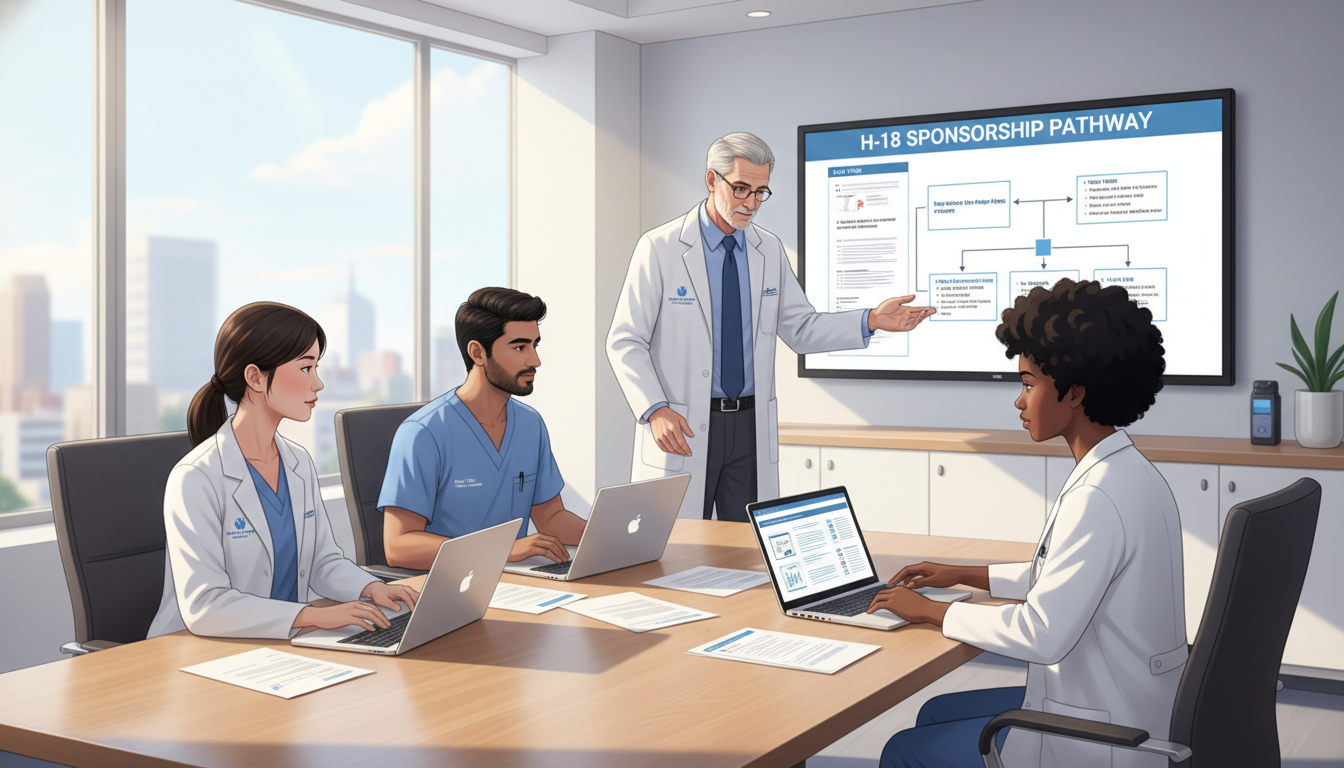
Understanding H‑1B Sponsorship in Great Lakes Residency Programs
For international medical graduates (IMGs), the Great Lakes region—Illinois, Indiana, Michigan, Minnesota, Ohio, and Wisconsin—offers a strong concentration of academic centers and community hospitals, many of which are open to H‑1B sponsorship. Yet policies vary widely by institution and even by specialty, and they change over time. Knowing how H‑1B residency programs work, where they are commonly offered, and how to strategically target them is critical if you want to match while maintaining your long‑term U.S. immigration options.
This guide focuses on H‑1B sponsorship programs for residency programs in the Great Lakes region, with an emphasis on practical planning for IMGs.
1. H‑1B vs. J‑1 for Residency in the Great Lakes Region
Before targeting specific midwest residency programs, you need clarity on how the H‑1B pathway differs from the J‑1 visa option.
1.1. Core differences
J‑1 (ECFMG-sponsored):
- Most common visa for IMGs in U.S. residency.
- Sponsored by ECFMG (not the hospital).
- Requires return to home country for 2 years after training unless you obtain a J‑1 waiver (e.g., Conrad 30, federal interest waivers).
- Less flexibility for moonlighting, research extensions, or early transitions to fellowship in some cases.
H‑1B (employer-sponsored):
- Sponsored directly by the hospital/university.
- Does not automatically carry a 2‑year home residency requirement.
- Often preferred by IMGs planning long‑term U.S. practice and future green card applications.
- Can be complex because:
- Requires USMLE Step 3 before starting H‑1B–sponsored residency.
- Higher legal and filing costs for programs.
- Stricter scrutiny on prevailing wage and work conditions.
1.2. Why some residents prefer H‑1B
Many IMGs specifically seek H‑1B residency programs because:
- No J‑1 home-country requirement – you won’t need a J‑1 waiver job in a Health Professional Shortage Area after residency, giving you more geographic and specialty flexibility.
- Easier transition to long‑term employment – after training, you may move directly into another H‑1B role or employment‑based green card sponsorship.
- Better alignment with academic or subspecialty careers – smoother pathway from residency to fellowship or research positions, especially in large Great Lakes university hospitals.
However, not all H‑1B roles are the same. Key distinctions include:
- Cap‑subject H‑1B – counted within the national annual H‑1B lottery cap.
- H‑1B cap exempt – not counted against the cap; usually offered by universities, their affiliated nonprofit hospitals, and certain research institutions.
Most big academic centers in the Great Lakes region are H‑1B cap exempt, which is a significant benefit to you.
2. How H‑1B Sponsorship Works for Great Lakes Residency Programs
2.1. Who qualifies for H‑1B in residency?
To be eligible for H‑1B sponsorship as an IMG entering residency, you typically must have:
- Valid ECFMG certification.
- Completed USMLE Step 1, Step 2 CK, and Step 3 before the program files the H‑1B petition.
- A medical degree equivalent to a U.S. MD or DO.
- State eligibility for a training or full license (depending on state rules and year of training).
In the Great Lakes region, many state medical boards (e.g., Illinois, Michigan, Minnesota, Ohio) require some combination of exams and credentials that must be in place for either a training license or H‑1B support letter. Programs may set internal earlier deadlines, often by spring before July 1 start.
2.2. The application and timing puzzle
For H‑1B–sponsored residency positions, timing is critical:
Before Match season (June–December)
- Take and pass USMLE Step 3 as early as possible.
- Clarify with each program: Do they sponsor H‑1B? For which specialties? Any Step 3 deadlines?
Interview season (October–January)
- Explicitly state in your communication and interviews that you are seeking H‑1B, not J‑1.
- Be prepared to explain why and show you understand the process and obligations.
Post‑Match (March–June)
- Once matched to an H‑1B‑friendly program, work quickly with their HR/immigration office.
- Many academic Great Lakes centers are H‑1B cap exempt, so they can file petitions without worrying about the spring lottery date. Still, internal timelines are strict.
2.3. H‑1B cap‑exempt advantage in the Great Lakes region
Most large Great Lakes residency institutions (e.g., university hospitals in Chicago, Cleveland, Minneapolis, Milwaukee, Detroit, Columbus, Indianapolis) are affiliated with:
- A public or private university, or
- A nonprofit academic medical center.
These entities are usually H‑1B cap exempt, meaning:
- You are not subject to the annual H‑1B lottery.
- Petitions can be filed at any time of year.
- Extensions during residency and fellowship are typically easier.
This H‑1B cap exempt status is a major reason why IMGs often target great lakes residency programs for long‑term training and career development.

3. H‑1B‑Friendly Trends in Great Lakes & Midwest Residency Programs
Policies change over time, and each program has unique rules. Instead of listing specific institutions (which may become outdated), this section highlights patterns you can use to build your own up‑to‑date H‑1B sponsor list.
3.1. Frequent H‑1B sponsors in the Great Lakes region
In the Great Lakes states, H‑1B sponsorship is most common at:
Large academic medical centers
- University‑affiliated hospitals in Chicago, Cleveland, Columbus, Detroit, Minneapolis, and Milwaukee.
- Many of these openly state “We sponsor J‑1 and H‑1B visas” on their GME websites.
High‑volume community teaching hospitals
- Some non‑university hospitals that host multiple residencies (e.g., Internal Medicine, Family Medicine, Pediatrics, Psychiatry, Surgery) also support H‑1B, especially if they have a long tradition of training IMGs.
Subspecialty‑oriented centers
- Hospitals with strong fellowship pipelines (cardiology, GI, pulmonary/critical care, nephrology, hematology/oncology, neurology, and more) are more likely to view H‑1B residents as long‑term assets.
Examples of specialties in the region where H‑1B sponsorship is relatively common:
- Internal Medicine
- Family Medicine
- Pediatrics (less common than IM/FM, but present in some academic centers)
- Psychiatry
- Neurology
- Pathology
- Anesthesiology
- Certain surgical prelim programs (though categorical surgery is more restrictive)
3.2. Where H‑1B sponsorship is less likely
In the Great Lakes and broader Midwest residency programs, H‑1B can be less common in:
- Smaller community hospitals without strong academic affiliations.
- New residency programs just starting their GME infrastructure.
- Some surgical and competitive specialties that prioritize U.S. graduates and limit visa complexities (e.g., Orthopedics, Dermatology, Plastic Surgery, ENT).
That said, exceptions do exist. Always confirm by checking each program’s website or contacting the program coordinator.
3.3. How to research and build your H‑1B sponsor list
Because official H‑1B residency programs lists are not always maintained, you need to gather information from multiple sources:
Program websites (GME + department pages)
- Look specifically for “Visa Sponsorship” or “For International Medical Graduates” sections.
- Phrases to look for:
- “We sponsor J‑1 and H‑1B visas”
- “We accept J‑1 and H‑1B (cap‑exempt) visas for residency training”
- “H‑1B sponsorship is considered for exceptional candidates with passed USMLE Step 3”
FREIDA (AMA Residency & Fellowship Database)
- Filter by region/state using Great Lakes states and search for programs that list H‑1B under visa types (though FREIDA can lag behind real policies).
Program coordinator emails
- A short, clear email works best:
- Introduce yourself, mention your IMG status.
- Ask:
- “Do you sponsor H‑1B visas for categorical residents?”
- “Is USMLE Step 3 required before ranking?”
- “Does policy differ by specialty or track?”
- A short, clear email works best:
Current residents & alumni
- Use LinkedIn, program resident profiles, or alumni networks.
- Ask politely about their visa type and program experience.
Over time, you will build a personalized H‑1B sponsor list focused on the Great Lakes residency landscape, which is more valuable than any static, publicly available list.
4. Strategic Application Planning for H‑1B in the Great Lakes
4.1. Prioritizing programs and specialties
When applying to midwest residency programs with an H‑1B focus, consider:
- Competitiveness of your profile (scores, attempts, YOG, clinical experience).
- Visa flexibility of each specialty:
- More flexible: Internal Medicine, Family Medicine, Psychiatry, Neurology, Pathology.
- Moderately flexible: Pediatrics, Anesthesiology, OB/GYN (varies by institution).
- Less flexible: Dermatology, Radiology, Orthopedic Surgery, Plastic Surgery.
For most IMGs seeking H‑1B in the Great Lakes region, a broad and diverse application strategy within moderately competitive fields is safest.
Example strategy:
A strong IMG with Step 1: 238, Step 2: 245, Step 3: Passed; 2 years research in cardiology in Chicago might:
- Apply widely to Internal Medicine in Illinois, Ohio, Michigan, Minnesota, Wisconsin, and Indiana.
- Prioritize academic centers with known H‑1B sponsorship.
- Add some community IM programs that explicitly state “H‑1B considered” on their site.
4.2. Step 3 timing and documentation
For H‑1B, Step 3 is a non‑negotiable in almost every Great Lakes program. Practical tips:
- Aim to pass Step 3 at least 6–9 months before July 1 start date.
- If you are targeting the upcoming Match, try to complete Step 3 before or during early application season (September–October).
- If you haven’t passed Step 3 by rank list deadlines, many H‑1B‑willing programs may shift you into the J‑1 category or rank you lower.
For each program on your H‑1B sponsor list, ask:
- “Is passing Step 3 required by the rank list deadline, contract signing, or before H‑1B filing?”
- “If I do not have Step 3 by your deadline, would you consider me on J‑1 instead?”
4.3. Crafting your application narrative
In your ERAS application and interviews:
State your visa preference clearly but professionally
- In your personal statement or CV, you don’t need to write a long explanation, but you may mention:
- “I plan to remain in the United States long‑term and therefore prefer H‑1B sponsorship if available.”
- In your personal statement or CV, you don’t need to write a long explanation, but you may mention:
Prepare interview answers
When asked about visa needs, respond concisely:- “I am ECFMG certified and have passed USMLE Step 3. I am seeking an H‑1B–sponsored position if your program offers it. I understand the process, including prevailing wage and cap‑exempt issues for academic centers.”
Emphasize stability and long‑term commitment
Programs invest more administrative effort to sponsor H‑1B; show that you are:- Likely to finish the residency.
- Interested in staying in the region or within their network for fellowship/employment.

5. Legal and Practical Considerations for H‑1B Residents
5.1. H‑1B duration and extensions during residency
H‑1B status is usually granted in increments of up to three years, with a maximum of six years in most cases. For residency and fellowship:
- Residency (3–4 years) – often covered by an initial petition plus an extension.
- Longer tracks (IM + fellowship) – may require planning to avoid hitting the six‑year cap before you transition to permanent residency (green card) or another status.
Academic Great Lakes hospitals that are H‑1B cap exempt may have experience with:
- Filing H‑1B extensions for fellowship after residency.
- Transitioning from cap‑exempt to cap‑subject roles later (with careful planning).
5.2. Moonlighting and side work
Moonlighting rules vary by state and program. Under H‑1B:
- Your employment is employer‑specific and role‑specific.
- Any external moonlighting outside the sponsoring hospital usually requires a concurrent H‑1B petition, which many GME offices are reluctant to pursue.
- Internal moonlighting within the same institution may be allowed if your immigration counsel confirms it is incidental to your primary role and consistent with your LCA/job description.
In contrast, some J‑1 residents have broader ability to moonlight with ECFMG’s approval and within institutional policies. This is a nuanced area—discuss directly with your GME office and immigration lawyer.
5.3. Transition after training
One of the main advantages of an H‑1B residency in a Great Lakes region institution is smoother post‑training transitions:
- Remain at the same cap‑exempt hospital as a faculty member or hospitalist on an H‑1B extension.
- Move to another cap‑exempt employer (another university hospital) in a different state without going through the H‑1B lottery.
- If you later move to a cap‑subject private practice, you may need to go through the standard H‑1B lottery unless you are already counted or have changed status appropriately.
Because the Great Lakes region is dense with academic centers (Chicago, Cleveland, Ann Arbor, Minneapolis, Madison, Columbus, etc.), remaining within a cap‑exempt ecosystem long‑term is often possible and strategically wise.
5.4. Common pitfalls to avoid
Assuming all programs within a university system share the same policy
- Some departments accept H‑1B; others do not. Always confirm at the program level.
Relying solely on old forum posts or spreadsheets
- Policies may change yearly. Verify with GME offices for the current cycle.
Missing Step 3 deadlines
- This is the single most common reason an IMG misses out on H‑1B, even in an otherwise friendly program.
Not maintaining clear communication
- If your Step 3 or ECFMG status changes, promptly inform your program.
- Clarify whether the program filed your H‑1B as cap exempt and whether any conditions apply.
6. Action Plan: Securing an H‑1B‑Friendly Great Lakes Residency
Below is a step‑by‑step approach you can start now.
Step 1: Clarify your long‑term goals
- Do you aim to settle permanently in the U.S. and avoid J‑1 waiver requirements?
- Are you comfortable restricting your applications primarily to H‑1B‑friendly programs, which may narrow the pool?
If long‑term U.S. practice is your priority and your profile is competitive, prioritizing H‑1B makes sense.
Step 2: Complete exams early, especially USMLE Step 3
- Schedule Step 3 as soon as you are eligible and reasonably ready.
- Aim to have the result before ERAS opens or, at the latest, before rank order list deadlines.
Step 3: Create a focused Great Lakes H‑1B sponsor list
For each Great Lakes state (Illinois, Indiana, Michigan, Minnesota, Ohio, Wisconsin):
- Use FREIDA, program websites, and Google search queries such as:
- “Internal Medicine residency H‑1B sponsorship [state]”
- “Psychiatry H‑1B visa Great Lakes region”
- Note each program’s:
- Visa policy wording.
- Specialty.
- Academic vs. community classification.
- Contact coordinators to confirm current policy and Step 3 requirements.
Organize this into your personal H‑1B sponsor list spreadsheet.
Step 4: Apply strategically and widely
- Submit ERAS early with a strong, polished application.
- Apply broadly to midwest residency programs across multiple Great Lakes states, focusing on specialties with historically better IMG and H‑1B acceptance.
Step 5: Advocate professionally during interviews
- Be honest and concise about your visa preference.
- Emphasize you have completed Step 3 (if true) and understand the responsibilities of H‑1B sponsorship.
- Highlight your commitment to both the program and potentially the region for long‑term practice.
Step 6: After you match
- Work closely with the GME/HR office and respond quickly to document requests.
- Track your H‑1B filing timeline and maintain copies of all important documents (I‑797 approval, I‑94, DS‑160 confirmation if consular processing is needed).
- Ask about future options: fellowship, faculty appointments, and continuing cap‑exempt status.
FAQs: H‑1B Sponsorship for Great Lakes Residency Programs
1. Are most Great Lakes residency programs willing to sponsor H‑1B visas?
Not most, but a significant subset—especially large academic centers and some major community teaching hospitals—do sponsor H‑1B. Institutions affiliated with universities or nonprofit academic medical centers are often H‑1B cap exempt and more experienced with IMG visas. Smaller community programs may limit sponsorship to J‑1 only, so you must check each program individually.
2. Do I absolutely need USMLE Step 3 for H‑1B residency in this region?
In practice, yes. The vast majority of Great Lakes residency programs that offer H‑1B sponsorship require a passed Step 3 before they initiate the H‑1B petition. A few may consider ranking you contingent on passing Step 3 by a specific date, but relying on this is risky. For a serious H‑1B strategy, treat Step 3 as mandatory and complete it early.
3. If I match to a Great Lakes program that only offers J‑1, can I later switch to H‑1B during residency?
Switching from J‑1 to H‑1B during residency is difficult and often impossible because the J‑1 is sponsored by ECFMG with clear rules, including the home-country requirement. Some exceptions exist (e.g., changes in circumstances or certain government programs), but you should not count on converting to H‑1B mid‑residency. If H‑1B is your priority, you need to target H‑1B‑friendly programs from the beginning.
4. How can I tell if a program is H‑1B cap exempt and why does that matter?
A program is usually H‑1B cap exempt if it is directly owned by, or has a formal affiliation with:
- A public or private university, or
- A nonprofit research institution.
You can often see this on their website (e.g., “University Hospital” or “academic medical center affiliated with X University”). Cap exemption matters because it removes the dependency on the H‑1B lottery, allowing the hospital to file H‑1B petitions year‑round and refile if any issues arise. Many Great Lakes academic centers are cap exempt, which is a major advantage of training in this region.
By understanding these dynamics, planning your exams strategically, and building a tailored H‑1B sponsor list for Great Lakes residency programs, you significantly increase your chances of matching into a program that supports both your training and your long‑term goals in the United States.