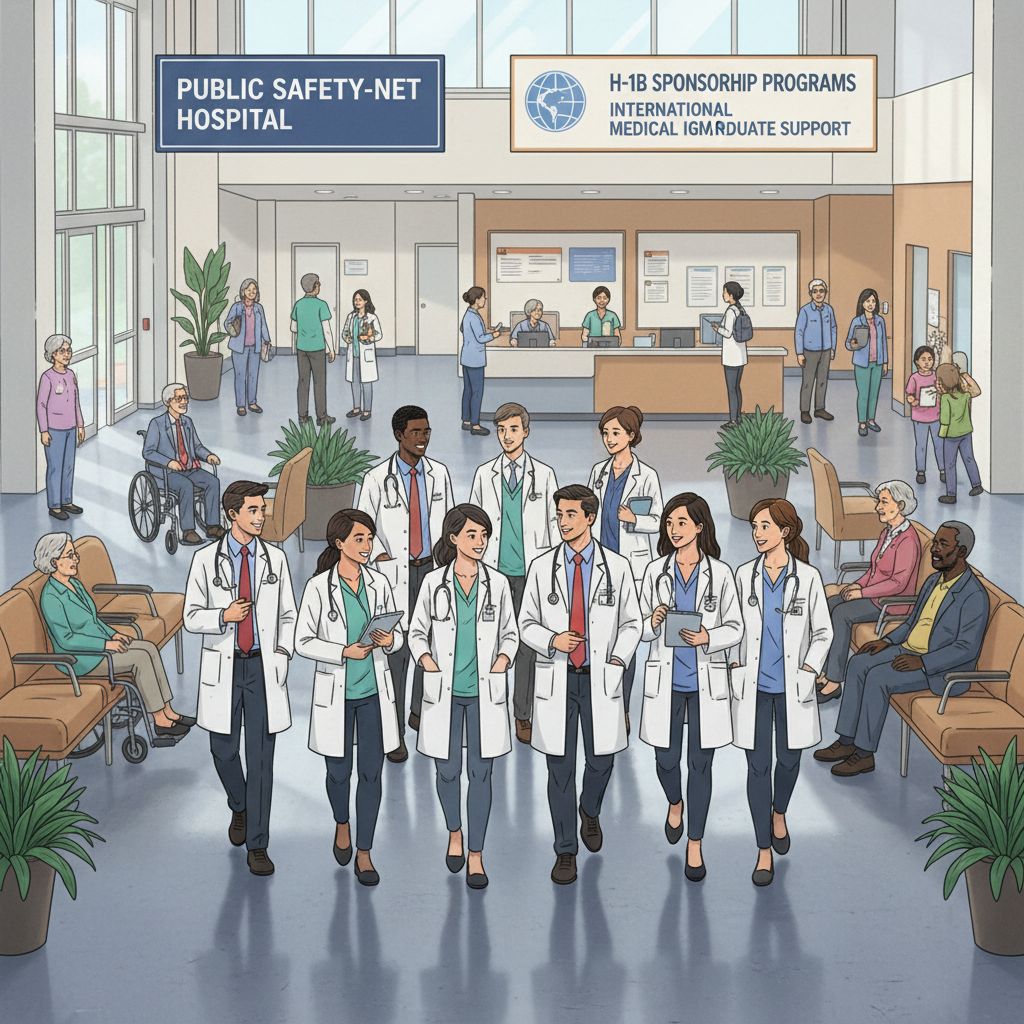
Understanding H-1B Sponsorship for Caribbean IMGs in Internal Medicine
For a Caribbean medical school graduate aiming for internal medicine residency in the United States, visa strategy can be just as important as exam scores and clinical performance. If your long‑term goal is to stay and practice in the U.S., H-1B sponsorship programs are especially attractive because they create a more direct pathway to permanent employment and eventually a green card.
However, H-1B residency programs are fewer, more competitive, and more complex than J‑1 options. As a Caribbean IMG, you need a clear, realistic plan that integrates visa strategy into every stage of your application, from school selection to the SGU residency match (or other Caribbean medical school residency pathways) and beyond.
This guide breaks down what you need to know—specifically for internal medicine (IM)—and how to maximize your chances of landing an IM match at an H-1B sponsoring residency program.
J‑1 vs H‑1B: Why Visa Type Matters for Caribbean IMGs
Before targeting H-1B residency programs, you must understand how H-1B compares with J‑1, the most common training visa for IMGs.
Key Differences: J‑1 vs H‑1B for Internal Medicine Residency
J‑1 (ECFMG-sponsored)
- Most common visa for IMGs in residency.
- Sponsored by ECFMG, not by individual programs.
- Requires two-year home country physical presence after training (unless you obtain a J‑1 waiver).
- Many waiver jobs are in underserved or rural areas.
- Less administrative burden on programs, so more IM programs accept it.
H‑1B (employer-sponsored)
- Sponsored by the residency program or hospital.
- Considered dual intent: easier to move toward green card later.
- No mandatory two-year home return requirement.
- More complex and costly for programs (legal fees, documentation, wage requirements).
- Fewer programs offer H‑1B, especially for categorical internal medicine residency.
For many Caribbean IMGs, the long-term flexibility of H‑1B is the main attraction. It may allow you to:
- Transition directly from residency to a hospitalist or fellowship position on H‑1B.
- Apply for permanent residency without going through a J‑1 waiver job.
- Minimize geographic limitations after training.
However, because of the added cost and complexity for institutions, only a subset of IM programs sponsor H‑1B visas, and some have strict additional requirements.
Eligibility Requirements for H‑1B Internal Medicine Residency
Not all residency applicants who qualify for J‑1 will qualify for H‑1B. As a Caribbean IMG, you must meet both immigration and professional requirements.
1. USMLE Requirements
Most H‑1B residency programs require:
- USMLE Step 1: Passed (often with a first-attempt preference).
- USMLE Step 2 CK: Passed before ranking; some require score by application deadline.
- USMLE Step 3:
- Strongly preferred;
- In many H‑1B sponsor programs, it is mandatory before they can file H‑1B.
- Some programs will only rank candidates who have passed Step 3.
For Caribbean medical school residency applicants, this means:
- If you are targeting H‑1B internal medicine programs, plan to complete Step 3 during your final year of med school or during a gap year before residency starts.
- You need to time your Step 3 result so it is available by rank list certification or at latest by early spring, depending on program policy.
Action tip:
When you review a program’s website, look for explicit language like:
- “We sponsor H‑1B visas for candidates who have passed USMLE Step 3.”
- “Step 3 is required before we can file H‑1B.”
- “J‑1 only; we do not sponsor H‑1B visas.”
If Step 3 is required and you know you cannot complete it before rank list deadlines, that program is not realistically H‑1B‑viable for you during that match cycle.
2. ECFMG Certification and Degree Requirements
For H‑1B, you must:
- Hold an MD or equivalent from a recognized medical school (including accredited Caribbean schools).
- Be ECFMG certified by the time of H‑1B filing (usually after Match, before residency starts).
Caribbean medical school graduates from institutions like SGU, AUC, Ross, Saba, etc., commonly qualify, but it’s essential that:
- Your school is recognized by appropriate authorities (e.g., listed in World Directory of Medical Schools and meeting ECFMG criteria).
- You have no gaps or major concerns in your academic history that would trigger extra questions in credentialing.
3. English Proficiency
H‑1B does not require a separate English exam the way some J‑1 categories may require for other fields. Still, programs will evaluate your communication skills carefully during:
- US clinical rotations (especially U.S. letters of recommendation).
- Interviews (clarity, professionalism, and ability to function safely in a clinical environment).
4. Immigration and Timing Rules
Key immigration points for H‑1B in residency:
- Residency H‑1B petitions are typically filed as “H‑1B cap exempt” (more on this below).
- You must maintain your legal status in the U.S. up to residency start (e.g., F‑1, B‑1/B‑2, no status, or outside the U.S.—each situation has different implications).
- Prior immigration history (overstays, unauthorized work, etc.) can complicate H‑1B approval.
If you have any immigration concerns beyond the standard IMG pathway, you should discuss them with an immigration attorney early, ideally before the ERAS season opens.
Understanding H‑1B Caps, Cap-Exempt Status, and Residency Programs
Much of the confusion around H‑1B comes from the annual cap and the lottery system. Residency training H‑1Bs fall into an important exception.
Cap-Subject vs H‑1B Cap-Exempt
Cap-subject H‑1B:
- Used for most private-sector jobs.
- Subject to an annual limit (currently 65,000 regular cap + 20,000 US master’s cap).
- Requires entry into the lottery (usually March–April each year).
- If not selected, the applicant cannot start work on H‑1B that year.
H‑1B cap-exempt:
- Not subject to the annual cap or lottery.
- Can be filed anytime during the year.
- Typical cap-exempt employers include:
- Universities and colleges.
- Non-profit entities affiliated with universities.
- Certain non-profit or government research organizations.
- Some teaching hospitals that are institutionally affiliated with universities.
How This Applies to Internal Medicine Residency
Most larger academic internal medicine programs are:
- University-based, or
- University-affiliated teaching hospitals.
These institutions often qualify as H‑1B cap exempt, which is why residency H‑1Bs can be filed outside the lottery.
For you as a Caribbean IMG, this matters in two ways:
Residency H‑1B (cap-exempt)
- The internal medicine residency program files your H‑1B as cap-exempt.
- You start PGY‑1 (or PGY‑2 if advanced) on time, without waiting for a lottery.
Post-residency H‑1B (cap-subject vs cap-exempt)
- If you join another university hospital or cap-exempt employer for fellowship or hospitalist work, you may continue as cap-exempt.
- If you later move to a private practice or community hospital that is not cap-exempt, you might need to go through the H‑1B cap lottery at that time.
This creates a strategy consideration:
Starting your career in an academic or cap-exempt setting can give you a more stable H‑1B platform from which to later transition to a green card or other statuses.
Identifying H‑1B Sponsor Programs in Internal Medicine
There is no official, single “H‑1B sponsor list” published by the U.S. government for residency programs. However, you can build a realistic working list using several methods.

1. Program Websites and Visa Policy Pages
Most ACGME-accredited internal medicine residencies have a “Eligibility Criteria”, “International Medical Graduates,” or “Visa Sponsorship” section. Look for:
- “We sponsor J‑1 only” → not helpful for H‑1B goals.
- “We sponsor J‑1 and H‑1B visas” → potential H‑1B program.
- “H‑1B sponsorship may be considered on a case-by-case basis for exceptional candidates” → possible, but very competitive; treat as “reach” programs.
Document each program’s stance in a spreadsheet with columns like:
- Program name
- University vs community
- Visa types sponsored (J‑1 / H‑1B / none)
- Step 3 required? (Y/N)
- Caribbean IMG friendly? (has history of Caribbean graduates)
- Notes (fellowship strengths, location, etc.)
2. FREIDA and Other Databases
The AMA FREIDA database includes some visa information, but it is not always up to date. Use it as a starting point:
- Filter programs by internal medicine.
- Check for IMGs and visa info when available.
- Always verify by visiting the program’s own website.
In addition, some independent IMG advising groups compile informal H‑1B sponsor lists based on past match outcomes. These can be useful references, but always cross-check with the most recent program info.
3. Alumni and Current Residents
As a Caribbean IMG, your best real-time data often comes from:
- Alumni from your school (e.g., SGU residency match lists, Ross, AUC, Saba match outcomes).
- Friends or seniors currently in U.S. internal medicine residencies.
Steps:
- Find alumni via LinkedIn, alumni associations, or school match publications.
- Identify which internal medicine programs have recently matched Caribbean graduates.
- Politely reach out and ask:
- What visa they are on (J‑1 vs H‑1B).
- Whether their program still sponsors H‑1B.
- Any unwritten criteria (e.g., Step 3 requirement, score cutoffs).
Programs that have previously taken Caribbean IMGs on H‑1B are high-value targets for your list.
4. SGU and Other Caribbean School Match Lists
Schools like St. George’s University (SGU) regularly publish detailed match lists. While these do not list visa type, they help in two ways:
- They show which internal medicine programs already accept Caribbean IMGs.
- Among those, a subset is known to sponsor H‑1B visas.
For example:
- If you see that SGU residency match data repeatedly shows graduates at a certain major academic IM program, and that program states it sponsors H‑1B, it is likely IMG-friendly and H‑1B-friendly.
- Build a small “priority list” of such programs to focus on.
Application Strategy: Maximizing Your Chance at an H‑1B IM Match
Getting into any internal medicine residency is competitive; narrowing your target to H‑1B residency programs makes it even more selective. You must balance visa goals with match realism.

1. Build a Competitive Academic Profile
For H‑1B sponsoring internal medicine programs, especially at academic centers, you should aim for:
- Solid USMLE scores (no absolute cutoff, but often Step 1 and Step 2 CK above national average help).
- First-attempt passes on all exams, particularly if your scores are not stellar.
- Completed USMLE Step 3 before rank submission if possible.
Other key factors:
- Strong U.S. clinical experience (ideally core rotations and sub-internships at teaching hospitals).
- Letters of recommendation from U.S. internal medicine attendings who know your work well.
- Evidence of professionalism, reliability, and good communication from your clinical evaluations.
2. Align Personal Statement and CV with Internal Medicine Goals
H‑1B sponsoring programs are often academic and care about:
- Long-term commitment to internal medicine (e.g., hospitalist or academic careers).
- Interest in quality improvement, research, or teaching.
- Clear, realistic immigration planning and career trajectory.
Highlight:
- Any scholarly work (publications, QI projects, case reports, poster presentations).
- Leadership positions or teaching roles as a student (peer teaching, tutoring).
- Genuine interest in underserved populations, primary care, or hospital medicine if relevant to their mission.
3. Balance H‑1B and J‑1 Programs on Your ERAS List
A common mistake is applying only to H‑1B granting programs. This can dramatically lower your overall match probability, especially if your academic profile is borderline.
Recommended approach:
- Apply broadly to at least 80–120 internal medicine programs, depending on your competitiveness.
- Include:
- A core group of H‑1B sponsoring IM programs (especially those with a history of Caribbean IMG matches).
- A larger group of J‑1 sponsoring IM programs to ensure you still have a high chance of matching.
Once you have matched, you can re-evaluate your long-term immigration strategy:
- J‑1 to H‑1B through J‑1 waiver jobs (H‑1B cap-exempt or cap-subject).
- Alternatively, try for a fellowship at a cap-exempt institution later.
4. Communicating Visa Preferences Professionally
In interviews and emails, you must walk a fine line:
- Programs do not want to feel that you only care about them as an immigration pathway.
- At the same time, you must be transparent about needing visa sponsorship.
General guidelines:
- On ERAS, indicate that you require visa sponsorship and list both J‑1 and H‑1B if you are open to both.
- In interviews, if asked directly:
- State that you are eligible for both J‑1 and H‑1B.
- Express flexibility, but if the program clearly offers H‑1B, you may share that you’d consider it ideal for long-term practice in the U.S.
- Avoid long immigration monologues; keep it succinct and focused on your role as a future internal medicine physician.
5. Planning Timeline for Step 3
For an H‑1B IM match, Step 3 timing is crucial:
- If possible, schedule USMLE Step 3:
- Near the end of your final clinical year, or
- During a structured study period before graduation.
- Target to have your Step 3 result by December–January of the application year or at latest by February, if the program permits.
If you cannot realistically complete Step 3 early enough:
- Treat H‑1B programs that require Step 3 as long shots, not your core targets.
- Focus on J‑1 friendly internal medicine programs for that match cycle, then later pursue H‑1B via J‑1 waiver and cap-exempt employment.
Post-Residency Planning: Using H‑1B for Long-Term Stability
If you successfully match into an H‑1B sponsoring internal medicine residency, your immigration planning shifts to maintaining and leveraging H‑1B after training.
1. Duration of H‑1B in Residency and Fellowship
Key rules:
- H‑1B has a maximum of six years in total (exceptions exist if you are in the green card process).
- Many IM residencies are three years; fellowship adds 2–3 more years.
- If you do IM residency + fellowship entirely on H‑1B, you must monitor your total stay.
Strategies:
- Some residents choose to:
- Complete IM residency on H‑1B.
- Transition to a J‑1 for fellowship if needed, though this is less common and has its own tradeoffs.
- Others start green card processing during or soon after residency to extend beyond the six-year H‑1B limit.
2. H‑1B Cap-Exempt vs Cap-Subject After Residency
After residency, your job options affect your H‑1B strategy:
Cap-exempt jobs:
- University hospitals, teaching institutions, or certain non-profit/underserved settings.
- You can move between cap-exempt employers without entering the lottery.
- Ideal for those who want academic careers or continued training.
Cap-subject jobs:
- Many private practice groups, community hospitals not affiliated with universities.
- You must enter the H‑1B lottery to transfer or start such jobs if not previously counted under the cap.
As a Caribbean IMG, consider:
- Planning your first post-residency job in a cap-exempt environment while starting your green card process, to avoid the uncertainty of the lottery.
- Once you have an employment-based green card (or at least an approved I‑140), your dependence on H‑1B cap issues decreases significantly.
3. Alternative Paths if You Don’t Match into H‑1B Programs
If you match into a J‑1 internal medicine program instead:
- Use residency to build a strong clinical and professional profile:
- Board certification in internal medicine.
- Excellent evaluations and letters.
- U.S. work experience in diverse patient populations.
- After residency, explore:
- J‑1 waiver jobs (often in underserved areas) with H‑1B sponsorship.
- Cap-exempt employers (safety-net hospitals, university-affiliated community hospitals).
Even if you do not start on H‑1B, you can still eventually obtain H‑1B status and permanent residency; it simply follows a different timeline and geographic pattern.
Practical Example Scenarios for Caribbean IMGs
To make this more concrete, consider three Caribbean IMG profiles.
Scenario 1: SGU Graduate with Strong Scores and Early Step 3
- Step 1: 238 (first attempt)
- Step 2 CK: 244 (first attempt)
- Step 3: Passed by December of application year
- Two U.S. IM Sub-I rotations at academic centers, strong LoRs
- No visa yet; currently outside the U.S.
Strategy:
- Build a list of 30–40 H‑1B sponsoring internal medicine residencies (university-based, Caribbean‑friendly).
- Apply to 80–100 total IM programs, including J‑1 friendly ones to maintain match security.
- Emphasize interest in academic IM, quality improvement, and teaching in personal statement.
- During interviews, indicate eligibility and preference for H‑1B where appropriate.
Outcome:
- High chance of interviewing at several H‑1B programs.
- Realistic possibility of an IM match on H‑1B at an academic center.
Scenario 2: Caribbean IMG with Average Scores, No Step 3 by Interview Season
- Step 1: 219
- Step 2 CK: 224
- Step 3: Not yet taken; plan for spring
- Limited research, but solid US clinical rotations
Strategy:
- Target mostly J‑1 friendly internal medicine programs, both community and university-affiliated.
- Include only a small subset of H‑1B programs that:
- Do not explicitly require Step 3 at the time of application, or
- Have historically accepted applicants without early Step 3.
- Focus on strong letters, clear narrative, and broad application pool.
Outcome:
- Higher likelihood of matching on J‑1.
- H‑1B may be pursued later through waiver jobs or academic positions.
Scenario 3: Caribbean IMG Already in the U.S. on F‑1 with Excellent Academic Profile
- Completing clinical rotations in the U.S. on F‑1
- Step 1: 245
- Step 2 CK: 252
- Step 3: Planned for late third or early fourth year
- Interested in academic IM and research
Strategy:
- Aggressively target top-tier H‑1B sponsoring internal medicine residencies.
- Use F‑1/OPT timing carefully, with early consultation from school’s international office and possibly an immigration attorney.
- Plan to have Step 3 completed before rank lists, maximizing H‑1B eligibility.
Outcome:
- Strong prospect for matching into a university-based IM residency on H‑1B, followed by fellowship and eventual academic career.
FAQs: H‑1B Sponsorship Programs for Caribbean IMGs in Internal Medicine
1. Is it realistic for a Caribbean IMG to match into an internal medicine residency with H‑1B sponsorship?
Yes, it is realistic—but more competitive than matching into J‑1 programs. Caribbean IMGs do match into H‑1B sponsoring internal medicine residencies every year, especially at academic centers with a history of working with Caribbean graduates (as seen in SGU residency match lists and other Caribbean medical school residency outcomes). To be competitive, you generally need solid USMLE scores, early Step 3, strong U.S. clinical experience, and a well-researched list of target programs.
2. Do all H‑1B sponsoring internal medicine programs require USMLE Step 3 before ranking?
Not all, but many do. Some will only consider H‑1B if Step 3 is already passed by the time they submit rank lists. Others will interview without Step 3 but insist on a passing score before they file the petition. Always check the program website and confirm during the interview season. If Step 3 timing is tight for you, prioritize programs that explicitly state flexible policies.
3. How can I find an up-to-date H‑1B sponsor list for internal medicine residencies?
There is no official government-maintained H‑1B sponsor list for residencies. Your best approach is to:
- Carefully review each program’s website for visa information.
- Use FREIDA and other databases as starting points (but not final authorities).
- Leverage Caribbean alumni networks, school match lists, and LinkedIn to confirm where IMGs have recently matched on H‑1B.
- Create your own, personalized H‑1B sponsor list and update it each season.
4. If I start on J‑1 for internal medicine residency, can I still get H‑1B later?
Yes. Many IMGs complete residency on J‑1 and later move to H‑1B through J‑1 waiver jobs or academic positions. This often involves working for a certain number of years in an underserved or rural area, or for cap-exempt institutions. While starting on H‑1B may be more straightforward for long-term settlement, a J‑1 route can also successfully lead to H‑1B and permanent residency with careful planning.
By understanding how H‑1B works, identifying realistic sponsor programs, and aligning your exams, clinical rotations, and application strategy accordingly, you can significantly strengthen your chances of securing an internal medicine residency that supports your long-term goal of practicing in the United States as a Caribbean IMG.