Understanding H-1B Sponsorship Pathways for Caribbean IMGs in the Texas Triangle
For a Caribbean medical school graduate, matching into a U.S. residency is challenging enough; adding the H-1B layer can feel overwhelming. Yet, the Texas Triangle (Houston–Dallas–San Antonio) can be a highly strategic region for Caribbean IMGs who want an H-1B pathway rather than J-1.
This guide focuses specifically on H-1B sponsorship programs for Caribbean IMG in the Texas Triangle, with an emphasis on practical planning, program targeting, and what you need to do from MS3 through Match Day.
You’ll see references to:
- Caribbean medical school residency outcomes (especially from schools like SGU, AUC, Ross)
- SGU residency match trends in Texas
- Specific challenges around H-1B residency programs, H-1B sponsor list, and H-1B cap exempt status
- Common hubs: Houston, Dallas, San Antonio residency programs and nearby cities
1. H-1B Basics for Caribbean IMGs in Residency
Before looking at individual Texas programs, it’s crucial to understand what makes residency-based H‑1B different from “regular” H‑1Bs used in tech or other industries.
1.1 J‑1 vs H‑1B for Residency
Most IMGs in U.S. graduate medical education are sponsored on a J‑1 visa (via ECFMG). H‑1B is a smaller but important pathway for certain candidates.
Key differences:
J‑1 visa
- Sponsored by ECFMG, not the hospital directly
- Requires two-year home-country physical presence after training (unless you get a J‑1 waiver)
- Typically easier for programs to process
- Many Texas community and university programs default to J‑1 only
H‑1B visa
- Employer-sponsored (hospital or university files petition)
- No automatic two-year home requirement
- Can often transition directly into fellowship or hospitalist/attending jobs (sometimes at the same institution)
- Higher documentation bar (USMLE Step scores, state license eligibility, etc.)
- More administrative work and legal costs for the program
For many Caribbean IMGs who want to stay long-term in the U.S. without a J‑1 waiver, H‑1B residency programs are especially attractive.
1.2 Cap-Exempt H‑1B for Residency
Most residency positions are with entities that qualify as H‑1B cap exempt:
- Universities or university-affiliated hospitals
- Non-profit research or higher-education organizations
- Some large academic systems
Being H‑1B cap exempt has huge advantages:
- No need to go through the annual H‑1B lottery
- Petitions can be filed any time of year
- No numerical cap limit
Most major academic centers in Houston, Dallas, and San Antonio fall into this category. That’s why the Texas Triangle is particularly important for Caribbean IMGs seeking H‑1B.
2. Strategic Overview: Texas Triangle Opportunities for Caribbean IMGs
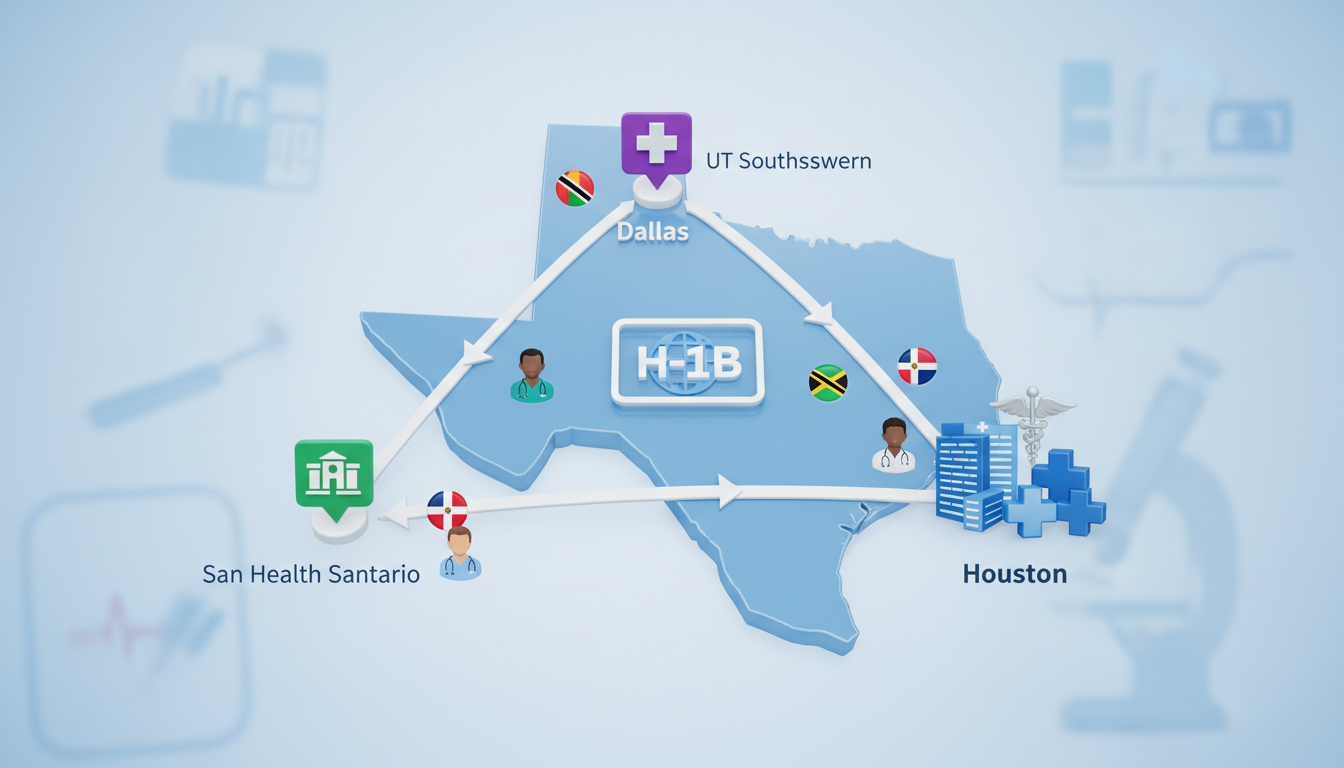
The Texas Triangle—Houston, Dallas–Fort Worth, San Antonio (plus nearby academic hubs like Austin and Galveston)—offers a dense concentration of hospitals that historically accept IMGs and often sponsor visas.
2.1 Why Texas is Attractive for Caribbean Medical School Graduates
For a Caribbean medical school residency, Texas stands out for several reasons:
- High volume of residency positions in Internal Medicine, Family Medicine, Pediatrics, Psychiatry, and more
- Large academic centers with H‑1B cap exempt status
- Many programs with a track record of matching Caribbean IMGs, including from SGU, Ross, AUC, Saba, etc.
- Relatively lower cost of living compared to coastal states
- Growing populations and diverse patient demographics, including large Caribbean and Latin American communities
If you study SGU residency match lists, for example, you’ll often find SGU residency match results showing placements in Texas Internal Medicine, Family Medicine, and Pediatrics—frequently at programs with visa sponsorship.
2.2 Common Specialties for H‑1B in Texas
H‑1B is not equally common across all specialties. For Caribbean IMGs in the Texas Triangle, the most realistic targets for H‑1B include:
- Internal Medicine (categorical)
- Family Medicine
- Pediatrics
- Psychiatry
- Neurology
- Pathology
- Some Transitional Year / Preliminary Medicine programs (often stepping stones to advanced specialties)
Competitive specialties (Dermatology, Orthopedics, Ophthalmology, Plastic Surgery) are extremely unlikely to sponsor H‑1B for a Caribbean IMG applicant unless you have exceptional research and connections.
3. Program Types and Sponsorship Patterns in the Texas Triangle
This section outlines the broad patterns for Houston, Dallas, San Antonio residency programs and how they typically approach H‑1B sponsorship for IMGs.
Important disclaimer: Policies can change yearly. Always verify on program websites and by contacting coordinators. Use this section as a strategic map, not a definitive H‑1B sponsor list.
3.1 Houston Area
Houston is home to the Texas Medical Center, the largest medical complex in the world. Many institutions here are academic and thus often H‑1B cap exempt.
Typical institutional patterns you might see (not exhaustive, policies subject to change):
Large Academic Centers (university-affiliated)
- Examples include major university hospitals and cancer centers
- Tend to:
- Sponsor J‑1 routinely
- Sponsor H‑1B for especially competitive candidates or particular specialties
- IMGs: Accepted, but you usually need strong profiles (higher USMLE scores, substantial U.S. clinical experience, solid LORs)
Community-based / University-affiliated hospitals
- Often more open to Caribbean IMGs
- Many advertise: “J‑1 and H‑1B visas considered”
- Some specify USMLE Step score minimums and require all Steps passed before ranking
Smaller community programs
- Sometimes J‑1 only (to reduce admin burden)
- But a few may sponsor H‑1B on a case-by-case basis if they have a track record
For a Caribbean IMG, Houston can be high-yield if you:
- Prioritize community or hybrid academic–community programs
- Demonstrate strong clinical communication skills and solid Step scores
- Have U.S. rotations in Texas or at least within the South
3.2 Dallas–Fort Worth (DFW) Area
The Dallas–Fort Worth metroplex combines major academic centers with large community programs.
Common patterns:
University-based programs
- Often H‑1B cap exempt
- More likely to have structured visa policies
- May state:
- “J‑1 preferred; limited H‑1B sponsorship for exceptional candidates”
- Or: “We sponsor J‑1 and H‑1B visas”
- Often require:
- All USMLE Steps passed on first attempt
- Step 3 at least in progress or passed for H‑1B
Hospital system-based programs
- Some large health systems in DFW have intentionally grown their IM and FM residencies
- Many are IMG friendly and often visible in Caribbean medical school residency match lists
- Visa sponsorship varies by site; some sponsor both J‑1 and H‑1B
Smaller community programs in nearby cities
- Can be IMG friendly but might be J‑1 only
- H‑1B may be rare but possible if:
- The hospital is non-profit and affiliated with a university
- There is a precedent of H‑1B sponsorship for residents or fellows
3.3 San Antonio and Central Texas
San Antonio and nearby cities (including Austin, and further out, Galveston) have a mix of academic and community programs.
Patterns:
- Academic centers often:
- Accept IMGs
- Sponsor J‑1 reliably
- Sometimes sponsor H‑1B, especially for Internal Medicine, Family Medicine, and Neurology
- Community-based programs:
- Often J‑1 only (but always check)
- May be more open to Caribbean IMGs, particularly if your clinical experience and Spanish skills are strong (a plus in South/Central Texas)
Because San Antonio and Central Texas have somewhat fewer total positions compared to Houston or DFW, competition for H‑1B spots can feel tighter, but the environment can be very IMG-supportive.

4. Building Your Personal H‑1B Strategy as a Caribbean IMG
Instead of randomly applying, Caribbean IMGs should design an intentional plan around H‑1B residency programs in the Texas Triangle.
4.1 Clarify Your Visa Priorities Early
Ask yourself:
- Is avoiding the J‑1 two-year home requirement essential for you?
- If yes, H‑1B (or rarely, other pathways like O‑1) should be a major focus.
- Are you flexible on specialty?
- H‑1B is more accessible in IM, FM, Peds, Psych, Pathology.
- Very competitive specialties + H‑1B + Caribbean IMG is usually a very high bar.
- Would you accept J‑1 if H‑1B is not available?
- Many Caribbean IMGs match on J‑1 and later get J‑1 waivers, especially in primary care and underserved areas.
- If you’re strictly H‑1B only, your application pool will be smaller and more competitive.
Your answers determine how heavily you should weight Texas Triangle H‑1B sponsor list targeting vs broader J‑1 friendly applications.
4.2 Researching a Realistic H‑1B Sponsor List
There’s no single official H‑1B sponsor list for residency programs, and commercial lists are often incomplete or outdated. Build your own evidence-based list focusing on:
Program websites
- Look for words like:
- “We sponsor J‑1 and H‑1B visas”
- “J‑1 visa only”
- “Visa sponsorship: J‑1. H‑1B may be considered for exceptional candidates.”
- Note any Step 3 requirements for H‑1B.
- Look for words like:
NRMP and FREIDA
- FREIDA sometimes includes visa types accepted.
- Search filters can help you narrow to programs that indicate H‑1B sponsorship.
Program reports and alumni pages
- SGU residency match data, AUC, Ross, and others often show:
- Caribbean IMGs matching at certain Texas programs
- You may see patterns, e.g., repeated matches at the same Internal Medicine or Family Medicine programs.
- SGU residency match data, AUC, Ross, and others often show:
Networking and forums
- Current residents on:
- Residency program Instagram/LinkedIn
- Specialty-specific WhatsApp/Telegram groups
- Ask: “Does your program currently have residents on H‑1B?” and “What’s the typical visa policy?”
- Current residents on:
Create a spreadsheet of Texas Triangle programs:
- City (Houston, Dallas, San Antonio, surrounding)
- Specialty
- Visa policy (J‑1 only / J‑1 + H‑1B / unclear)
- Step requirements (Step 3 needed?)
- Past Caribbean IMG matches (if known)
This becomes your personalized, high-yield H‑1B sponsor list for the Texas Triangle.
4.3 Timing: USMLE Steps and H‑1B Eligibility
Most H‑1B residency programs require:
- USMLE Step 1: Passed
- USMLE Step 2 CK: Passed (often on first attempt)
- USMLE Step 3:
- Either passed before visa filing
- Or explicitly allowed to be taken soon after starting PGY‑1 (this is becoming less common; many Texas programs prefer Step 3 before H‑1B filing)
For a Caribbean IMG targeting H‑1B:
- Plan to take Step 3 during your gap year or before ranking programs, if possible.
- When you email programs, highlight:
- “Step 3: Passed on first attempt” (if true)
- This can significantly strengthen your H‑1B case.
4.4 Application Strategy: How Broad Should You Apply?
Given your focus on Caribbean medical school residency and Texas Triangle H‑1B options, consider a tiered approach:
Tier 1 – High Priority H‑1B Programs (Texas Triangle)
- Programs that:
- Explicitly state H‑1B sponsorship
- Have current H‑1B residents
- Specialties: IM, FM, Peds, Psych, Path
- These get maximum effort: tailored personal statements, targeted emails, geographic interest emphasized.
- Programs that:
Tier 2 – J‑1 plus Possible H‑1B
- Programs that say:
- “J‑1 only” (but had exceptions historically)
- or have ambiguous websites but are academic/non-profit
- You may match on J‑1 but could occasionally negotiate H‑1B if you’re an exceptional candidate.
- Programs that say:
Tier 3 – National J‑1 Friendly Programs
- To protect yourself from going unmatched, especially if aiming for IM, FM, Peds
- Broaden beyond Texas to other regions known for IMGs and J‑1 sponsorship.
A typical Caribbean IMG who is H‑1B interested but not H‑1B only might apply to:
- 30–60 programs in IM/primary care within Texas (mix of H‑1B friendly + J‑1 friendly)
- Additional 40–60 programs nationally, especially in IMG‑friendly regions
5. Communicating with Texas Programs About H‑1B
How and when you talk about H‑1B can influence how programs perceive you as an applicant.
5.1 Before Applying
If a program website is unclear about visas and you’re trying to decide whether to apply:
Send a brief, respectful email to the program coordinator:
- Introduce yourself (Caribbean IMG, medical school, graduation year)
- Mention USMLE status (including Step 3 if done)
- Ask specifically:
- “Does your program sponsor J‑1 and/or H‑1B visas for residents?”
Keep it short so coordinators can answer quickly.
If they respond “J‑1 only,” you then decide whether to apply anyway (if you’d accept J‑1) or skip.
5.2 During Interviews
Once you receive an interview from a Texas Triangle program:
- Do not lead with visa questions in the first 5–10 minutes; focus on your clinical interests, fit with the program, and patient care.
- Closer to the end, or with the program coordinator, you can ask:
- “I am an international graduate and will require visa sponsorship. Could you clarify your policy on J‑1 and H‑1B for residents?”
- “Do you currently have any residents on H‑1B status?”
Be transparent. Programs appreciate honesty early rather than surprise visa issues after the rank list is set.
5.3 After Interviews / Before Rank List
If a program seemed enthusiastic but vague on H‑1B, and they’re in your top choices:
- Send a thank-you email that:
- Reiterates your strong interest, especially in living in Houston/Dallas/San Antonio
- Politely confirms: “As discussed, I am eligible for H‑1B and have completed Step 3. I remain very interested in your program and would appreciate any further clarification on your H‑1B sponsorship practices for residents.”
This gives them a chance to discuss with GME and clarify internally.
6. Practical Examples and Scenarios
To make this concrete, here are a few representative scenarios that Caribbean IMGs aiming for the Texas Triangle might face.
6.1 Scenario A: SGU Graduate Targeting Internal Medicine in Houston
- Profile:
- SGU graduate, 1 year out
- Step 1: Pass
- Step 2 CK: 233
- Step 3: Passed
- 3 U.S. IM rotations (including one in Texas)
- Needs visa sponsorship; strongly prefers H‑1B
Strategy:
- Create a list of Houston-area IM programs that:
- Are academic or large community
- State J‑1 and H‑1B sponsorship (or at least have current H‑1B residents)
- Apply broadly within Houston + Dallas IM programs, plus some in San Antonio and Austin.
- In ERAS:
- Emphasize ties to Texas (if any), language skills, and comfort with diverse populations.
- During interviews:
- Mention Step 3 completion and interest in long-term practice in Texas, which can align with hospitals’ long-term staffing needs.
Expected outcome:
- Good chance of interviews at mid-tier and community IM programs in Texas.
- Reasonable probability of at least some H‑1B options if performance during interviews is strong.
6.2 Scenario B: Ross Graduate Targeting Family Medicine in DFW, J‑1 Acceptable but Prefers H‑1B
- Profile:
- Ross graduate, recent
- Step 1: Pass
- Step 2 CK: 220
- Step 3: Not yet taken
- Strong FM rotations in rural and underserved settings
- Open to J‑1 but would prefer H‑1B if available
Strategy:
- Apply to a wide mix of DFW and Houston FM programs, including:
- University-affiliated FM programs (higher chance of H‑1B cap exempt)
- Community FM residencies in IMG‑friendly systems
- Also include national FM programs known to be IMG and J‑1 friendly as safety net.
- Prepare a clear narrative:
- Interest in primary care, underserved communities
- Long-term plan of staying in Texas, possibly pursuing a J‑1 waiver later if on J‑1
Expected outcome:
- Multiple interviews likely in FM.
- Some programs may only offer J‑1; others may discuss H‑1B possibilities depending on candidate strength and Step 3 plans.
6.3 Common Pitfalls to Avoid
Relying solely on outdated H‑1B sponsor lists
- Always cross-check with the program’s own website and recent residents.
Not taking Step 3 early enough
- For many H‑1B residency programs, Step 3 is a practical gatekeeper.
Being inflexible on specialty or location
- If you insist on a highly competitive specialty + Texas only + H‑1B only, you dramatically reduce your match odds.
Raising visa issues too late
- Programs prefer knowing your visa needs upfront or early in the process.
FAQ: H‑1B Sponsorship for Caribbean IMGs in the Texas Triangle
1. Do many Texas residency programs sponsor H‑1B for Caribbean IMGs?
A meaningful minority do, especially among university-affiliated, H‑1B cap exempt programs in Internal Medicine, Family Medicine, Pediatrics, Psychiatry, and Pathology. However, J‑1 remains far more common. Caribbean IMGs can and do obtain H‑1B residency programs in Houston, Dallas, and San Antonio, but it requires strategic targeting and strong exam performance.
2. Is Step 3 mandatory for H‑1B residency sponsorship?
In practice, often yes or strongly preferred. Many Texas programs require Step 3 to file H‑1B petitions for incoming residents. Some may allow filing while Step 3 is pending, but this is becoming less common. If H‑1B is important for you, plan to take and pass Step 3 before rank lists or soon after graduation.
3. How can I find out if a specific program in Houston, Dallas, or San Antonio sponsors H‑1B?
Use a multi-step approach:
- Check the program’s official GME or residency website for visa information.
- Search FREIDA for visa types accepted.
- Look for current or past residents (on LinkedIn or program pages) with H‑1B status.
- Email the program coordinator politely to confirm: “Do you sponsor J‑1 and H‑1B visas for residents?”
Compile this into your own H‑1B sponsor list for the Texas Triangle.
4. If I match on J‑1 in Texas, can I still stay in the U.S. long term?
Yes, many IMGs on J‑1 complete residency and fellowship in Texas, then obtain a J‑1 waiver job (e.g., in underserved or rural areas) within or outside Texas. After completing the waiver service (typically 3 years), they can often transition to H‑1B or permanent residence. H‑1B for residency is convenient but not the only route to a long-term U.S. career.
By combining a clear understanding of visa mechanics, targeted research on Houston, Dallas, San Antonio residency programs, and early Step 3 planning, a Caribbean IMG can significantly improve their chances of securing an H‑1B sponsorship program in the Texas Triangle—positioning themselves for a stable, long-term medical career in the United States.