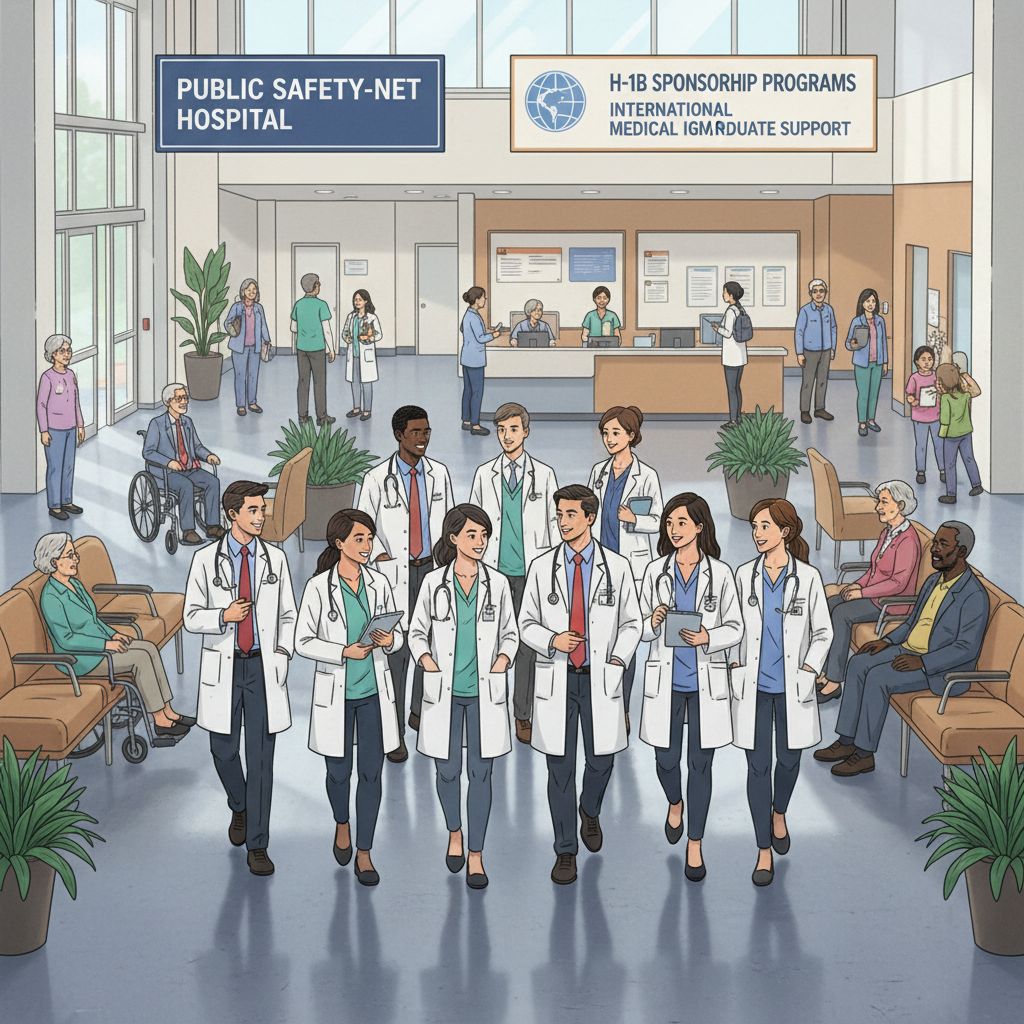
Understanding H‑1B Sponsorship in Clinical Informatics
Clinical informatics is one of the most rapidly growing fields in medicine, sitting at the intersection of patient care, data science, and health IT. For international medical graduates (IMGs) and foreign-trained health professionals, the question is not just how to build a career in informatics, but also where to find H‑1B sponsorship programs that make this path realistically achievable.
This guide focuses on H‑1B sponsorship opportunities in:
- Clinical informatics fellowship programs
- Health IT training roles in academic medical centers
- Related residency pathways that lead into clinical informatics
- Institutions and program types that are typically H‑1B cap exempt and IMG‑friendly
You will find practical strategies, examples, and tips you can use this cycle, whether you are targeting a formal ACGME‑accredited clinical informatics fellowship or a broader health IT career with clinical responsibilities.
1. Basics of H‑1B Sponsorship in Graduate Medical Education
Before mapping out specific pathways, it is essential to understand how the H‑1B visa works in the context of US medical training and clinical informatics.
1.1 Core features of the H‑1B for physicians and informaticians
Key H‑1B characteristics relevant to clinical informatics:
- Dual-intent visa: You may pursue permanent residency (green card) without jeopardizing your H‑1B status.
- Employer-specific: You can only work for the sponsoring institution and in the role described in your petition (e.g., “Clinical Informatics Fellow” or “Assistant Professor, Clinical Informatics”).
- Time limit: Generally up to 6 years total (with some extensions for green card applicants).
- Prevailing wage requirement: The institution must pay at or above the prevailing wage for that role and location. For academic hospitals, this is often aligned with PGY salary scales.
For physicians, H‑1B is most commonly used for:
- Residency and fellowship training (in cap‑exempt academic centers)
- Academic faculty positions with partial clinical effort
- Specialized roles in health IT and informatics with a clinical or research component
1.2 H‑1B cap vs. H‑1B cap exempt: Why this matters for clinical informatics
When you read about the “H‑1B lottery,” that refers to the H‑1B cap—a numerical limit on the number of new H‑1B visas available each year for private-sector employers. Many healthcare and academic training programs, however, fall into the H‑1B cap exempt category.
Cap-subject employers (lottery applies):
- Most private companies (including EHR vendors, health IT startups, consulting firms)
- Non-academic hospitals that are not affiliated with a university in the right way
H‑1B cap exempt employers (no lottery):
- Institutions of higher education (universities)
- Non-profit hospitals that are formally affiliated with an institution of higher education
- Non-profit research organizations or governmental research organizations
Most clinical informatics fellowship programs are based in university-affiliated academic medical centers or major teaching hospitals that qualify as H‑1B cap exempt institutions. This is a major advantage for IMGs:
- Sponsorship can be initiated any time of the year (no April lottery deadline).
- The risk of not being selected in a lottery is removed.
- You can often progress from residency → fellowship → faculty within a cap-exempt ecosystem.
2. Pathways Into Clinical Informatics with H‑1B Sponsorship
Clinical informatics is a subspecialty; that means your visa and training journey usually involves multiple steps. Understanding the typical pathways will help you time your H‑1B requests and target programs that are IMG-friendly.
2.1 Standard pathway: Residency → Clinical Practice → Clinical Informatics Fellowship
For physicians, board-certified clinical informaticians generally follow this route:
- Residency training in a primary specialty (Internal Medicine, Pediatrics, Family Medicine, Pathology, etc.).
- Clinical practice (sometimes immediately after residency; sometimes overlapping with informatics work).
- ACGME-accredited Clinical Informatics Fellowship (usually 2 years).
For IMGs, the visa strategy often looks like this:
- Step 1: Secure a residency at a program that accepts H‑1B (or at least does not prohibit it).
- Step 2: Stay in the same institution or academic network where clinical informatics fellowship and health IT training programs exist.
- Step 3: Transition from residency H‑1B to fellowship H‑1B (often staying cap exempt the entire time).
Why this matters:
Your choice of residency strongly influences how easy it will be to obtain H‑1B sponsorship for clinical informatics later, especially if you want a smooth transition within the same institution.
2.2 Direct informatics-focused positions for non-physicians
Clinical informatics is multidisciplinary. Besides physicians, these roles may be eligible for H‑1B sponsorship:
- Clinical informatics analysts (with nursing, pharmacy, or allied health background)
- Health IT data scientists or informaticians
- EHR optimization specialists with clinical credentials
- Pharmacists with informatics focus
For non-physician healthcare informatics professionals, H‑1B sponsorship usually comes from:
- Large academic medical centers with robust health IT departments
- H‑1B cap exempt research institutes working on health informatics and digital health
- Occasionally from EHR vendors or health IT companies (cap-subject; lottery applies)

3. How Clinical Informatics Fellowships Handle H‑1B Sponsorship
Most candidates searching for clinical informatics fellowship opportunities with H‑1B sponsorship discover that program policies are not always clearly advertised. You will need a strategy to evaluate programs systematically.
3.1 Typical visa patterns in clinical informatics fellowships
Common patterns among US clinical informatics fellowship programs:
J‑1 only
- Some programs default to J‑1 via ECFMG, especially if they primarily recruit IMGs coming directly from residency on J‑1.
- They may say “We do not sponsor H‑1B for fellowship.”
Case-by-case H‑1B
- Programs that prefer J‑1 but can sponsor H‑1B in special circumstances, often for candidates:
- Already on H‑1B at the same institution
- With unique expertise (e.g., strong programming background, prior informatics degree)
- Policies may depend on institutional legal counsel and GME office.
- Programs that prefer J‑1 but can sponsor H‑1B in special circumstances, often for candidates:
Open to both J‑1 and H‑1B
- These are your most promising options.
- Often large academic centers with established H‑1B residency programs and a track record of helping IMGs progress to fellowship and faculty roles.
3.2 How to identify IMG-friendly, H‑1B-supportive informatics fellowships
Because there is no official “H‑1B sponsor list” for clinical informatics fellowship, you must infer which programs are likely IMG‑friendly and H‑1B‑friendly.
Practical steps:
Start from the residency side
- Look up internal medicine, pediatrics, or family medicine programs at the same institution.
- If many of them openly sponsor H‑1B, the institution is accustomed to H‑1B processing and may be flexible for clinical informatics too.
Check program websites carefully
- Look for phrases like:
- “We accept J‑1 and H‑1B visas”
- “We are able to sponsor H‑1B for qualified candidates”
- If visas are not mentioned at all, plan to email the program coordinator directly.
- Look for phrases like:
Talk to current or recent fellows
- Ask whether any current or past fellows were on H‑1B.
- If yes, clarify whether they:
- Started H‑1B directly in fellowship, or
- Transferred from residency in the same institution.
Evaluate institutional type
- University hospital or major teaching hospital? Likely H‑1B cap exempt.
- Free-standing private hospital without formal university affiliation? More likely cap-subject and less predictable.
Example:
You are a PGY‑2 internal medicine resident on H‑1B at a large Midwestern university hospital. The same hospital advertises an ACGME-accredited clinical informatics fellowship. When you ask your GME office, they respond: “We typically sponsor H‑1B for clinical informatics fellows who are already on H‑1B within our institution.” This is an ideal, low-risk pathway.
3.3 Application timing and documentation needs
When applying for clinical informatics fellowship on H‑1B, keep in mind:
- Lead time: Institutional legal teams need months to process H‑1B petitions. Apply early and confirm visa feasibility before ranking or accepting offers.
- Board eligibility and licensing: You’ll need:
- Completion of primary specialty residency (or equivalent)
- Relevant US state medical license or eligibility
- USMLE steps passed (or COMLEX equivalent if applicable)
Important documents for H‑1B:
- Valid passport
- ECFMG certification (for IMGs)
- USMLE scores
- Residency completion certificate (or letter of good standing if currently in training)
- Employment offer letter clearly stating role and salary
- CV with detailed education and prior training history
4. H‑1B-Friendly Institutions and System Types for Clinical Informatics
While specific program lists change frequently, you can focus on types of institutions and common structural patterns that are historically IMG-friendly and supportive of H‑1B for health IT training and clinical informatics fellowship.
4.1 Academic medical centers with robust informatics ecosystems
The most promising environments combine:
- Large academic hospital with EHR optimization teams
- ACGME-accredited clinical informatics fellowship
- Departments of biomedical informatics or health systems sciences
- Existing H‑1B residency programs in internal medicine, pediatrics, family medicine, pathology, or psychiatry
Within such institutions, you often find:
- Multiple informatics roles:
- Clinical informatics fellow
- Medical director of informatics (faculty)
- EHR physician champion
- Research positions in health IT and data science
- More familiarity with H‑1B compliance and cap exemption mechanisms
- Opportunities to transition from trainee to junior faculty while staying cap exempt
4.2 University–hospital affiliations and H‑1B cap exemption
When evaluating a potential program, consider:
- Does the hospital appear on the university’s website as an official teaching affiliate?
- Does the GME office sit administratively under the university or under the health system?
- Are residents formally “employees” of the university, the hospital, or a separate GME corporation?
For H‑1B cap exempt status, the safest scenario is:
- You are employed by a non-profit hospital formally affiliated with an institution of higher education, or
- Directly by the university itself.
This allows:
- Year-round H‑1B filing for fellowships and faculty roles
- Less dependence on the April lottery timing
- More stable long-term planning for IMGs pursuing clinical informatics careers
4.3 How to use publicly available data to infer H‑1B policies
While there is no centralized H‑1B sponsor list specific to clinical informatics fellowship, you can still use US government and third-party tools to your advantage:
US Department of Labor’s H‑1B disclosure data
- Search by institution name to see historical H‑1B petitions filed.
- If you see many entries for “Resident Physician,” “Fellow Physician,” or “Physician – Internal Medicine,” that institution is likely H‑1B-friendly.
H‑1B salary and petition databases (public websites based on government data)
- Look for job titles such as “Clinical Informatics Fellow,” “Health Informatics Specialist,” or “Assistant Professor – Biomedical Informatics.”
- Use this to identify which systems have previously sponsored visas in informatics-related roles.
Program alumni LinkedIn profiles
- Search for clinical informatics fellowship alumni and check their visa status if mentioned, or their sequence of positions.
- Alumni who are IMGs working in the US long-term are good clues that the institution supports non-citizen physicians.

5. Practical Strategies to Improve Your H‑1B Prospects in Clinical Informatics
Whether you are entering residency, already in training, or seeking a non-physician informatics role, certain strategies will dramatically increase your chances of securing and maintaining H‑1B sponsorship.
5.1 Choose residency programs with flexible visa policies
If you are still at the residency selection stage and aspire to clinical informatics:
Prioritize H‑1B-accepting residencies
- Programs that clearly state “We sponsor H‑1B” give you more control over your long-term visa strategy.
- These programs are often more willing to invest in applicants with niche interests like clinical informatics.
Assess informatics infrastructure
- Do they have:
- A chief medical information officer (CMIO) or department of clinical informatics?
- Opportunities to work on EHR optimization, clinical decision support, or data analytics projects?
- A formal track or elective in health IT training?
- Do they have:
Look for internal pathways
- Programs that encourage residents to pursue:
- MS or MPH degrees in biomedical informatics
- Dual roles as resident + informatics scholar
- Institutions offering in-house clinical informatics fellowship are especially advantageous.
- Programs that encourage residents to pursue:
5.2 Build a strong informatics portfolio early
Programs that go through the effort of H‑1B sponsorship want fellows who demonstrably add value. Strengthen your candidacy by:
- Participating in EHR optimization committees or user groups
- Leading or contributing to quality improvement projects that leverage data extraction or clinical decision support
- Pursuing coursework or certificates in:
- Clinical informatics
- Health data science
- Public health informatics
Concrete examples that impress fellowship directors:
- Implementing a new EHR-based alert that reduced medication errors
- Creating a dashboard for tracking sepsis outcomes or hospital readmissions
- Contributing to publications or posters in informatics or health services research
A strong informatics CV can persuade programs and institutional attorneys that sponsoring you on H‑1B is worthwhile, even when J‑1 is their default.
5.3 Coordinate closely with GME and legal counsel
Once you are in a potential fellowship pipeline:
Clarify visa options before committing
- Ask the program director and program coordinator specifically:
- “Does your institution sponsor H‑1B for clinical informatics fellows?”
- “Is there a difference between external candidates and those already in your residency?”
- Ask the program director and program coordinator specifically:
Engage early with the GME office
- The GME office often works directly with immigration counsel.
- They can confirm whether your case is cap exempt and whether timing aligns with your graduation and start date.
Plan transitions carefully
- If switching institutions between residency and fellowship, you will need:
- H‑1B transfer (if both are cap exempt, this is usually straightforward)
- Updated license and employment documents
- If switching institutions between residency and fellowship, you will need:
5.4 Consider long-term strategy: Fellowship, faculty, and green card
Clinical informatics can be a stable platform for long-term US practice and immigration planning:
- Many informatics faculty roles are cap exempt and involve:
- A mix of clinical practice (e.g., 0.4–0.6 FTE)
- Health IT project leadership
- Teaching and research responsibilities
- These roles often qualify for employment-based permanent residence (e.g., EB‑2 or EB‑1 categories).
When evaluating a program, ask:
- “Do your clinical informatics fellows often transition into faculty or staff informatics roles here?”
- “Has the institution supported green card applications for graduating fellows?”
Institutions that are comfortable sponsoring permanent residency for informatics faculty are typically aligned with IMGs’ long-term goals.
6. Common Pitfalls and How to Avoid Them
Many talented IMGs interested in clinical informatics get derailed not by lack of skill, but by preventable visa missteps. Being aware of frequent issues will help you avoid them.
6.1 Assuming all fellowships can sponsor H‑1B
Some candidates assume that if a program sponsors H‑1B for residency, it must automatically do so for all fellowships. In reality:
- Each fellowship often has its own budget and hiring policies.
- Some departments may have decided to accept only J‑1 for fellowship to simplify administration.
Solution: Always ask specifically about the clinical informatics fellowship’s visa policy; do not generalize from other specialties.
6.2 Overlooking J‑1 considerations
Even if your long-term goal is H‑1B or permanent residence, you may still encounter J‑1 training opportunities. Remember:
- J‑1 often comes with a 2-year home residency requirement, which can significantly restrict future US practice unless you obtain a waiver.
- Transitioning from J‑1 to H‑1B requires either fulfilling the 2-year requirement or securing a J‑1 waiver in a designated underserved area.
For some IMGs, J‑1 may still be acceptable if:
- They plan to do a waiver job in a clinical role after fellowship.
- Their home country does not enforce the 2-year rule heavily, or they have other means to waive it.
But if your goal is to work in academic clinical informatics in a major city, be especially careful before accepting a J‑1 clinical informatics fellowship.
6.3 Ignoring the H‑1B cap when moving to private industry
Many clinical informatics fellows ultimately transition into:
- EHR vendors
- Digital health startups
- Health IT consulting firms
These employers are usually cap subject, meaning that:
- If you move from a cap-exempt academic role to a private company, you may have to go through the H‑1B lottery.
- If you are not selected, you may be unable to continue working despite having a job offer.
Strategies to manage this:
- Time your move to coincide with a new H‑1B filing cycle and have backup options.
- Consider staying longer in a cap-exempt academic position while exploring permanent residency (which can later facilitate a smooth move to industry).
- Look for hybrid or joint appointments where part of your time is still anchored in a cap-exempt institution.
FAQs: H‑1B Sponsorship and Clinical Informatics
1. Do most clinical informatics fellowship programs sponsor H‑1B visas for IMGs?
No. Policies vary widely. Some fellowships sponsor only J‑1, some consider H‑1B on a case-by-case basis, and some are openly supportive of both. You must check each program individually. Starting from institutions that already have strong H‑1B residency programs increases your chances.
2. Are clinical informatics fellowships usually H‑1B cap exempt?
Yes, in many cases. Most are based in academic medical centers or university-affiliated hospitals that are H‑1B cap exempt, allowing year-round filing without the lottery. Always verify whether your specific employer of record (university vs. hospital vs. affiliated entity) qualifies as cap exempt.
3. Can I go directly into a clinical informatics fellowship without US residency?
For physicians, this is rare and typically not compatible with board certification requirements in clinical informatics. You usually need to complete a US (or equivalent) residency in a primary specialty first. Non-physician clinical informatics or health IT training roles may have different pathways but are subject to separate H‑1B criteria.
4. How can I find a reliable H‑1B sponsor list for clinical informatics programs?
There is no official, specialty-specific H‑1B sponsor list for clinical informatics. Instead, combine several methods:
- Check GME and program websites for explicit visa statements.
- Search public H‑1B disclosure data for your target institutions.
- Network with current fellows and alumni on LinkedIn.
- Prioritize large academic medical centers known for both health IT training and strong IMG participation.
By understanding how H‑1B, cap exemption, and institutional structures intersect, you can design a realistic, stepwise plan to enter and advance in clinical informatics as an IMG or internationally trained health professional.