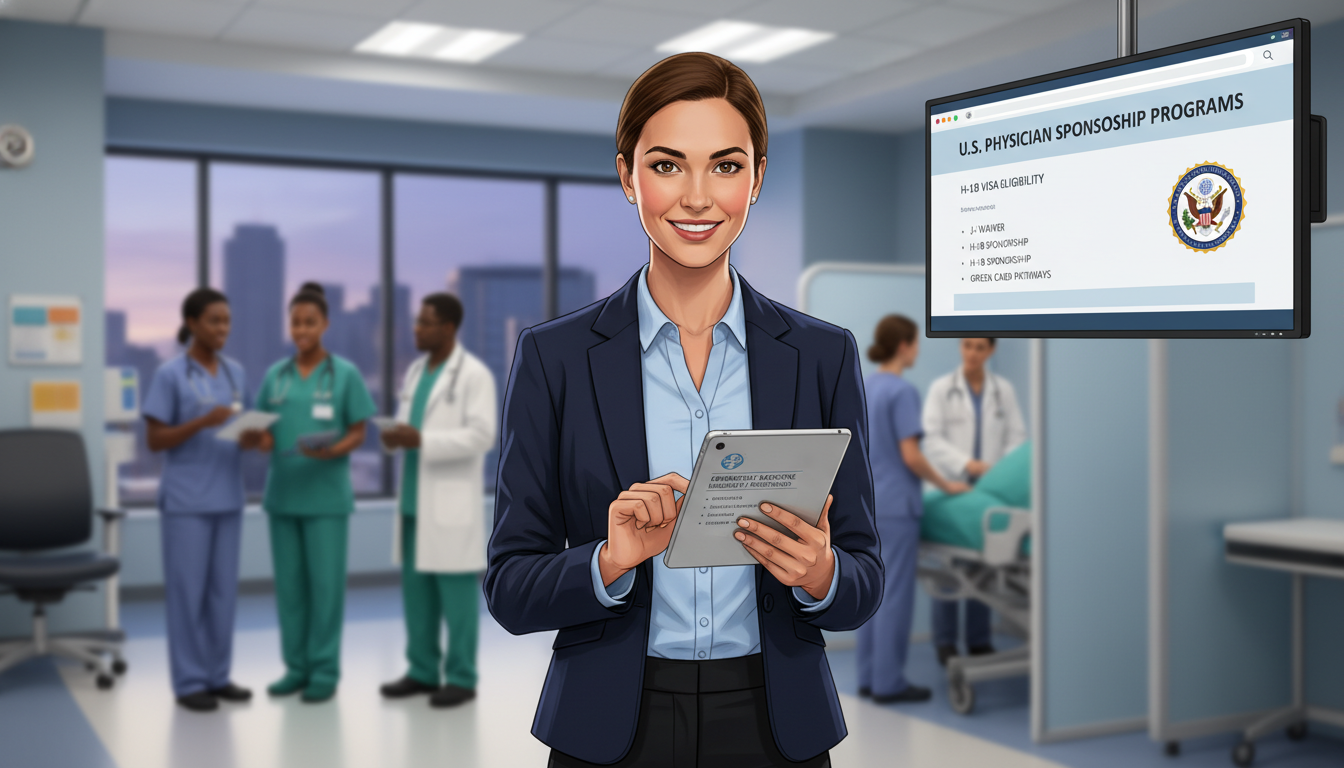
Understanding H-1B Sponsorship in Emergency Medicine for IMGs
For an international medical graduate (IMG) targeting emergency medicine residency in the United States, choosing between J-1 and H-1B visas is one of the most strategic decisions you will make. This IMG residency guide will focus specifically on H-1B sponsorship programs in Emergency Medicine (EM)—who offers them, what they require, and how to position yourself competitively for the EM match as an international medical graduate.
While the J-1 visa is more common, a growing number of H-1B residency programs in EM are open to IMGs, especially those who are fully ECFMG certified and USMLE-complete by the start of residency. Understanding how H-1B works, where to find an H-1B sponsor list, and how H-1B cap exempt status fits in is essential to planning your path.
This article breaks down the process step-by-step and provides practical, actionable advice to help you target H-1B–friendly EM programs more strategically.
1. H-1B vs J-1 for Emergency Medicine IMGs: What’s the Difference?
1.1 The Big Picture: Why IMGs Care About Visa Type
Both J-1 and H-1B visas allow you to train as a resident in the US, but the long-term career implications differ significantly:
J-1 visa
- Sponsored by ECFMG
- Requires a two-year home country physical presence after training (unless you obtain a waiver)
- Most waivers require working in underserved areas after residency (often primary care or hospitalist roles; pure EM roles can be harder to obtain, depending on region)
- Simpler for programs to manage
H-1B visa
- Employer-sponsored, not via ECFMG
- No automatic two-year home return requirement
- May offer a more direct route to:
- Fellowship training
- Academic positions
- Long-term employment without the added J-1 waiver step
- More paperwork and cost for programs, so fewer offer it
For an IMG committed to a long-term EM career in the US, an H-1B residency can be highly attractive. It can simplify your timeline for permanent residency and remove the uncertainty of J-1 waiver jobs in emergency medicine.
1.2 Key Requirements for H-1B Residency Sponsorship
Most H-1B–friendly EM programs align around several non-negotiable requirements:
Full ECFMG Certification by the time of H-1B petition (and usually before ranking)
USMLE Steps:
- Step 1: Passed (score still matters for selection even if officially pass/fail)
- Step 2 CK: Passed, with strong score
- Step 3: Passed before the H-1B petition can be filed
- Many EM programs require Step 3 passed by rank list deadline or by a specific cut-off (e.g., February–March of the match year)
State medical board eligibility
The H-1B petition is typically tied to a limited license or training permit. State boards often require:- Verified medical school diploma and transcripts
- ECFMG certification
- USMLE steps completed (including Step 3 for some states)
Because of these requirements, programs that sponsor H-1B preferentially rank IMGs who:
- Have already passed Step 3 by the time of interview
- Show strong academic records and US clinical experience (USCE)
- Can start on time without visa-related delays
2. How H-1B Residency Sponsorship Works in Practice
2.1 Cap-Exempt vs Cap-Subject H-1B in Residency
H-1B visas in graduate medical education are typically H-1B cap exempt. This is crucial and favorable for IMGs:
Cap-Exempt H-1B:
- Not subject to the annual numerical cap
- Not tied to the usual April lottery timeline
- Can be filed at any time of year
- Common for positions at:
- Non-profit academic medical centers
- University-affiliated teaching hospitals
- Government or public institutions
Cap-Subject H-1B:
- Subject to annual quota and lottery
- Not typically used for residency positions
- More relevant when you move to private practice or non-teaching hospitals after training
Most emergency medicine residency programs that sponsor H-1B are cap exempt, which means they can file your petition outside the lottery, as long as they meet institutional and state licensing requirements.
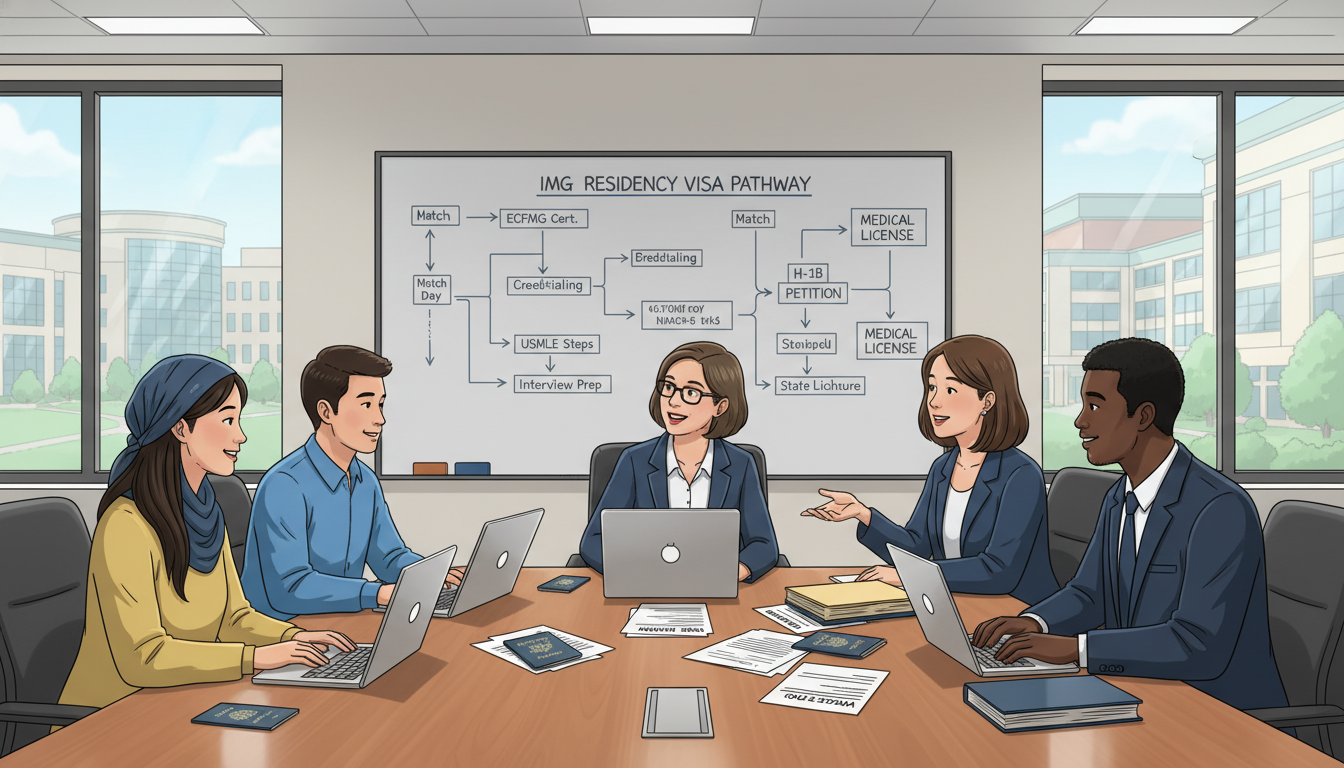
2.2 Timeline: Matching + H-1B Processing
A typical EM match + H-1B timeline for an IMG might look like:
January–February (Application Year)
- ERAS applications already submitted
- Interviews with EM programs
- You communicate your Step 3 and visa status clearly
- Many programs finalize visa decisions before rank list certification
March (Match Day)
- You match at an H-1B–sponsoring EM program
- Program’s GME/HR/legal department starts H-1B paperwork
April–May
- Program files your H-1B petition (premium processing is common to ensure timely approval)
- You deal with any state licensing/training permit requirements
June–July
- Visa interview at U.S. consulate (if you are outside the U.S.)
- You enter the U.S. in H-1B status and start orientation and residency in late June or early July
Critical point: If you do not have Step 3 completed by the time the institution must submit its H-1B petition, they may not be able to sponsor you. That’s why Step 3 timing is one of the most important strategic decisions in your H-1B EM match plan.
3. How to Identify H-1B-Friendly Emergency Medicine Programs
There is no single official, complete H-1B sponsor list for EM residencies. However, you can systematically build a list of H-1B residency programs that have historically supported IMGs.
3.1 Use Official Program Databases Strategically
FREIDA (AMA Residency & Fellowship Database)
- Filter by specialty: Emergency Medicine
- Use additional filters: “Accepts or sponsors visas”
- Many programs specify “J-1 only” or “J-1 and H-1B.”
- However, some programs change policies year to year—FREIDA is a starting point, not the final authority.
Program Websites
- Go to the GME Office or Residency Program pages
- Look for:
- “We sponsor J-1 and H-1B visas for eligible candidates”
- “We accept only J-1 visas sponsored by ECFMG”
- Some academic centers have a GME-level H-1B policy that applies across all residencies, including EM.
State Licensing Boards
- Research EM residency states where:
- Training licenses are obtainable with ECFMG and USMLE Steps 1–3
- Programs historically sponsor H-1B
- This helps you understand where H-1B is logistically feasible.
- Research EM residency states where:
3.2 Networking and Direct Communication
Because policies evolve, direct confirmation is often your best option.
- Email the Program Coordinator or Program Director (PD)
A concise email can clarify:- Whether they sponsor H-1B for EM residents
- If Step 3 is required at the time of ranking vs before residency start
Example email approach:
“I am an international medical graduate planning to apply to your Emergency Medicine residency. Could you please confirm if your program is able to sponsor H-1B visas for residency training, and whether USMLE Step 3 must be completed before ranking applicants or before the start of training? I want to ensure I meet all necessary requirements.”
- Talk to current or former residents (especially IMGs)
- Use LinkedIn, alumni networks, or professional organizations
- Ask:
- “What visa types does your program currently support?”
- “Have they sponsored H-1B specifically for EM residents in the past few years?”
3.3 Patterns of H-1B-Friendly EM Programs
While individual programs vary, the following common patterns can guide your search:
University-affiliated Level 1 trauma centers
- Often have:
- Strong GME infrastructure
- Immigration attorneys
- Experience with H-1B processing
- More likely to be H-1B cap exempt
- Often have:
Large academic EM residency programs
- More positions and more historical precedent with IMGs
- Often higher comfort with complex visa cases
Programs with a history of IMG residents
- If a program consistently ranks IMGs, they may be more open to sponsoring H-1B for strong candidates
Keep in mind:
- Some programs might sponsor H-1B only in special cases, such as:
- Applicants who already have H-1B from prior work
- Highly competitive candidates with unique research or academic profiles
- Others may have strict institutional policies:
- “We only sponsor J-1” or
- “H-1B only in rare exceptions with strong justification.”
4. Building a Strong H-1B-Focused EM Application as an IMG
To be competitive for H-1B sponsorship in emergency medicine, you need both a strong core EM profile and visa-readiness.
4.1 Academic and Exam Strategy
USMLE Performance
- Step 1: Even if officially pass/fail, your performance and attempts matter in discussions and selection.
- Step 2 CK: Aim for a score significantly above the national average; this is particularly important as an IMG.
- Step 3:
- Target completion before ERAS submission if possible, or at least before ranking.
- A first-attempt pass on Step 3 is highly reassuring for H-1B–sponsoring programs.
ECFMG Certification
- Complete this as early as you can.
- Delays in primary source verification can slow your licensing and therefore H-1B petition.
Clinical and Research Experience in EM
- US Clinical Experience (USCE) in emergency departments is highly valued:
- EM electives or sub-internships (if still a student)
- Observerships or externships (if a graduate)
- Research in emergency medicine (or critical care, trauma, simulation) strengthens your academic profile and shows commitment to the specialty.
- US Clinical Experience (USCE) in emergency departments is highly valued:
4.2 Targeted ERAS Strategy for H-1B EM Programs
Because not all EM programs offer H-1B, you should segment your application list:
- Tier 1: EM programs that clearly state “We sponsor H-1B”
- Tier 2: Programs that sponsor “J-1 and may consider H-1B”
- Tier 3: Programs that do not explicitly mention H-1B or have unclear wording—contact directly
- Exclude: Programs that explicitly say “J-1 only”
Distribute your ERAS applications across tiers, but prioritize Tier 1 and Tier 2 if your goal is definitely H-1B.
Practical tips:
- Clearly mention in your personal statement and ERAS application:
- Your visa status/needs
- Completion of Step 3 (with date and score)
- Your long-term plan to practice EM in the US
- In your CV and interview:
- Emphasize your stability, long-term commitment, and ability to remain in the US without the need for a J-1 waiver
4.3 Interviews: How to Talk About H-1B Without Hurting Your Chances
Programs want outstanding residents, not “visa problems.” Frame your visa situation clearly and confidently:
Do:
- State your visa preference directly but professionally:
- “As an IMG, I am eligible and fully prepared for H-1B sponsorship. I have already passed Step 3 and hold ECFMG certification.”
- Reassure them:
- “I understand the requirements for state licensing and H-1B, and I am committed to providing all documentation early to avoid any delays.”
- Emphasize your long-term goals:
- “My long-term plan is to remain in the U.S. as an emergency physician, ideally in academic or community settings that value education and research.”
Avoid:
- Presenting visa sponsorship as if it is “owed” to you
- Appearing unfamiliar with the basics of H-1B vs J-1
- Giving inconsistent answers about your exam status or licensing plans
If a program states early in the process that they cannot sponsor H-1B, do not try to pressure them. Instead, focus your energy on programs where sponsorship is realistic.

5. Common Pitfalls and How to Avoid Them
5.1 Applying Before Step 3 with H-1B as Your Only Plan
Many IMGs make the mistake of applying widely for H-1B despite not having Step 3. This can severely limit your options.
Better strategy:
- If you strongly prefer H-1B:
- Aim to complete Step 3 at least several months before ERAS opens, or at minimum before interviews.
- If that’s not possible, consider:
- Applying with J-1 openness this season, while still favoring programs that might consider H-1B later
- Taking a research/observership year in the US to complete Step 3 and then re-apply with a stronger, H-1B-ready profile
5.2 Underestimating How Few EM Programs Sponsor H-1B
In emergency medicine, the ratio of J-1-only to H-1B–sponsoring programs is not equal. Many EM residencies still prefer J-1 because:
- It’s administratively simpler
- Their institutions have standard processes for J-1 via ECFMG
- They may not have internal legal support for H-1B petitions
You must:
- Apply broadly
- Combine your H-1B preferences with a realistic backup strategy:
- Either being open to J-1, or
- Planning more than one application cycle with improved credentials over time
5.3 Ignoring State Licensing Timelines
Some states are slow in issuing training licenses, particularly for IMGs with foreign documentation. If your licensing is delayed, your H-1B petition may also be delayed, which can jeopardize your ability to start on time.
Action steps:
- Research the licensing board requirements in the state of your matched program as soon as you match.
- Submit documents immediately when your program or GME office instructs.
- Keep copies of:
- Medical school diploma and transcripts
- ECFMG certificate
- USMLE score reports
- Translations and notarizations as required
6. Long-Term Career Planning: H-1B During and After EM Residency
6.1 H-1B During Residency and Fellowship
If you train in EM on an H-1B visa, you might later:
- Extend H-1B for a fellowship (e.g., critical care, ultrasound, toxicology, EMS)
- Continue at the same cap-exempt institution, often in an academic role
In many cases, your H-1B during residency is cap exempt, and subsequent employment at the same or similar qualifying institution can remain cap exempt.
6.2 Moving from Cap-Exempt to Cap-Subject Employment
If you later want to work in:
- A private emergency medicine group
- A non-teaching community hospital
- A non-cap-exempt organization
You will typically need a cap-subject H-1B via the regular lottery unless:
- You secure employment with another cap-exempt institution (e.g., academic center, non-profit hospital, or government facility), or
- You transition to a different visa/green card category (e.g., employer-sponsored permanent residency).
Planning tips:
- Talk early with your future employers about visa strategy.
- Consider staying initially in academic or cap-exempt centers while your green card is processed.
- Be aware that some EM jobs in smaller or rural hospitals may have less experience handling complex immigration cases; you may be more competitive for positions at large health systems.
6.3 Comparing H-1B vs J-1 in Long-Term EM Careers
H-1B Advantages:
- No mandatory two-year home return requirement
- Greater flexibility immediately after residency
- Simpler pathway for some fellowship opportunities and academic jobs
J-1 Advantages:
- More EM programs are familiar with and willing to sponsor J-1
- Easier to secure for initial residency training
- Waiver jobs sometimes come with incentives (loan repayment, bonuses, higher pay in underserved areas)
As an IMG focused specifically on emergency medicine, think about:
- Your willingness to work in underserved or rural areas after training (common path for J-1 waiver)
- Your interest in academic vs community EM
- The feasibility of building a strong enough profile early to secure an H-1B spot
FAQ: H-1B Sponsorship for IMGs in Emergency Medicine
1. How many emergency medicine programs sponsor H-1B for IMGs?
There is no official centralized H-1B sponsor list for EM. A minority of EM residencies sponsor H-1B; most sponsor only J-1. The number changes as institutions revise policies. You should use FREIDA, program websites, direct emails, and networking with current residents to identify current H-1B residency programs and confirm their policies each application cycle.
2. Do I absolutely need Step 3 before applying to H-1B-friendly EM programs?
You can technically apply without Step 3, but for H-1B sponsorship, most EM programs require Step 3 to be passed before ranking or at least before the H-1B petition is filed. In practice, having Step 3 done before interviews makes you far more competitive and reassures programs that you are visa-ready.
3. Is it harder to match into emergency medicine on H-1B than on J-1?
Yes, it is usually more challenging. Fewer EM programs sponsor H-1B, and those that do tend to be selective. You must:
- Demonstrate strong academic and clinical performance
- Complete Step 3 early
- Convince programs you are worth the extra administrative work and cost
However, for a well-prepared IMG, H-1B matching in EM is achievable with a targeted, realistic strategy.
4. If I train in EM on an H-1B visa, will I still be H-1B cap exempt later?
Your residency and often fellowship will generally be under an H-1B cap exempt category because they are at non-profit or academic institutions. If you continue working at a similar cap-exempt institution after training, you can remain cap exempt.
If you move to a private, non-exempt employer, you will likely need to secure a cap-subject H-1B (lottery) or pursue a green card pathway. Planning ahead with immigration counsel and prospective employers is critical.
By understanding the structure of H-1B cap exempt residency positions, building a deliberate exam and application timeline, and targeting H-1B-friendly emergency medicine programs, you can significantly improve your chances of successfully matching as an international medical graduate and building a sustainable EM career in the United States.