Choosing an H-1B–sponsoring residency program is one of the most strategic decisions you will make as a non-US citizen IMG. The Northeast Corridor—stretching from Boston through New York City and Philadelphia to Washington, DC—is dense with academic medical centers and community hospitals, many of which have long experience training foreign national medical graduates and supporting complex visa issues.
This article explains how H-1B residency programs work, what’s different for IMGs, where to look in the northeast residency programs landscape, and how to realistically target east coast residency programs that may be IMG- and visa-friendly. It is written specifically for the non-US citizen IMG (foreign national medical graduate) planning to match in the Northeast Corridor.
Understanding H-1B Sponsorship for Residency
For a non-US citizen IMG, the main visa options for GME training are J-1 and H-1B. Knowing the practical differences helps you decide where to apply and how to position yourself.
J-1 vs H-1B in Residency Training
J-1 (ECFMG-sponsored):
- Most common visa for IMGs in US residency.
- Sponsored by ECFMG (Educational Commission for Foreign Medical Graduates).
- Requires a two-year home-country physical presence after training (or a waiver) before you can work in the US on H-1B/green card.
- Usually easier and faster for programs to manage.
- Many community hospitals and smaller programs only sponsor J-1, not H-1B.
H-1B (employer-sponsored):
- Sponsored directly by the residency program/institution.
- No mandatory two-year home-country requirement.
- Can transition more smoothly to H-1B or permanent residency for post-training jobs.
- Requires USMLE Step 3 passed before H-1B petition filing in many states/programs.
- Higher legal and filing costs for the institution; more administrative work.
Because of the administrative and financial burden, only a subset of northeast residency programs sponsor H-1B visas. Those that do often have more selective criteria for non-US citizen IMGs.
Cap-Exempt vs Cap-Subject H-1B in GME
A key concept is H-1B cap exemption:
- The annual H-1B lottery (regular and master’s cap) applies to most private employers.
- Many teaching hospitals are H-1B cap exempt, meaning they can file H-1B petitions any time of year without going through the lottery.
In the Northeast Corridor, most major academic medical centers—Harvard-affiliated hospitals, Yale, Columbia, Cornell, NYU, Penn, Hopkins, GWU, Georgetown, etc.—are part of universities or non-profit teaching systems that are H-1B cap exempt.
What this means for you:
- As an IMG in residency within a cap-exempt institution, your H-1B is not subject to the lottery, a major advantage.
- When you later move to a non–cap exempt employer (e.g., a private practice hospital job), you may have to enter the H-1B lottery unless you obtain permanent residency by then.
Understanding that most east coast residency H-1B sponsors are cap exempt helps you plan long-term: your first job after residency may be the moment when H-1B cap issues become critical.
Core Requirements for H-1B Residency as a Non-US Citizen IMG
While each hospital has its own policies, there are common expectations you should anticipate as a foreign national medical graduate seeking an H-1B sponsorship.
Academic and Licensing Prerequisites
1. ECFMG Certification
- Mandatory for all IMGs, regardless of visa.
- Must be completed early enough to support licensing and visa timelines.
- Delays in your ECFMG certificate can delay state license processing and H-1B filing.
2. USMLE Step 3
- Crucial difference from J-1: Most H-1B residency programs require Step 3 before filing the petition.
- Because the Match is in March and most programs want H-1B petitions in by late spring/early summer, you should aim to:
- Take Step 3 no later than December–January of the application cycle.
- Have results available before programs finalize visa sponsorship category.
Some institutions or states technically allow H-1B without Step 3, but:
- Many northeast residency programs explicitly require Step 3 to reduce legal risk.
- With many qualified applicants, programs simply prefer applicants with Step 3 already passed.
3. State Medical License or Training Permit
- For H-1B, most states need at least a training license issued before your H-1B can be approved.
- Requirements vary:
- New York, Massachusetts, Pennsylvania, New Jersey, and DC all have their own forms, timelines, and primary-source verifications.
- Plan for several months of processing; missing a document can set you back.
Program-Specific Eligibility Filters
When you research H-1B residency programs along the Northeast Corridor, expect some or all of the following criteria:
- Minimum USMLE scores (often higher than J-1-only programs):
- Step 1 & 2 CK typically above 225–230 (many academic centers prefer 235+).
- Time since graduation:
- Some require graduation within 3–5 years.
- Clinical experience:
- US clinical experience (observerships, externships, sub-internships).
- Some programs require hands-on US experience, especially in Internal Medicine or Pediatrics.
- Communication and professionalism:
- Strong English communication skills are closely scrutinized given medico-legal risks and patient expectations.
Actionable tip:
If you are a non-US citizen IMG targeting H-1B residency programs in the Northeast, treat Step 3 as non-negotiable and schedule it as soon as your Step 2 CK is done and you’re eligible. Align your study plan with application timelines.
Northeast Corridor Landscape: Types of H-1B–Friendly Programs
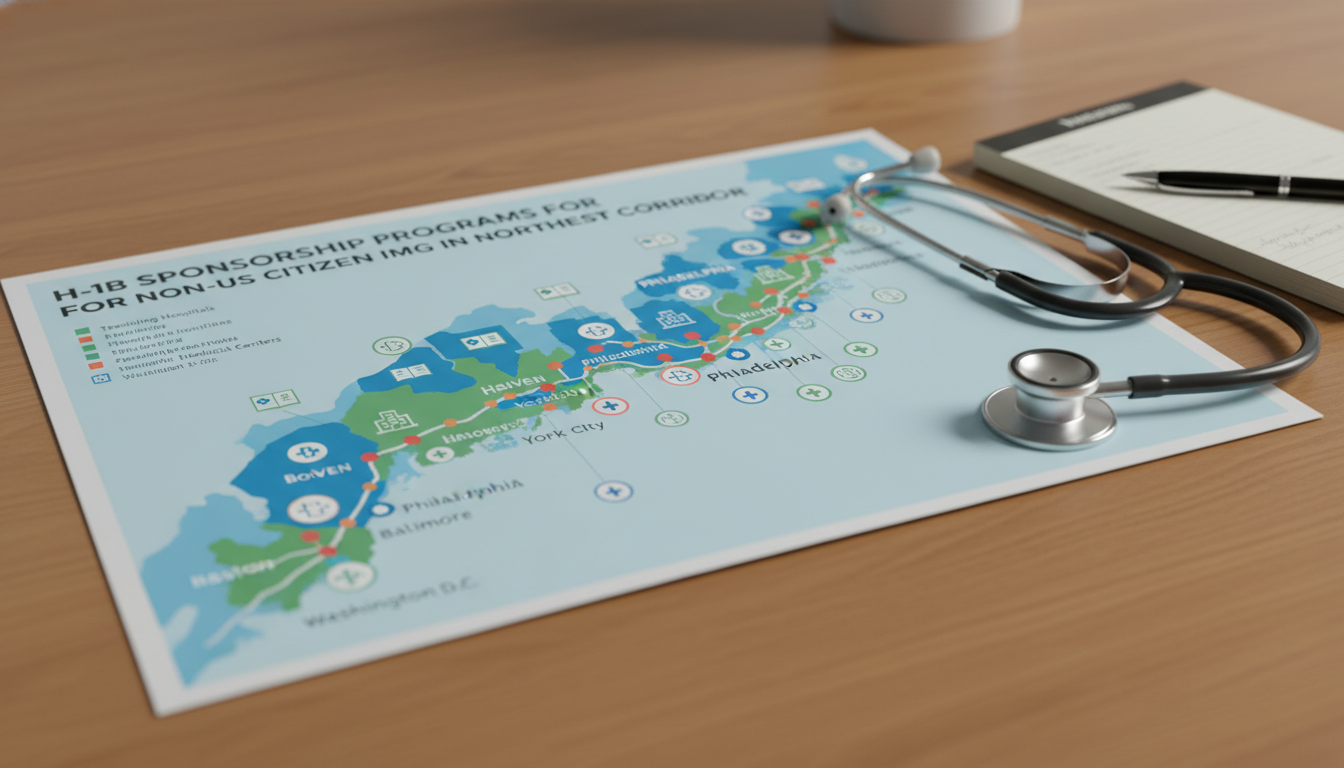
The Northeast Corridor is not a single market. It spans major cities with different levels of competition, cost of living, and institutional visa policies. Understanding these patterns helps you build a realistic H-1B sponsor list.
1. Major Academic Medical Centers
These are usually H-1B cap exempt institutions affiliated with universities. Many have a history of sponsoring H-1B visas for residents and fellows, especially in high-demand specialties.
Typical characteristics:
- Strong research infrastructure.
- Large residency class sizes.
- More structured international office/immigration teams.
- More familiar with complex visa cases.
In the Northeast Corridor, examples of this category (for illustration; always verify current policies) include:
- Boston area:
- Massachusetts General Hospital (Harvard)
- Brigham and Women’s Hospital (Harvard)
- Beth Israel Deaconess (Harvard)
- Boston Medical Center (Boston University)
- Tufts Medical Center
- Connecticut / New Haven & Hartford:
- Yale-New Haven Hospital
- UConn-affiliated hospitals
- New York City:
- NewYork-Presbyterian (Columbia & Cornell)
- Mount Sinai Health System
- NYU Langone
- Montefiore (Einstein)
- SUNY Downstate, SUNY Stony Brook, SUNY Upstate affiliated hospitals
- Philadelphia:
- Hospital of the University of Pennsylvania
- Jefferson Health (Thomas Jefferson University)
- Temple University Hospital
- Drexel-affiliated hospitals
- Baltimore/Washington, DC:
- Johns Hopkins Hospital
- University of Maryland Medical Center
- MedStar Georgetown
- George Washington University Hospital
Reality check:
Many of these elite programs:
- Are extremely competitive for any applicant (US or IMG).
- Sponsor H-1B primarily for subspecialty fellows rather than for all residency categories.
- May limit H-1B sponsorship to specific specialties (e.g., Pathology, Neurology, Internal Medicine) and not sponsor in others.
You must check each program website for “Visa Sponsorship” or “International Applicants” information. Policies can differ between departments within the same institution.
2. University-Affiliated Community Programs
These are community hospitals affiliated with universities or large academic systems. They often:
- Have a moderate level of research and academic activity.
- Serve diverse patient populations.
- May be more open to non-US citizen IMGs if you meet criteria.
Some of these programs do sponsor H-1B, but with restrictions:
- Only for candidates who already passed Step 3.
- Only for certain specialties or for a limited number of positions.
- Priority to J-1 sponsorship, with H-1B as an exception.
In the Northeast Corridor, look at:
- Community teaching hospitals in New Jersey, Long Island, Westchester, and upstate New York.
- Affiliate hospitals of large academic systems (e.g., Penn Medicine community sites, Montefiore affiliates, UMass affiliates in Massachusetts).
3. Standalone Community Hospitals
Many standalone community hospitals:
- Sponsor only J-1 for IMGs.
- Avoid H-1B due to higher cost and complexity.
However, there are exceptions. Occasionally a community hospital:
- Has historically sponsored H-1B for a small number of residents.
- Will consider H-1B for a top candidate who has Step 3 and strong credentials.
To identify such H-1B residency programs:
- Examine their current resident roster: If you see IMGs with H-1B listed, that’s a strong signal.
- Email or call the program coordinator directly with a concise inquiry.
Building a Realistic H-1B Sponsor List in the Northeast Corridor
There is no official, up-to-date, universal “H-1B sponsor list” for residencies. Policies change frequently. You must build your own targeted H-1B sponsor list using multiple data sources.

Step 1: Start with Specialty and Geography
Clarify your own constraints:
Specialty choice
- Internal Medicine, Family Medicine, Pediatrics, Psychiatry, and Pathology generally have more H-1B–friendly options than competitive specialties like Dermatology or Plastic Surgery.
Geographic focus within the Northeast Corridor
- Are you open to suburban or smaller-city locations (e.g., New Haven, Hartford, Allentown, Albany, Rochester, Scranton)?
- Limiting yourself only to Boston, NYC, and DC severely narrows H-1B options.
Step 2: Use Official Program Websites
For each program on your initial target list:
- Visit the GME Office or Residency Program website.
- Look specifically for:
- “Visa Sponsorship” sections.
- “International Medical Graduates” or “Prospective Residents – IMGs” pages.
- Identify statements like:
- “We sponsor J-1 and H-1B visas for eligible candidates.”
- “We sponsor only J-1 visas.”
- “For non-US citizen IMG applicants, H-1B may be considered on a case-by-case basis.”
Carefully track these in your personal H-1B sponsor list spreadsheet:
- Program name
- Location
- Specialty
- Visa types accepted (J-1 / H-1B / none)
- Notes (Step 3 requirement, time since graduation, etc.)
Step 3: Verify with Recent Residents and Coordinators
Online information can lag 1–3 years behind reality. To update your H-1B sponsor list:
- Check current resident biographies on the program site:
- If some residents list “H-1B” as their visa, that’s strong evidence of recent sponsorship.
- Connect on LinkedIn or professional networks:
- Search the program name + “resident” + “H-1B” or “IMG”.
- Email the program coordinator with a focused question:
- Introduce yourself briefly.
- State that you are a non-US citizen IMG and ask:
- Whether the program sponsors H-1B for residency.
- Whether Step 3 is required prior to ranking or match.
- Keep your email concise, respectful, and specific.
Always frame questions professionally:
- Programs are busy; asking “Are you H-1B cap exempt?” or “Can you guarantee me an H-1B?” can sound naive.
- Better wording:
“I am an ECFMG-certified IMG planning to complete USMLE Step 3 before Match Day. Does your program currently sponsor H-1B visas for incoming residents who meet all licensing requirements?”
Step 4: Prioritize H-1B–Friendly Program Types
When choosing where to invest your ERAS applications (and your money), consider:
- Programs that explicitly state they sponsor H-1B and:
- Have a history of doing so,
- Train a significant number of IMGs,
- And are located beyond the top 2–3 most competitive city centers.
For example:
- Instead of only applying to Manhattan and central Boston, include:
- New Jersey (Newark, Jersey City, suburban areas).
- Western Massachusetts (Springfield, Worcester).
- Upstate New York (Rochester, Buffalo, Albany).
- Eastern Pennsylvania (Scranton, Allentown, Bethlehem).
These regions often have east coast residency programs that:
- Serve diverse, underserved communities,
- Are more accustomed to IMG integration,
- And may be more flexible regarding H-1B sponsorship compared with ultra-competitive urban flagships.
Strategic Application Planning for H-1B-Seeking IMGs
Timing Your Exams and Documentation
For a foreign national medical graduate targeting H-1B:
USMLE Step 3 Timeline
- Ideal: Take Step 3 by November–December of the application cycle.
- Absolute latest: January–February, depending on result release and program deadlines.
- Remember: Some state licensing boards need verification that takes weeks or months.
Credentialing and Licensing
- Start gathering:
- Medical school transcripts.
- Dean’s letters.
- Internship completion certificates.
- Ensure all documents match exactly (names, dates).
- Anticipate that primary source verification can delay licensing needed for H-1B petitions.
- Start gathering:
Immigration Status History
- If you are currently in the US (F-1, J-1, H-4, etc.), be ready to explain:
- Your current status.
- Any previous H-1B usage.
- Whether you are cap-exempt already.
- If you are currently in the US (F-1, J-1, H-4, etc.), be ready to explain:
Application Strategy: Balancing Ambition and Safety
Because H-1B is more limited, non-US citizen IMGs should:
Apply broadly:
- Include a mix of:
- Academic centers known to sponsor H-1B.
- University-affiliated community hospitals.
- Do not rely only on a handful of famous “name-brand” programs.
- Include a mix of:
Balance J-1 and H-1B options:
- Unless you absolutely must avoid J-1, consider applying to J-1-only programs as well.
- A match into a strong J-1 program can still lead to:
- Waiver jobs in underserved areas,
- Future H-1B sponsorship for employment,
- And eventual green card paths.
Highlight H-1B-readiness in your application:
- Mention in your personal statement or ERAS experiences that:
- You have passed USMLE Step 3,
- You are ECFMG-certified,
- You understand and are prepared for H-1B requirements (without making it the main focus of your narrative).
- Mention in your personal statement or ERAS experiences that:
Example phrasing:
“As an ECFMG-certified IMG who has already completed USMLE Step 3, I am fully prepared to meet state licensing and visa requirements for residency training.”
This reassures program directors that you are logistically low-risk for H-1B sponsorship.
Interview Season: How to Discuss Visa Issues
During interviews for northeast residency programs:
Do:
- Confirm visa policies respectfully.
- Wait until later in the interview or until they ask about your status.
- Phrase questions strategically, such as:
- “For international graduates, does the program currently sponsor both J-1 and H-1B visas?”
- “If a resident enters with J-1, are there any opportunities to transition to H-1B for later training years, or is J-1 used consistently throughout?”
Do not:
- Make visa your only topic.
- Press for guarantees (“Will you definitely give me H-1B?”).
- Argue about J-1 vs H-1B policy with faculty.
Your goal: demonstrate that you understand the process and are prepared, but you are primarily focused on training quality and patient care.
Long-Term Planning: Post-Residency Pathways from an H-1B Residency
Training on an H-1B visa in a cap-exempt hospital opens some doors and closes others. Planning ahead is critical for non-US citizen IMGs.
Staying in the Academic / Cap-Exempt World
If you complete residency in a cap-exempt H-1B residency program (most academic centers in the Northeast Corridor):
- You can often:
- Extend H-1B for fellowship at another cap-exempt institution.
- Continue cap-exempt employment in academic or non-profit hospitals.
Advantages:
- Avoid the H-1B lottery if you stay in cap-exempt roles.
- Easier continuity if you maintain H-1B status through training and early career.
Moving to Cap-Subject Employment
If after residency/fellowship you want to:
- Join a private practice group,
- Work for a community hospital without university affiliation,
- Or work in a high-paying metropolitan private employer,
You may need to:
- Enter the H-1B lottery (if you have not already been counted under the cap in a previous cap-subject job).
- Or pursue a green card through employer sponsorship.
For some non-US citizen IMGs, the path looks like:
- Residency on cap-exempt H-1B.
- Fellowship on cap-exempt H-1B.
- Academic job with employer–sponsored EB-2 green card.
- Later transition to private practice after obtaining permanent residency.
Comparing with J-1 Waiver Route
If you were to choose J-1 instead of H-1B for residency:
- You must either:
- Return to your home country for two years, or
- Secure a J-1 waiver job (often in underserved/rural areas) for three years.
In contrast, starting with H-1B residency:
- Avoids the two-year home-country requirement.
- May give you more direct options for long-term work in the Northeast Corridor.
However, J-1 waiver jobs can accelerate permanent residency if:
- The employer sponsors your green card.
- You complete the three-year service in an underserved area.
The best path depends on:
- Your personal goals,
- Family situation,
- Willingness to work in underserved communities,
- And your ability to match into H-1B-friendly programs.
FAQs: H-1B Sponsorship Programs for Non-US Citizen IMGs in the Northeast Corridor
1. Is it realistic for a non-US citizen IMG to match into an H-1B-sponsoring program in the Northeast?
Yes, but it requires strong credentials and careful planning. Many northeast residency programs are willing to sponsor H-1B visas, especially academic centers and university-affiliated hospitals. However, the competition is intense. You should:
- Pass Step 3 early.
- Aim for solid USMLE scores (often >230).
- Accumulate relevant US clinical experience.
- Apply broadly, including smaller cities and community-based academic programs.
2. Do all academic programs in the Northeast sponsor H-1B visas?
No. Even among large academic institutions, policies vary by:
- Hospital system,
- Department, and
- Year-to-year budget and legal considerations.
Some top-tier programs sponsor only J-1 for residents and reserve H-1B for fellows or faculty. You must verify each program’s current policy via their official website or by contacting the GME office. Never assume that “academic” automatically equals “H-1B-friendly.”
3. Can I apply to both J-1 and H-1B programs in the same Match cycle?
Yes. Your ERAS application does not lock you into one visa type. You can:
- Apply to programs that sponsor only J-1,
- Programs that sponsor both, and
- Programs that are H-1B-only (rare).
If you match into a program that supports H-1B and you meet their criteria (including Step 3), you may receive H-1B sponsorship. If you match into a J-1-only program, you will train on J-1. Many non-US citizen IMGs keep both pathways open until Match results and contract discussions clarify the visa option.
4. Where can I find an official H-1B sponsor list for northeast residency programs?
There is no centralized, official, always-updated H-1B sponsor list specifically for residency programs. You must build your own:
- Use program websites to check visa policies.
- Review current resident profiles for signs of H-1B sponsorship.
- Use networking (alumni, LinkedIn, forums) to gather recent experiences.
- Email program coordinators for confirmation.
Treat any online “H-1B sponsor list” as a starting point only. Policies can change quickly, especially after institutional legal audits or funding shifts.
By understanding H-1B fundamentals, recognizing the importance of cap-exempt institutions, and systematically building your own Northeast Corridor H-1B sponsor list, you can design a realistic application strategy. For a non-US citizen IMG, aligning your exam timing, specialty choice, and geographic flexibility with the visa realities of east coast residency programs is the key to turning your H-1B ambitions into an actual matched position.