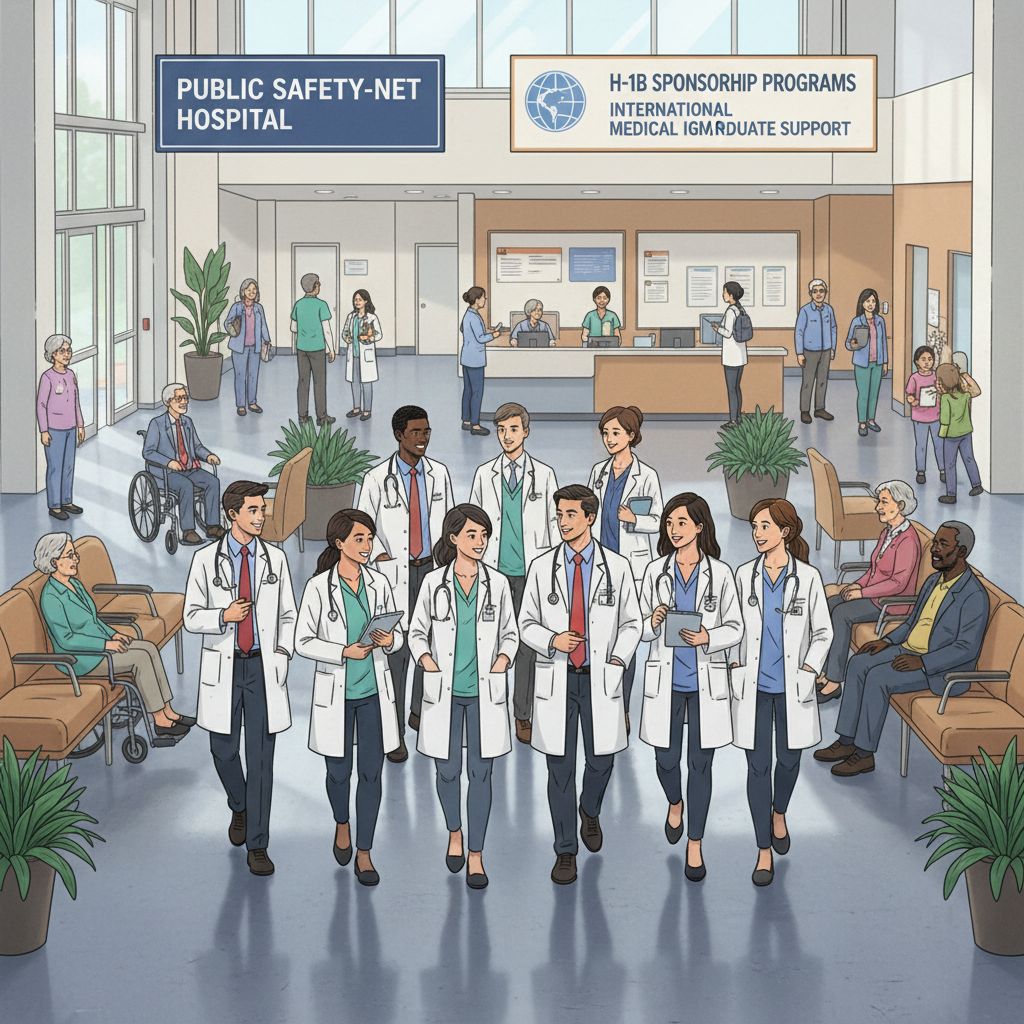
Understanding H-1B Sponsorship for Non-US Citizen IMGs
For a non-US citizen IMG, the right visa pathway can determine where you match, how you train, and how easily you transition to independent practice. Among all options, H-1B residency programs stand out because they allow dual intent (training plus potential long-term US career) and often position you better for future employment and green card sponsorship.
Yet, H-1B sponsorship is more complex, more expensive for programs, and therefore less common than J-1 sponsorship. Knowing how it works—and how to strategically target IMG friendly residency programs that sponsor H-1B visas—can dramatically improve your match prospects and long‑term planning as a foreign national medical graduate.
This guide walks you through the essentials: how the H‑1B works for residency and fellowship, what “cap-exempt” means, where to find H‑1B sponsor lists, how to evaluate international graduate programs, and practical steps to maximize your chances.
H-1B Basics for Residency and Fellowship
What is an H-1B Visa in the Residency Context?
The H-1B is a temporary work visa for specialty occupations that require at least a bachelor’s degree—medicine qualifies, and residency is considered employment. For a non-US citizen IMG, an H-1B allows you to:
- Work and get paid as a resident physician
- Have dual intent (you can legally plan for a green card while on H‑1B)
- Often be a more attractive candidate for long-term hospital or academic jobs after training, because you’re already work-visa authorized
Key differences from J-1:
- No two-year home residency requirement
- Employer-sponsored (the residency program files the petition)
- Usually needs all USMLE Steps passed before start date (often including Step 3)
- More upfront cost and paperwork for the program
Cap vs. Cap-Exempt: Why It Matters
H-1B visas are normally subject to an annual numerical cap (the “H-1B lottery”). But many residency programs are H-1B cap exempt, meaning they can sponsor H‑1Bs at any time of the year, outside the lottery.
Cap-exempt institutions include:
- Nonprofit institutions of higher education (e.g., university hospitals)
- Nonprofit organizations related to or affiliated with such institutions
- Certain nonprofit research or government research organizations
Most large academic teaching hospitals fall into these categories, which is why H-1B cap exempt residency programs are central to IMG planning.
Why this helps you:
- No need to compete in the H-1B lottery during training
- More flexible start dates and extensions
- Fewer interruptions to your residency due to visa timing
However, once you leave a cap-exempt setting for a private practice or community hospital that is cap-subject, you may need to enter the cap/lottery at that stage (often after training, when switching jobs).

J-1 vs H-1B: Strategic Comparison for Non-US Citizen IMGs
J-1 Visa: Pros and Cons
Most non-US citizen IMGs in GME are sponsored by the ECFMG J-1 visa. It’s widely accepted because it’s straightforward for programs.
Pros:
- Easiest and most common pathway for international graduate programs
- Less expensive and administratively simpler for programs
- Large majority of IMG friendly residency positions accept J‑1
Cons:
- Two-year home-country physical presence requirement after training (unless you obtain a waiver)
- Waivers usually require service in underserved or rural areas
- Can limit subspecialty training timing (especially if waiver required before fellowship)
- Not dual intent—more complicated if you plan early green card pathways
H-1B Visa: Pros and Cons
Pros:
- Dual intent: compatible with long-term US immigration plans
- No mandatory home-country return requirement
- More straightforward transition to permanent employment and green card sponsorship
- Attractive option for employers after residency
Cons:
- Not all programs sponsor it—only a subset of IMG friendly residency programs
- Higher legal and filing costs for employers
- Strict eligibility:
- Must have passed USMLE Step 3 before H-1B filing in most states
- Must meet state licensing/permit requirements
- Some specialties/programs impose internal caps on the number of H-1B residents per year
When is H-1B Typically Better?
H-1B is usually the better fit for a non-US citizen IMG who:
- Plans to stay long-term in the US and pursue permanent residence
- Wants flexibility after training (geography, type of employer)
- Already has, or expects to easily obtain, USMLE Step 3 and required credentials early
- Is applying mainly to university-affiliated or large teaching hospitals that are likely H‑1B cap exempt
If your profile or timing makes H-1B unrealistic (e.g., difficulty scheduling Step 3 before start), J‑1 can still be a strong pathway—especially if you’re comfortable with doing a J‑1 waiver service after training.
Types of Programs That Sponsor H-1B for IMGs
Not every residency program willing to consider IMGs will sponsor H‑1B. Understanding which institutions are most likely to sponsor, and why, helps you target applications wisely.
1. Major University and Academic Teaching Hospitals
These are often the most H-1B friendly environments for IMGs:
- Usually nonprofit, university-affiliated = H-1B cap exempt
- Have immigration offices or legal counsel experienced with H-1B petitions
- Frequently publish explicit H-1B sponsorship policies for residents and fellows
Common patterns:
- Internal rules such as: “H-1B considered only for applicants who have passed all USMLE Steps including Step 3 at time of ranking.”
- Preference to convert J-1 to H-1B for senior residents/fellows who are staying on as faculty or subspecialty trainees
2. Large Nonprofit Community Teaching Hospitals
Some community-based but academically-affiliated hospitals (often teaching sites for medical schools) also qualify as H-1B cap exempt and may sponsor H‑1B for residency:
- Often sponsor a limited number of H-1B positions per year
- May restrict H-1B sponsorship to critical need specialties (e.g., Internal Medicine, Family Medicine, Psychiatry)
For a non-US citizen IMG, these hospitals can be excellent IMG friendly residency options if they state openness to foreign national medical graduates and H-1B sponsorship.
3. Fellowship Programs at Academic Centers
Even if your core residency won’t sponsor H‑1B, some fellowship programs will, especially in:
- Cardiology
- Gastroenterology
- Hematology/Oncology
- Pulmonary/Critical Care
- Nephrology
- Endocrinology
If you start on J‑1 for residency and later match into an H-1B fellowship in a cap-exempt institution, you can potentially switch visa types—though you must still deal with J-1 obligations if they apply (e.g., two-year rule and waiver).
4. Programs That Rarely or Never Sponsor H-1B
Be cautious with:
- Smaller for-profit community hospitals (often cap-subject, less likely to sponsor H-1B for GME)
- Newer residency programs with limited administrative infrastructure
- Programs that explicitly state "J-1 only" in their policies or outreach
These can still be excellent J-1 options but are usually not ideal if your goal is specifically to secure an H‑1B from the start.

Building and Using an H-1B Sponsor List Strategically
Why You Need Your Own H-1B Sponsor List
There is no single, official, perfectly accurate H-1B sponsor list for residency and fellowship programs. Policies change with:
- Program leadership
- Institutional budgets
- Immigration law shifts
- Prior experiences with H-1B residents
Creating your own, updated list tailored to IMG friendly residency programs gives you a competitive edge and helps you focus your efforts.
Step 1: Review Official Program Websites
Start with each program’s GME or residency page. Look specifically for:
- A “Visa” or “Eligibility” section
- Statements like:
- “We sponsor J-1 and H-1B visas for qualified applicants.”
- “H-1B visas may be considered for exceptional candidates who have passed USMLE Step 3.”
- “ECFMG J-1 visa only; H-1B visas are not sponsored.”
Record for each program:
- Visa types accepted (J‑1, H‑1B, other)
- USMLE Step 3 requirement and timing
- Any wording like “limited basis,” “case-by-case,” or “no H‑1B”
Step 2: Use FREIDA and Other Databases Carefully
The AMA’s FREIDA database sometimes lists visa information, but it can be:
- Out-of-date
- Incomplete
- Inconsistent across specialties
Still, it’s a useful initial filter. Combine FREIDA with:
- Program websites
- GME office pages
- University HR/immigration pages
Where possible, cross-check everything.
Step 3: Verify with GME Offices or Program Coordinators
Once you have a draft H-1B sponsor list, confirm directly:
- Email GME offices or program coordinators well before ERAS opens
- Ask concise, targeted questions, for example:
“I am a non-US citizen IMG planning to apply to your Internal Medicine residency. Does your program currently sponsor H-1B visas for incoming residents, or is it J-1 only? If H-1B is possible, do you require USMLE Step 3 to be completed before ranking or only before start date?”
Log responses in a spreadsheet; note date and contact person.
Step 4: Confirm Cap-Exempt Status
For long-term planning, also note whether each institution is H‑1B cap exempt:
- Look for descriptors like “nonprofit academic medical center,” “university hospital,” or “affiliated with [University Name].”
- Many university hospitals will state clearly that they are cap-exempt in HR or legal documents (sometimes on careers pages).
Including a cap-exempt flag in your H-1B sponsor list helps you plan beyond residency—for example, staying on as a fellow or junior faculty.
Application Strategy for Non-US Citizen IMGs Seeking H-1B
Core Eligibility: What You Need in Place
To be a realistic candidate for H-1B residency sponsorship, you typically need:
ECFMG Certification
- All Steps required for certification (Step 1, Step 2 CK) completed
USMLE Step 3
- Many H-1B residency programs insist Step 3 is:
- Passed before ranking OR
- At least expected to be completed before the residency start date
- Many H-1B residency programs insist Step 3 is:
State Licensing Requirements
- Some states require a certain number of postgraduate clinical training years or specific documentation from your medical school
- For H-1B, you need to be eligible for a training license/permit; the program’s GME office usually helps, but you must meet all prerequisites
No Unresolved Immigration Violations
- Prior status issues, overstays, or unauthorized employment can complicate H‑1B approval
Academic and Profile Strength
Because H-1B sponsorship is more costly and complex, some programs reserve it for stronger applicants. You improve your competitiveness by:
- Strong USMLE scores (especially Step 2 CK and Step 3)
- US clinical experience (USCE) with:
- Recent hands-on rotations or observerships
- Strong, detailed letters of recommendation from US faculty
- Demonstrated academic engagement:
- Research (especially at US institutions)
- Quality improvement or leadership activities
- Conference presentations or publications
For many IMG friendly residency programs that sponsor H‑1B, you must show you are likely to complete training successfully and contribute meaningfully to the program.
Crafting Your ERAS Application with H-1B in Mind
Personal Statement
- Emphasize your long-term commitment to practicing in the US
- Highlight your readiness for independent work and professional responsibility (H-1B = employee)
- If appropriate, briefly mention your familiarity with US healthcare systems and EHRs
CV and Experiences
- Highlight US-based experiences prominently
- Clarify roles and responsibilities (especially in US settings)
Letters of Recommendation
- Aim for at least 2–3 US letters from faculty who:
- Are familiar with GME
- Can credibly vouch for your clinical readiness
- If possible, letters from faculty at institutions that are themselves known to sponsor H‑1B are especially persuasive.
- Aim for at least 2–3 US letters from faculty who:
Program Signaling and Application Volume
- Use any specialty-specific signaling mechanisms (e.g., Internal Medicine signals) to target H‑1B friendly sites.
- Apply to a broad but realistic range: include a mix of:
- Highly competitive academic programs
- Moderately competitive IMG friendly residency programs that you’ve confirmed sponsor H‑1B
- A few backup programs that sponsor J‑1 only, in case H‑1B is not feasible
Timing of USMLE Step 3
For a non-US citizen IMG seeking H-1B, your Step 3 timing strategy is crucial:
- Aim to pass Step 3 before interviews if possible; it’s a strong signal that you’re H‑1B ready.
- If that’s not possible, be transparent:
- Inform programs of your scheduled exam date and preparation plan.
- Remember that for cap-exempt H‑1Bs, filing can occur later in the spring—but you don’t want any delays that risk your start date.
After Match: From Offer to H-1B Approval
Post-Match Communication
Once you match into an H‑1B sponsoring program:
- Confirm your visa type with the GME office:
- Some programs may default to J‑1 unless you explicitly request H‑1B.
- Clarify deadlines:
- When they need your Step 3 results
- When they will initiate your H‑1B petition
- Any documents needed from your side (diploma, transcripts, ECFMG certificate, passport scans, etc.)
H-1B Petition Process (High-Level Overview)
The residency program (as employer) will:
- File a Labor Condition Application (LCA) with the Department of Labor
- Prepare and file the I‑129 H-1B petition with USCIS, usually with:
- Proof of the institution’s cap-exempt status (if applicable)
- Evidence that the position is a specialty occupation
- Your qualifications (degrees, ECFMG certification, USMLE Step 3, license or permit eligibility)
- Receive receipt notice and eventually approval notice (I‑797)
If you are outside the US, you will then:
- Use the I‑797 to schedule a visa interview at a US embassy/consulate
- Enter the US in H‑1B status to start residency
If you are already in the US in another status, you may have:
- Change of status approved by USCIS (no new stamping until you travel)
- Or choose consular processing if that’s safer given your situation
Maintaining and Extending H-1B During Training
Important points during residency:
- H-1B is typically approved in up to 3-year increments; total maximum is 6 years, with certain exceptions.
- Programs may:
- File extensions if residency is longer than initial H‑1B period
- Later sponsor H‑1B for fellowship or faculty roles at the same or affiliated institution
If you plan a multi-step training path (residency + fellowship), try to keep track of:
- How many years of H‑1B time you’ve used
- Whether you may soon need a green card process or cap-subject H‑1B if moving to a non-cap-exempt employer after fellowship
Frequently Asked Questions (FAQ)
1. As a non-US citizen IMG, is H-1B always better than J-1?
Not always. H‑1B offers advantages (dual intent, no home residency requirement), but:
- Fewer programs sponsor it
- Requirements (especially Step 3) are stricter
- It can be riskier if you can’t get Step 3 done in time
If your main goal is simply to enter US GME, and you have strong offers from J‑1 only international graduate programs, a J‑1 path can still be the right choice—especially if you are open to doing a J‑1 waiver job later.
2. Can I start residency on J-1 and later switch to H-1B?
Yes, it is sometimes possible, but complicated:
- If you start on J‑1, you typically incur the two-year home residency requirement.
- To change to H‑1B later (for fellowship or job), you must:
- Complete the two-year requirement, OR
- Secure a J‑1 waiver (e.g., Conrad 30, VA, or federal waiver programs)
This is why many non-US citizen IMGs who are certain they want long-term US practice try to obtain H‑1B from the start, if feasible.
3. Are H-1B residency programs usually more competitive?
They can be. Compared with similar programs that are J‑1 only:
- H‑1B sponsoring programs may receive higher numbers of IMG applications.
- Some use H‑1B sponsorship selectively, only for top candidates or specific specialties.
- Academic centers that sponsor H‑1B also tend to attract competitive US graduates and IMGs alike.
However, if you target IMG friendly residency programs that openly welcome foreign national medical graduates and include them in your H‑1B sponsor list, you can still be highly competitive with a strong profile.
4. How do I know if a program is truly H-1B cap exempt?
Most university hospitals and large nonprofit teaching hospitals are cap-exempt, but to confirm:
- Look for official wording such as:
- “Nonprofit organization affiliated with an institution of higher education”
- “Cap-exempt H-1B employer” on HR or legal pages
- Ask the GME office directly:
- “Is your institution considered H‑1B cap exempt for residency positions?”
If an institution is cap-subject, they may still be able to sponsor H‑1B, but you’d be subject to the annual cap and lottery, which adds risk and timing challenges.
By understanding how H-1B residency programs work, how to identify truly IMG friendly residency programs that sponsor H‑1B, and how to position yourself as a strong candidate, you can move from uncertainty to a targeted, realistic strategy. As a non-US citizen IMG, your visa pathway is not just paperwork—it’s a foundational part of your career planning in the US healthcare system.