Understanding H-1B Sponsorship for Vascular Surgery: Why It Matters for Non‑US Citizen IMGs
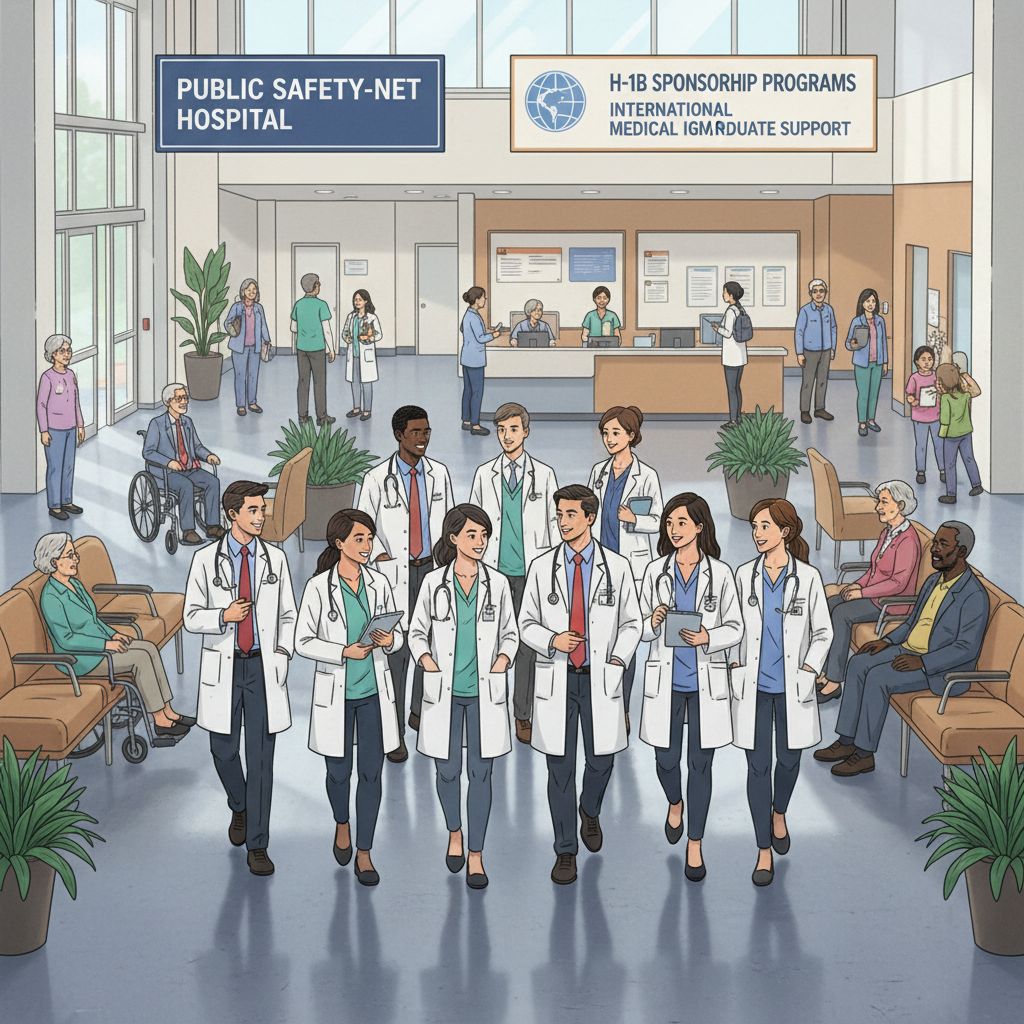
For a non-US citizen IMG (international medical graduate) interested in vascular surgery, immigration status is not a side issue—it is central to whether you can train, moonlight, and eventually practice in the United States. Among the available visa options, the H-1B stands out as particularly attractive for those entering a vascular surgery residency, especially the integrated vascular program (0+5).
However, H-1B sponsorship is not uniform across programs, and vascular surgery has unique training pathways that complicate planning. Understanding which programs sponsor H-1B, how H-1B cap exempt status works, and how to build a realistic application strategy is essential for any foreign national medical graduate targeting this highly competitive specialty.
This article provides a structured, practical guide to:
- H-1B basics for resident physicians
- Specific considerations for vascular surgery training (0+5 and 5+2 pathways)
- How to identify and evaluate H-1B residency programs
- Strategic application planning for non-US citizen IMGs
- Common pitfalls and FAQ
H-1B Basics for Non‑US Citizen IMGs in Vascular Surgery
What is the H-1B and why do residents care?
The H-1B is a temporary work visa for “specialty occupations” that require at least a bachelor’s degree or higher. Physicians use the H-1B to work in clinical roles that require an MD/DO plus post-graduate training.
For a non-US citizen IMG, the H-1B has several advantages over J-1:
- No home-country 2-year return requirement (unlike J-1)
- More flexible path to permanent residency (green card) during or after training
- In many institutions, broader moonlighting options than J-1
- Eligible spouse (H-4) may sometimes obtain work authorization (depending on the principal’s immigration status and green-card process stage)
However, not all vascular surgery programs can or will sponsor H-1B, and some hospitals only sponsor J-1 for residency. That is why targeted program selection is crucial.
Cap-subject vs H-1B cap exempt
The general H-1B system has an annual numerical cap. Most employers must enter the H-1B lottery in March, and if selected, employment begins in October. Residency programs cannot wait for this process—training must start July 1.
This is where H-1B cap exempt status becomes critical.
Most GME institutions are either:
- Cap-exempt (typical for major academic centers), or
- Affiliated with a cap-exempt institution (e.g., university-affiliated hospitals)
Cap-exempt employers include:
- Nonprofit universities
- Nonprofit hospitals affiliated with universities
- Nonprofit research organizations
- Governmental research organizations
For residents and fellows, this means:
- No H-1B lottery
- No annual numerical cap
- H-1B can be filed and approved any time of year
- The status is typically tied to your GME institution
Most large academic medical centers with vascular surgery programs fall into this H-1B cap exempt category, which is a substantial advantage for non-US citizen IMGs seeking training.
Core eligibility requirements for H-1B residency sponsorship
While each institution sets its own policies, common baseline requirements for a foreign national medical graduate seeking H-1B sponsorship in vascular surgery include:
USMLE/COMLEX
- USMLE Steps 1 and 2 CK passed; Step 3 is often:
- Required before H-1B petition at many institutions
- Strongly preferred or recommended at others
- Some programs will not consider H-1B unless Step 3 is already passed at application or interview time.
- USMLE Steps 1 and 2 CK passed; Step 3 is often:
ECFMG Certification
- Must be ECFMG certified before H-1B start date.
- Some institutions require ECFMG certification before ranking you.
State Medical License or Training License
- Many states require Step 3 for a full license but not for a training license.
- Some H-1B policies are tied to whether the hospital uses a full license vs. a training license for residents.
Sponsoring Employer Requirements
- The hospital or university must be willing and authorized to sponsor H-1B for residents.
- Internal GME or legal office policies may restrict visa categories.

Vascular Surgery Training Pathways and Their Visa Implications
Vascular surgery is offered primarily through:
- Integrated Vascular Surgery Residency (0+5)
- Independent Vascular Surgery Fellowship (5+2)
Each has distinct immigration and H-1B sponsorship considerations.
1. Integrated vascular program (0+5) and H-1B
The integrated vascular program is a highly competitive 5-year residency combining core surgery and vascular surgery into one continuum. For a non-US citizen IMG, this pathway has both advantages and challenges.
Advantages:
- Single match event: You secure your vascular track from day 1, rather than matching general surgery first.
- Continuous H-1B status: If sponsored, you may be on a single, extended H-1B trajectory (with extensions) throughout the 5 years.
- Academic centers with integrated programs are often H-1B cap exempt institutions.
Challenges:
- Few positions nationally (dozens of spots vs hundreds in general surgery).
- Many integrated programs have strict visa policies, sometimes:
- Only J-1 sponsorship
- Or US citizens/green card holders only
- H-1B for a 5-year integrated program can be logistically complex due to:
- Initial 3-year H-1B period + extension
- Requirement to remain with one employer or manage transfers carefully
Practical tip:
If your primary goal is H-1B and long-term US practice, you may need to balance the dream of an integrated vascular position against a more common and visa-friendly general surgery residency followed by vascular fellowship.
2. Independent vascular surgery fellowship (5+2) considerations
The traditional route is:
- 5 years General Surgery → 2 years Vascular Surgery Fellowship
As a non-US citizen IMG:
- If you already have H-1B for general surgery residency, continuing H-1B for the vascular fellowship is often realistic, especially at the same institution or another academic center.
- Many vascular surgery fellowships are at large academic programs that are H-1B cap exempt and accustomed to sponsoring subspecialty fellows.
- You may have more negotiating power for H-1B during fellowship if you have:
- Strong surgical CV
- US LORs and publications
- Proven performance in a US residency
Key distinction:
For some foreign national medical graduates, the path is:
- J-1 for general surgery → J-1 for vascular fellowship → J-1 waiver job
- H-1B for general surgery → H-1B for vascular fellowship → transition to employer-sponsored H-1B or green-card track
Understanding which path is realistic for you depends heavily on:
- Your USMLE profile
- Program competitiveness
- Willingness to work in underserved areas later (for J-1 waiver jobs)
- Availability of H-1B residency programs that accept IMGs in surgery
Identifying H-1B-Friendly Vascular Surgery Programs
There is no official, constantly updated H-1B sponsor list for vascular surgery programs. Policies change yearly with GME leadership and institutional legal review. However, you can systematically identify programs likely to sponsor H-1B.
Step 1: Understand typical H-1B-friendly institutional profiles
Programs more likely to sponsor H-1B for a non-US citizen IMG:
- Are large academic centers or university hospitals
- Have a history of IMG trainees in surgery and subspecialties
- Have multiple visa categories represented (H-1B and J-1)
- Are H-1B cap exempt due to university affiliation
- Publicly display or mention:
- “We sponsor J-1 and H-1B visas”
- “We accept qualified non-US citizen IMG applicants”
In contrast, programs that may be less likely to sponsor H-1B:
- Small community-based vascular programs
- Institutions that have never or rarely matched IMGs in surgery
- Hospitals with explicit policies of “J-1 only” for GME
Step 2: Review program and GME websites systematically
For each integrated vascular program and vascular fellowship you are interested in:
Visit:
- The program’s own webpage
- The GME office / Office of Graduate Medical Education site
- The institutional international office or visa office pages
Look for wording such as:
- “We sponsor ECFMG J-1 visas and H-1B visas for eligible trainees.”
- “Visa types sponsored: J-1, H-1B (for residents who have completed USMLE Step 3).”
- “We do not sponsor H-1B for residency training.”
Confirm details:
- Step 3 requirement before application vs before starting
- Any limitations (e.g., “No H-1B for preliminary or categorical general surgery” but maybe for fellowship only)
- Whether H-1B is only for fellows or also for integrated (0+5) residents
Keep a spreadsheet noting:
- Program name
- Visa policy (J-1 only, J-1/H-1B, or unspecified)
- Any explicit language on H-1B
- History of residents/fellows who were IMGs (from alumni pages)
This becomes your personalized, updated H-1B sponsor list for vascular surgery and aligned GME programs.
Step 3: Use publicly available match lists and alumni data
To infer H-1B receptiveness, scan:
- General surgery residency websites at the same institution:
- If they show multiple IMGs with names suggesting non-US citizenship, that’s a favorable sign.
- Vascular surgery fellowship alumni:
- IMGs who stayed at the same institution for jobs afterward may have transitioned from J-1 to H-1B, indicating institutional flexibility.
While this doesn’t guarantee H-1B sponsorship for you, it strongly suggests the institution is used to navigating immigration complexity.
Step 4: Directly email GME or program coordinators—strategically
Emailing every program with “Do you sponsor H-1B?” is risky if phrased poorly; you don’t want to appear visa-focused over training-focused.
Consider a more professional approach:
- Mention your credentials (ECFMG status, USMLE scores, Step 3 plan or completion).
- Express clear interest in vascular surgery training at their institution.
- Ask a specific, concise question such as:
- “Could you please clarify which visa categories your program is able to support for incoming residents/fellows?”
- “For qualified non-US citizen IMG applicants, does your GME sponsor J-1 only, or is H-1B also an option (assuming USMLE Step 3 completion)?”
This avoids sounding like you are only interested if they offer an H-1B, while still getting the information you need.

Application Strategy for Non‑US Citizen IMGs Seeking H-1B in Vascular Surgery
Because vascular surgery is ultra-competitive and H-1B is restrictive, your strategy must be both aspirational and realistic.
1. Build a profile that makes H-1B worth it for programs
H-1B sponsorship is expensive and time-intensive for institutions. Programs are more likely to sponsor H-1B for a foreign national medical graduate who clearly adds value.
Strengthen your application by:
- USMLE performance
- Strong Step 2 CK score (and Step 1 if numeric)
- Step 3 passed as early as possible
- Vascular-specific exposure
- Electives or observerships in vascular surgery
- Vascular surgery research (case reports, QI projects, retrospective studies)
- Presentations or posters at vascular or surgical meetings
- US clinical experience (USCE)
- Rotations in surgery at US teaching hospitals
- Strong letters from US vascular or general surgeons
- Academic productivity
- Publications or presentations with vascular content
- Demonstrated commitment to academic surgery
Programs are more willing to take on the administrative burden of H-1B for an applicant they see as a high-yield, long-term contributor to the specialty.
2. Time your USMLE Step 3 strategically
For H-1B sponsorship, Step 3 is often the bottleneck. Consider:
- Goal: Complete Step 3 before ERAS submission for maximum flexibility.
- If not possible, aim for:
- Step 3 before interviews or
- At least before rank list due dates, and clearly indicate your exam date in ERAS.
Include in your personal statement or CV:
- “USMLE Step 3 scheduled for [Month/Year]; committed to timely completion to facilitate visa options including H-1B.”
Some institutions will not even interview you for H-1B if Step 3 is not already passed, so earlier is better.
3. Diversify your pathways: integrated vs general surgery
For a non-US citizen IMG, a robust strategy may include:
- Applying to integrated vascular programs that are known to accept IMGs and/or sponsor H-1B.
- Simultaneously applying to categorical general surgery programs with H-1B or at least J-1 sponsorship.
- Planning for a 5+2 vascular fellowship as a realistic secondary path.
In other words:
- Use the integrated vascular program as a stretch goal.
- Treat general surgery + vascular fellowship as your structured backup that still leads to a vascular career.
4. Prioritize H-1B residency programs in your rank list
If your priority is to remain on H-1B and avoid the J-1 waiver route:
- Give higher rank to:
- Programs that explicitly offer H-1B and where you have confirmed eligibility.
- Be honest about your level of risk tolerance:
- Are you willing to train on J-1 and later pursue a waiver job in an underserved area?
- Or is avoiding the 2-year home residence requirement essential?
Write two versions of your rank list if needed:
- Ideal (if H-1B works out)
- Practical (if only J-1 options match)
Ultimately, you submit one final NRMP rank order list, but building both on paper clarifies your priorities.
5. Understand long-term immigration implications
Choosing H-1B vs J-1 for vascular training affects your career trajectory:
If you train on J-1:
- Must complete a 2-year home-country return OR
- Obtain a J-1 waiver (e.g., via Conrad 30, VA, or underserved area employment)
- Many waiver positions are in rural or underserved communities, potentially outside high-volume vascular centers.
If you train on H-1B:
- No 2-year home-country requirement.
- You can potentially move to another H-1B cap exempt academic job or a cap-subject job (if selected in the lottery) after training.
- Easier to begin the green card process earlier, especially in academic positions.
Your choice of H-1B residency programs now shapes where and how you can practice vascular surgery later.
Practical Example Scenarios for Non‑US Citizen IMGs
Scenario 1: Non-US citizen IMG with strong scores and early Step 3
- Step 1: 240s (numeric), Step 2 CK: 250+, Step 3 passed
- Multiple vascular surgery observerships and one US publication
- ECFMG certified and 1 year of research in a US vascular lab
Strategy:
- Apply broadly to integrated vascular programs that have any history of IMGs or mention H-1B.
- Apply widely to categorical general surgery at university or university-affiliated hospitals with documented H-1B sponsorship.
- Emphasize academic interest and vascular commitment in your personal statement.
- During interviews, discuss your long-term vascular goals and readiness to comply with visa requirements.
Outcome:
- Highly competitive for both general surgery and some integrated vascular programs that consider strong IMGs for H-1B sponsorship.
Scenario 2: Non-US citizen IMG with mid-range scores, no Step 3 yet
- Step 1: pass, Step 2 CK: low 230s, Step 3 not taken
- Limited USCE, but strong home-country surgery training and significant vascular exposure
Strategy:
- Take Step 3 as soon as possible and report your scheduled date in ERAS.
- Focus on general surgery categorical at academic centers that accept IMGs (even if J-1 only).
- Apply to a few integrated vascular programs, but recognize lower chances without Step 3 and with moderate scores.
- Consider a J-1-based path with eventual J-1 waiver job, unless you can secure H-1B general surgery at a smaller set of institutions.
Outcome:
- Realistic goal: Match into general surgery on J-1 or H-1B, then proceed to vascular fellowship later.
- Aim to strengthen profile for future vascular match through research and US connections.
FAQs: H-1B Sponsorship in Vascular Surgery for Non‑US Citizen IMGs
1. Do any integrated vascular surgery (0+5) programs sponsor H-1B for non-US citizen IMGs?
Yes, some integrated vascular programs at large academic centers have sponsored H-1B visas for exceptional foreign national medical graduates. However:
- Policies vary widely and change over time.
- Some programs accept IMGs but only on J-1.
- A smaller subset is open to H-1B for residents, especially if Step 3 is completed early.
You must verify each program’s current policy via their website and, if unclear, by contacting the GME office or program coordinator. Treat an updated, self-compiled H-1B sponsor list as a living document rather than relying on outdated online forums.
2. Is it realistic to aim only for H-1B programs and refuse J-1 options?
It is possible but carries risk. Vascular surgery is highly competitive, and restricting yourself purely to H-1B residency programs may:
- Significantly limit the number of programs you can apply to.
- Decrease your overall chance of matching.
A more balanced strategy is:
- Prioritize H-1B-friendly institutions.
- Include some J-1 programs as safety options if you are open to J-1 waiver paths later.
- Reassess your priorities annually based on interview offers and visa policy updates.
3. Do I absolutely need Step 3 before applying for vascular surgery on H-1B?
While a few institutions may allow H-1B filing with Step 3 pending, most H-1B residency programs require Step 3 passed before they can submit your petition, and some require it even before ranking you. For a foreign national medical graduate aiming at H-1B in vascular surgery, Step 3 is effectively:
- Strongly recommended before ERAS submission
- Often functionally mandatory by the time of contract/visa processing
If you cannot take Step 3 early, you may need to rely more heavily on J-1 options initially, then move to H-1B later in your career.
4. How does being in an H-1B cap exempt residency help my long-term career?
Training at an H-1B cap exempt institution (typical for academic hospitals) offers several advantages:
- No lottery; your H-1B is not limited by the national cap.
- You can extend your H-1B status during your full residency and vascular fellowship.
- After training, you can:
- Stay in a cap-exempt academic role, or
- Attempt to move to a cap-subject private practice (if selected in the H-1B lottery) or transition via other immigration routes.
For a non-US citizen IMG, this offers a more flexible path to permanent practice compared with J-1, which typically requires a waiver position or 2-year home return.
By understanding how the H-1B system intersects with vascular surgery’s unique training structure, you can plan a strategy that aligns your career ambitions, immigration goals, and realistic match prospects. For a non-US citizen IMG, success depends not only on clinical excellence but also on early, deliberate planning around H-1B residency programs, cap-exempt institutions, and long-term visa pathways in vascular surgery.