Understanding H-1B Sponsorship in NYC Residency Programs
New York City is one of the most popular destinations for international medical graduates (IMGs) seeking U.S. training. Its dense concentration of academic medical centers, safety-net hospitals, and community programs makes it especially attractive. For many IMGs, however, the key practical question is: Which NYC residency programs sponsor H-1B visas, and what does that process involve?
This article explains how H-1B sponsorship works in the context of New York City residency training, which institutions commonly support H-1B visas, and how you can strategically target NYC residency programs that are more “H-1B friendly.” It is designed for IMGs and non–U.S. citizen graduates of U.S. medical schools who are planning to apply to NYC programs and want a realistic, step-by-step roadmap.
We will also touch on how H-1B cap-exempt rules work for teaching hospitals, what documents you need, and how to evaluate whether a program fits your immigration goals.
J-1 vs H-1B in NYC: Why H-1B Matters
Most international applicants to NYC residency programs first hear about the J-1 visa, sponsored by the Educational Commission for Foreign Medical Graduates (ECFMG). The J-1 is widely accepted and relatively straightforward, but it comes with a critical limitation for many IMGs: the two-year home-country physical presence requirement (also called the “home return requirement”).
By contrast, an H-1B visa:
- Does not automatically impose a two-year home residence requirement
- Can be a more direct stepping-stone to long-term employment and potential permanent residency
- Is often favored by IMGs who plan to build a U.S.-based career without depending on J-1 waivers
However, the H-1B comes with its own challenges:
- Not all NYC programs sponsor H-1B visas
- It requires passing USMLE Step 3 (or COMLEX equivalent) before H-1B petition filing for residency
- It generally involves higher legal costs and more complex institutional processes
- Some programs may only offer H-1B for fellowship or later training, not for PGY-1
As an applicant, your first task is to be clear on why you want an H-1B and whether it fits your profile:
H-1B is often a good fit if you:
- Want to avoid the J-1 home return requirement
- Plan to stay and work in the U.S. long-term
- Are confident you can complete all USMLE Steps, including Step 3, early enough
- Are applying to academic or large teaching hospitals that are likely to be H-1B cap-exempt
J-1 may be more practical if you:
- Are flexible about doing a J-1 waiver or working abroad after training
- Are applying broadly, including many community programs with no H-1B history
- Do not expect to have Step 3 completed before rank lists are due
For New York City residency, both visa paths are actively used, but H-1B sponsorship is concentrated in specific systems and specialties.
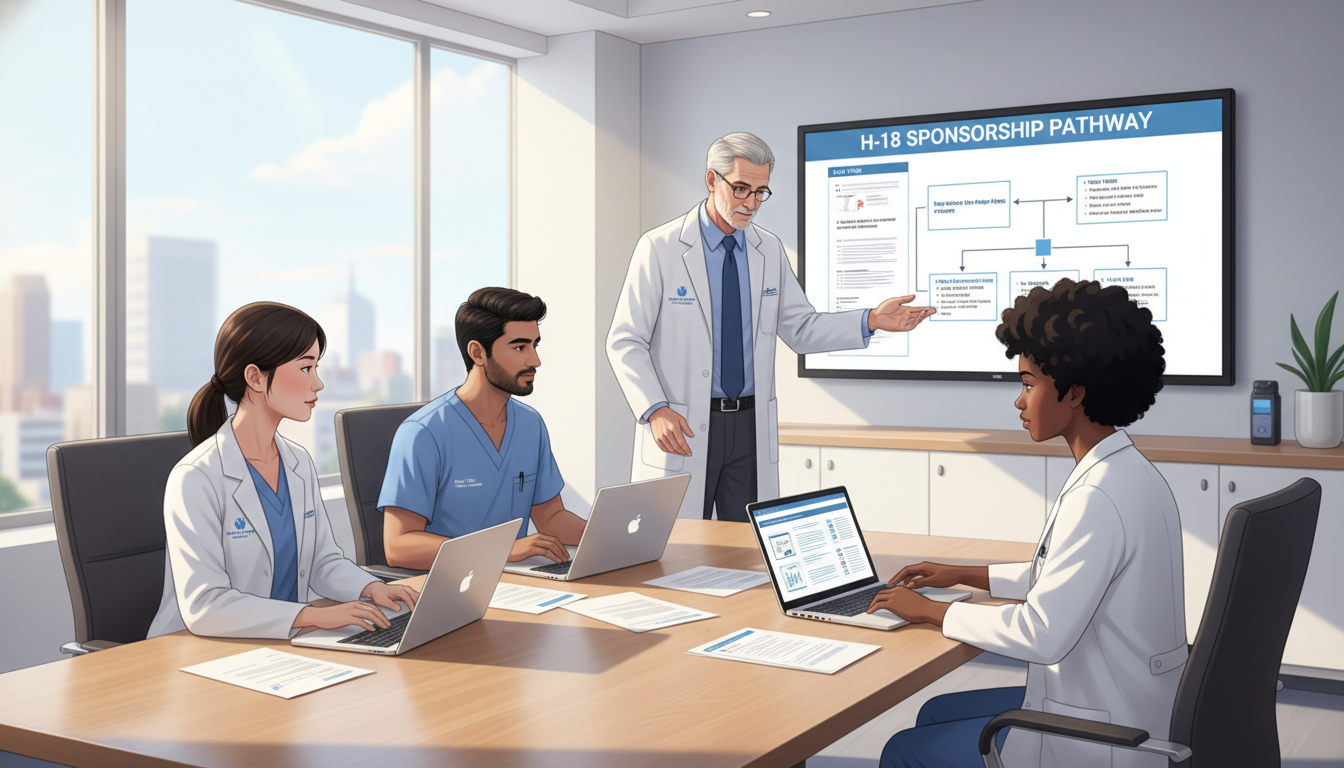
How H-1B Works for NYC Residency Programs
To successfully match into a New York City residency with H-1B sponsorship, you need to understand how the mechanics differ from H-1B in other fields.
1. Cap-exempt vs Cap-subject: Why Teaching Hospitals Are Different
Most large academic NYC residency programs are part of H-1B cap-exempt institutions. This is crucial.
Cap-subject H-1B (standard industry H-1B):
- Limited annual numerical cap
- Requires entry into an April lottery
- October 1 employment start date
H-1B cap-exempt (for many teaching hospitals and universities):
- No annual quota limitation
- No need for the H-1B lottery
- Can file and start at any time of year, as long as petitions are processed in time
- Usually applies to institutions that are:
- Non-profit universities, or
- Non-profit organizations affiliated with universities, including academic medical centers
Most major NYC academic hospitals fall under this H-1B cap-exempt category, which makes H-1B sponsorship for residency realistically possible.
2. Requirements Specific to Residents
For a residency H-1B, U.S. immigration regulations and hospital policies typically require:
- USMLE Step 1 and Step 2 CK passed
- USMLE Step 3 passed (before petition filing; some institutions require Step 3 before ranking you)
- Valid ECFMG certification
- Graduation from a recognized medical school (with verification documents)
- State medical board–related paperwork (training license eligibility or permit)
- Proof of employment offer from the residency program (contract or official letter)
In NYC, Step 3 timing is a frequent stumbling block. Many NYC residency programs that offer H-1B sponsorship will not entertain H-1B discussions until you:
- Have matched, and
- Have provided Step 3 results within a tight deadline (often late March or April)
Some institutions go further and require Step 3 before ranking H-1B–seeking applicants.
3. Timeline Considerations for NYC Applicants
If you are targeting H-1B residency programs in New York City:
By application season (September):
- Aim to have Step 3 scheduled or completed
- Clearly indicate Step 3 plans in ERAS
- Mention your visa preference coherently (e.g., “Open to J-1 or H-1B; H-1B preferred if Step 3 completed”)
By interview season (October–January):
- Be prepared to discuss your visa situation succinctly
- Ask directly—but professionally—about H-1B policies, Step 3 deadlines, and whether H-1B is truly an option for categorical residents
By rank list deadline (February/March):
- Ideally have Step 3 passed and reported
- If waiting for scores, understand that some programs may be hesitant to commit to H-1B ranking
After Match (March onwards):
- Work closely with GME and legal offices
- Provide documents immediately for filing
- If delays occur, programs may switch you to J-1, defer start date, or—rarely—withdraw the match (usually avoided at all costs)

Types of NYC Institutions That Commonly Sponsor H-1B
While official lists change year to year, patterns are surprisingly stable. NYC residency programs that consider H-1B typically fall into several categories.
Important: Policies change often. Always verify directly with each program’s website or GME office. What follows is a framework and typical examples, not a static H-1B sponsor list.
1. Large Academic Medical Centers and University Hospitals
These are the core H-1B cap-exempt institutions in New York City, and they often have structured immigration support:
- Major university-affiliated systems in Manhattan, Brooklyn, Queens, and the Bronx
- Large internal medicine, surgery, pediatrics, psychiatry, neurology, and subspecialty programs
- In-house or contracted immigration attorneys, clear HR processes, and budgets for visa fees
Many of these centers regularly sponsor H-1B for fellowship, and some also do so for residency, particularly for:
- IMGs with strong academic records
- Graduates of U.S. medical schools who are non–U.S. citizens
- Applicants with Step 3 completed early and strong program fit
If your goal is H-1B in NYC, targeting at least some large academic programs is essential.
2. Community Teaching Hospitals with University Affiliation
Many NYC community hospitals partner with universities for academic oversight. These institutions often:
- Are non-profit and university-affiliated, hence may be H-1B cap-exempt
- Have smaller but diverse residency programs (IM, FM, OB/GYN, Psychiatry, etc.)
- Sponsor H-1B on a case-by-case basis, usually for highly motivated and organized candidates
These hospitals may not publicly shout “H-1B-friendly,” but their history of employing IMGs as faculty or fellows is a positive sign.
3. Safety-Net and Public Hospitals
NYC’s safety-net hospitals and public systems serve large uninsured and underserved populations. Some of these:
- Are deeply reliant on IMGs
- Are affiliated with academic medical schools
- Have extensive experience with both J-1 and H-1B visa pathways
Because they are mission-driven and IMG-heavy, they may be open to H-1B residency sponsorship if circumstances permit (funding, timing, and your Step 3 status).
4. Smaller or Purely Community Programs
Pure community hospitals or non-teaching private hospitals in NYC are less likely to sponsor H-1B, partly due to:
- Limited HR/legal infrastructure
- Cost constraints
- Preference for J-1 or U.S. citizen/green card applicants
Some may be cap-subject employers, which complicates aligning July 1 residency start dates with the October 1 H-1B start date under the standard lottery timeline—another reason H-1B may be less practical for them.
How to Identify H-1B-Friendly NYC Residency Programs
Since there is no official, always-up-to-date H-1B sponsor list for NYC residency programs, smart applicants build their own research strategy. Below is a practical approach.
1. Use Official Program Websites and GME Pages
Look for a “Visa Sponsorship” or “International Applicants” section. Common phrases indicating H-1B openness include:
- “We sponsor J-1 and H-1B visas for eligible applicants”
- “H-1B sponsorship is available for exceptional candidates with USMLE Step 3 completed”
- “J-1 required; H-1B considered only in rare circumstances”
Whenever H-1B sponsorship is clearly mentioned, note:
- Whether it applies to residency vs fellowship only
- Whether Step 3 is required before interview, before ranking, or before contract signing
- Any specialty-specific policies (e.g., IM vs Surg vs Psych)
2. Review Past Resident Profiles
Many NYC residency programs list current or recent residents on their websites, including:
- Medical school
- Country of origin
- Sometimes visa status or biographies mentioning prior visa type
Patterns that suggest H-1B friendliness:
- IMGs from diverse countries who remained in NYC for fellowship
- Alumni profiles mentioning “joined the faculty on H-1B” or similar
- Repeated recruitment of non–U.S. citizens trained in NYC
While this doesn’t directly prove residency H-1B sponsorship, it signals institutional comfort with H-1B processes.
3. Use Applicant Communities and Data Sources Wisely
Platforms like:
- Reddit (r/IMGs, r/medicalschool, r/residency)
- Student Doctor Network
- Specialty-specific forums
- WhatsApp/Telegram IMG groups
often share anecdotal reports—“Program X sponsored H-1B for 2023 residents.” Treat this as a lead, not definitive truth:
- Use it to identify programs to investigate further
- Do not rely solely on anonymous reports when planning your entire strategy
4. Verify During Interviews
Your interview day is an appropriate and important time to clarify visa policies. Targeted questions:
- “Does your program currently sponsor H-1B visas for categorical residents, or is this limited to fellows?”
- “If yes, are there specific conditions, such as Step 3 timing or only for certain specialties?”
- “How many residents in your recent entering classes have been on H-1B?”
Ask these questions politely and briefly—this is about understanding program fit, not demanding special treatment.
5. Contact GME Offices Directly (Tactfully)
If policies are unclear online and you do not get an interview, you can sometimes email the program coordinator or GME office:
- Keep your email concise
- State your status (IMG, ECFMG certified, Step 3 status)
- Ask one direct question about whether they ever sponsor H-1B for residency
Example email template:
Dear [Coordinator Name],
I am an ECFMG-certified IMG planning to apply to your [Specialty] residency program in the upcoming ERAS cycle. I have completed USMLE Step 3 and am exploring New York City residency options that may sponsor H-1B visas.
Would you be able to share whether your program currently sponsors H-1B visas for categorical residents, or if your institution limits H-1B sponsorship to fellows?
Thank you for your time and assistance.
Sincerely,
[Your Name], MD
Not everyone will respond, but even a few answers can help you refine your personal H-1B sponsor list for NYC.

Building a Smart Application Strategy for H-1B in NYC
Because NYC is so competitive and H-1B policies are stricter than J-1, you need a layered strategy that balances ambition with realism.
1. Categorize Programs into Three Buckets
When planning your NYC list, group programs as:
Likely H-1B sponsors
- Clear statements on websites
- Known academic centers, cap-exempt hospitals
- Documented history of H-1B residents or fellows
Possibly H-1B sponsors
- University-affiliated, large GME structure
- Ambiguous or mixed website language
- Some anecdotal reports from recent applicants
Unlikely H-1B sponsors
- Website explicitly states J-1 only
- For-profit or non-teaching hospital with little IMG presence
- No university affiliation, very limited GME footprint
Apply broadly, but give extra attention (personalized letters, strong CV alignment) to your Likely and Possible buckets.
2. Prioritize Early Step 3 Completion
For an NYC H-1B plan, USMLE Step 3 is strategic, not optional:
- Target taking Step 3 before or early in interview season
- This allows you to confidently tell programs:
- “Step 3 is completed,” or
- “Scheduled for [date]; results expected before rank list deadline”
Step 3 completion often distinguishes serious H-1B candidates from the rest.
3. Strengthen Your Application Profile for NYC
Because many NYC residency programs are highly competitive, your overall application must be strong, not just your visa plan.
Helpful features include:
- U.S. clinical experience, especially in NYC or the Northeast
- Strong letters of recommendation from U.S. faculty
- Clear commitment to underserved urban populations (for safety-net hospitals)
- Evidence of research, QI, or academic engagement (for academic centers)
- Professional personal statement explaining your long-term goals
When programs have to decide whether to “spend” institutional resources on an H-1B resident, strong applicants are more likely to receive that support.
4. Be Flexible on Visa if Needed
An important tactical decision: Will you accept J-1 if H-1B is not offered?
Options:
H-1B only:
- You signal to programs that you can only join on H-1B
- Risk: Fewer interviews and ranks; some programs may not rank you at all
Open to J-1 and H-1B (H-1B preferred):
- You keep more doors open in the NYC market
- You can still aim for H-1B if possible but won’t lose an otherwise excellent program
Many IMGs find a middle path: apply broadly, choose a mix of visa policies, and then rank according to both training quality and visa support.
5. Think Beyond Residency: Long-Term Planning
When evaluating NYC residency programs from an H-1B perspective, consider your long-term plans:
- Are you hoping to stay in NYC for fellowship or job afterward?
- Does the institution have multiple fellowship programs where H-1B is normal?
- Is there a history of residents transitioning from J-1 to H-1B for fellowship within the same system?
Even if you start on J-1, training at a cap-exempt H-1B-friendly institution may open later doors. Conversely, if you start on H-1B in a cap-exempt NYC residency, you should learn about later transitioning to cap-subject employment (for private practice or non-academic jobs) and how to maintain or recreate cap-exempt eligibility if you plan to stay within academic medicine.
FAQs: H-1B Sponsorship for NYC Residency Programs
1. Are all New York City residency programs H-1B cap-exempt?
No. Many large academic medical centers and university-affiliated hospitals in NYC are H-1B cap-exempt, but some community or private hospitals are not. Cap-exempt status typically requires being a non-profit university or a non-profit institution affiliated with a university. Always verify institutional type and affiliation; cap-exempt employers are the most realistic option for H-1B residency programs starting in July.
2. Is Step 3 absolutely required for an H-1B residency in NYC?
In practice, yes. U.S. immigration rules and New York State licensing requirements mean that Step 3 is almost always mandatory before an H-1B petition for residency can be filed. Many NYC programs either require Step 3 before ranking you for H-1B consideration or insist that you pass it soon after the Match. If you are serious about H-1B, assume that Step 3 is non-negotiable and plan your exam schedule accordingly.
3. How can I find an up-to-date H-1B sponsor list for NYC residency programs?
There is no official, comprehensive H-1B sponsor list specifically for residency programs in New York City. Instead, you should:
- Check each program’s website for visa policies
- Use alumni, forums, and IMG communities to identify programs that “have done it before”
- Ask clarifying questions during interviews
- Occasionally contact coordinators or GME offices by email
Over time, you will build your own tailored list of likely H-1B residency programs in NYC.
4. If I match to a J-1–only program in NYC, can I later switch to H-1B?
Sometimes, but it depends on multiple factors:
- Whether your future employer (fellowship or job) is H-1B cap-exempt
- Whether your J-1 home return requirement has been waived (e.g., via a J-1 waiver program)
- Institutional policies and federal regulations at the time of your transition
Many IMGs complete NYC residency on J-1, obtain a J-1 waiver job (often outside NYC), and later return to academic or private practice positions in the city on H-1B. Others transition directly into H-1B cap-exempt fellowships if they secure a waiver and meet requirements. Early planning with an immigration attorney is recommended if you foresee a complex path.
Thoughtful planning, early Step 3 completion, and strategic application choices can significantly increase your chances of securing an H-1B-sponsored residency position in New York City. Use the guidelines in this article to map the landscape, identify realistic targets, and align your immigration strategy with your long-term career goals.