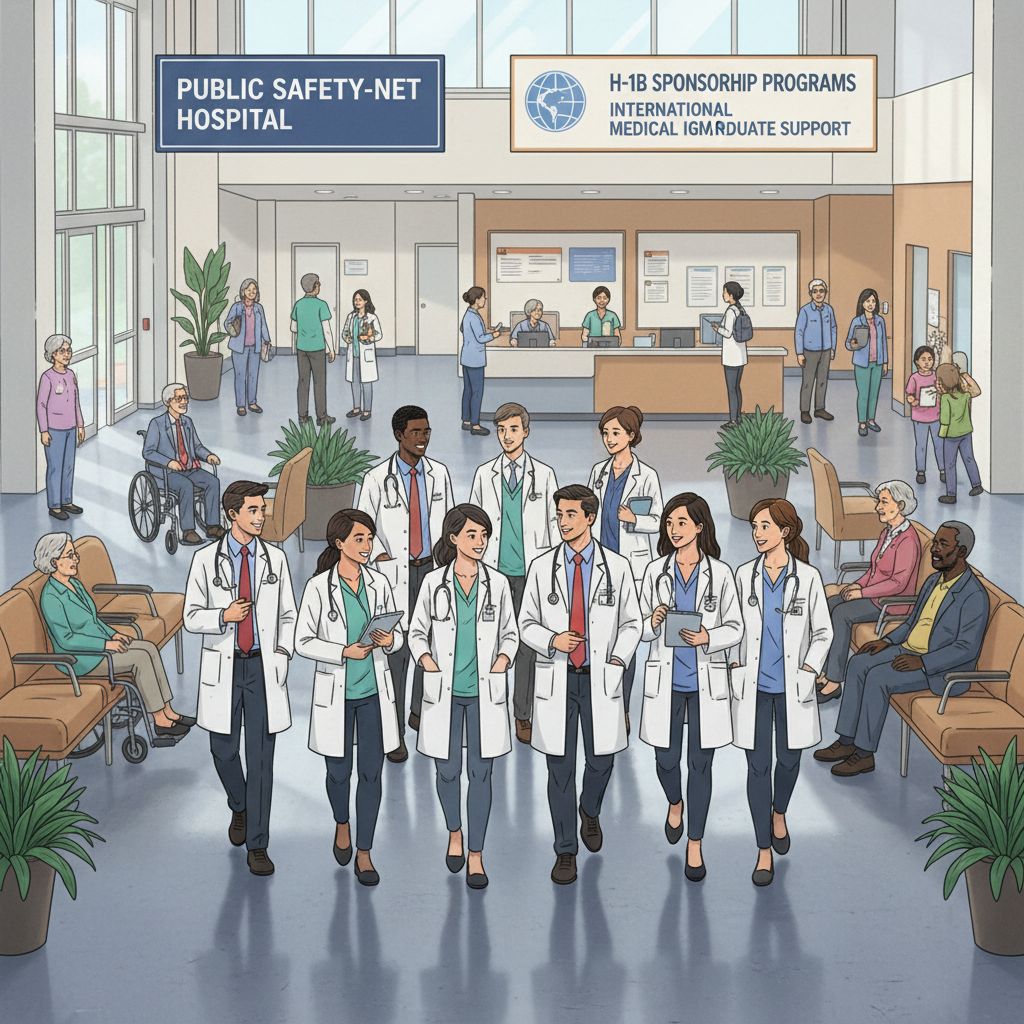
Understanding H-1B Sponsorship in Pediatrics Residency
For many international medical graduates (IMGs), securing a pediatrics residency in the United States under H-1B sponsorship feels like navigating a maze. Requirements vary between programs, policies change, and accurate information can be hard to find. Yet, for those who want to avoid the J-1 waiver process or aim for a more flexible career path after training, H-1B residency programs can be an excellent option.
This guide walks you through how H-1B sponsorship works specifically in pediatrics, how it affects your peds match strategy, and how to identify and approach programs that may support your goals. You’ll find practical, step‑by‑step advice rather than generic immigration theory, with a focus on making smart, informed decisions as an applicant.
H-1B vs J-1 for Pediatrics Residents: What Really Matters
Most pediatric IMGs match into residency on J-1 sponsorship through the Educational Commission for Foreign Medical Graduates (ECFMG). However, a smaller but important subset match on H-1B. Understanding the trade‑offs is critical before you build your application strategy.
Core Differences Relevant to Pediatrics
1. Sponsoring entity
J-1 visa
- Sponsor: ECFMG (not the hospital directly)
- Hospital complies with ECFMG rules but does not file immigration paperwork itself
H-1B visa
- Sponsor: Hospital or university (the “employer”)
- Institution must prepare and file an H-1B petition with USCIS
- This places financial, legal, and administrative burden directly on the program
Why it matters: Many pediatrics departments are overstretched and may choose J-1 only because it is operationally easier, not because of any issue with IMGs.
2. Home-country return vs. post‑residency flexibility
J-1
- Typically requires a 2-year home-country physical presence after training
- Most pediatricians avoid this by obtaining a J-1 waiver job (often in underserved/shortage areas; e.g., Conrad 30)
- Early career path is often limited to specific waiver-eligible sites
H-1B
- No 2-year home return requirement
- After residency/fellowship, you can:
- Transition to another H-1B (hospital or private practice)
- Move toward permanent residency (green card) without a waiver
- More flexibility in job choice and location, especially in subspecialties like neonatology, pediatric cardiology, or pediatric critical care
Why it matters: If you anticipate an academic career, subspecialty training, or long‑term practice in a specific city/region, H-1B provides greater control.
3. Exam requirements
For H-1B residency programs, exam completion is non‑negotiable:
- USMLE Step 1: Required by all ACGME pediatrics programs
- USMLE Step 2 CK: Required by all for ranking
- USMLE Step 3:
- Required for H-1B in most states before starting residency
- Strongly preferred to have passed Step 3 before the rank list deadline
- For J-1: Step 3 is not required to start residency
Practical implication: If your Step 3 timeline is uncertain, relying exclusively on H-1B options is risky. You should plan to take and pass Step 3 early in the application cycle (ideally by December–January of the match year).
4. Training duration and renewals
Pediatrics is a 3-year residency (PL-1 to PL-3). Many residents will then pursue a 3-year fellowship.
- H-1B basics
- Standard limit: 6 years total in H-1B status (with rare exceptions)
- Time in residency + fellowship counts against this 6-year cap
- Academic/university hospitals are often H-1B cap exempt (see below)
Example scenario:
- 3-year pediatrics residency (H-1B cap exempt)
- 3-year pediatric cardiology fellowship (H-1B cap exempt)
- After 6 total years of H-1B, you may need:
- A green card process already underway, or
- A reset of H-1B time (by leaving the U.S. for a qualifying period)
- Or move into another cap-exempt role
This is manageable with proper planning, but you must be aware of the clock.
5. Cost and administrative workload
H-1B petitions involve:
- Filing fees
- Attorney fees (if the hospital uses outside counsel)
- HR and GME administrative time
Many hospitals will only consider H-1B for high-priority candidates (e.g., top of their rank list, strong academic/improvement potential) because of this burden.
Key Concepts: H-1B Cap, Cap-Exempt, and Pediatrics Programs
Understanding the H-1B cap and cap exemption is essential when evaluating pediatric residency sponsorship.
What is the H-1B cap?
- The U.S. government limits (caps) the number of new H-1B visas issued annually in the private sector.
- A lottery typically determines who can file a capped H-1B petition.
- Application timing is tied to specific windows (usually March registrations, October start dates).
For residency positions, going through the private-sector H-1B cap is impractical and misaligned with the July 1 residency start date. Most residency sponsors instead rely on cap-exempt H-1B.
What does “H-1B cap exempt” mean?
Certain employers are not subject to the numerical cap and can file H-1B petitions year-round without a lottery. These include:
- Non-profit hospitals affiliated with universities
- University-based academic medical centers
- Non-profit research institutions
Most major children’s hospitals and academic pediatrics departments fall into this H-1B cap exempt category.
Why this is good for pediatric IMGs:
- No H-1B lottery
- Greater timing flexibility (petitions can be filed for a July 1 start date)
- More predictable pathway from residency to fellowship within the same or similar institutions
H-1B sponsor list vs reality in pediatrics
You may find “H-1B sponsor list” documents or spreadsheets online that list:
- Programs that have previously sponsored H-1B residents/fellows
- Hospitals known to be H-1B cap exempt and IMG-friendly
These can be a very useful starting point, but remember:
- Lists are historical, not guarantees of current policy
- GME leadership can change, and policies are frequently updated
- A program that once sponsored H-1B may switch to J-1 only, or vice versa
Actionable approach:
- Use any H-1B sponsor list as a lead generation tool, not a final decision-maker.
- Always verify with the program website and, ideally, by direct communication with the program coordinator or GME office during the current application cycle.
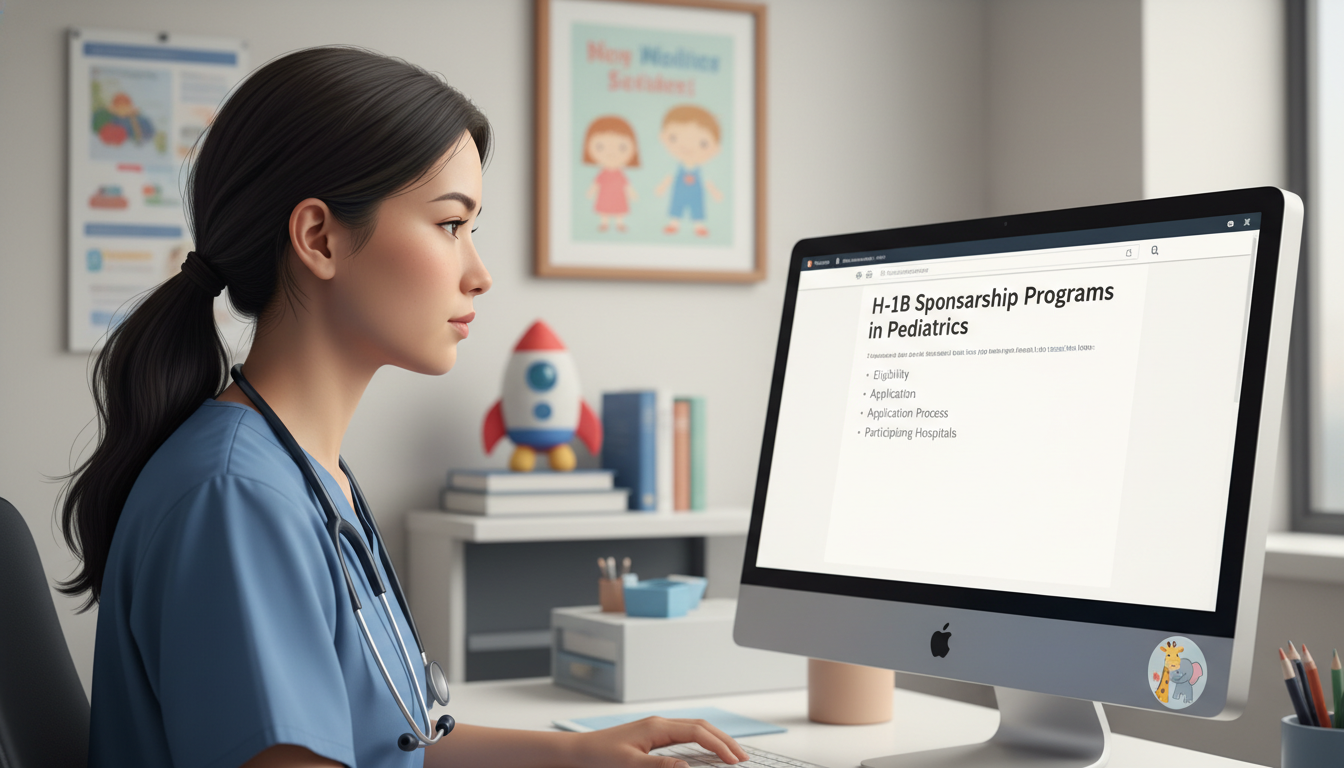
How to Identify H-1B-Friendly Pediatrics Residency Programs
Finding pediatrics residency programs that may sponsor H-1B is part research project, part networking. Below is a structured process you can follow.
Step 1: Use official sources as your foundation
1. FREIDA (AMA Residency & Fellowship Database)
- Search for pediatrics residency programs.
- Filter by “Accepts international medical graduates.”
- Within individual program listings, check for:
- Visa types accepted (J-1, H-1B, “other”)
- Notes or comments on visa sponsorship
Not all programs specify their H-1B policy on FREIDA, but many will state if they do not sponsor H-1B.
2. Program websites
For each pediatrics residency program of interest:
- Look for sections labeled:
- “International Medical Graduates”
- “Visa Sponsorship”
- “Eligibility Requirements”
- Key phrases to look for:
- “J-1 only”
- “We sponsor J-1 and H-1B visas”
- “H-1B available in select circumstances”
- “H-1B considered for exceptional candidates with USMLE Step 3 completed”
Be careful to distinguish between:
- “We have faculty or staff on H-1B” (not about residents)
- “We sponsor H-1B visas for residents” (what you need)
Step 2: Build your personalized H-1B pediatrics target list
Create a spreadsheet with columns like:
- Program name
- Location (city, state)
- Affiliation (university, community, children’s hospital)
- IMGs accepted (Y/N)
- H-1B policy (Yes / J-1 only / Case-by-case / Unknown)
- Info source (website, FREIDA, email reply, resident contact)
- Notes (Step 3 requirement, ECFMG, priority factors, etc.)
As you research, code programs into categories:
Clearly H-1B friendly
- Explicitly state they sponsor H-1B for residents
- Preferably mention pediatrics or categorical programs specifically
Possibly H-1B friendly / case-by-case
- Accept IMGs and mention H-1B “in select cases”
- Affiliated with university/children’s hospital (likely H-1B cap exempt)
- May require strong justification from the department
Not H-1B friendly
- Website clearly states “J-1 only”
- Program replies that they do not sponsor H-1B for residency
Unknown
- No mention of visa policy
- Requires outreach or clarification
Step 3: Use targeted outreach (without overwhelming programs)
Who to contact:
- First line: Program coordinator (email listed on the website)
- Alternative: Program administrator or GME office if coordinator contact fails
Timing:
- Ideally, before you finalize your ERAS program list
- Avoid sending multiple emails close together; give them at least 1–2 weeks to respond
Example email template:
Subject: Question About Visa Sponsorship for Pediatrics Residency Applicants
Dear [Ms./Mr./Mx./Dr.] [Last Name],
I am an international medical graduate planning to apply to your pediatrics residency program this cycle. I have completed USMLE Step 1, Step 2 CK, and Step 3, and I am ECFMG certified.
I was hoping you could clarify your current policy on visa sponsorship. Specifically, does your program sponsor H-1B visas for incoming categorical pediatric residents, or do you accept J-1 visa applicants only?
I greatly appreciate your time and guidance as I plan my application strategy.
Sincerely,
[Your Full Name]
[Medical School, Graduation Year]
[AAMC/ERAS ID, if available]
Key principles:
- Be short, polite, and specific.
- Mention Step 3 if you have passed it; this signals you understand H-1B requirements.
- Do not pressure them; you are asking for policy clarification, not a favor.
Step 4: Talk to current or recent residents
If you are able to connect with residents via:
- Program social media (Instagram, X/Twitter, LinkedIn)
- Alumni from your medical school
- Online forums or IMG communities
Ask carefully targeted questions like:
- “Do you know if your program currently sponsors H-1B for incoming residents?”
- “Have any co-residents joined on H-1B in recent years?”
- “Does the program require Step 3 before ranking applicants for H-1B sponsorship?”
This can give you real-world data, but always remember it may not reflect official or current policy.
Crafting a Pediatrics Application Strategy Around H-1B
Once you understand the landscape, you’ll need to design a strategy that balances your visa preference with realistic match chances.
1. Decide your primary visa pathway preference
Ask yourself:
- Do you absolutely require H-1B, or is it a strong preference?
- Would you be willing to accept a J-1 position if you matched only to J-1 programs?
- How flexible are you about location, type of institution, and training environment?
Typical profiles:
H-1B required (for personal, legal, or family reasons)
- You will focus primarily or exclusively on H-1B residency programs
- Your list will be limited; match risk is higher
- You must ensure excellent scores, strong clinical experience, and early Step 3 completion
H-1B preferred, J-1 acceptable
- You will apply more broadly, including J-1 pediatrics programs
- You can prioritize H-1B-friendly programs but still keep overall match chances high
2. Optimize your profile for H-1B pediatrics programs
Academic metrics:
- Aim for above-average USMLE/COMLEX scores for pediatrics
- A pass in Step 3 by the time programs rank applicants is highly valuable
- No test failures if possible; if present, be ready with a clear explanation and strong subsequent performance
Clinical experience:
- U.S. clinical experience in pediatrics (or at least core specialties)
- Strong letters from U.S. pediatricians or pediatric subspecialists
- Evidence of good communication skills, teamwork, and reliability in a pediatric setting
Research and leadership (bonus but not mandatory):
- Pediatric-related research, quality improvement, or advocacy work
- Participation in child-health-related projects, community outreach, or leadership roles can make you more attractive to academic children’s hospitals
3. Be explicit about your visa situation in communication
In ERAS application:
- Under personal statement or supplementary sections, you can briefly mention:
- Your current visa status (if in the U.S.)
- That you have completed Step 3 (if true) and are eligible for H-1B
In interviews (if asked, or when appropriate):
- Be clear, confident, and concise:
- “Given that I have already passed Step 3 and I am ECFMG certified, I am eligible for H-1B sponsorship. I would be grateful for your consideration of either H-1B or J-1, depending on your institution’s policies.”
- Avoid sounding demanding or inflexible, unless you truly cannot accept J-1 for legal reasons.
4. Balancing your program list for the peds match
To protect your chances in the peds match:
- If you’re H-1B required, your “safety” programs must also be H-1B willing. This is challenging because:
- More competitive academic programs are often the ones able to handle H-1B
- Less competitive community programs may be J-1 only
- Consider applying to a large number of H-1B-friendly pediatrics programs across the country.
If you’re H-1B preferred, J-1 acceptable:
- Create tiers in your application list:
- Tier 1: H-1B-friendly academic children’s hospitals and university programs
- Tier 2: Programs that accept IMGs and are “case-by-case” for H-1B
- Tier 3: Solid J-1-only programs where you’d still be happy to train
During your ranking, you can rank H-1B programs higher, but do not drastically cut down your overall list.

Practical Scenarios and Common Pitfalls for IMGs
To make this more concrete, let’s explore typical IMG situations and decisions.
Scenario 1: Strong IMG with Step 3 done, aiming for academic pediatrics
- High USMLE scores, U.S. pediatrics rotations, publications in child health
- ECFMG certified and Step 3 passed before September
- Interested in future fellowship (e.g., neonatology or pediatric hematology-oncology)
Recommended strategy:
- Target H-1B cap exempt academic peds programs aggressively
- Emphasize your readiness for H-1B in applications and communications
- Build a list of 40–60 pediatrics programs, with a high proportion of H-1B-friendly institutions
- Include some J-1-only programs if H-1B is a preference, not an absolute necessity
- For fellowship, staying within the same or similar academic network will often simplify ongoing H-1B sponsorship
Scenario 2: IMG without Step 3 by application time
- Step 1 and Step 2 CK passed, good profile, but Step 3 not yet taken
- Wants H-1B but uncertain about exam timing
Pitfalls:
- Some programs will not even consider H-1B without Step 3 results available before ranking
- Waiting for Step 3 too long can leave you in a weaker position for H-1B sponsorship
Possible approach:
- Book Step 3 as early as feasible; ideally, you receive the result before January
- Be transparent with programs where you interview:
- “My Step 3 date is [X]; I expect results by [Y].”
- Apply broadly, including J-1 programs, recognizing that your H-1B viability for this cycle is limited
Scenario 3: Already in the U.S. on another visa (F-1 OPT, H-4, etc.)
If you are graduating from a U.S. medical school on F-1 or living in the U.S. on H-4, you might consider:
- Transitioning directly to H-1B through a residency program
- Highlighting the fact that you are already in the U.S. and familiar with the system
Programs may be slightly more comfortable sponsoring H-1B if you:
- Are physically present in the U.S.
- Have a clean immigration history
- Are perceived as lower-risk from a compliance perspective
Scenario 4: Long-term career planning with H-1B
Think beyond residency:
- Many pediatric subspecialties are in-demand (e.g., NICU, PICU, pediatric neurology)
- Large academic centers and children’s hospitals often remain H-1B cap exempt, supporting:
- Residency → Fellowship → Junior faculty
- However, if you want to work in private practice or non-academic settings later:
- You may then face the H-1B cap and lottery
- Having strong CV and subspecialty skills increases your chance of employers sponsoring you and supporting a green card early
Early in residency, it helps to:
- Learn about your institution’s prior experience sponsoring green cards
- Talk with more senior residents/fellows who are on H-1B about their paths
- Consider seeking early legal advice (through institutional counsel or private attorney) if your long-term plan is complex
Frequently Asked Questions (FAQ)
1. Are there many pediatrics residency programs that sponsor H-1B?
Compared to internal medicine, the number of pediatrics residency programs that sponsor H-1B is smaller, but non‑trivial. Many large academic children’s hospitals and university programs are H-1B cap exempt and have at least some history of H-1B sponsorship, especially for fellows. However:
- Only a subset regularly sponsor H-1B for incoming categorical residents
- Policies shift with changes in GME leadership and institutional priorities
You will need to actively research and confirm current policies during each match cycle.
2. Do I absolutely need USMLE Step 3 to get an H-1B for pediatrics residency?
In practical terms, yes for most programs.
- Most state medical boards and GME offices require Step 3 for H-1B residents.
- Programs that consider H-1B often state explicitly: “Step 3 must be passed before visa filing” or before ranking.
- Without Step 3, your H-1B options are extremely limited and uncertain.
If H-1B is a priority, plan your exam schedule so that Step 3 is passed before or during the application/interview season, with results in hand before rank lists are finalized.
3. Is H-1B always better than J-1 for pediatrics training?
Not universally. H-1B has important advantages (no 2-year home requirement, easier transition to long-term U.S. practice), but:
- J-1 is more widely accepted by pediatrics residency programs
- J-1 often involves less paperwork and cost for the program, which means more opportunities overall
- Many pediatricians successfully complete J-1 residency and fellowship, then obtain a J-1 waiver job and later green cards
The “better” option depends on:
- Your long-term career goals
- Your flexibility to work in underserved or rural areas after training
- Your risk tolerance and desire to keep location and employer options open
4. How can I get an up-to-date H-1B sponsor list for pediatrics?
There is no single official, always-current H-1B sponsor list for pediatrics residency. However, you can:
- Use FREIDA and program websites to identify programs that mention H-1B
- Search for institutional information on H-1B cap exempt status (university-affiliated hospitals, large children’s hospitals)
- Consult:
- IMG communities and forums
- Alumni networks from your medical school
- Current residents and fellows
- Keep your own updated spreadsheet based on direct program communication each cycle
Treat any published list as a reference point, not as definitive proof of current policy. Always verify with the program itself.
Pursuing pediatrics residency with H-1B sponsorship is possible, but it requires early planning, careful program selection, and proactive communication. By understanding how the H-1B system interacts with academic children’s hospitals, the peds match, and your long-term career goals, you can build a strategy that maximizes both your chances of matching and your future flexibility as a pediatrician in the United States.