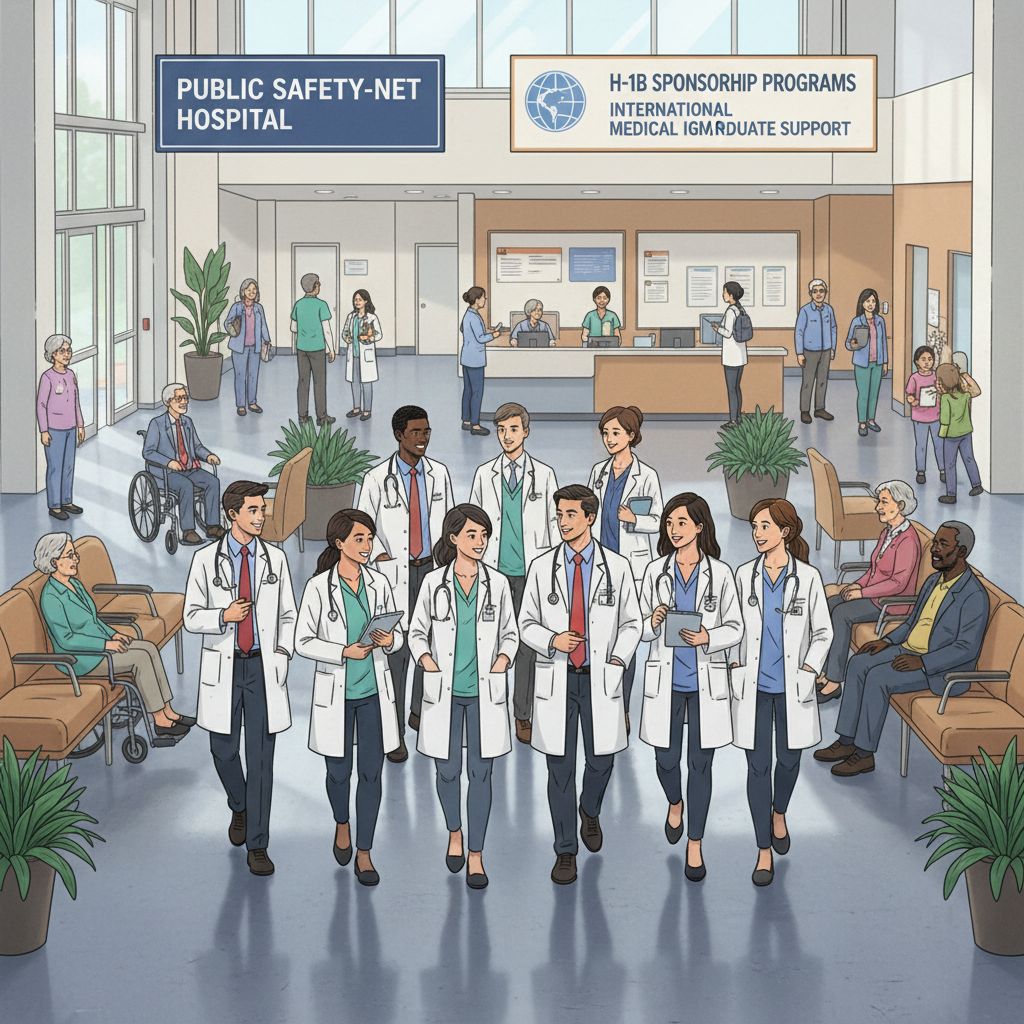
Understanding H-1B Sponsorship in Addiction Medicine
H-1B sponsorship in addiction medicine sits at the intersection of immigration law, graduate medical education, and a rapidly expanding clinical subspecialty. For many international medical graduates (IMGs), an addiction medicine fellowship that offers H-1B sponsorship can be a gateway to a long-term career in U.S. academic medicine or community practice.
However, the landscape is complex. Fellowship vs residency rules differ, some institutions are H-1B cap exempt, others are not, and policies vary widely from program to program. Knowing how to identify H-1B residency programs and addiction medicine fellowship opportunities—and how to interpret an institutional H-1B sponsor list—is crucial.
This guide walks you through the essentials:
- How H-1B sponsorship works in the U.S. clinical training context
- Unique features of addiction medicine training and certification
- Types of institutions likely to support H-1B and cap-exempt petitions
- Strategies to find and evaluate H-1B-friendly addiction medicine programs
- Practical steps to strengthen your application as an IMG
Throughout, the focus is on actionable advice you can use for the upcoming match and fellowship cycles.
1. H-1B Basics for Physicians and IMGs
1.1 What is the H-1B for physicians?
The H-1B is a temporary work visa for “specialty occupations” requiring specialized knowledge and at least a bachelor’s degree (for physicians, this means MD/DO or equivalent plus any required licensure). For clinical physicians, an H-1B generally requires:
- ECFMG certification (for IMGs)
- Passing USMLE Steps (usually Steps 1, 2 CK, and sometimes Step 3, depending on employer and state)
- State medical licensure or eligibility (e.g., training license or full license, depending on level)
- Employment in a clinical or academic role that meets the wage and specialty occupation requirements
In graduate medical education, two broad contexts exist:
Residency and Fellowship Training
- You are enrolled as a trainee in an ACGME-accredited (or comparable) program.
- Employer: usually the hospital, university, or health system sponsoring the training.
Post-training Employment (Attending, Faculty, Clinical Positions)
- You function independently, often with a full, unrestricted license.
- Employer: hospital, university, clinic, private group, or health system.
Addiction medicine fellowships can fall into both worlds: some are formal ACGME-accredited training programs; others are non-ACGME fellowships or blended faculty/clinical roles with training components.
1.2 H-1B Cap and Cap-Exempt Institutions
One of the most important distinctions is cap-subject vs H-1B cap exempt:
Cap-subject H-1B
- Subject to the annual national quota of 65,000 “regular” plus 20,000 “advanced degree” H-1Bs.
- Requires registration and participation in the annual March lottery.
- If not selected, you cannot start work on H-1B in that fiscal year.
H-1B cap-exempt
- Certain employers are exempt from the quota and can file H-1B petitions anytime:
- Institutions of higher education (universities)
- Non-profit entities related to or affiliated with such institutions (teaching hospitals)
- Non-profit research organizations
- Governmental research organizations
- Many academic hospitals and large teaching health systems that run addiction medicine fellowship programs fall into this category.
- Certain employers are exempt from the quota and can file H-1B petitions anytime:
For an IMG seeking addiction medicine training, a cap-exempt H-1B is highly advantageous:
- No dependence on the lottery
- More predictable start dates
- Flexibility to extend or transfer within the cap-exempt ecosystem
Understanding whether a program’s institutional sponsor is cap exempt should be one of your first questions.
2. Addiction Medicine Training Pathways and Visa Relevance
2.1 What is Addiction Medicine as a Specialty?
Addiction medicine is a growing subspecialty focused on the prevention, evaluation, diagnosis, and treatment of substance use disorders and related conditions. It includes:
- Management of alcohol, opioid, stimulant, and other substance use disorders
- Medication-assisted treatment (e.g., buprenorphine, methadone, naltrexone)
- Co-occurring psychiatric and medical conditions
- Care across settings: inpatient consults, outpatient clinics, ED, primary care integration, and community programs
- Public health, policy, harm reduction, and systems-level interventions
Addiction medicine now has recognized board certification pathways through the American Board of Preventive Medicine (ABPM) and others, typically following a primary residency (e.g., Internal Medicine, Family Medicine, Psychiatry, Emergency Medicine, Pediatrics, OB/Gyn, etc.).
2.2 ACGME vs Non-ACGME Addiction Medicine Fellowships
You will encounter two main types of addiction medicine fellowship:
ACGME-accredited addiction medicine fellowships
- Standardized curriculum and structures
- Eligible for ABPM subspecialty certification (subject to board requirements)
- Often embedded in academic medical centers and major teaching hospitals
- More likely to have established institutional policies on visa sponsorship, including H-1B
Non-ACGME addiction medicine fellowships or training tracks
- Can vary widely in structure and recognition
- Sometimes offered by community hospitals, mental health centers, or health systems
- May combine clinical practice with formal training but can be less standardized
- Visa policies are highly variable; some avoid H-1B due to administrative burden
Because institutional experience with visas matters greatly, ACGME-accredited fellowships at universities or major teaching hospitals are often more likely to sponsor H-1B and maintain an H-1B sponsor list at the GME or legal office level.
2.3 Addiction Medicine and Prior J-1 Training
Many IMGs come to addiction medicine after completing a residency on a J-1 visa. Key considerations:
J-1 Home Residency Requirement (HRR)
- If you trained in residency on a J-1 via ECFMG, you are typically subject to a 2-year home country physical presence requirement.
- Unless you obtain a J-1 waiver, you cannot change status in the U.S. to H-1B.
J-1 Waiver–H-1B Link
- Many IMGs obtain a J-1 waiver through clinical service in underserved areas (e.g., Conrad 30, VA, or federal programs).
- These positions are usually H-1B roles, frequently in primary care or psychiatry; some explicitly integrate addiction medicine or substance abuse training.
If you are J-1 and hoping to do an addiction medicine fellowship next, clarify your HRR status early. Some addiction medicine fellowships will sponsor H-1B only if you are not subject to HRR, or if you will complete your waiver obligations first.

3. Where and How to Find H-1B-Friendly Addiction Medicine Programs
3.1 Targeting Institutional Types Likely to Sponsor H-1B
When searching for addiction medicine fellowship positions, certain institutional profiles are more likely to sponsor H-1B and be H-1B cap exempt:
University-affiliated academic medical centers
- Typically part of or affiliated with an institution of higher education.
- Maintain robust international offices or GME visa coordinators.
- Often have established policies for H-1B residency programs and subspecialty fellowships.
Large teaching hospitals related to universities
- Many qualify as non-profit entities related to a higher education institution.
- Commonly host multiple fellowships: cardiology, GI, ID, and addiction medicine.
- Their GME offices usually have documented H-1B sponsor lists and prior experience.
VA medical centers affiliated with universities
- May sponsor H-1B through their university partners or independently.
- Addiction psychiatry, pain, and substance use positions often exist here.
Non-profit research or mental health organizations with academic ties
- Some addiction medicine training tracks are based in NIH-funded research centers or state mental health systems.
- If designated as non-profit research organizations, they may qualify as cap exempt.
Conversely, small community hospitals or freestanding rehab centers without academic affiliation may be less likely to manage H-1B sponsorship, although there are exceptions.
3.2 Using Official Directories and Program Websites
To identify addiction medicine fellowship programs that may be H-1B friendly:
ACGME / ABPM / ASAM Listings
- Use the ACGME public program search or ABPM addiction medicine fellowship directory.
- The American Society of Addiction Medicine (ASAM) also maintains fellowship listings.
- Create an initial list of programs that fit your geographical and clinical interests.
Program Websites
- Carefully read sections on “International Applicants,” “Visa Sponsorship,” and “GME Policies.”
- Look specifically for statements like:
- “We sponsor J-1 and H-1B visas for eligible candidates.”
- “H-1B sponsorship available for qualified applicants.”
- Or, on the negative side, “We do not sponsor H-1B visas.”
Institutional GME Office Pages
- Many universities have a GME or Office of International Services page that states whether H-1B sponsorship is possible.
- Some institutions have a formal H-1B sponsor list that shows which departments or programs have historically hired on H-1B.
Even if the program site is vague, a clearly H-1B-friendly GME policy at the institutional level is a promising sign.
3.3 Networking, Alumni, and Data from Prior Matches
Information on H-1B sponsorship is often not fully transparent. Strategies to fill the gap:
Email program coordinators or program directors
- Ask direct but concise questions (see section 5).
- Clarify whether addiction medicine fellows have been on H-1B status in recent years.
Connect with current or recent fellows
- Use LinkedIn, institutional pages, or ASAM/IMG interest groups.
- Look for fellows whose backgrounds indicate IMG status. Politely ask about their visa paths.
Review physician profiles
- Many university sites show faculty/fellow bios noting medical school, residency country, and visa narratives indirectly.
- IMGs in recent cohorts suggest at least some openness to non-U.S. graduates and possibly to H-1B.
Residency program visa policies
- If an institution sponsors H-1B for residency programs (e.g., Internal Medicine, Psychiatry), it is more likely—but not guaranteed—to extend the same policy to addiction medicine fellowship.
4. Institutional H-1B Policies and Sponsor Lists
4.1 Interpreting an Institutional H-1B Sponsor List
Some universities or health systems publish an internal or public H-1B sponsor list. This may include:
- Departments and divisions that have sponsored H-1B before
- Job classifications (e.g., GME trainees vs faculty vs researchers)
- Cap-exempt vs cap-subject categorizations
If you gain access to such a list (publicly or via a coordinator):
- Look for “Addiction Medicine,” “Psychiatry,” “Internal Medicine,” or “Family Medicine” divisions
- If addiction medicine is not listed specifically, but the department (e.g., Psychiatry) appears multiple times, there may be a path to sponsorship through that department.
- If only non-clinical or research roles appear, clinical H-1B for fellows may not be common there.
Remember that not appearing on an H-1B sponsor list does not mean “never”; it may simply mean “not yet.”
4.2 Differences Between GME H-1B and Staff H-1B
Institutions may have separate policies for:
GME-trainee H-1B (residency and fellowship)
- Usually processed with institutional templates.
- Requires program approval plus central GME/immigration office review.
- Often limited to specific specialties where training structure clearly fits H-1B criteria.
Staff/Faculty H-1B (post-fellowship attending positions)
- Handled through faculty HR processes.
- May have separate wage and credential requirements.
- Sometimes easier to justify if you are serving a critical clinical need such as substance abuse treatment in underserved populations.
When researching addiction medicine fellowship opportunities, ask explicitly whether the GME category of H-1B is available; don’t assume that faculty H-1B automatically implies trainee H-1B.
4.3 H-1B Residency Programs as a Gateway to Addiction Medicine
For many IMGs early in their careers, the question is not only which addiction medicine fellowships sponsor H-1B, but also which residency training programs will put them in a strong position for later addiction medicine training.
Key features of H-1B-friendly residency programs relevant to addiction medicine:
- Specialties that lead naturally to addiction medicine
- Psychiatry, Internal Medicine, Family Medicine, Pediatrics, Emergency Medicine, OB/Gyn.
- Track-record of H-1B sponsorship
- Programs that have consistently sponsored H-1B for IMGs in those residencies.
- Substance abuse training in residency
- Integrated addiction psychiatry or addiction medicine rotations.
- Buprenorphine waiver training, SBIRT, and community addiction clinic exposure.
Completing residency at an institution that is clearly H-1B-friendly and robust in substance abuse training increases your probability of a smooth transition into addiction medicine fellowship—often at the same or a closely affiliated institution.

5. Practical Steps for IMGs Seeking H-1B in Addiction Medicine
5.1 Clarify Your Immigration Situation Early
Before you start contacting programs, take stock of your own status:
- Are you currently on: F-1, J-1, H-1B (cap subject or cap exempt), O-1, or another status?
- If J-1, are you subject to the 2-year home residency requirement?
- Have you already used cap-subject H-1B time in another field?
- How many years of H-1B time remain (given the 6-year maximum, with exceptions)?
If your case is complex, consider consulting an experienced immigration attorney. You do not need to share all legal details with programs, but a clear understanding will help you ask the right questions.
5.2 How to Ask Programs About H-1B Sponsorship
When you email program coordinators or directors, keep it honest and concise. For example:
Dear [Name],
I am an international medical graduate currently completing [residency / other training] and very interested in your Addiction Medicine Fellowship. I wanted to clarify your policies on visa sponsorship for fellows.
Could you please let me know whether your program and institution are able to sponsor H-1B visas for clinical fellowship trainees?
Thank you for your time and guidance.
Sincerely,
[Your Name, Credentials]
If you are J-1 with HRR, you might add:
I am currently on a J-1 visa and subject to the 2-year home residency requirement. I would appreciate any information on whether your program can accept fellows who will be on J-1, or if you have experience with candidates who complete a J-1 waiver and then join on H-1B.
Track responses in a simple spreadsheet with columns such as:
- Program name
- City/State
- H-1B: Yes/No/Case-by-case/Unknown
- J-1: Yes/No
- Last confirmed (date)
- Notes (e.g., “H-1B for faculty only,” “Cap exempt,” “IMG-friendly with multiple H-1B fellows”)
5.3 Strengthening Your Addiction Medicine Profile as an IMG
Programs that invest the time and resources into H-1B sponsorship usually expect a strong candidate. Enhance your profile by:
Clinical experience with substance use disorders
- Rotations in addiction psychiatry, consult-liaison, or substance use clinics.
- Documented experience in ED management of intoxication/withdrawal, MAT initiation, or community programs.
Research or quality improvement in addiction medicine
- Projects on opioid prescribing, overdose prevention, alcohol withdrawal protocols, etc.
- Presentations at ASAM, APA, ACP, or similar conferences.
Formal substance abuse training
- Buprenorphine (MOUD) training, SBIRT courses, or ASAM online modules.
- Any local or regional certificate programs in addiction medicine.
Demonstrated interest in underserved and global health
- IMGs often bring unique perspectives on substance use in diverse populations; highlight this.
- Experience in low-resource settings, harm reduction initiatives, or policy/advocacy work.
5.4 Managing Timelines and Contingencies
Timelines for addiction medicine fellowships vary, but common patterns include:
- Applications 12–18 months before the fellowship start date.
- Interviews several months later.
- Visa filing typically after a contract is issued.
For cap-exempt H-1B:
- Petitions can be filed at any time; premium processing may be available.
- You can align start dates more flexibly (e.g., July 1 or alternative dates).
For cap-subject H-1B:
- You must consider the March lottery and October 1 start dates, which rarely align with July 1 fellowship starts.
- Many pure clinical fellowships avoid cap-subject H-1B because of this mismatch.
Have backup options:
- Programs that sponsor only J-1, if you are able to use J-1.
- Positions where addiction medicine is part of a broader clinical job (e.g., psychiatry or primary care roles with substantial substance use work) that may serve as an alternate route to addiction-focused practice while on H-1B.
6. Long-Term Career Planning in Addiction Medicine on H-1B
6.1 Transitioning from Fellowship to Attending on H-1B
After addiction medicine fellowship, you may pursue:
- Academic attending roles (faculty positions with teaching, research, and clinical duties).
- Hospital-based addiction medicine consult services.
- Outpatient addiction clinics, methadone programs, or integrated primary care.
- Public health and systems-level positions addressing the overdose crisis.
For IMGs on H-1B:
- If your fellowship was at a cap-exempt institution, you might stay in the cap-exempt ecosystem at another university or affiliated non-profit.
- Transitioning to a private practice or for-profit employer may require:
- Entry into the H-1B cap lottery (if you have never been counted before), or
- Remaining under cap exemption if structured through a qualifying entity.
6.2 Considering J-1 Waivers vs H-1B from the Start
Some IMGs prefer to complete residency (or even fellowship) on J-1 and then obtain a J-1 waiver job that heavily involves addiction medicine or substance abuse training; others aim for H-1B from residency onward.
Pros of starting on H-1B for residency and fellowship:
- No 2-year home residency requirement.
- More straightforward pathway from residency to addiction medicine fellowship to attending roles.
- Easier to remain in the same institution or system long term.
Challenges:
- Fewer residency programs offer H-1B than J-1.
- Some states and institutions have stricter licensing and Step 3 requirements for H-1B.
Pros of J-1 then waiver in addiction-related practice:
- More residency options at the start.
- Post-residency J-1 waiver jobs can align with addiction medicine (e.g., opioid treatment clinics, FQHCs with robust SUD services).
- After waiver service, you may convert to H-1B or even permanent residence (e.g., through employer sponsorship).
The “best” route depends heavily on your personal circumstances, specialty plans, and geographic preferences.
6.3 Using Addiction Medicine Expertise to Support Permanent Residence
Your long-term objective is likely to secure a more permanent immigration status. Addiction medicine expertise can be a strong asset for:
Employment-based permanent residence (EB-2, EB-3)
- Many hospitals and community health systems seek addiction specialists due to the ongoing overdose and substance use crisis.
- Shortage of specialists can support green card sponsorship.
National Interest Waiver (NIW)
- Work focusing on opioid epidemic mitigation, harm reduction, and treatment of underserved populations can be argued as being in the national interest.
- Strong evidence of contributions (research, systems improvement, community impact) strengthens your case.
Strategically, an H-1B role in addiction medicine at a cap-exempt institution may offer both professional satisfaction and a solid platform for future permanent residence petitions.
FAQs: H-1B Sponsorship in Addiction Medicine
1. Do most addiction medicine fellowships sponsor H-1B visas?
No. Policies vary widely. Some ACGME-accredited academic programs are open to H-1B sponsorship, especially at H-1B cap-exempt institutions. Others sponsor only J-1 or do not support any visas. You must check each program individually—often by emailing the coordinator and reviewing institutional GME policies.
2. Is it easier to get H-1B sponsorship for residency or for addiction medicine fellowship?
Residency programs generally have more standardized structures and established visa policies; some explicitly identify as H-1B residency programs. Addiction medicine fellowships can be more variable—some programs are very IMG- and H-1B-friendly, while others avoid H-1B due to administrative complexity. However, once you secure H-1B residency in a large academic system, moving into an addiction medicine fellowship at the same institution may be more straightforward.
3. If I train on a J-1 visa, can I still do an addiction medicine fellowship on H-1B later?
Possibly, but the 2-year home residency requirement is key. If you are subject to the J-1 HRR, you typically must either:
- Complete the HRR by returning home for 2 years, or
- Obtain a J-1 waiver (often via service in an underserved area) before changing to H-1B.
Some physicians complete J-1 residency, do a J-1 waiver job with significant addiction medicine practice, and then later pursue fellowship or advanced roles on H-1B or as permanent residents.
4. How can I quickly identify if a program is H-1B cap exempt?
Indicators of H-1B cap-exempt status include:
- The program is part of a university or medical school (institution of higher education).
- The hospital is a non-profit teaching hospital formally affiliated with a university.
- The institution or its GME office explicitly states they are H-1B cap exempt.
If uncertain, ask the GME office or immigration services directly: “Is your institution considered H-1B cap exempt for clinical trainees?” This status makes year-round H-1B sponsorship for addiction medicine fellowships much more feasible.
By combining a clear understanding of visa rules with a targeted search for addiction medicine programs at H-1B-friendly, cap-exempt institutions, you can strategically plan both your fellowship training and your long-term career in addiction medicine in the United States.