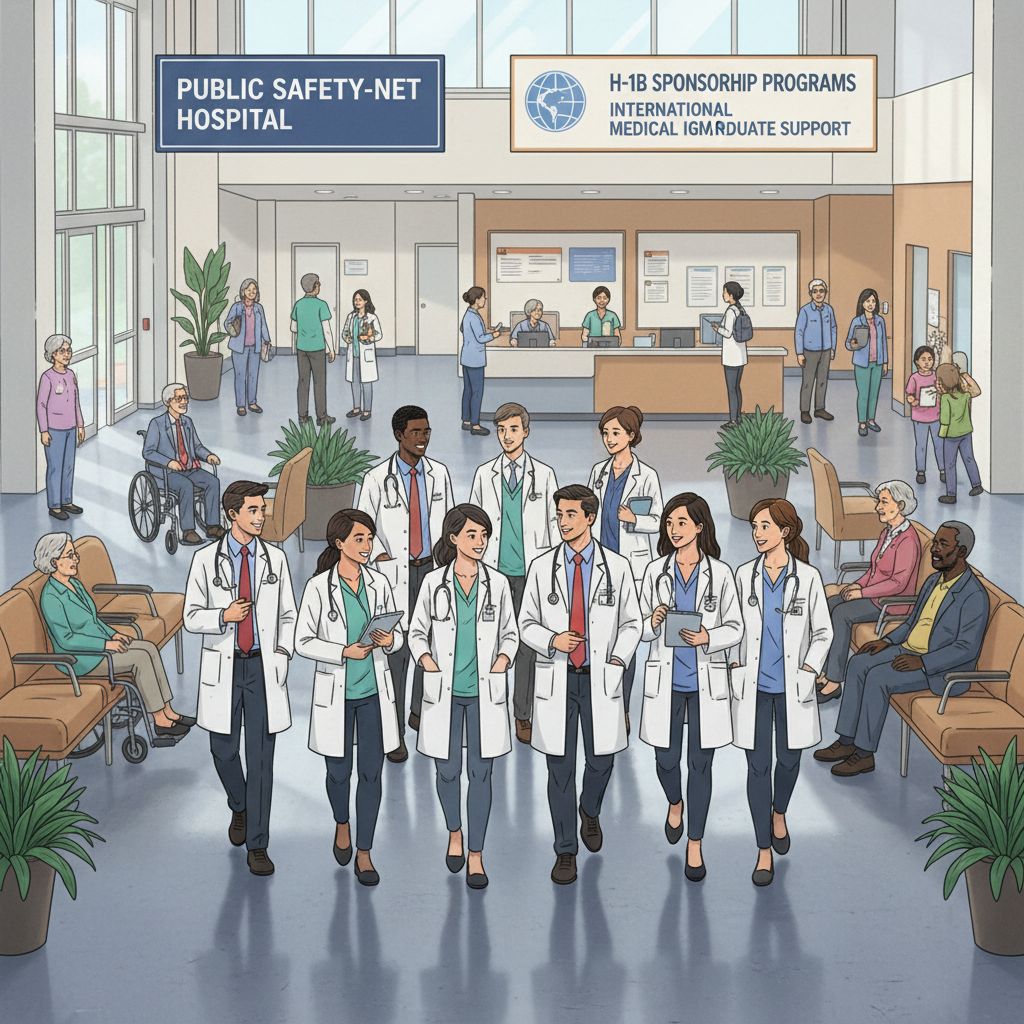
Understanding H-1B Sponsorship in Transitional Year for Caribbean IMGs
For a Caribbean medical school graduate aiming to match into a transitional year residency in the United States, H-1B sponsorship can feel like a complex maze. As a Caribbean IMG, you not only have to manage ERAS, interviews, and ranking strategies, but also evaluate which programs can actually sponsor and support your visa status long-term.
This article breaks down how H-1B sponsorship works specifically in the context of transitional year (TY) programs, the implications for future specialty training, and how a Caribbean medical school residency applicant (especially SGU, AUC, Ross, or Saba graduates) can strategically plan for an H-1B–friendly path.
1. Foundations: How H-1B Works for Caribbean IMGs in Residency
Before targeting H-1B residency programs, you need a clear understanding of the basics, especially how they intersect with transitional year training.
1.1 What Is the H-1B for Residency?
For residency and fellowship, the H-1B is a temporary work visa that allows you to work in the U.S. in a “specialty occupation” (physician). Key points for Caribbean IMGs:
- Employer-sponsored: The residency program (hospital or institution) files the petition.
- Dual intent: You can pursue permanent residence while on H-1B—often attractive for long-term U.S. plans.
- Duration: Typically up to 6 years total, often granted in 3-year increments.
- Full licensure or exam requirements: Most states and institutions require:
- ECFMG certification
- USMLE Steps 1, 2 CK, and often 3 passed before filing the H-1B
For a transitional year residency, this is especially important: many TY programs that offer H-1B will insist on Step 3 passed by the time they file the petition (often in spring prior to July 1 start).
1.2 H-1B vs J-1 for Transitional Year
Most IMGs in residency are sponsored by the J-1 exchange visitor visa, backed by ECFMG. While J-1 is more common, it has drawbacks:
- Two-year home residency requirement after training (unless waived)
- Limited flexibility in moonlighting and some employment types
- Need for a J-1 waiver job after training to stay in the U.S.
By contrast, the H-1B:
- Does not automatically require you to return home
- Allows an easier transition to employment-based green cards
- Is often preferred if you plan a long-term U.S. career
However, H-1B comes with trade-offs:
- Fewer hospitals sponsor H-1B, especially for a transitional year residency
- USMLE Step 3 and state-specific requirements must be completed early
- Filing fees and legal work fall on the program, so many avoid it
1.3 H-1B Cap vs Cap-Exempt Programs
A central concept you must understand is H-1B cap vs H-1B cap exempt:
Cap-subject H-1B:
- Limited by the annual national quota (65,000 regular + 20,000 U.S. master’s cap)
- Requires selection in the H-1B lottery in March
- Start dates often in October (can be tricky for July residency starts)
H-1B cap-exempt:
- Not subject to the lottery
- Can file and start any time of year
- Applies to many residency hospitals because they are:
- Non-profit institutions affiliated with a university
- Government or public hospitals
- Non-profit research or educational institutions
Most residency programs—including many TY programs—operate through H-1B cap exempt institutions. For you as a Caribbean IMG, this is good news: it means the H-1B can be filed without worrying about the national cap or lottery.
2. Transitional Year (TY) and H-1B: Realities and Challenges
Transitional year residencies are often one of the trickier categories when it comes to H-1B sponsorship.
2.1 What Is a Transitional Year Residency?
A transitional year residency is a one-year, broad-based clinical training program. Common uses for TY programs:
- PGY-1 year before advanced specialties:
- Radiology
- Anesthesiology
- Neurology
- Physical Medicine & Rehabilitation (PM&R)
- Dermatology
- Radiation Oncology
- Sometimes for IMGs aiming to strengthen their profile before switching to categorical programs
Many Caribbean medical school residency applicants see TY as a potential entry point into the U.S. system.
2.2 Why Many TY Programs Don’t Offer H-1B
From a program’s perspective, sponsoring H-1B for just one transitional year can be unattractive:
- Short duration: One year of training does not justify the legal and filing costs for some institutions.
- Administrative burden: Preparing H-1B petitions, dealing with state licensure/Step 3 requirements.
- Continuity concerns: If the resident needs H-1B again for their advanced program, coordination becomes more complex.
As a result, many transitional year residencies are J-1 only. You must be very intentional in your search for TY programs that are open to H-1B.
2.3 When a TY Program Is H-1B-Friendly
There are a few scenarios where a transitional year residency may be more likely to sponsor H-1B:
Institutional visa policy
Some major academic centers have a broad policy of supporting H-1B for all residency types, including TY.Integrated advanced programs
Transitional year positions linked to an in-house advanced specialty (e.g., TY + Radiology at the same institution) may be more open to multi-year planning under H-1B.High IMG volume and experience
Programs with a history of working with Caribbean IMGs (e.g., SGU residency match pathways) may already be familiar with H-1B processing and more willing to consider it.Institutional H-1B cap exempt status
TY programs within cap-exempt health systems (teaching hospitals, university-affiliated centers) often find it simpler to process H-1B.

3. How to Identify H-1B-Friendly Transitional Year Programs
There is no official, public master H-1B sponsor list for transitional year programs, but you can build a practical strategy for identifying H-1B-friendly options.
3.1 Use Program Websites and Visa Policies
Most ACGME-accredited programs will list visa policies on their websites. Look for sections labeled:
- “International Medical Graduates”
- “Visa Sponsorship”
- “Eligibility & Requirements for IMGs”
Common wording:
- “We sponsor J-1 visas only.” → Not H-1B friendly.
- “We sponsor J-1 and H-1B visas for qualified candidates.” → H-1B possible.
- “H-1B sponsorship considered on a case-by-case basis.” → Potentially open, but selective.
Be specific: you want to know if the TY program itself sponsors H-1B, not just the institution in general.
3.2 Check Institutional H-1B History and Cap-Exempt Status
Even if the transitional year program doesn’t clearly mention H-1B, the broader institution might give clues:
- Is it a university-affiliated teaching hospital?
- Does the institution appear in the general H-1B sponsor list (e.g., publicly available USCIS data or employment-based immigration databases)?
- Do they clearly describe themselves as:
- Non-profit hospital affiliated with a U.S. medical school
- Public or county teaching hospital
These characteristics often indicate H-1B cap exempt status, which makes H-1B sponsorship more feasible.
You can also:
- Search “[Hospital Name] H-1B” in Google Scholar or Google to see if they sponsor physicians/scientists.
- Check alumni or LinkedIn to see if any prior residents list “H-1B” under immigration status.
3.3 Use the NRMP and FREIDA Strategically
Tools like AMA FREIDA and program directories can help:
- Filter by transitional year residency specialty.
- Click individual programs to see:
- Visa policies (sometimes noted)
- IMG percentages (higher IMG presence often correlates with visa experience)
- Note programs with a track record of Caribbean medical school residency matches (SGU, AUC, Ross, Saba). These institutions are more likely to be comfortable with international graduates and possibly with H-1B.
3.4 Ask Directly: Email the Program Coordinator
Because many websites are incomplete or outdated, the most reliable method is direct communication. When emailing, be specific and concise:
Sample email (adapted for a Caribbean IMG targeting TY + H-1B):
Dear [Program Coordinator/Program Director],
I am a final-year medical student at [Your Caribbean Medical School] and am very interested in your Transitional Year program.
I am an international medical graduate who will require visa sponsorship. Could you please let me know if your TY program is able to sponsor H-1B visas for incoming residents, assuming completion of USMLE Step 3 and all state licensing requirements before July 1?
Additionally, if your institution supports H-1B sponsorship for residents planning to continue into advanced specialties (e.g., Radiology, Anesthesiology), I would be very grateful to learn about that.
Thank you for your time and consideration.
Sincerely,
[Name], [Expected Graduation Year], [School]
Keep a spreadsheet of responses categorized as:
- “H-1B supported”
- “J-1 only”
- “Case-by-case / rare”
Over time, this becomes your personal H-1B sponsor list for transitional year programs.
4. Strategic Planning for Caribbean IMGs: From TY to Advanced Training on H-1B
If you are a Caribbean IMG targeting H-1B sponsorship, the transitional year cannot be viewed in isolation. You must plan the entire path: TY → Advanced specialty → Employment.
4.1 Decide Whether TY Is Your Best Entry Point
Ask yourself:
- Are there categorical programs in your desired specialty that are more H-1B friendly than transitional year options?
- Would applying directly to categorical internal medicine, family medicine, or neurology (which often sponsor H-1B more readily) be a better path?
For some, a categorical residency with H-1B is more stable than a one-year transitional year residency followed by uncertainty.
4.2 Align Your Advanced Specialty Plans
Many Caribbean IMGs use TY as a stepping stone into competitive or advanced specialties. You must ensure your visa path can support this.
Example 1: TY + Radiology on H-1B
- Year 0: Final year at SGU, pass Step 1 and 2 CK, start preparing for Step 3.
- Match cycle: Apply to both:
- Transitional year programs that sponsor H-1B.
- Advanced diagnostic radiology programs that sponsor H-1B or J-1 (you’ll need to decide which visa you’ll use long-term).
- Year 1 (TY):
- Start on H-1B (if TY sponsors) at an H-1B cap-exempt hospital.
- Prepare for seamless transition into your advanced radiology program.
- Years 2–5: Radiology residency on H-1B (either new petition at another cap-exempt institution or porting your H-1B if rules allow).
Key risk: If your TY program sponsors H-1B but your advanced program is J-1 only, you’ll need to switch visa types, which is possible but requires careful timing and planning.
Example 2: TY → Anesthesiology with Mixed Visa Policies
- Your TY is H-1B-compatible, but your preferred anesthesiology program is J-1-only.
- You may have to prioritize:
- Staying on H-1B for long-term immigration benefits, or
- Switching to J-1 to access a specific, more competitive program.
Make this decision early, ideally before applying.
4.3 Importance of Step 3 for H-1B-Friendly TY Programs
For almost any H-1B residency program, USMLE Step 3 is critical. As a Caribbean IMG:
- Aim to complete Step 3 by fall/winter of the application year if possible.
- Some programs will:
- Rank you contingent on Step 3 being passed by a certain date.
- Refuse to file an H-1B if Step 3 is not complete.
Plan realistically with your Caribbean medical school schedule:
- If you are from SGU, Ross, AUC, or Saba, discuss with your dean’s office or advising team how previous graduates timed Step 3 to secure H-1B residency programs.
- Review SGU residency match data and visa breakdowns if available; SGU and other Caribbean schools often publish match lists that show which hospitals commonly take their graduates—and some of those are known H-1B sponsors.
4.4 Managing the Six-Year H-1B Clock
Remember: H-1B typically has a six-year maximum (with exceptions when you start green card processes).
Consider the timeline:
- Transitional Year: 1 year
- Advanced Specialty:
- Radiology: 4 years
- Anesthesiology: 3 years
- Neurology: 3–4 years (including prelim/TY year)
- PM&R: 3 years after PGY-1
If all your training is on H-1B, you could approach or exceed 6 years during residency and fellowship. To avoid problems:
- Discuss with your program or immigration attorney:
- When to start your PERM/I-140 process (if they support it).
- Whether some period will be under J-1 vs H-1B to “save” H-1B time for post-training employment.
- For some Caribbean IMGs, a mixed path (TY on J-1, advanced residency on H-1B, or vice versa) is the most realistic.

5. Practical Application Strategy for Caribbean IMGs
To maximize your chances of success in both the residency match and H-1B sponsorship, you need a structured plan.
5.1 Build a Tiered Program List
For a Caribbean IMG, balance risk and opportunity:
Tier 1: H-1B-capable transitional year programs
- Confirmed H-1B sponsorship (via website or coordinator).
- Preferably in H-1B cap-exempt institutions.
- Programs with history of Caribbean medical school IMGs.
Tier 2: H-1B-capable categorical programs
- Internal medicine, family medicine, neurology, etc.
- These can serve as stable alternatives if TY H-1B options are limited.
Tier 3: J-1 programs that are strong in your desired specialty path
- In case your H-1B pathway is not viable or Step 3 timing doesn’t work out.
This diversified approach ensures you are competitive in the match and realistic about visa outcomes.
5.2 Tailor Your Application as a Caribbean IMG
H-1B-capable programs often expect:
- Strong USMLE scores (especially Step 2 CK; Step 3 passed is a major bonus).
- Solid U.S. clinical experience:
- Sub-internships, electives, or audition rotations.
- Good performance at U.S. teaching hospitals where they can see your capability.
- Clear communication of your long-term goals:
- Emphasize commitment to the U.S. healthcare system.
- Avoid sounding like you are only interested because of visa convenience.
If you are from an institution with a robust SGU residency match record or similar Caribbean medical school residency track, highlight:
- Outcomes of graduates similar to you (if appropriate).
- Your performance relative to your class.
- Any leadership or research that stands out.
5.3 Interview Conversations About H-1B
Discussing visas during interviews must be handled carefully:
- Do not make visa the first or only topic.
- Once rapport is built and if they mention IMGs/visas, you can ask:
- “Does your program currently sponsor H-1B for residents, assuming eligibility and successful completion of Step 3?”
- “How have you supported previous international graduates through visas?”
Focus on:
- Your readiness (Step 3, ECFMG certification).
- Your knowledge of H-1B cap-exempt status and limited burden on the institution.
- Your long-term commitment to completing the full training program.
5.4 Coordinating with Advanced Programs
If you already have an advanced position (e.g., Radiology PGY-2 spot) coordinated through the Match, communicate early:
- Ask both your transitional year and advanced program about:
- Their preferred visa type.
- How they have managed H-1B transitions in the past.
- Ideally, you want:
- Both TY and advanced program to be H-1B-friendly and cap-exempt.
- Clear agreement on:
- Who files which petition.
- Timing of H-1B transfers.
If they have conflicting preferences (e.g., TY prefers J-1, advanced prefers H-1B), seek advice from immigration counsel early.
6. Key Takeaways and Action Plan
For a Caribbean IMG seeking H-1B sponsorship in a transitional year residency, the path is challenging but possible with early planning and realistic expectations.
Core points to remember:
- Most TY programs lean toward J-1 only, but some H-1B-friendly exceptions exist, particularly in large academic or cap-exempt institutions.
- As a Caribbean IMG, passing USMLE Step 3 early greatly improves your H-1B prospects.
- Treat the transitional year as part of a multi-year strategy—what matters is how your visa status supports your full specialty and long-term career.
- Build your own H-1B sponsor list using:
- Program websites
- FREIDA + NRMP data
- Direct emails to coordinators
- Consider whether a categorical H-1B program (internal medicine, family medicine, neurology, etc.) may be a more secure path than a one-year TY H-1B.
Action steps:
- Clarify your specialty goal (Radiology, Anesthesiology, PM&R, etc.) and whether you truly need a TY.
- Plan Step 3 timing with the intention of being eligible for H-1B by the time programs file petitions.
- Research transitional year programs and categorize them by visa policy.
- Contact coordinators to confirm H-1B support, documenting all responses.
- Construct a balanced rank list with:
- H-1B-friendly TY programs
- H-1B-friendly categorical alternatives
- Strong J-1 programs as backup.
- Engage with your Caribbean school’s advising office—many have historical knowledge of which institutions consistently support H-1B for their graduates.
By combining solid exam performance, strategic program selection, and early visa planning, a Caribbean IMG can successfully navigate the search for H-1B-friendly transitional year programs and set up a stable foundation for long-term practice in the United States.
FAQs: H-1B and Transitional Year for Caribbean IMGs
1. Do many transitional year residency programs sponsor H-1B for Caribbean IMGs?
No. Compared to categorical internal medicine or family medicine, fewer transitional year residencies sponsor H-1B, especially for a one-year training period. However, some academic, H-1B cap-exempt institutions with strong IMG participation will consider H-1B for TY residents, particularly when linked to advanced specialties. You must actively identify and confirm these programs individually.
2. Is Step 3 absolutely required to get an H-1B residency position?
Practically, yes for most programs. While there may be rare exceptions due to state law differences, the overwhelming majority of H-1B residency programs require:
- ECFMG certification, and
- USMLE Step 3 passed before they file the H-1B petition.
As a Caribbean IMG targeting H-1B, planning and passing Step 3 early is one of the most important steps you can take.
3. Can I start residency on J-1 and later switch to H-1B for my advanced specialty?
In many cases, yes. It is common for IMGs to:
- Complete a transitional year or prelim year on J-1, then
- Enter an advanced residency or fellowship on H-1B, or vice versa.
However, switching visa types requires careful timing and coordination between ECFMG, USCIS, and your programs. Work closely with your program’s GME office and consider consulting an immigration attorney before making this decision.
4. Are H-1B cap-exempt transitional year programs better for long-term career planning?
Generally, yes. H-1B cap exempt hospitals (non-profit, university-affiliated, or government institutions) can file H-1B petitions at any time and are not limited by the annual cap or lottery. For a Caribbean IMG in a transitional year, training in a cap-exempt setting can:
- Simplify the H-1B process
- Make transfers between residency and fellowship programs smoother
- Offer more continuity in your immigration status
However, your long-term career success still depends on completing a full specialty residency and (often) fellowship, so always evaluate the entire training pathway, not just the TY year.