Understanding H‑1B Sponsorship for Caribbean IMGs in Dallas–Fort Worth
For a Caribbean international medical graduate (IMG), the Dallas–Fort Worth (DFW) metroplex can be an excellent place to build a career. The region has a dense healthcare system, large academic centers, strong community hospitals, and a diverse patient population. Many graduates from Caribbean medical schools—including those aiming for an SGU residency match or similar pathways—ask the same question: Where can I find H‑1B residency programs in Dallas that are IMG‑friendly and realistic for me?
This article explains H‑1B sponsorship basics, how they apply to residency and fellowship in DFW, and how Caribbean IMGs can strategically approach H‑1B residency programs, including building a personalized H‑1B sponsor list.
H‑1B Sponsorship Basics for Caribbean IMGs
Before zooming in on Dallas residency programs and DFW medical training opportunities, it’s important to understand how H‑1B works in the context of U.S. graduate medical education.
What is an H‑1B visa in residency?
The H‑1B is a temporary worker visa category for “specialty occupations” that require at least a bachelor’s degree in a specific field. In residency:
- The employer (hospital or university) is the sponsor.
- You are the beneficiary.
- The H‑1B is tied to a specific employer, location, and role (e.g., PGY‑1 Internal Medicine, UT Southwestern).
For physicians, H‑1B typically requires:
- Passing USMLE Step 1, Step 2 CK, and Step 3 before petition filing.
- ECFMG certification by the time you start training.
- A valid state medical training license/permit (e.g., Texas Physician-in-Training (PIT) permit).
Because passing Step 3 before Match is a high bar, not all Caribbean medical school graduates can realistically target H‑1B residency programs from the start. But if H‑1B is a priority, building your strategy around this requirement is essential.
H‑1B vs J‑1 for residency
Most IMGs match on a J‑1 visa, sponsored by ECFMG. So why chase H‑1B?
Advantages of H‑1B for many Caribbean IMGs:
- No 2‑year home-country physical presence requirement.
- May provide a smoother transition to employment‑based permanent residence (green card) later.
- Some states and employers are more familiar with H‑1B pathways than J‑1 waivers.
Challenges:
- You must have USMLE Step 3 passed before the program files the H‑1B petition; many programs want this before ranking.
- Legal and filing fees are higher for the employer.
- Not all programs are willing or able to sponsor H‑1B, especially for categorical residents.
For Caribbean IMGs who see the U.S. as their long‑term professional home, the H‑1B option is attractive—but it requires deliberate planning well before ERAS season.
Understanding “Cap‑Exempt” H‑1B in DFW
You will often see the term H‑1B cap‑exempt in discussions of residency and fellowship programs. This is crucial in the DFW context.
H‑1B cap vs cap‑exempt: what it means for you
Cap‑subject H‑1B:
- Limited annual number of new visas (the “cap”).
- Requires registration in a lottery (usually in March).
- Most private employers are cap‑subject.
Cap‑exempt H‑1B:
- Not subject to the annual numerical quota.
- Can file any time of year.
- Typically includes:
- Institutions of higher education (universities),
- Non‑profit organizations affiliated with universities,
- Certain non‑profit research organizations,
- Governmental research organizations.
Many academic residency programs in Dallas–Fort Worth—especially those tied to a university—are H‑1B cap‑exempt. That means a program can file an H‑1B for you outside the lottery process if they are willing to sponsor.
For Caribbean IMGs, practicing in an H‑1B cap‑exempt environment (residency and possibly early attending roles at academic centers) can create a more stable, predictable immigration path, especially if you are not ready to compete for a cap‑subject H‑1B immediately after training.
Major DFW Institutions and Their H‑1B Sponsorship Landscape
The DFW metroplex includes a mix of large academic health systems and robust community hospitals. Policies can and do change, but this section offers an orientation to where Caribbean IMGs should start their research on H‑1B residency programs in DFW.
Important: Always verify information directly with programs each year (websites, emails, or virtual open houses). Nothing in this article is legal advice or a guarantee of sponsorship.
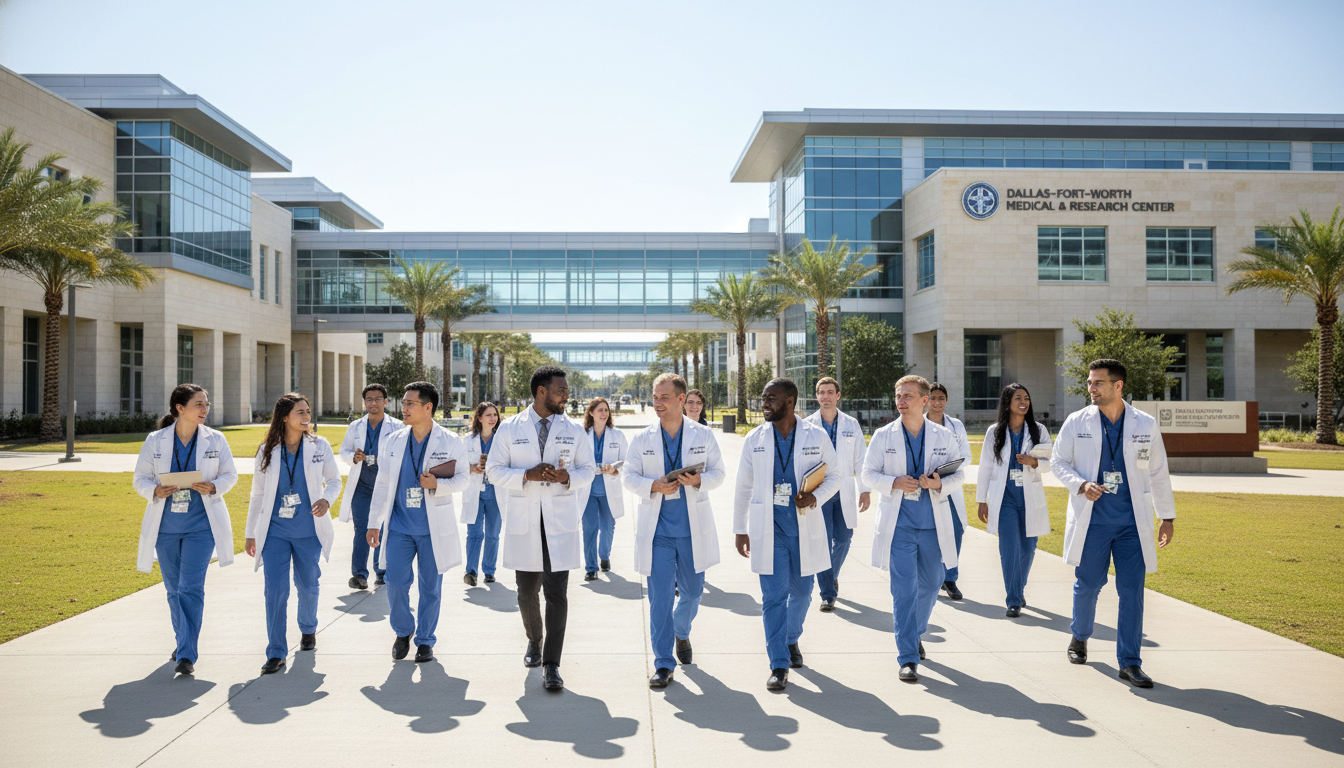
1. UT Southwestern Medical Center (Dallas)
UT Southwestern (UTSW) is the flagship academic institution in Dallas and a major anchor for DFW medical training.
Why it matters to Caribbean IMGs:
- University-based and typically categorized as H‑1B cap‑exempt.
- Large number of residency and fellowship programs.
- Strong history of employing IMGs, including those from Caribbean medical schools, though competitiveness is high.
Residency programs of interest (examples):
- Internal Medicine
- Pediatrics
- Anesthesiology
- Neurology
- Pathology
- Radiology
- Psychiatry
- General Surgery and some surgical subspecialties (often more competitive)
H‑1B‑related considerations:
- Some departments at UTSW have historically sponsored H‑1B for residents and fellows, especially in Internal Medicine and subspecialties.
- Policies may vary by department:
- Some accept both J‑1 and H‑1B.
- Some prefer J‑1 for categorical residents but may consider H‑1B for fellows.
- Caribbean IMGs aiming for UTSW should:
- Confirm whether the department sponsors H‑1B and if they require Step 3 before ranking.
- Attend virtual Q&As or email the program coordinator for specifics.
2. Texas Health Resources and affiliated programs
Texas Health Resources is a major system in the region, with multiple hospitals across Dallas–Fort Worth. Some sites host ACGME‑accredited residency programs in partnership with universities.
Why it matters:
- Multiple training sites in both urban and suburban DFW.
- Some programs may be university‑affiliated and therefore eligible for cap‑exempt H‑1B.
Potential programs (examples; check specific years):
- Internal Medicine residency programs (e.g., Texas Health Presbyterian Hospital Dallas and partners).
- Family Medicine and other primary care specialties at various sites.
Action items for Caribbean IMGs:
- Research each Texas Health residency program individually.
- Look for language such as “We sponsor J‑1 and H‑1B visas” or “ECFMG‑sponsored J‑1 only.”
- Email coordinators to clarify:
- Past history of H‑1B sponsorship,
- Whether Step 3 is required to even be ranked for H‑1B consideration.
3. Baylor Scott & White and Baylor University Medical Center (Dallas)
While Baylor Scott & White has a significant presence in North Texas, not all sites have their own residency programs, and visa policies vary.
At Baylor University Medical Center at Dallas and affiliated programs:
- Some programs are university‑affiliated or have academic components.
- Historically, some have sponsored H‑1B for fellows or residents, but this is department‑specific.
For a Caribbean IMG:
- Check each Baylor residency or fellowship program website for explicit language.
- Especially examine Internal Medicine, Transitional Year, OB/Gyn, Surgery, and subspecialties.
- Contact program offices to ask about H‑1B residency programs at their DFW campuses.
4. John Peter Smith (JPS) Health Network (Fort Worth)
JPS is the Tarrant County public hospital system in Fort Worth with several residency programs.
Typical features:
- Strong community mission.
- High patient volume, diverse and often underserved populations.
- Known for being IMG‑friendly in some departments.
H‑1B sponsorship varies by department and year; J‑1 is often the primary visa type, but Caribbean IMGs should:
- Explore JPS Internal Medicine, Family Medicine, Emergency Medicine, and other specialties.
- Directly inquire whether they support H‑1B for residents (and under what conditions).
5. Other community and university‑affiliated DFW programs
In the broader DFW area, also consider:
- Medical City Healthcare and its teaching hospitals.
- Methodist Health System (Methodist Dallas, Methodist Charlton, etc.).
- Cook Children’s Medical Center (primarily pediatrics‑focused, Fort Worth).
- Newer community programs expanding in response to physician workforce needs.
Many of these programs may lean toward J‑1 sponsorship only, but policies do change and some community programs have started sponsoring H‑1B to stay competitive in recruiting high‑quality residents, including Caribbean medical school graduates.
Building Your Personal H‑1B Sponsor List as a Caribbean IMG
A generic “H‑1B sponsor list” is rarely precise enough to guide your residency strategy. As a Caribbean IMG in the Dallas–Fort Worth area (or targeting it), you should build a personalized list that reflects current program policies, your competitiveness, and your visa timing.

Step 1: Clarify your visa and career priorities
Ask yourself:
- Is H‑1B absolutely non‑negotiable, or is J‑1 acceptable if the training quality is strong?
- Are you open to practicing temporarily in another region for a strong H‑1B residency or fellowship, then later relocating to DFW?
- How far are you from being Step 3‑ready?
- If you are pre‑Step 1 or Step 2 CK, you may need a multi‑year timeline.
If long‑term life plans (family constraints, financial factors, or home-country obligations) make the J‑1 two‑year home requirement very difficult, you’ll need to prioritize H‑1B residency programs more aggressively.
Step 2: Use public tools to research H‑1B usage
Several tools help identify employers that have historically filed H‑1B petitions. While they’re not residency‑specific, they can confirm whether a hospital or university has sponsored H‑1B physicians before. Examples include:
- U.S. Department of Labor’s OFLC disclosure data (Labor Condition Applications).
- Private H‑1B search tools (e.g., myvisajobs, H1Bdata, Trackitt searches).
When you search:
- Use employer names like “UT Southwestern Medical Center,” “Baylor University Medical Center,” “Texas Health Presbyterian Hospital Dallas,” etc.
- Look specifically for Physician, Resident Physician, Fellow Physician, Internal Medicine Physician, or similar job titles.
If you see several recent petitions for physician roles, that program or system is more likely to be open to H‑1B requests from residents or fellows.
Step 3: Systematically check residency program websites
For each DFW program you are considering, look for:
- A “For International Medical Graduates” or “Visa Sponsorship” section.
- Any mention of:
- “We accept J‑1 and H‑1B visas.”
- “We sponsor only J‑1 visas.”
- “We do not sponsor visas.”
Create a spreadsheet with columns like:
- Program name and specialty.
- Location (Dallas, Fort Worth, Plano, etc.).
- Visa policy from website.
- Notes: “Mentions H‑1B,” “J‑1 only,” “No info.”
- Contact person and email.
- Date last verified.
Step 4: Email programs to clarify H‑1B policy
If a website is unclear, politely email the program coordinator. Example template:
Subject: Visa Sponsorship Inquiry – [Your Name], Caribbean IMG Applicant
Dear [Coordinator Name],
I am a Caribbean international medical graduate interested in applying to the [Program Name] at [Institution] for the [Application Year] cycle. I am currently in the process of passing USMLE Step 3 and am hoping to train in the Dallas–Fort Worth area on an H‑1B visa.
Could you please let me know whether your program sponsors H‑1B visas for categorical residents (or prelim residents/fellows) and whether there are any additional requirements (e.g., Step 3 passed before ranking)?
Thank you very much for your time and assistance.
Sincerely,
[Your Full Name]
[USMLE scores/ECFMG certificate, if appropriate]
Log their responses in your spreadsheet—this becomes your custom H‑1B sponsor list for DFW medical training.
Step 5: Match your competitiveness to program competitiveness
A realistic H‑1B strategy balances:
- Your USMLE scores (and whether you’re an SGU residency match candidate or from another Caribbean medical school).
- Timing of Step 3.
- Strength of your clinical experiences (especially U.S. clinical experience).
- Specialty competitiveness.
For example, if you are a solid but not top‑tier applicant and you require H‑1B sponsorship, you might:
- Focus on Internal Medicine, Family Medicine, or Pediatrics programs in DFW that explicitly accept H‑1B.
- Use academic programs like UTSW as “reach” options.
- Include community‑based programs with proven IMG friendliness and any history of H‑1B.
Application Strategy for Caribbean IMGs Targeting H‑1B in DFW
To maximize your chances in Dallas–Fort Worth, your approach should be both academic and pragmatic.
1. Plan your exam timeline backward from Match
Because many H‑1B‑sponsoring programs require Step 3 before ranking, your timeline should aim for:
- Step 1 and Step 2 CK completed well before ERAS opens.
- Step 3 either:
- Completed before applications open (ideal), or
- Scheduled early enough that you can report “scheduled Step 3 date” on ERAS and update programs quickly once passed.
For Caribbean medical school residency candidates (including those from SGU, Ross, AUC, etc.):
- If you anticipate delays in exams, consider:
- Applying one year later to ensure Step 3 completion, or
- Applying more broadly to J‑1‑friendly programs and J‑1 waiver pathways later.
2. Use DFW clinical experiences strategically
If you can obtain clinical rotations or observerships in Dallas–Fort Worth:
- Prefer rotations at institutions that host residency programs (even if not at the exact program you want).
- Network with faculty who understand the local GME ecosystem.
- Seek strong letters of recommendation from DFW attendings who can comment on your clinical readiness and communication skills.
For example:
- A sub‑internship or acting internship at a UTSW‑affiliated hospital can enhance your credibility for DFW internal medicine or surgery programs.
- Rotations at Texas Health or Baylor teaching hospitals can signal that you understand the local patient population and healthcare systems.
3. Be explicit—but tactful—about your visa needs
In communications and interviews:
- Be honest: “I will need visa sponsorship and am particularly interested in H‑1B if available, as I have completed/plan to complete Step 3.”
- Show flexibility when possible: “I understand many programs sponsor J‑1; I am open to J‑1 if that is the only option, but I would like to understand whether your program can consider H‑1B.”
If you insist on H‑1B only, your pool of possible programs shrinks. Caribbean IMGs must weigh the risk of not matching vs. the long‑term immigration advantages of H‑1B.
4. Consider a two‑step path if needed
If direct H‑1B sponsorship in a DFW residency is not feasible, consider:
- Matching into a J‑1 residency (possibly in DFW or elsewhere).
- Then targeting:
- A fellowship on H‑1B (often more common at academic centers), and/or
- A J‑1 waiver job (in Texas or another state), followed by:
- H‑1B employment after waiver completion, or
- Transition to permanent residency (green card).
This two‑step approach is common among IMGs and may still allow you to ultimately settle in Dallas–Fort Worth as an attending.
Practical Examples: Pathways for a Caribbean IMG in DFW
To make the above concepts concrete, here are sample scenarios.
Example 1: SGU graduate with strong scores
- Graduate from SGU (or a similar Caribbean medical school) with:
- Step 1: 235
- Step 2 CK: 245
- Step 3 planned during the summer before ERAS.
- Clinical electives:
- Internal Medicine sub‑I at a UTSW‑affiliated hospital.
- Cardiology elective at a Baylor Dallas affiliate.
Strategy:
- Build a DFW‑focused H‑1B sponsor list (UTSW Internal Medicine + community programs with H‑1B history).
- Apply broadly in Internal Medicine, including:
- Academic programs (UTSW as a reach).
- Community/university‑affiliated programs in Dallas and Fort Worth.
- Include some non‑DFW programs with known H‑1B support as a safety net.
- Highlight DFW clinical experiences, strong letters from local attendings, and serious long‑term interest in living in Dallas.
Example 2: Caribbean IMG with mid‑range scores and no Step 3 yet
- Step 1: 220
- Step 2 CK: 225
- No Step 3 by ERAS season.
- Some U.S. clinical experience, but not in DFW.
Strategy:
- Realize that direct H‑1B residency in DFW will be challenging for this cycle.
- Prioritize IMG‑friendly J‑1 programs in Internal Medicine and Family Medicine—both in DFW and nationally.
- Consider one of the following:
- Match into a J‑1 program and later target H‑1B for fellowship at a place like UTSW.
- Delay your application by one year, pass Step 3, gain stronger U.S. clinical experience (ideally in Texas), and then reenter as a more competitive H‑1B candidate.
Frequently Asked Questions (FAQ)
1. Are there truly H‑1B cap‑exempt residency programs in Dallas–Fort Worth?
Yes. Many academic and university‑affiliated institutions in DFW (such as UT Southwestern and some Baylor or Texas Health–affiliated programs) qualify as H‑1B cap‑exempt employers. This allows them to file H‑1B petitions for residents or fellows any time of year, outside the lottery.
However, cap‑exempt eligibility does not mean they automatically sponsor H‑1B for every IMG. Each residency or fellowship program sets its own policy on whether to use H‑1B or J‑1.
2. Is it realistic for a Caribbean IMG to get H‑1B sponsorship for residency in DFW?
It is possible but competitive. Key points:
- You almost always need USMLE Step 3 before the program can file for H‑1B, and many programs require it before ranking you.
- Academic programs like UT Southwestern can and do sponsor H‑1B, often favoring the most competitive applicants.
- Caribbean IMGs with strong scores, robust U.S. clinical experience (especially in DFW), and excellent letters can be competitive, but they still face significant competition from U.S. grads and other IMGs.
Balancing H‑1B aspirations with broader application strategies (including J‑1 options) is critical to avoid going unmatched.
3. How do I know if a Dallas residency program sponsored H‑1B in the past?
You can:
- Search public H‑1B databases (e.g., DOL’s OFLC data, private tools like myvisajobs), using employer names like “UT Southwestern Medical Center” or “Baylor University Medical Center.”
- Check the residency program website for visa policy statements.
- Directly email program coordinators to ask:
- Whether they sponsor H‑1B for residents/fellows.
- Whether Step 3 before ranking is required.
No single source is perfect, so cross‑checking is crucial.
4. If I match on a J‑1 in DFW, can I still end up working there long‑term?
Yes, though the path may be longer:
- Complete your J‑1 residency (and possibly fellowship).
- Obtain a J‑1 waiver job—often in an underserved area or HPSA, possibly within Texas.
- Work for the required 3 years in the waiver position.
- Afterward, many physicians transition to standard H‑1B or permanent residence (green card)–based employment, including in metro areas like Dallas–Fort Worth.
Some physicians eventually return to DFW academic centers (e.g., UTSW, Baylor) as attendings after completing J‑1 waiver obligations.
For a Caribbean IMG interested in DFW medical training and long‑term practice, H‑1B sponsorship is a powerful but complex goal. By understanding cap‑exempt structures, researching each program’s policy, planning your Step 3 timeline, and realistically aligning your profile with program competitiveness, you can create a focused, data‑driven application strategy for Dallas–Fort Worth residency and beyond.