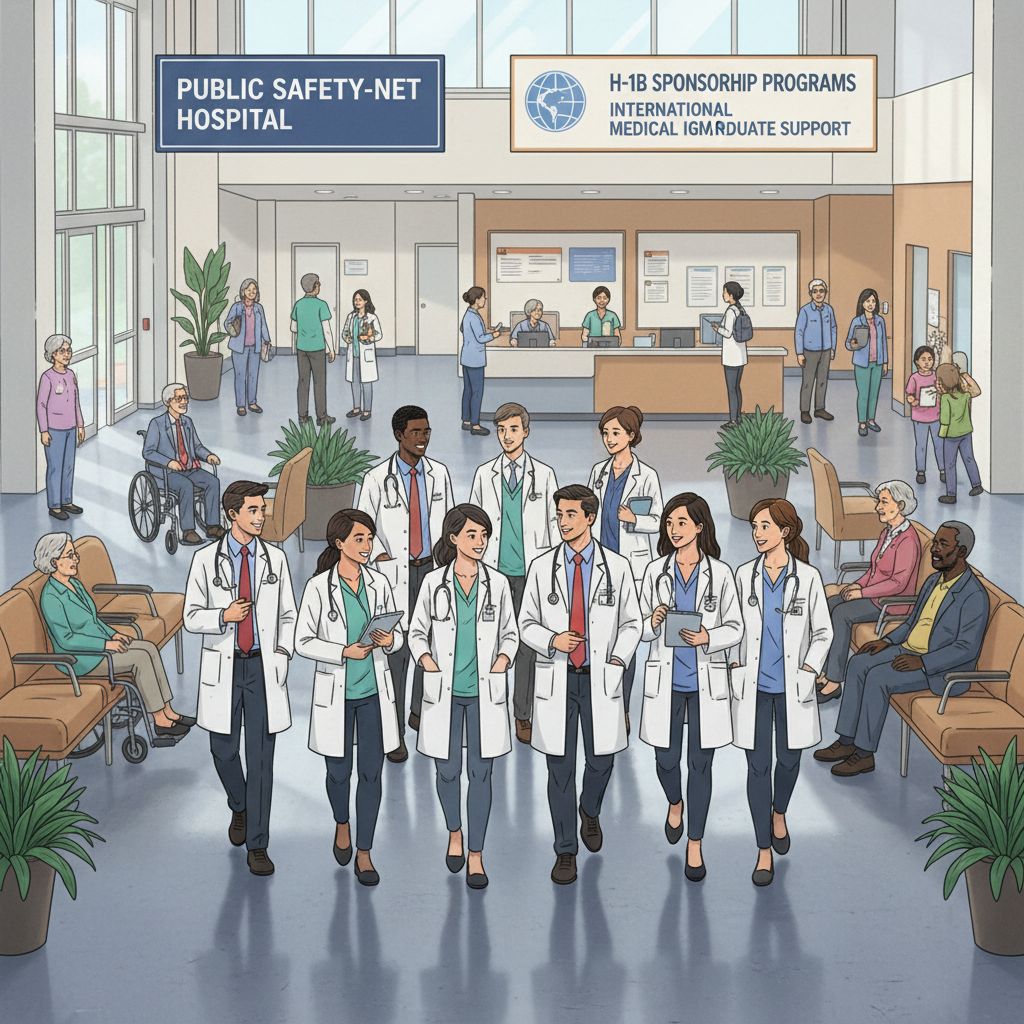
Understanding H‑1B Sponsorship in State University Residency Programs
For many Caribbean IMGs, securing an H‑1B–sponsored residency in a U.S. state university program is the critical bridge between graduation and long‑term practice in the United States. While J‑1 visas are more common, H‑1B residency programs offer unique advantages: no two‑year home return requirement, a clearer path to long‑term employment, and often more stability for applicants with families.
However, the process is complex. Each institution has its own visa policy, and not all state university residency programs will sponsor H‑1B visas—some have stopped entirely. This article explains how H‑1B sponsorship works in residency, how Caribbean medical school graduates (especially SGU alumni) can position themselves for an SGU residency match or similar outcomes, and how to navigate the H‑1B sponsor list, cap‑exempt rules, and application strategies.
We will focus specifically on opportunities and realities within state university residency and public medical school residency programs, where many Caribbean IMGs ultimately train.
J‑1 vs H‑1B: What Caribbean IMGs Need to Know
Before targeting specific H‑1B residency programs, you need to understand the basic differences between visa options—and how they affect your long‑term plans.
Core Differences Between J‑1 and H‑1B for Residency
J‑1 (ECFMG‑Sponsored Exchange Visitor Visa)
- Most common visa for residency/fellowship.
- Sponsored by ECFMG, not the hospital directly.
- Requires you to return to your home country for two years after training OR obtain a waiver (often via serving in a medically underserved area).
- Lower administrative cost for programs; simpler for them to manage.
- Some state university programs use J‑1 exclusively and will not offer H‑1B.
H‑1B (Specialty Occupation Work Visa)
- Sponsored directly by the residency program / employing institution.
- No automatic two‑year home return requirement.
- Counts against the 6‑year H‑1B maximum (residency + fellowship years matter).
- More flexible for staying in the U.S. long‑term, transitioning to other jobs, and eventually green card sponsorship.
- Paperwork and costs are higher, so fewer programs offer it, and criteria tend to be stricter.
Why Caribbean IMGs Often Prefer H‑1B
For many Caribbean graduates—particularly from schools like St. George’s University (SGU), Ross, AUC, Saba—there are practical reasons to favor H‑1B:
- You may have strong U.S. family or personal ties and want to avoid the J‑1 home return rule.
- You may be seeking longer‑term stability in a specific region or state.
- You may want easier transitions between residency, fellowship, and attending jobs without waivers.
However, many SGU residency match results (and other Caribbean medical school residency outcomes) still rely heavily on J‑1 placements, especially in competitive state university programs. Treat H‑1B as a strategic bonus, not a guarantee.
Common Misconceptions
“State universities always sponsor H‑1B.”
Not true. Many public medical school residency programs are J‑1 only or will consider H‑1B only in special cases (e.g., internal candidates, exceptional applicants).“Any H‑1B at a university is cap‑exempt.”
Often true, but not automatically. You must verify whether the employer entity meets H‑1B cap‑exempt definitions (we’ll discuss this below).“If my Caribbean medical school is well‑known, I automatically qualify for H‑1B.”
Reputation helps, but program policy and your exam scores matter more than school name alone.
H‑1B Fundamentals for Residency: Cap‑Exempt vs Cap‑Subject
Understanding the H‑1B cap is essential for Caribbean IMGs aiming at H‑1B residency programs in state university systems.
The H‑1B Cap in Simple Terms
- Standard U.S. employers fall under an annual numerical limit called the H‑1B cap.
- To work for these employers, you must go through the annual H‑1B lottery (unless you are already counted against the cap).
Residencies that are cap‑subject are riskier: if your petition isn’t selected, you cannot start on time. Fortunately, most university‑based residencies are cap‑exempt, but you must confirm.
H‑1B Cap‑Exempt: Why Universities Are Different
An employer is H‑1B cap‑exempt if it is:
- A nonprofit institution of higher education, or
- A nonprofit entity related to or affiliated with an institution of higher education, or
- A nonprofit or governmental research organization.
Most state university residency and public medical school residency programs qualify, because they are directly part of a state university system or a university‑affiliated teaching hospital.
For you, this means:
- They can file H‑1B petitions at any time of year, not just during the lottery cycle.
- You are exempt from the H‑1B cap while working for these institutions (H‑1B cap‑exempt status).
- This is why H‑1B sponsorship is more commonly seen in university hospitals than in purely community‑based private hospitals.
However, not every hospital with a university affiliation is automatically cap‑exempt. Always confirm:
- Who is the actual H‑1B employer (the university vs. a separate private health system)?
- Does that employer appear on any internal or published H‑1B sponsor list used by the GME office?
Transitioning from Cap‑Exempt to Cap‑Subject
After residency or fellowship at a state university program:
- If you move to a private group or non‑university hospital that is cap‑subject, you will typically need to enter the H‑1B lottery (unless you previously held a cap‑subject H‑1B).
- Some graduates time their applications carefully by working in university‑affiliated or H‑1B cap‑exempt environments long enough to find a cap‑subject employer willing to sponsor them via the lottery.
For Caribbean IMGs, this means your first H‑1B (residency) might be cap‑exempt, but your long‑term career planning must consider eventual transitions to cap‑subject employers.
Which State University Programs Sponsor H‑1B? Policy Patterns and Research Strategy
There is no single official, complete H‑1B sponsor list for residencies. Policies can change annually. You must combine multiple sources of information and verify for each program, each season.
Common Patterns in Public Medical School Residency Programs
In practice, many state university residencies follow one of these models:
J‑1 Only
- Official policy: “We only sponsor J‑1 visas through ECFMG.”
- Rare exceptions, if any.
J‑1 Preferred, H‑1B Possible in Limited Cases
- Will “consider” H‑1B for applicants who:
- Have passed USMLE Step 3 before ranking.
- Are highly competitive or already known to the institution (e.g., doing electives there).
- Policies can be subjective and depend heavily on GME leadership.
- Will “consider” H‑1B for applicants who:
J‑1 and H‑1B Equally Accepted
- More common in certain specialties (e.g., Internal Medicine, Pediatrics, Psychiatry) at large academic centers.
- Often clearly stated on their website.
Flexible but Quiet
- Some programs do sponsor H‑1B, but do not advertise this clearly.
- Often discovered by speaking directly with current residents or coordinators.
For Caribbean medical school residency applicants, state university residency programs in Internal Medicine, Family Medicine, Pediatrics, and Psychiatry are generally more accessible and more likely to entertain H‑1B, compared with ultra‑competitive specialties.
How to Research Program‑Specific H‑1B Policies
Use this step‑by‑step approach:
Check Official Program Website
- Look for sections like “International Medical Graduates,” “Visa Sponsorship,” or “Eligibility Criteria.”
- Phrases like “We only sponsor J‑1 visas” are clear red flags.
- If you see “We accept J‑1 and H‑1B,” that’s a strong sign—but not the whole story.
Review GME / Institution‑Level Policy
- Many state universities have GME office pages with visa policies that apply across all residency programs.
- They may publish:
- A general stance (e.g., “The institution sponsors J‑1 and occasionally H‑1B visas”)
- Requirements for H‑1B (Step 3, USMLE scores, degree verification)
Use NRMP/ERAS Program Descriptions
- Program descriptions often list “Visa types sponsored.”
- Cross‑verify against the website, as ERAS details can be outdated.
Contact the Program Coordinator (Strategically)
- When policies are unclear, a short, focused email is acceptable.
- Include: your status (Caribbean IMG, graduation year), USMLE status, and a single specific question, e.g.:
- “Does your program sponsor H‑1B visas for qualified IMG applicants?”
- Avoid flooding them with multiple questions; coordinators are very busy in interview season.
Network with Current Residents, Especially Caribbean IMGs
- Look up residents on program websites or LinkedIn.
- Focus on those with Caribbean medical school backgrounds (e.g., SGU, Ross, AUC, etc.).
- Politely ask:
- What visa are you on?
- Does the program currently sponsor H‑1B for IMGs?
- Any specific requirements (Step 3 deadlines, score cutoffs)?
Use Public Databases (With Caution)
- The U.S. Department of Labor and some private sites publish employer H‑1B data.
- You can search for the university hospital name to see if they have filed H‑1Bs for residents or physicians before.
- This is historical data, not a promise of current policy, but it’s a good clue.

Example: Interpreting Confusing Policies
Imagine a state university Internal Medicine residency website says:
“We typically sponsor J‑1 visas and may consider H‑1B for exceptional applicants who have passed USMLE Step 3.”
Implications for a Caribbean IMG:
- You should not assume H‑1B is guaranteed.
- Step 3 completion before rank list is a minimum, not a ticket.
- You should aim to be in the top tier of their applicant pool to have a realistic chance at H‑1B consideration.
If you see:
“We only sponsor J‑1 visas through ECFMG”
Then you should assume no H‑1B at all, regardless of scores or credentials.
Building a Competitive Profile for H‑1B Sponsorship as a Caribbean IMG
Even at H‑1B‑friendly state university programs, competition is intense for limited H‑1B slots. You must stand out.
1. Prioritize High‑Yield Specialties and Settings
As a Caribbean IMG seeking H‑1B sponsorship, your best odds are usually in:
- Internal Medicine (especially large university‑affiliated programs)
- Family Medicine (some state programs, though many are J‑1‑only)
- Pediatrics
- Psychiatry
- Pathology (at some academic centers)
Ultra‑competitive specialties (Dermatology, Neurosurgery, Orthopedics, Ophthalmology) almost never sponsor H‑1B for IMGs directly out of Caribbean medical school, especially in state university settings.
2. USMLE Performance and Step 3 Timing
For H‑1B‑sponsoring programs, USMLE scores matter greatly:
- Aim for at least above the national mean on Step 1 and Step 2 CK. Higher is better for H‑1B consideration.
- Many institutions require Step 3 before issuing an H‑1B offer. Practically, this means:
- Take Step 3 before or early during application season if you are targeting H‑1B.
- For SGU residency match or other Caribbean medical school residency candidates seeking H‑1B, Step 3 completion can be the difference between J‑1 and H‑1B, or even between interview vs. no interview.
3. U.S. Clinical Experience (USCE) and State University Exposure
To be competitive for public medical school residency programs:
- Seek audition electives/sub‑internships at your target state university programs or at least in the same region.
- Strong letters from U.S. academic faculty (preferably at state/public universities) carry significant weight.
- If your Caribbean school has established pipelines (e.g., SGU clinical rotations at certain state universities), leverage these; SGU residency match data often clusters around their long‑standing hospital partners.
4. Research, QI, and Academic Involvement
To stand out for H‑1B in academic settings:
- Participate in research projects, quality improvement (QI) initiatives, or case reports during your clinical rotations.
- Even 1–2 solid posters or publications can strengthen your application, particularly for public medical school residency programs that emphasize academic output.
- Ask faculty at your rotations about opportunities early, not just in the final weeks.
5. Communication and Professionalism
H‑1B sponsorship represents additional cost and administrative effort for a program. They will reserve it for applicants they view as low‑risk, high‑yield residents:
- Demonstrate clear, professional communication in all emails and interviews.
- Show reliability, maturity, and understanding of the U.S. healthcare system.
- Avoid sending unprofessional mass emails to coordinators about visa sponsorship.
6. Personal Statement and Interview Messaging
Given your Caribbean IMG and H‑1B interests:
- In your personal statement, emphasize a long‑term commitment to practicing in the U.S. and perhaps in underserved or academic settings.
- Do not make the entire narrative about visa needs. Instead, integrate it subtly:
- Stress your clinical interests, educational goals, and fit with state university training.
- At interviews, be prepared to discuss visa logistics only if asked. Over‑focusing on H‑1B too early can give the impression you care more about visa than training quality.
Application Strategy: Balancing H‑1B Ambition with Match Security
For Caribbean medical school residency applicants—especially those from SGU, Ross, AUC, etc.—there’s a delicate trade‑off: you want H‑1B, but you must also maximize your chance of matching somewhere.
1. Categorize Programs by Visa Policy
Create a personal spreadsheet with categories like:
Category A: Strong H‑1B Sponsor History
- State university programs that clearly state they sponsor H‑1B for IMGs.
- Confirmed by residents, GME, or recent graduates.
Category B: J‑1 Preferred, H‑1B Possible
- Programs that may consider H‑1B with Step 3 and strong metrics.
- Good to apply, but don’t rely exclusively on these.
Category C: J‑1 Only, But Strong Fit
- Programs where you’d be happy training on J‑1 if H‑1B is not possible.
- Helps protect you from going unmatched.
Aim to apply across all three categories, with a higher proportion in A and B if H‑1B is your priority, but never ignoring C completely.
2. Be Realistic About Program Competitiveness
Public medical school residency programs at highly ranked state universities can be extremely competitive for IMGs, especially when H‑1B is on the table. To improve your odds:
- Target mid‑tier and regional state universities, not just the top‑ranked flagships.
- Consider programs in less popular locations (midwest, rural states) that may have fewer U.S. grads applying and may be more open to Caribbean IMGs.
3. Ranking Strategy in NRMP
When you build your rank list:
- Rank your preferred H‑1B‑sponsoring programs highest (Categories A and B), assuming the training quality meets your career goals.
- However, do not artificially lower J‑1‑only programs you actually like just because they lack H‑1B; matching into a solid J‑1 program is better than going unmatched.
- The NRMP algorithm is applicant‑favorable; always rank based on true preference, not guesswork about how programs will rank you.
4. Post‑Match and Beyond: Plan B and Long‑Term Strategy
If you match into:
An H‑1B residency
- Confirm timing of filing, start date, and cap‑exempt status.
- Discuss long‑term plans early: fellowship, academic vs. private practice, potential green card sponsorship.
A J‑1 residency
- Begin exploring J‑1 waiver options during PGY‑1 and PGY‑2 (e.g., Conrad‑30, federal programs).
- Many state university alumni on J‑1 later secure waivers and eventually transition to H‑1B or permanent residency through underserved positions.
In both cases, Caribbean IMGs have successfully built careers in U.S. medicine. H‑1B can make the path smoother but is not the only route.

Practical Examples: How Caribbean IMGs Have Navigated H‑1B in State Universities
Example 1: SGU Graduate Matching Internal Medicine with H‑1B
- Profile: SGU graduate, strong clinical evaluations, Step 2 CK above 240, Step 3 completed before ERAS submission.
- Strategy:
- Targeted ~20 public medical school residency Internal Medicine programs known to sponsor H‑1B.
- Completed a sub‑internship at one of these state universities; obtained a strong letter.
- Applied broadly, including J‑1‑only programs as backup.
- Outcome:
- Multiple interviews; matched at the same state university where they rotated.
- Program filed a cap‑exempt H‑1B petition; resident started on time and later transitioned into a fellowship.
Example 2: Caribbean IMG Matching Pediatrics on J‑1, Later Getting H‑1B
- Profile: Ross graduate, solid but not exceptional scores, no Step 3 at application time.
- Strategy:
- Applied broadly to Pediatrics programs, mostly state university and community programs.
- Did not specifically target H‑1B due to timing.
- Outcome:
- Matched at a state university program that only sponsors J‑1.
- During PGY‑2, explored J‑1 waiver options and identified a federally qualified health center.
- Completed residency, fulfilled waiver in an underserved area on H‑1B through the waiver employer (cap‑subject), then later obtained permanent residency.
Example 3: Candidate Over‑Focusing on H‑1B and Going Unmatched
- Profile: Caribbean IMG with average scores, limited USCE, Step 3 incomplete.
- Strategy:
- Applied almost only to H‑1B‑sponsoring state university programs, ignoring solid J‑1‑only options.
- Sent multiple emails pushing for H‑1B, which some coordinators found off‑putting.
- Outcome:
- Few interviews, no match.
- Required a re‑application year, extra observerships, and later accepted a J‑1 position.
Lesson: Balance H‑1B goals with realistic match strategy. Do not narrow your options too aggressively.
FAQs: H‑1B Sponsorship Programs for Caribbean IMGs
1. As a Caribbean IMG, should I refuse to consider J‑1 and only apply to H‑1B residency programs?
No. For most Caribbean IMGs, applying only to H‑1B programs is risky and often leads to fewer interviews and lower match rates. J‑1 is still the most common and practical path into U.S. residency, including at many state university programs. The optimal approach is to:
- Prioritize H‑1B‑friendly programs,
- But also include J‑1‑only programs where you would be happy training, especially in your specialty of interest and desired region.
2. Does graduating from a well‑known Caribbean school like SGU guarantee H‑1B sponsorship?
It does not. SGU residency match outcomes include both J‑1 and H‑1B placements, but H‑1B is never guaranteed, even for SGU, Ross, or AUC graduates. Programs base H‑1B decisions on:
- Institutional policy (many are J‑1‑only),
- Your USMLE scores and Step 3 status,
- Your overall competitiveness and fit,
- And their available resources that year.
Your school’s reputation helps open doors but is only one component of your overall profile.
3. Do I need USMLE Step 3 to get an H‑1B residency?
In practice, yes in most cases. While a few institutions might consider filing H‑1B with Step 3 pending, the majority of H‑1B‑friendly state university residency programs require Step 3 to be passed before issuing a contract or filing the petition. If H‑1B is a priority:
- Plan to take Step 3 before or early in the application cycle.
- Highlight Step 3 completion in your ERAS application and CV.
4. How can I find an accurate H‑1B sponsor list for state university residencies?
There is no single, official, and fully up‑to‑date H‑1B sponsor list for residency programs. To identify H‑1B‑friendly state university and public medical school residency programs:
- Review program and GME websites for visa policies.
- Check ERAS/NRMP listings for “Visa types sponsored.”
- Talk to current residents (especially other Caribbean IMGs).
- Use public H‑1B employer databases to confirm that a university hospital has historically filed H‑1B petitions, while recognizing that policies change.
Always re‑check policies each application season; what was true for last year’s Caribbean IMGs may not hold this year.
This framework should help you, as a Caribbean IMG, approach H‑1B sponsorship in state university residency programs strategically: understanding cap‑exempt rules, targeting realistic specialties and institutions, building a strong profile, and balancing H‑1B ambitions with the overarching goal—successfully matching into a quality residency in the United States.