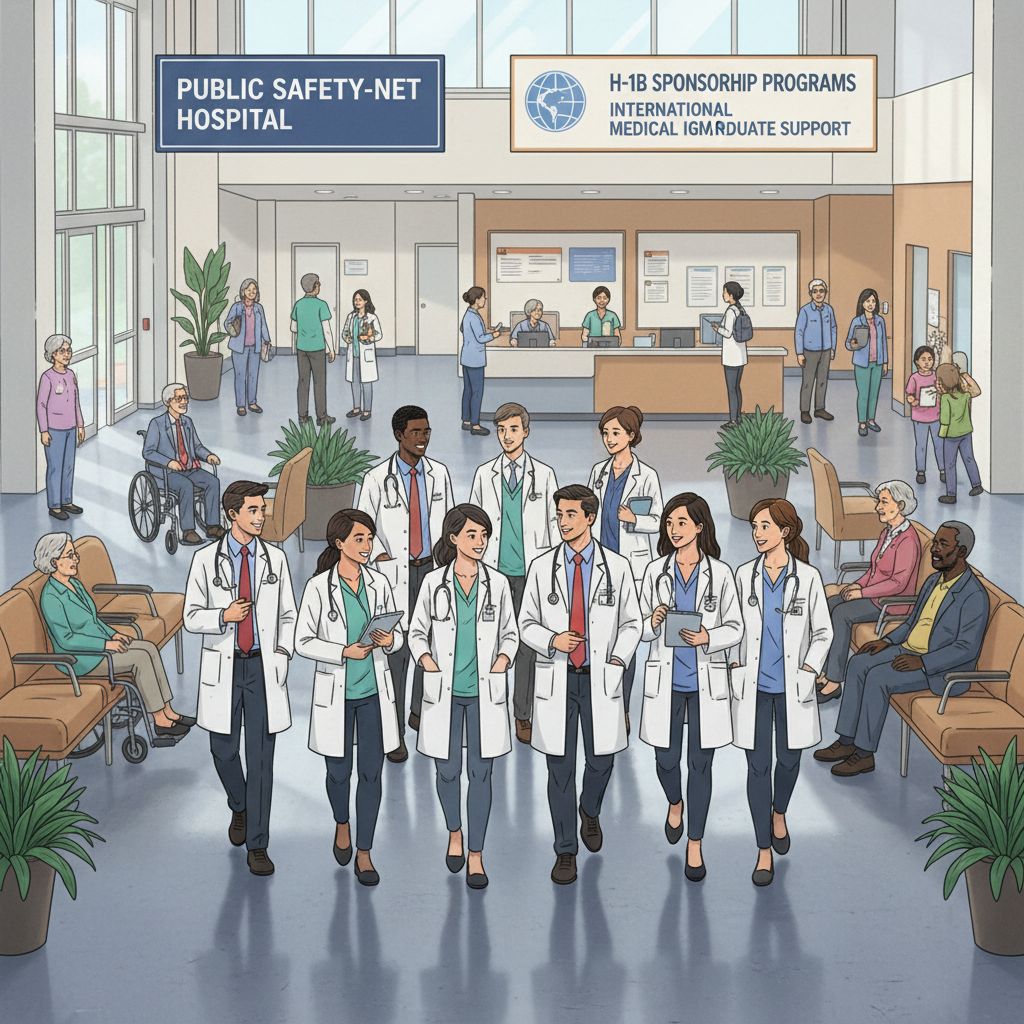
Understanding H‑1B Sponsorship for Caribbean IMGs in the Sun Belt
For a Caribbean IMG, especially from schools like St. George’s University (SGU), AUC, Ross, or Saba, the Sun Belt region can be one of the best paths into U.S. graduate medical education. Warm weather, large health systems, and diverse patient populations have helped create many Caribbean medical school residency opportunities—especially in internal medicine, family medicine, pediatrics, and psychiatry.
If you need visa sponsorship, the stakes are higher: you must target programs that explicitly support H‑1B residency programs or, when necessary, J‑1. Understanding where and how to secure H‑1B sponsorship in Sun Belt states (e.g., Texas, Florida, Georgia, the Carolinas, Arizona, Alabama, Louisiana, Mississippi, Tennessee, and parts of California) can significantly shape your application strategy.
This article focuses on:
- How H‑1B visas work for residency and fellowship
- Differences between H‑1B and J‑1 for Caribbean IMGs
- Sun Belt specialties and program types more likely to sponsor H‑1B
- Building a personal H‑1B sponsor list from scratch
- Practical application strategies and timing for Caribbean medical school residency applicants
H‑1B vs. J‑1: What Caribbean IMGs Must Know
Before you build a residency list, you need a clear understanding of the visa landscape. Your entire strategy—program selection, exam timing, document readiness—depends on this.
H‑1B Basics for Residency
For graduate medical education, an H‑1B is a temporary worker visa in a specialty occupation. In residency, that means:
- You must have passed all USMLE Steps required for licensure in that state (typically Steps 1, 2 CK, and 3) before an H‑1B petition can be filed.
- The employer (teaching hospital or university) is your H‑1B sponsor. You cannot self‑petition.
- Many residency programs are H‑1B cap exempt because they are nonprofit, university‑affiliated or government institutions. This is a major advantage over corporate H‑1Bs, which are subject to a lottery.
For Caribbean IMGs, this means:
- If you are targeting H‑1B‑friendly programs, you must plan to take and pass USMLE Step 3 early (often before ranking deadlines, and definitely before residency start date).
- You should confirm that the program sponsors H‑1B for residents, not just for faculty or fellows.
J‑1 Basics for Residency
The J‑1 is an exchange visitor visa administered primarily through ECFMG for physicians in training:
- Most U.S. residency programs that accept IMGs are familiar and comfortable with J‑1 sponsorship.
- You don’t need Step 3 completed before starting residency on J‑1.
- The major limitation: the two‑year home residency requirement in your country of last permanent residence (unless you later obtain a waiver, such as a Conrad 30 waiver in an underserved area).
For Caribbean IMGs whose home country is not the U.S. (even if you studied in Grenada, St. Maarten, or Dominica but are a citizen of another country), the J‑1 can create complications:
- If you plan to remain in the U.S. long‑term, a future J‑1 waiver job is almost mandatory.
- Specialty choice matters: it’s easier to secure J‑1 waivers for primary care and psychiatry than for some competitive subspecialties.
Key Pros and Cons for Caribbean IMGs
H‑1B Advantages:
- No automatic two‑year home return requirement
- Easier transition to employment‑based green card after residency or fellowship
- Employers in the Sun Belt (especially large health systems and safety‑net hospitals) often already use cap‑exempt H‑1Bs, which simplifies the process
H‑1B Disadvantages:
- Must pass Step 3 early, often adding expense and time pressure to an already intense SGU residency match or Caribbean medical school residency application process
- Not all programs are willing to sponsor H‑1B; some will only offer J‑1 or require U.S. citizenship/green card
- Some Sun Belt programs limit H‑1B sponsorship to certain specialties or only a few positions per year
J‑1 Advantages:
- More widely accepted; many community and university‑affiliated southern residency programs are very familiar with J‑1
- No Step 3 requirement before starting residency
- ECFMG handles most of the J‑1 sponsorship paperwork
J‑1 Disadvantages:
- Two‑year home residency requirement (unless waived)
- Can complicate long‑term plans for permanent residency in the U.S.
- Some fellowship programs prefer or only accept H‑1B
For many Caribbean IMGs in the Sun Belt, an optimal strategy is:
Apply broadly, including both H‑1B and J‑1–friendly programs, but give priority to H‑1B residency programs where feasible, especially if you already have or can quickly obtain Step 3.
Where H‑1B Sponsorship Lives in the Sun Belt
H‑1B sponsorship patterns are not random. If you understand who sponsors, you can focus your energy and ERAS applications on programs with a realistic chance of supporting your visa.
1. Large University and Academic Medical Centers
Many academic centers in the Sun Belt are H‑1B cap exempt and already use H‑1Bs for fellows and faculty. These institutions are more likely to extend H‑1B sponsorship to residents.
Examples of settings (not an exhaustive or official H‑1B sponsor list, and policies change):
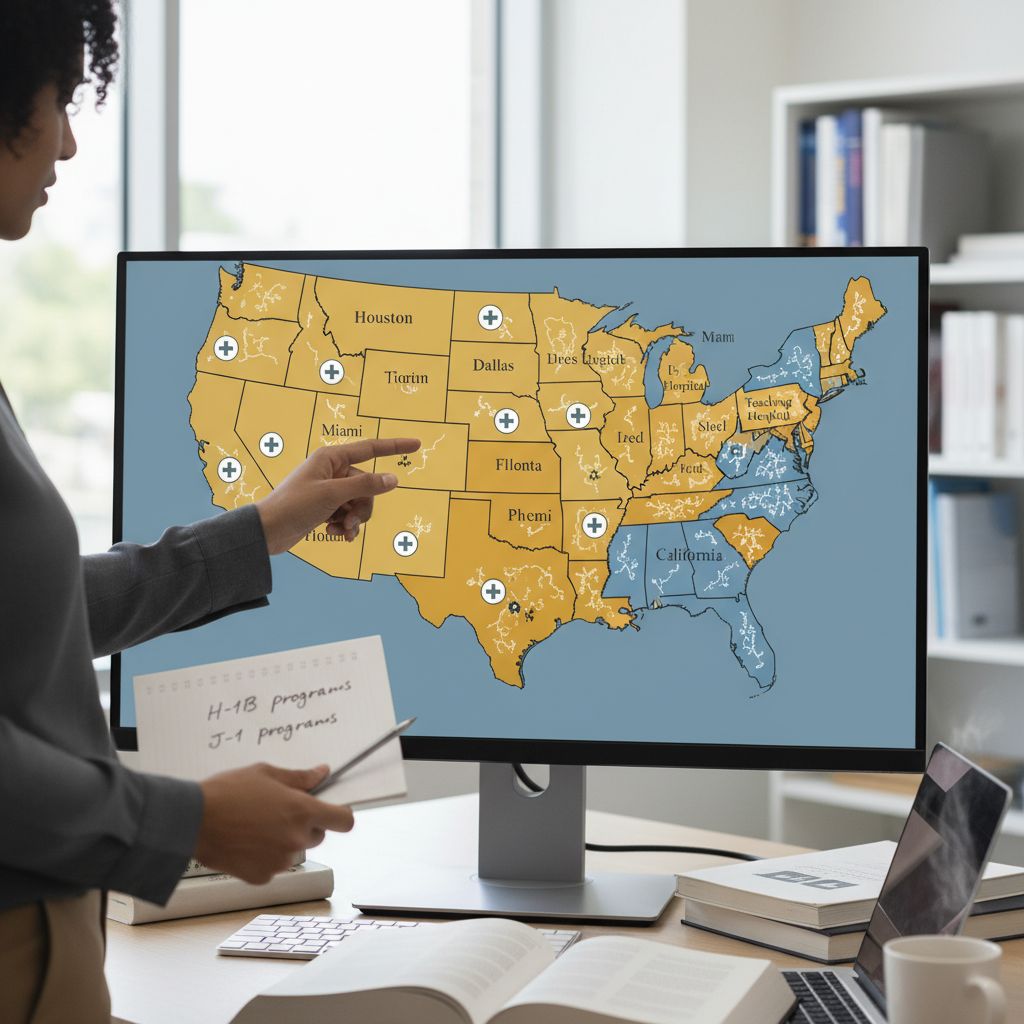
- University‑affiliated hospitals in Texas (Houston, Dallas, San Antonio, Austin, El Paso, Lubbock)
- Public university systems in Florida, Georgia, Alabama, the Carolinas, Arizona, and Tennessee
- Major academic centers in large Sun Belt cities: Miami, Tampa, Jacksonville, Atlanta, Phoenix, Tucson, New Orleans, Birmingham, Charlotte, Raleigh‑Durham, Nashville, San Diego, Los Angeles, and others
These institutions tend to:
- Have dedicated GME offices with immigration staff or outside counsel
- Be more familiar with Caribbean graduates from big schools (SGU, Ross, AUC, Saba), improving the probability of an SGU residency match or Caribbean medical school residency opportunity that includes visa sponsorship
- Maintain written policies on H‑1B vs. J‑1 sponsorship on their website
2. Large Community Teaching Hospitals
Many Caribbean IMGs end up in community‑based but university‑affiliated programs in the Sun Belt:
- County hospitals
- Safety‑net hospitals
- Large non‑profit community hospitals partnering with medical schools
These often qualify as H‑1B cap exempt institutions because of their affiliations and non‑profit status. Some of them have a long history of training IMGs and may be more flexible with visa sponsorship.
Clues a program might be IMG‑friendly and possibly H‑1B‑friendly:
- Website clearly lists current residents and their medical schools, with a strong presence of Caribbean IMGs
- Explicit mention of visa sponsorship (H‑1B and/or J‑1) on their GME or residency pages
- Rotations through underserved or rural areas, which may later support waiver opportunities if you end up on J‑1
3. Sun Belt Specialties More Likely to Offer H‑1B
H‑1B sponsorship tends to cluster in core specialties and in programs that depend heavily on IMGs to fill positions. For Caribbean IMGs targeting the Sun Belt, realistic H‑1B‑friendly specialties often include:
- Internal Medicine (categorical and prelim)
- Family Medicine (especially in rural or underserved southern residency programs)
- Pediatrics
- Psychiatry
- Pathology
- Some Neurology and PM&R programs
More competitive specialties (e.g., Dermatology, Plastic Surgery, Ophthalmology, ENT, Urology) rarely sponsor H‑1B for IMGs, and even when they do, they may prefer U.S. grads.
If your goal is primarily H‑1B sponsorship plus long‑term U.S. practice, consider combining:
- A core specialty in a Sun Belt location with a track record of sponsoring H‑1B
- Later sub‑specialization once you already have an H‑1B, possibly at the same or another cap‑exempt institution
4. Understanding H‑1B Cap Exempt in Residency
For most Caribbean IMGs, the good news is that residency programs at academic or non‑profit hospitals are usually H‑1B cap exempt:
- You are not subject to the 85,000/year H‑1B cap or the April lottery that corporate hires face.
- The hospital can file an H‑1B petition for you at almost any time of year (as long as it aligns with residency start dates and their internal timeline).
However:
- If you later move from a cap‑exempt residency to a for‑profit employer (e.g., private hospital or clinic), you may then need to obtain a cap‑subject H‑1B.
- Planning long‑term (residency → fellowship → first job) is essential so you don’t get stuck.
How to Build a Personal H‑1B Sponsor List in the Sun Belt
There is no single official H‑1B sponsor list for residency programs. Policies change yearly, and some programs sponsor only in rare, case‑by‑case scenarios. You must build your own, current list before applying.
Step 1: Start with Visa‑Friendly Specialty and Location
As a Caribbean IMG in the Sun Belt, choose a combination of:
- 1–2 preferred states (e.g., Texas + Florida, or Georgia + the Carolinas, or Arizona + Texas)
- 2–3 specialties (e.g., Internal Medicine + Family Medicine + Psychiatry)
This yields a manageable pool of programs to research.
Step 2: Use Official Program and GME Websites
For each program:
- Go to the official residency program website.
- Look for sections labeled:
- “International Medical Graduates”
- “Visa Sponsorship”
- “Eligibility Requirements”
- Note the exact wording:
- “We sponsor J‑1 only, no H‑1B.” → Exclude from your H‑1B list.
- “We sponsor J‑1 and H‑1B visas” → Include, but confirm details by email if possible.
- “We accept J‑1; H‑1B considered on a case‑by‑case basis.” → Include as “possible,” but treat as less reliable.
- No mention at all → Move to Step 3 (direct outreach).
Create a spreadsheet with columns such as:
- Program name
- State and city
- Specialty
- Visa policy statement (copy‑paste text)
- “H‑1B status” (Yes / No / Case‑by‑case / Unknown)
- Last confirmed year (e.g., “Checked website: 2025 cycle”)
Step 3: Direct Email or Call to Verify Policy
For any program where H‑1B policy is unclear or “case‑by‑case,” a polite, brief email can clarify:
- Address it to the program coordinator or program director (email listed on the site).
- Include your status as a Caribbean IMG and note that you will require visa sponsorship.
- Ask a precise question, such as, “Does your program sponsor H‑1B visas for residents who have passed USMLE Step 3 before residency start?”
Record the responses in your spreadsheet. Programs sometimes change policies based on GME leadership or institutional decisions; having current confirmation is critical.
Step 4: Use Alumni and Current Residents as Informal Data Points
If you’re at a Caribbean medical school with strong Sun Belt ties (e.g., SGU, AUC, Ross, Saba), use:
- Alumni databases and match lists from your school to identify:
- Which Sun Belt programs have a history of accepting Caribbean grads
- Whether alumni there are on J‑1 or H‑1B
- LinkedIn or social media to contact current residents:
- Ask whether their program sponsors H‑1B and how common it is.
This is particularly useful in big states like Texas and Florida where many southern residency programs actively recruit IMGs.
Step 5: Monitor for Changes Each Cycle
Programs may:
- Stop sponsoring H‑1B due to budget or administrative reasons
- Start sponsoring H‑1B after recruiting needs change
- Shift from “case‑by‑case” to “J‑1 only” or vice versa
Before each ERAS season, update your list:
- Revisit websites
- Send short re‑confirmation emails if previous info is over 1–2 years old
- Note any changes in your spreadsheet

Timing, Exams, and Documents: Making Yourself H‑1B-Ready
Even in H‑1B‑friendly programs, you must be logistically ready to be sponsored. The major bottleneck is usually USMLE Step 3 and document timing.
Step 1: Plan USMLE Step 3 Early
Most programs will not promise H‑1B unless Step 3 is passed before:
- Visa petition filing (often several months before July 1 start)
- Or at least before your contract start date
For Caribbean medical school residency applicants:
- Consider scheduling Step 3 between graduation and the start of residency, or
- If you will graduate early enough, take Step 3 during your final year, after passing 2 CK and completing enough clinical exposure.
Practical timeline (example):
- Final year of med school (Caribbean): Focus on 2 CK, electives in the Sun Belt.
- After 2 CK: Arrange exam date for Step 3 shortly after graduation.
- ERAS cycle:
- Apply in September (with Step 1 and 2 CK done, and Step 3 planned or already passed).
- By late winter/early spring, have Step 3 score available to reassure H‑1B‑friendly programs.
Step 2: Build a Strong, Visa‑Savvy ERAS Profile
For H‑1B‑focused Caribbean IMG applicants, your ERAS application should clearly communicate both competence and visa clarity.
Key elements:
- USMLE scores: Competitive, particularly in specialties like Internal Medicine or Psychiatry. Even when programs are IMG‑friendly, higher scores make H‑1B sponsorship more likely.
- Clinical experience in the U.S.: Electives or sub‑internships in Sun Belt teaching hospitals, ideally at your target institutions when possible.
- Personal statement:
- Mention your long‑term commitment to practicing in the U.S., especially in underserved or Sun Belt communities.
- Clarify in a neutral, non‑demanding way that you will require visa sponsorship, but focus on your strengths and fit, not the visa.
- CV and letters: Strong letters from U.S. faculty, especially from Sun Belt programs or attendings familiar with IMGs.
Step 3: Address Visa Status Transparently in Interviews
Program directors dislike surprises. Handle visa discussions with clarity and professionalism:
- Early in interviews (or if asked on forms), specify:
- You are a Caribbean IMG
- You will require sponsorship for either J‑1 or H‑1B
- You have passed or scheduled Step 3 if you are aiming specifically for H‑1B
Sample phrasing in an interview:
“I will require visa sponsorship and I am open to both J‑1 and H‑1B if your institution supports them. I have already passed Step 3, so if your program sponsors H‑1B, I would be fully eligible for that route.”
This signals flexibility while still inviting them to consider H‑1B.
Strategic Application Tips for Caribbean IMGs Targeting Sun Belt H‑1B Programs
Bringing all of this together, here’s how to design a realistic, effective strategy for the Caribbean IMG targeting H‑1B sponsorship programs in the Sun Belt.
1. Apply Broadly but Intelligently
A reasonable application strategy might be:
- 60–80 total applications (depending on specialty competitiveness, scores, and red flags).
- Group programs into tiers:
- Tier 1: Clearly state they sponsor H‑1B and list prior Caribbean IMGs.
- Tier 2: Case‑by‑case H‑1B sponsors or historically have had residents on H‑1B but no clear written policy.
- Tier 3: J‑1 only but otherwise IMG‑friendly Sun Belt programs (as backup).
Emphasize Tier 1 and Tier 2 for your H‑1B goals, but don’t ignore Tier 3 entirely if you need a broader safety net.
2. Align Rotations with Target Regions
If possible during your Caribbean clinical years:
- Prioritize elective rotations in the Sun Belt (Texas, Florida, Georgia, Arizona, the Carolinas, etc.).
- Target hospitals with:
- Known Caribbean IMG presence
- Academic affiliations
- Documented H‑1B or J‑1 support
An audition rotation at a potential H‑1B‑friendly program can sometimes be more influential than a small difference in test scores.
3. Use Your School’s Match Office Strategically
For Caribbean schools like SGU, the SGU residency match office and similar advising services at other Caribbean schools can:
- Share historical match data showing which Sun Belt programs matched SGU students on H‑1B or J‑1.
- Help you identify patterns such as:
- Some hospitals consistently take multiple Caribbean IMGs each year
- Certain specialties at certain institutions are particularly Caribbean‑friendly
Ask specifically:
- “Which Sun Belt internal medicine or family medicine programs have matched our graduates on H‑1B in the last 3–5 years?”
- “Are there alumni I can talk to who completed or are in H‑1B‑sponsored residencies in Texas, Florida, or Georgia?”
4. Keep Backup Plans in Mind
While you aim for H‑1B, also:
- Maintain J‑1‑friendly options in your list, especially in IMG‑dependent specialties like Internal Medicine, Family Medicine, and Psychiatry.
- Learn about J‑1 waiver options (e.g., Conrad 30) in Sun Belt states; even if you start on J‑1, your long‑term plan can still be U.S. practice through waiver service.
Balancing ambition with realistic backups protects you against the variability of the Match.
FAQs: H‑1B Sponsorship Programs for Caribbean IMGs in the Sun Belt
1. Do most Sun Belt programs sponsor H‑1B for Caribbean IMGs?
No. Many southern residency programs accept IMGs but sponsor J‑1 only. H‑1B sponsorship is more common in:
- Large academic medical centers
- Non‑profit, university‑affiliated hospitals
- Programs that historically rely on IMGs to fill positions
You must check each program’s policy individually. Building your own H‑1B sponsor list by reviewing websites and emailing coordinators is essential.
2. Is it possible to match into an H‑1B residency without Step 3?
It is rare and risky. Even if you match, most programs will not file an H‑1B petition without a passed Step 3, because some state medical boards require it for training licensure. You might then be forced into a J‑1 position instead. If H‑1B is a priority, plan to take and pass Step 3 before Match or at least before contract finalization.
3. Are Caribbean graduates like SGU at a disadvantage for H‑1B compared with U.S. MDs or DOs?
In competitive programs or specialties, yes, there can be a disadvantage. However, many Sun Belt institutions:
- Are familiar with Caribbean medical school residency training
- Have a history of SGU residency match success and other Caribbean IMG matches
- Value strong USMLE scores, U.S. clinical performance, and letters more than school name alone
If you demonstrate excellent academic performance and clinical skills, and target IMG‑friendly, H‑1B‑aware programs, you can absolutely secure H‑1B‑sponsored positions.
4. Will an H‑1B residency make it easier to stay in the U.S. permanently?
Generally yes, compared to a J‑1. An H‑1B residency:
- Avoids the two‑year home residence requirement
- Can be extended through fellowship and early attending years, especially in H‑1B cap exempt institutions
- Often facilitates employer‑sponsored green card processes after training
However, you must still manage the transition from cap‑exempt to cap‑subject employment if you move to a purely private employer. Long‑term planning with an immigration attorney is wise.
For Caribbean IMGs, the Sun Belt offers abundant training opportunities, but success with H‑1B residency programs requires early planning, strategic program selection, and meticulous attention to USMLE timing and documentation. By understanding where H‑1B sponsorship is most likely, proactively confirming policies, and building a personal, updated H‑1B sponsor list, you can dramatically improve your chances of matching into a residency that supports both your training and your long‑term future in the United States.