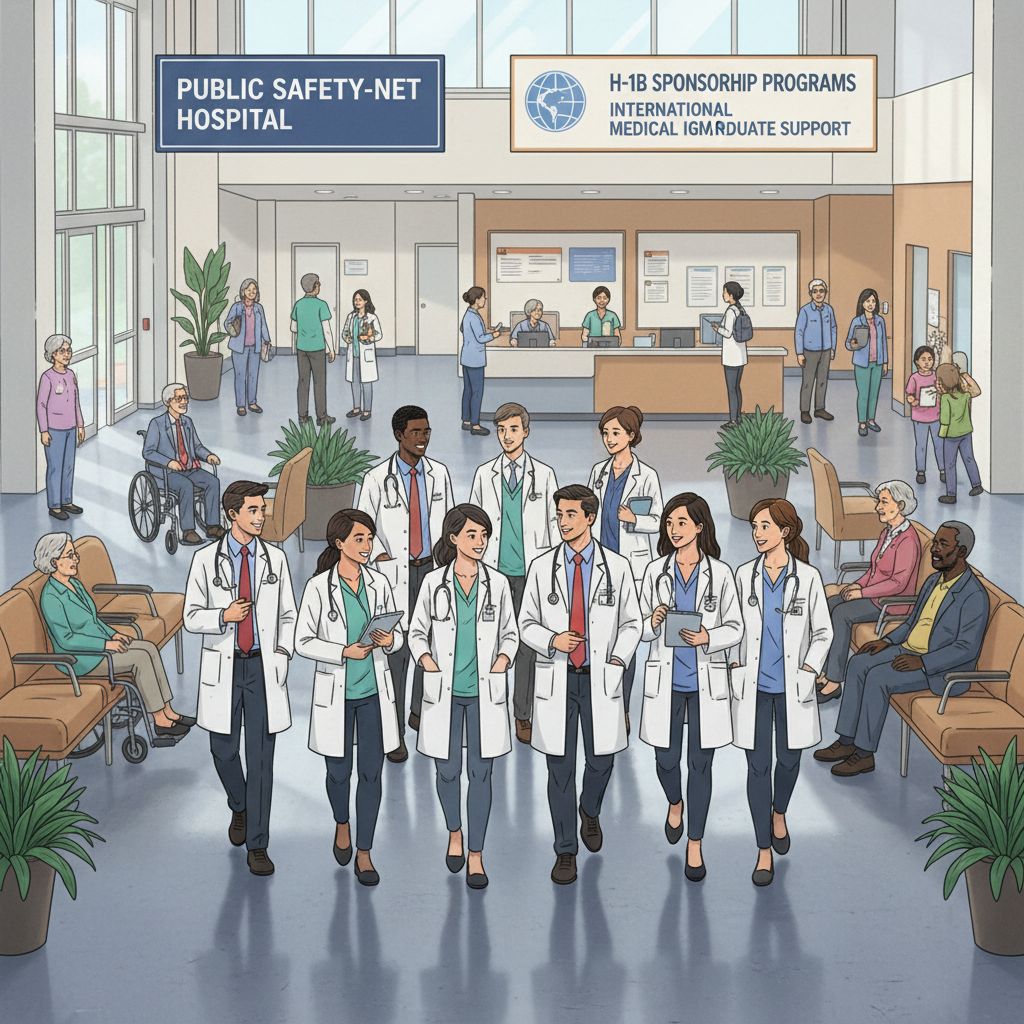
County hospitals and other safety net systems are some of the most IMG-friendly environments in US graduate medical education—and many of them are also among the most consistent H‑1B residency programs in the country. Understanding how H‑1B sponsorship works in these institutions can open powerful pathways for international medical graduates seeking training in the United States.
Below is a detailed, practical guide focused on H‑1B sponsorship programs within county hospital residency programs, including how these programs work, what H‑1B cap exempt means in this context, and strategies to identify and match into these positions.
Understanding County Hospitals and Safety Net Residency Programs
County hospitals and affiliated health systems are typically:
- Publicly funded or operated by local governments (county or city)
- Designated safety net hospitals, caring for large volumes of uninsured, underinsured, Medicaid, and vulnerable populations
- Frequently affiliated with university medical schools or academic consortia
- Located in urban or semi-urban areas, often in major metropolitan regions
Examples (for orientation only; always verify current policies):
- Los Angeles County + USC Medical Center
- Cook County Health (Stroger Hospital of Cook County)
- NYC Health + Hospitals facilities affiliated with academic centers
- Harris Health (Ben Taub, LBJ) in Houston
- Jackson Health System in Miami
For residency applicants, especially IMGs, county and safety net hospitals are attractive because they often:
- Serve high patient volumes (excellent clinical exposure)
- Have missions centered on health equity and underserved care
- Maintain historically IMG-friendly recruitment patterns
- Operate under structures that frequently allow H‑1B cap exempt sponsorship
This combination often makes them key components of any H‑1B sponsor list that IMGs build when planning their residency applications.
The Basics of H‑1B Sponsorship in County Hospital Residency Programs
H‑1B vs J‑1 in Residency
For residency and fellowship, non‑US citizen/IMG applicants typically train on either:
J‑1 visa (ECFMG-sponsored)
- Most common for residency and fellowship
- Requires eventual two‑year home country physical presence or a waiver
- Simpler and cheaper for programs to implement
H‑1B visa (employer‑sponsored)
- “Specialty occupation” visa, allows dual intent (pathway toward green card)
- Often preferred by IMGs planning long‑term US careers
- More expensive and bureaucratically complex for the hospital/program
Because H‑1B sponsorship requires more time, legal work, and cost, many community hospitals and small programs are reluctant to do it. By contrast, large county hospital residency programs are often structurally better equipped to handle H‑1B sponsorship, especially where:
- There is a strong academic affiliation with a university or medical school
- A centralized GME office and legal/immigration services exist
- The hospital/health system has prior experience sponsoring H‑1B or O‑1 visas
What “H‑1B Cap Exempt” Means in County Settings
The standard H‑1B is subject to an annual numerical cap (65,000 regular + 20,000 US master’s degree pool). However, some employers are H‑1B cap exempt, meaning they can file H‑1B petitions at any time of the year without being limited by the lottery or annual cap.
Cap-exempt organizations generally include:
- Institutions of higher education (universities, colleges)
- Nonprofit entities affiliated with institutions of higher education
- Nonprofit research organizations or governmental research organizations
Many county hospital systems:
- Are tightly affiliated with a public or private university (e.g., a medical school)
- Operate as nonprofit or public entities that qualify as affiliated organizations
When a county hospital residency program falls under one of these structures, it often qualifies as H‑1B cap exempt, meaning:
- Residents can start training on H‑1B without waiting for the April lottery
- The hospital can file H‑1B petitions outside the usual filing window
- Transitions to fellowship or subsequent academic employment can be more flexible
This is a major advantage for IMGs selecting safety net hospital residency programs, because it reduces the uncertainty of the H‑1B lottery.
Why County and Safety Net Hospitals Are Often Strong H‑1B Options
Mission and Workforce Needs
Safety net and county hospitals:
- Care for large numbers of Medicaid, uninsured, and underserved patients
- Rely heavily on resident physicians to deliver frontline care
- Face persistent workforce shortages in areas like primary care, internal medicine, psychiatry, and general surgery
Given these realities, many such programs:
- Have long histories of recruiting international medical graduates
- Value linguistic and cultural diversity that IMGs often bring
- Are more willing to sponsor H‑1B status to recruit and retain strong applicants
Academic and Legal Infrastructure
Compared with smaller community hospitals, county programs often:
- Have an academic affiliation with a medical school that facilitates cap-exempt status
- Maintain in‑house or contracted immigration lawyers or HR teams familiar with H‑1B processes
- Have established internal policies and procedures for H‑1B residency programs
This infrastructure reduces the burden and confusion for program directors, making them more open to H‑1B sponsorship for qualified candidates.
Established Track Records
Many county programs:
- Publicly state their visa sponsorship policies on program websites
- Showcase current or recent residents on H‑1B visas
- Are repeatedly mentioned in online communities and forums as IMG‑friendly and willing to sponsor H‑1B
Because of this, county hospitals are often foundational entries on a personalized H‑1B sponsor list that IMGs build during their application strategy planning.

How H‑1B Sponsorship Works in County Hospital Residency Programs
Key Eligibility Criteria
While specific details vary by institution and specialty, county hospital residency programs that sponsor H‑1B typically share several requirements:
USMLE Completion
- Almost always require USMLE Step 1, Step 2 CK, and often Step 3 before H‑1B filing
- Some programs will interview J‑1 and H‑1B candidates but only sponsor H‑1B if Step 3 is passed before rank list certification
ECFMG Certification
- Must have ECFMG certification by the start of residency (often required by the time rank lists are made)
Accredited Medical School and Graduation Date
- Graduation from a recognized medical school (WDOMS listed)
- Many county programs accept wider graduation year ranges than elite academic centers, which is beneficial for older graduates
English Proficiency and Clinical Readiness
- Strong communication skills (essential for high‑complexity, underserved settings)
- Evidence of US clinical experience (USCE) is often valued, especially in inpatient or safety net settings
Steps in the H‑1B Sponsorship Process for Residents
Offer and Match
- You match into a residency program that has indicated willingness to sponsor H‑1B.
Internal Eligibility Check
- GME office confirms that you:
- Have passed USMLE Step 3 (if required)
- Hold valid ECFMG certification
- Have no issues with prior visa status or unlawful presence
- GME office confirms that you:
Decision: H‑1B vs J‑1
- Some county programs give IMGs a choice; others strongly prefer J‑1 due to cost or institution policy.
- If you are eligible and the program agrees, the hospital’s HR/immigration office initiates H‑1B processing.
Petition Preparation
- Hospital/immigration counsel prepares:
- Labor Condition Application (LCA)
- Form I‑129 and H supplement
- Educational credentials, license/permit, ECFMG, Step scores
- You may need to provide:
- Passport copies
- Degree and transcripts
- Previous visa documentation (if any)
- Hospital/immigration counsel prepares:
Cap-Exempt Filing
- Because most county hospital residency programs are H‑1B cap exempt, they can:
- File petitions anytime once documents are ready
- Request start dates aligned with GME (typically July 1)
- Because most county hospital residency programs are H‑1B cap exempt, they can:
Consular Processing / Change of Status
- If you are outside the US:
- Use approved petition to apply for an H‑1B visa at a US consulate
- If you are inside the US on another status (e.g., F‑1 OPT, J‑1):
- A change of status may be requested if rules allow
- If you are outside the US:
Start of Training
- On approval, you begin residency under H‑1B with typical initial duration of 1–3 years, extendable up to a total of six years (with some exceptions if in green card process).
Identifying County Hospital Programs That Sponsor H‑1B
Building your own H‑1B sponsor list specifically focused on county and safety net hospitals is essential. Use a structured approach:
1. Start with ACGME and Program Websites
- Search the ACGME database and filter by program type (e.g., Internal Medicine, Pediatrics, Psychiatry) and location.
- Visit each program’s official website and look for:
- “International Medical Graduates” or “Visa Sponsorship” sections
- FAQs for applicants
- GME office pages for the health system or county network
Common statements to look for:
- “We sponsor J‑1 and H‑1B visas for eligible candidates.”
- “H‑1B considered for exceptional candidates who have passed USMLE Step 3.”
- “We are a cap-exempt institution associated with [University] and may sponsor H‑1B.”
2. Distinguish True County/Safety Net Programs
Clues that a program is part of a county or safety net system:
- The hospital name includes “County,” “Health + Hospitals,” or similar
- Described as a public hospital, “safety net,” or “indigent care” provider
- Heavy emphasis on underserved, Medicaid, or immigrant populations
- Affiliation with state universities (e.g., “University of Texas,” “State University of New York”) or major public school systems
These features often correlate with H‑1B cap exempt status, enhancing your chances of obtaining H‑1B for residency.
3. Contact GME/Program Coordinators Directly
If the website is unclear, email the program coordinator or GME office. Ask concise, targeted questions, for example:
“I’m an ECFMG-certified IMG planning to apply to your Internal Medicine program. Could you please clarify your current visa policies? Specifically, do you sponsor H‑1B visas for residents, and if so, do you require USMLE Step 3 to be completed before ranking candidates?”
This:
- Signals that you are organized and informed
- Allows you to adjust your application strategy based on actual policy
Always keep responses documented to guide your H‑1B residency programs list.
4. Use Networking and Alumni Insights
- Connect with current or recent residents (especially IMGs) via:
- Specialty‑specific forums and IMG groups
- Medical school alumni connections
- Ask:
- “Were you or your colleagues on H‑1B during residency?”
- “Did the hospital file H‑1B as cap exempt?”
- “Any specific challenges you faced regarding visas?”
Patterns of responses help validate whether the institution is truly H‑1B‑friendly.

Strategic Tips for IMGs Seeking H‑1B in County Hospital Residencies
1. Plan Early Around USMLE Step 3
For most H‑1B residency programs, particularly in county systems:
- Passing USMLE Step 3 before rank order list certification dramatically increases your chances of being considered for H‑1B.
- Step 3 demonstrates:
- Readiness for independent clinical responsibility
- Seriousness about long-term US career planning
- Compliance with state licensure and institutional rules
Actionable advice:
- If you are targeting H‑1B:
- Schedule Step 3 as soon as practically possible after Step 2 CK
- Aim to have the result available by December–January of application season
- Inform programs in your ERAS application and personal statements when your exam is scheduled
2. Tailor Your Program List Around Visa Realities
As an IMG interested in county hospital residency and H‑1B sponsorship, consider dividing your program list into tiers:
Tier A – County/Safety Net Programs that Explicitly Sponsor H‑1B
- Core of your strategy
- High priority for interviews and ranking
Tier B – Academic Programs with Safety Net Affiliations Open to Both H‑1B and J‑1
- Provides flexibility (you may accept J‑1 if H‑1B not feasible)
Tier C – Strong J‑1 Only Programs You Would Still Be Happy To Join
- Competitive training and potential later J‑1 waiver jobs in underserved areas
This structure ensures you don’t over‑concentrate applications solely on H‑1B programs, maintaining a balanced match strategy.
3. Emphasize Fit With Underserved, High‑Acuity Care
County hospital residency programs want residents who:
- Are comfortable working with diverse, low-resource, and often complex patient populations
- Have a demonstrated commitment to underserved care, health equity, or public health
- Can manage high patient volumes and emotionally challenging situations
To stand out:
- Highlight any experience in:
- Public or government hospitals in your home country
- Rural or low‑resource clinical work
- Free clinics, community outreach, or immigrant health organizations
- In personal statements and interviews:
- Articulate clearly why you want to train in a safety net hospital
- Describe specific examples of caring for underserved patients
This alignment between your profile and the mission of the program can make committees more willing to invest in the effort and cost of H‑1B sponsorship.
4. Understand Long‑Term Immigration Planning
Training at a cap-exempt H‑1B county hospital has both advantages and nuances:
Pros:
- No lottery uncertainty for your initial residency
- Often smoother transitions to cap-exempt fellowships or academic hospitalist jobs
- Dual intent allows you to begin green card processes sooner if employer-sponsored
Considerations:
- Moving later to a for‑profit, cap‑subject employer (e.g., some private practices) requires:
- Winning a cap‑subject H‑1B lottery, or
- Alternative immigration strategies (O‑1, NIW, family sponsorship, etc.)
- You must always maintain compliance with H‑1B rules (hours, duties, site of employment).
- Moving later to a for‑profit, cap‑subject employer (e.g., some private practices) requires:
Working with an experienced immigration attorney early in your career is wise, especially if you intend to remain in the US long term.
Frequently Asked Questions (FAQ)
1. Are all county hospital residency programs H‑1B cap exempt?
No. Many county and safety net hospitals are cap exempt because they are:
- Public or nonprofit institutions
- Affiliated with universities or medical schools
However, not every county hospital automatically qualifies. Some:
- Function as independent entities with different legal structures
- Choose not to utilize cap‑exempt H‑1B sponsorship despite eligibility
Always confirm cap-exempt status and H‑1B policies directly with the GME office or program administration.
2. Do all county hospital residencies that sponsor H‑1B require Step 3 before the Match?
Most do require USMLE Step 3 to proceed with H‑1B, but timing varies:
- Some require Step 3 before offering interviews
- Others allow you to interview but require Step 3 to be passed before rank list submission
- A smaller number may consider post‑Match completion, but this is becoming less common due to administrative and timing constraints
For the strongest position, plan to complete Step 3 before or early in application season, especially if you are specifically targeting H‑1B residency programs.
3. Is J‑1 or H‑1B better for IMGs training in county hospitals?
It depends on your long‑term goals:
- J‑1:
- More widely accepted and simpler for programs
- Requires a two‑year home residence or a J‑1 waiver job, often in an underserved area (which may align well with your safety net interest)
- H‑1B:
- Allows dual intent and more direct pathways to permanent residency
- Avoids the J‑1 home residency requirement
- May be more complex and competitive to secure
If your top priority is flexibility for long-term US immigration, H‑1B is often preferable. If your priority is maximizing match chances across a wide range of programs, J‑1 opens many more doors. Some IMGs apply broadly, then decide between H‑1B and J‑1 based on where they match.
4. How can I confirm if a specific county program was on an H‑1B sponsor list previously?
There is no single official, comprehensive H‑1B sponsor list for residency programs. To infer historical sponsorship:
- Search online for:
- “[Hospital name] H‑1B” or “[Program name] visa sponsorship”
- Publicly filed H‑1B data (some websites aggregate Department of Labor records)
- Review:
- Program alumni or resident bios (often note visa status or international background)
- IMG forums and mentoring groups where residents share experiences
- Contact:
- Current residents or recent graduates via LinkedIn or alumni networks
- Program coordinators directly
Remember that policies change over time, especially with shifting institutional budgets or federal immigration climate, so always verify current practices with the program during your application cycle.
County hospital and safety net residency programs are central players in the landscape of H‑1B cap exempt training opportunities for IMGs. With thoughtful planning around USMLE Step 3, careful program list construction, and a strong narrative aligned with underserved care, you can significantly improve your chances of securing an H‑1B‑sponsored residency in these vital institutions.