Understanding H-1B Sponsorship in Addiction Medicine for Caribbean IMGs
For many Caribbean international medical graduates (IMGs), especially those from schools like SGU, Ross, AUC, Saba, and AUA, securing a U.S. training position in addiction medicine under an H-1B visa can feel confusing and high-stakes. You must navigate immigration rules, program policies, and evolving fellowship requirements—while competing with both US grads and other IMGs.
This guide walks you step-by-step through how H-1B sponsorship works for residency and fellowship, how it specifically applies to addiction medicine, and what Caribbean IMGs can do strategically to maximize their chances. It focuses on:
- Using your Caribbean medical school residency experience as a strength
- Understanding which programs realistically sponsor H-1B
- Planning a pathway into addiction medicine (fellowship or practice-focused)
- Finding H-1B-friendly institutions and H-1B cap exempt options
- Building a targeted application strategy as a Caribbean IMG
Throughout, you’ll see practical examples tailored to Caribbean graduates and to addiction medicine as a specialty.
H-1B Basics for Caribbean IMGs in Clinical Training
What is the H-1B Visa in the Residency Context?
For medical training, the H-1B is a temporary worker visa that allows you to work in a “specialty occupation” in the U.S. In GME (residency/fellowship), that typically means:
- You have completed and passed all USMLE Steps required for state licensure (at minimum, Step 1, Step 2 CK, often Step 3)
- You hold an MD/MBBS equivalent that’s acceptable for ECFMG certification
- A program sponsors and petitions USCIS for you to work as a physician trainee
Key points relevant to Caribbean medical school residency applicants:
- Dual Intent: H-1B formally allows “dual intent” (you can pursue a green card later) unlike J-1.
- Dependents: Spouse/children get H-4 status (no work authorization for spouse in most cases).
- Duration: Typically granted in 3-year increments, with a 6-year total limit (some exceptions).
H-1B vs J-1 for Addiction Medicine Pathways
Most IMGs train on a J-1 clinical visa sponsored by ECFMG. The J-1 is common and widely accepted, but carries the two-year home residency requirement unless you later obtain a J-1 waiver.
For addiction medicine, the visa choice affects your long-term options:
If you choose J-1 for residency:
- Pros:
- Many more programs accept J-1 than H-1B.
- ECFMG sponsorship is relatively standardized.
- Cons:
- You may need a J-1 waiver job after fellowship (often in underserved areas).
- You must plan for the 2-year home requirement or a waiver path.
If you choose H-1B for residency or fellowship:
- Pros:
- No automatic 2-year home requirement.
- Smoother path toward H-1B cap exempt academic positions and potentially a green card.
- Some addiction medicine fellowships and academic centers prefer or only sponsor H-1B for certain roles.
- Cons:
- Fewer programs sponsor H-1B, especially for initial residency.
- You must pass USMLE Step 3 before H-1B residency start (often required before ranking).
- Higher institutional cost and more administrative burden.
For many Caribbean IMGs, an optimal strategy is:
- J-1 for core residency (e.g., Internal Medicine, Family Medicine, or Psychiatry), then
- H-1B for faculty or addiction medicine fellowship if institutionally allowed, or
- H-1B for residency at select programs that are known sponsors, positioning you for smooth transition into addiction medicine.
Pathways to Addiction Medicine for Caribbean IMGs
How Do You Reach Addiction Medicine?
Addiction medicine in the U.S. is primarily accessed in two ways:
- Subspecialty Fellowship (most common structured route)
- Direct Clinical Pathway + Certification (practice + exam, less structured, evolving as addiction medicine matures as a specialty)
At the residency level, there is no ACGME-accredited categorical “Addiction Medicine Residency.” Instead, addiction medicine is a subspecialty that typically requires completion of a primary residency first.
Common primary specialties that lead to addiction medicine:
- Internal Medicine
- Family Medicine
- Psychiatry
- Pediatrics
- Emergency Medicine
- Obstetrics & Gynecology
- Preventive Medicine / Public Health
As a Caribbean IMG, especially if you are a recent Caribbean medical school residency applicant (or future applicant), the most IMG-friendly paths typically are:
- Internal Medicine → Addiction Medicine Fellowship
- Family Medicine → Addiction Medicine Fellowship
- Psychiatry → Addiction Psychiatry / Addiction Medicine Fellowship
All of these can be done under J-1 or H-1B, but the availability of H-1B residency programs varies by specialty and institution.
Addiction Medicine Fellowship and H-1B
An addiction medicine fellowship is usually 1–2 years and is increasingly ACGME-accredited. Many academic centers that sponsor addiction medicine fellows are H-1B cap exempt (universities, university-affiliated hospitals, non-profit health systems).
This is significant:
- Cap-exempt employers (universities, non-profit teaching hospitals, some research institutions):
- Can file H-1B visas any time of year.
- Are not subject to the annual H-1B numerical cap.
- For addiction medicine, many fellowships are attached to:
- Academic medical centers
- VA hospitals
- University-based psychiatric or internal medicine departments
These institutions are often more familiar with sponsoring H-1B for trainees, including addiction medicine fellows. That means:
- If you can complete residency (even on J-1) and switch to H-1B for fellowship, you might:
- Avoid later J-1 waiver challenges.
- Position yourself longer-term at a cap-exempt academic or teaching role in addiction medicine.

H-1B Residency Programs: What Caribbean IMGs Need to Know
The Reality: Not All Programs Sponsor H-1B
Programs vary widely in how they approach visa sponsorship:
J-1 Only Programs
- Most community programs fall here.
- Simpler, cheaper, and familiar; they explicitly state “J-1 visa only.”
J-1 and H-1B Programs
- Common at large academic centers, university hospitals, and some well-resourced community systems.
- Often sponsor H-1B for exceptional IMG candidates, especially if they:
- Passed Step 3 early
- Have strong US clinical experience
- Fit a specific institutional need (e.g., addiction-related research or clinical interest)
No Visa Sponsorship
- A minority of programs sponsor no visas due to funding or policy constraints.
For a Caribbean IMG aspiring to addiction medicine, focusing on H-1B-friendly Internal Medicine, Family Medicine, or Psychiatry programs is strategic—especially at institutions that also offer addiction medicine fellowship.
H-1B Cap Exempt vs Cap Subject in Residency
Understanding H-1B cap rules is critical:
Cap Subject employers:
- Private practices, many community hospitals not affiliated with universities.
- Limited by the federal H-1B cap lottery.
- Harder to predict and usually not used for residency.
Cap Exempt employers:
- Universities, university-affiliated teaching hospitals, non-profit research organizations, and many major academic centers.
- Can file H-1B at any time, with no numerical annual limit.
- Most H-1B residency programs and fellowships for IMGs are cap exempt.
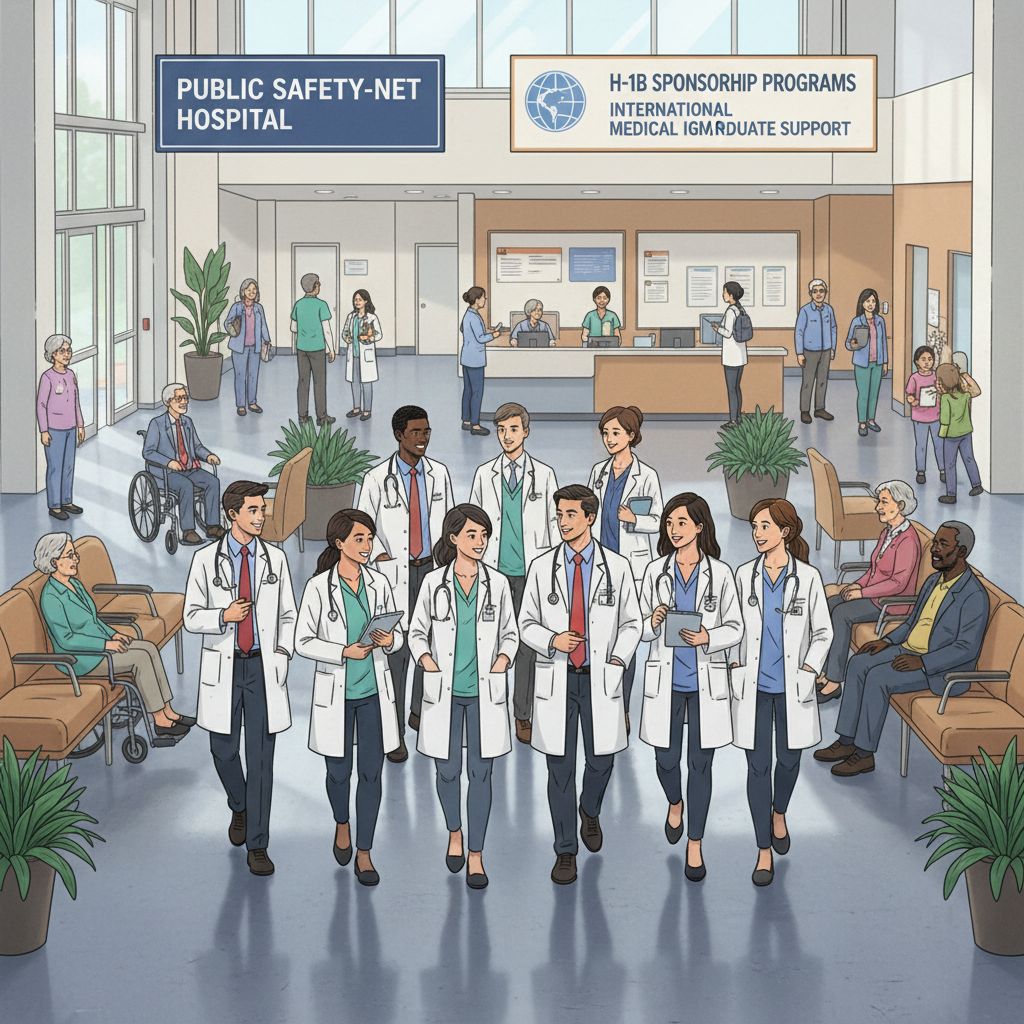
Addiction medicine is heavily centered in academic, teaching, and safety-net institutions, which tend to be cap exempt. This is good news for you:
- Once you secure H-1B in a cap-exempt residency, you can often:
- Continue in addiction medicine fellowship at the same or related cap-exempt employer.
- Transition into an academic or hospitalist/addiction medicine hybrid role on cap-exempt H-1B.
Building an H-1B Sponsor List for Addiction Medicine-Oriented IMGs
There is no official centralized H-1B sponsor list for residency and addiction medicine, but you can build an effective working list:
Use FREIDA and Program Websites
- Filter for IMG-friendly internal medicine, family medicine, and psychiatry programs.
- Check program “Visa” sections:
- Look for “H-1B sponsored” or “J-1 and H-1B.”
- Note which institutions also list:
- Addiction medicine services
- Substance use disorder clinics
- Consult-liaison psychiatry with addiction focus
Review Addiction Medicine Fellowship Rosters
- Identify academic centers that:
- Have addiction medicine fellowships and
- Accept IMGs or list H-1B as an acceptable visa choice.
- Then check whether their core residencies sponsor H-1B.
- Identify academic centers that:
Search Public H-1B Data
- Government databases and sites like “H1BGrader,” “MyVisaJobs,” etc. often list:
- Which hospitals/universities have historically filed H-1B petitions for physicians.
- Cross-reference with institutions that:
- Have addiction medicine fellowships and
- Offer residency in IM, FM, or psychiatry.
- Government databases and sites like “H1BGrader,” “MyVisaJobs,” etc. often list:
Network with Current Caribbean IMGs and Alumni
- Leverage SGU residency match outcome reports and similar match lists from Caribbean schools.
- Identify:
- Which hospitals repeatedly match Caribbean grads in IM, FM, or psychiatry.
- Ask alumni directly about H-1B and institutional practice.
You’ll end up with a personal, up-to-date H-1B sponsor list tailored to:
- Your specialty focus (e.g., internal medicine → addiction medicine)
- Institutions with addiction services/fellowships
- Historically IMG-friendly academic centers
Targeted Application Strategy for Caribbean IMGs
Step 1: Clarify Your Addiction Medicine Angle
Programs pay attention to coherent career narratives. For a Caribbean IMG aiming for addiction medicine, your story might emphasize:
- Clinical experiences with substance use disorders during Caribbean medical school or clerkships
- Public health or research interests in opioid use, alcohol-related liver disease, adolescent substance use, or dual diagnosis
- Community outreach or advocacy in the Caribbean addressing substance abuse training, harm reduction, or mental health integration
You don’t need formal addiction medicine fellowship experience yet, but you do need:
- Concrete experiences
- Clear motivation
- Realistic understanding of the field
Step 2: Choose a Compatible Core Residency
Given addiction medicine’s breadth, consider:
- Internal Medicine: Strong for patients with complex medical comorbidities (e.g., alcohol-related cirrhosis, infections from IV drug use, chronic pain and opioid dependence).
- Family Medicine: Excellent for primary care-integrated addiction treatment, community settings, and rural/underserved populations.
- Psychiatry: Ideal for dual diagnosis (mental illness + addiction), forensic work, and integrated behavioral health.
For Caribbean IMGs, consider:
- Your USMLE scores and attempts
- Where Caribbean IMGs from your school have historically matched
- Which specialty gives you more realistic access to H-1B residency programs
For example:
- If your scores are solid and you have strong letters, an academic internal medicine or psychiatry program that sponsors H-1B may be feasible.
- With average scores but strong clinical evaluations, a community or university-affiliated family medicine program that accepts H-1B might be a better option.
Step 3: Make H-1B Requirements Part of Your Timeline
To be competitive for H-1B residency programs:
Pass USMLE Step 3 Early
- Many H-1B programs require Step 3 before ranking or before submitting your H-1B petition.
- As a Caribbean IMG, schedule Step 3:
- During your post-graduation gap, or
- Early in your PGY-1 year on J-1, if planning to convert to H-1B for fellowship or later.
Prepare Documents for Visa Screening
- ECFMG certification (including Step 1 and 2 CK, and OET if required).
- Accurate records of Caribbean medical school training and rotations.
- Clear explanation of any gaps or red flags.
Align Visa Status with Professional Goals
- If your long-term goal is a U.S. career in addiction medicine, think through:
- Are you comfortable with a J-1 → waiver job → addiction medicine sequence?
- Or do you want to pursue H-1B from residency onward to avoid waiver constraints?
- If your long-term goal is a U.S. career in addiction medicine, think through:
Step 4: Communicate Early with Programs
Before you invest heavily in an application, email or call program coordinators:
Confirm:
- “Do you sponsor H-1B visas for residents/fellows?”
- “Do you sponsor H-1B for Caribbean IMGs or only for US graduates?”
- “Do you require USMLE Step 3 before the rank list?”
Ask about:
- Evolving policies (some programs changed during/after COVID-19).
- Whether they have addiction-related clinical rotations or research.
This helps you:
- Avoid wasting applications on J-1-only programs if you must have H-1B.
- Identify hidden H-1B options, especially among H-1B cap exempt academic centers.

Addiction Medicine Training Opportunities and Visa Strategy
Integrating Substance Abuse Training into Residency
Even before fellowship, you can build a strong addiction background:
Choose programs that emphasize:
- Substance abuse training in continuity clinics
- Inpatient or consult services for alcohol withdrawal, opioid detox, overdose management
- Rotations in methadone programs, buprenorphine clinics, or community rehab centers
During residency, seek:
- Extra electives in addiction medicine
- Mentors involved in addiction research or quality improvement
- Participation in hospital addiction consult services (where available)
This positions you competitively when applying to an addiction medicine fellowship, whether under J-1 or H-1B.
Addiction Medicine Fellowship Visa Policies
Addiction medicine fellowships vary in visa policies:
Many academic, university-affiliated fellowships are open to:
- J-1 visa holders
- H-1B (especially if they are already an H-1B cap exempt employer)
As a Caribbean IMG, your fellowship application is stronger if:
- You trained at a teaching hospital known for addiction or behavioral health
- You can demonstrate scholarly work: posters, QI projects, or publications in addiction/substance use.
Ask each fellowship:
- “Do you sponsor H-1B for addiction medicine fellows?”
- “Have you previously sponsored Caribbean IMGs?”
- “Is your institution H-1B cap exempt?”
In many cases, addiction medicine fellowships at large university hospitals are comfortable sponsoring H-1B and may actually prefer it for long-term recruitment.
Example Pathways for a Caribbean IMG
Scenario 1 – H-1B from Residency → Addiction Medicine Fellowship
- Graduate from SGU with decent scores and strong US letters.
- Secure H-1B residency in Internal Medicine at a university-affiliated hospital with a robust addiction consult service.
- During residency:
- Do electives in addiction medicine.
- Work on a QI project around opioid prescribing.
- Apply to the institution’s addiction medicine fellowship, staying on cap exempt H-1B.
- After fellowship, transition to academic addiction medicine faculty at the same institution, continuing on H-1B and later pursuing a green card.
Scenario 2 – J-1 Residency → H-1B Fellowship
- Graduate from a Caribbean medical school with average scores but extensive psychiatry electives.
- Match into psychiatry residency on J-1 at an IMG-friendly community/university-affiliated program with strong addiction content.
- Build a strong addiction portfolio.
- Apply for addiction medicine fellowship at a major academic center that sponsors H-1B cap exempt fellows.
- Transition from J-1 to H-1B for fellowship (if permissible) and then remain on H-1B in an academic setting, potentially bypassing the traditional J-1 waiver job in a purely primary care role.
Scenario 3 – J-1 All the Way, Then Waiver in Addiction-Focused Role
- Caribbean IMG completes family medicine residency on J-1.
- Pursues addiction medicine fellowship on J-1.
- Seeks a J-1 waiver job in a community health center or FQHC with high addiction burden.
- Combines primary care and addiction medicine, then later transitions to H-1B or permanent residency.
Each path has trade-offs, but if your priority is maximum flexibility in an academic addiction medicine career, targeting H-1B-friendly, cap-exempt institutions early is often advantageous.
Practical Tips to Strengthen Your H-1B-Focused Application
Maximize Your Caribbean and US Clinical Experience
Leverage core and elective rotations that exposed you to:
- Alcohol-related conditions
- Opioid use disorder
- HIV/hepatitis in IV drug users
- Co-occurring psychiatric conditions
Arrange US clinical experience (USCE) in:
- Addiction clinics
- Psychiatry or internal medicine services with high substance use cases
- Community health centers serving vulnerable populations
Programs that know you’ve seen and managed substance use disorders are more willing to invest in your future as an addiction specialist—making an H-1B petition feel more worthwhile to them.
Target Letters of Recommendation
Aim for letters from:
- Faculty supervisors who saw you manage patients with addiction
- Program directors or department chairs in internal medicine, family medicine, or psychiatry who can speak to your:
- Professionalism
- Reliability
- Commitment to underserved populations
- Any mentor involved in addiction research, even if it was a small project or case report
These letters should explicitly support your trajectory toward addiction medicine fellowship or an addiction-focused career.
Emphasize Long-Term Institutional Fit
H-1B sponsorship is expensive and administratively intensive. Programs are more likely to sponsor if they believe:
- You will stay for the full training program
- You might remain long term as faculty or a hospitalist with addiction expertise
- You add value in areas that matter to them: addiction consults, teaching, quality improvement
Highlight:
- Plans to pursue addiction medicine fellowship, ideally within their institution or network
- Interest in teaching medical students and residents about substance use disorders
- Commitment to working with underserved or high-need communities
Frequently Asked Questions (FAQ)
1. As a Caribbean IMG, is it realistic to get an H-1B residency that leads to addiction medicine?
Yes, but it is competitive and requires planning. You will need:
- Strong USMLE scores (including Step 3 before ranking at many programs)
- Solid US clinical experience and letters, preferably with substance abuse training exposure
- Strategic targeting of H-1B cap exempt academic programs in internal medicine, family medicine, or psychiatry
You should apply broadly, include J-1-friendly programs, and keep alternative paths open, but an H-1B residency is realistic for well-prepared Caribbean IMGs.
2. Can I switch from J-1 to H-1B for an addiction medicine fellowship?
In some cases, yes, especially if:
- The addiction medicine fellowship institution sponsors H-1B and is cap exempt
- You meet USMLE and licensing requirements for H-1B
- The institution is comfortable with your prior J-1 status
However, visa rules and institutional policies are complex and time-sensitive. Always consult:
- Your institution’s GME office
- An experienced immigration attorney specializing in physicians
3. Do all addiction medicine fellowships sponsor H-1B?
No. Addiction medicine fellowships vary widely:
- Some are J-1 only
- Some accept J-1 and H-1B
- A few may not sponsor visas at all
You must individually check each fellowship’s policy, using:
- Program websites
- Direct emails to coordinators
- Mentor or alumni guidance
Fellowships affiliated with large academic centers are more likely to be H-1B-friendly and H-1B cap exempt.
4. How can I find programs that both sponsor H-1B and offer strong addiction medicine training?
Use a stepwise approach:
- Identify addiction medicine fellowships via ACGME and professional organizations (e.g., American College of Academic Addiction Medicine).
- List their parent institutions and look up their core residencies in IM, FM, and psychiatry.
- Verify via FREIDA and program websites whether these residencies sponsor H-1B.
- Cross-check with public H-1B data to confirm that the institution has a history of H-1B petitions for physicians.
- Reach out directly to programs to confirm current H-1B residency programs policies.
By focusing on institutions with a pattern of addiction-focused services and prior H-1B sponsorship, you create a targeted and realistic route from Caribbean medical school residency training to a U.S. career in addiction medicine.