For Caribbean international medical graduates, the Great Lakes region offers a uniquely balanced landscape of strong training, diverse patient populations, and relatively robust H-1B sponsorship options. Navigating which programs will truly support an H-1B—and how that differs from J-1—can make or break your match strategy, especially if you’re coming from a Caribbean medical school residency pipeline like SGU, Ross, AUC, Saba, or AUA.
This guide will walk you through how H-1B sponsorship works in practice, which Great Lakes states and program types are more IMG‑friendly, how to research concrete H-1B sponsor lists and “cap-exempt” institutions, and how to design a smart application strategy as a Caribbean IMG.
Understanding H-1B Sponsorship in Residency (Caribbean IMG Focus)
H-1B sponsorship is more than a checkbox on a program website; it has practical, legal, and timing implications that are especially important for IMGs.
H-1B vs J-1: Why H-1B Matters for Many Caribbean IMGs
Most IMGs train on J‑1 visas sponsored by ECFMG, but many Caribbean graduates aim for an H‑1B residency for three key reasons:
No two-year home country requirement
J‑1 physicians must usually return to their home country for two years (or complete a waiver job) before getting certain US immigration benefits. H‑1B has no such requirement, giving more flexibility for:- Direct fellowship entry
- Transition to employment in competitive metro areas
- Earlier green card sponsorship
Easier transition to long-term US practice
With H‑1B, you can remain on the same status for fellowship and early attending positions, especially with H‑1B cap-exempt hospitals and universities.More leverage for career planning
H‑1B can sometimes simplify:- Employer-based green card sponsorship
- Moving between academic centers
- Planning a life in the US with fewer geographic constraints
Core Requirements for H-1B Residency Sponsorship
Residency programs that offer H‑1B have to meet strict requirements. As a Caribbean IMG, you must be prepared to meet these before the H‑1B petition is filed:
- USMLE Step 1 and Step 2 CK: Both passed, and increasingly:
- Many H‑1B programs want Step 3 passed before ranking you.
- Valid ECFMG Certification at the time of visa filing.
- State medical licensure or training permit eligibility, which often requires:
- Primary source verification
- Minimum USMLE attempts and score thresholds
Because of the Step 3 expectation, H‑1B resident positions tend to go to:
- Strongly prepared IMGs with early USMLE completion
- Candidates from structured Caribbean medical school residency pipelines (e.g., SGU residency match outcomes show that early exam planning is common among successful applicants)
Cap-Subject vs Cap-Exempt H-1B: Critical Distinction
For residency, almost all H‑1Bs are cap-exempt, which is good news.
Cap-exempt H-1B:
- Filed any time of year
- Not limited by the national H‑1B lottery
- Available through:
- Nonprofit hospitals affiliated with universities
- Academic medical centers
- Certain research institutions
Cap-subject H-1B:
- Limited number nationwide per year (regular H‑1B lottery)
- Filing tied to the annual April lottery
- Rarely used for residency
Most university-affiliated Great Lakes residency programs are H‑1B cap-exempt, making them highly valuable targets for Caribbean IMGs.
The Great Lakes Region Landscape for Caribbean IMGs on H-1B
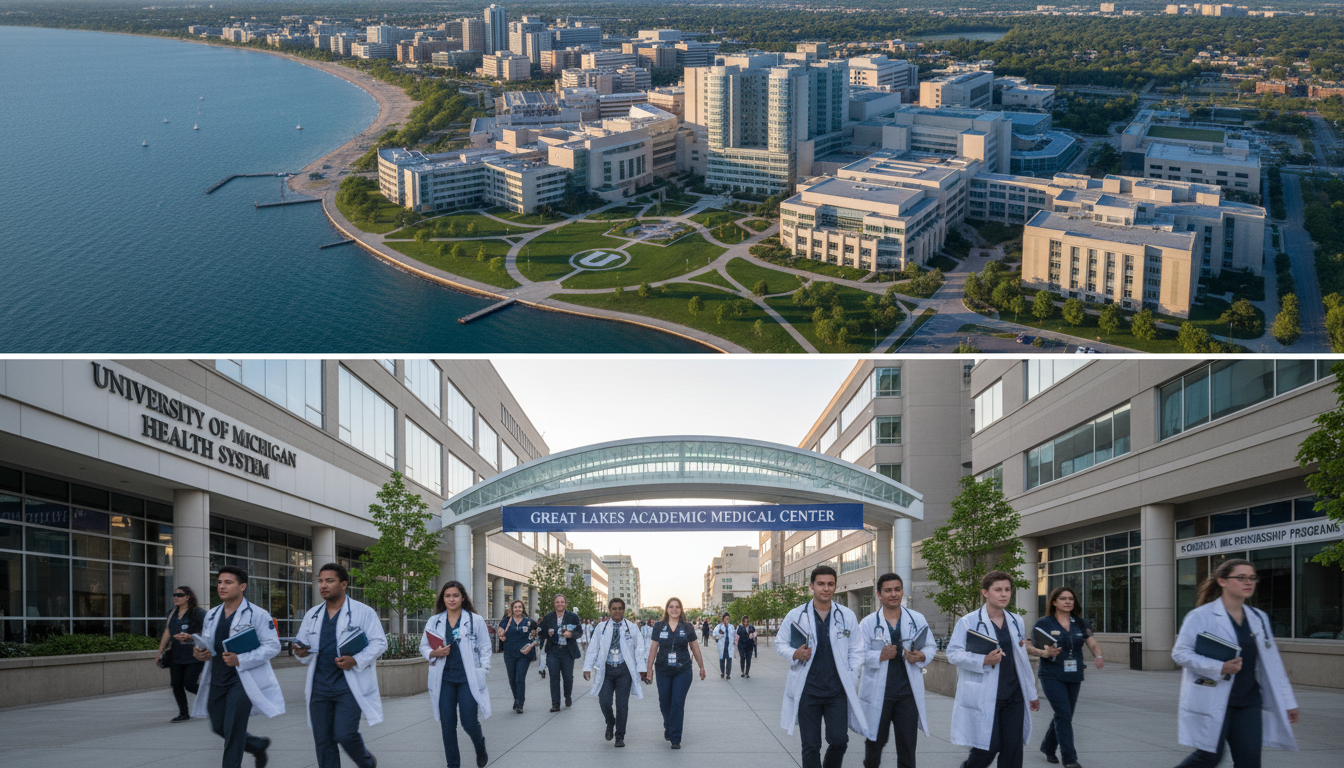
The Great Lakes region—commonly including Illinois, Michigan, Ohio, Wisconsin, Indiana, and Minnesota—is rich in academic centers, safety-net hospitals, and community programs with high IMG representation.
Why the Great Lakes Region Is Attractive for H-1B-Seeking Caribbean IMGs
High density of academic medical centers
These are more likely to:- Be H‑1B cap-exempt
- Maintain a formal H-1B sponsor list for residents
- Have experienced GME offices that know how to navigate IMG visas
IMG-friendly program histories
Many Great Lakes internal medicine, family medicine, pediatrics, and psychiatry programs:- Regularly match IMGs
- Include Caribbean IMG alumni
- Have long-standing visa sponsorship structures
Cost of living and lifestyle
Cities like Cleveland, Detroit, Milwaukee, Indianapolis, and several mid-sized “great lakes residency” hubs offer:- Lower cost of living than coastal metros
- Diverse patient populations
- Reasonable access to major airports, cultural communities, and Caribbean diaspora networks
Strong connection to Caribbean medical schools
Some Great Lakes hospitals have formal or informal relationships with large Caribbean schools. SGU residency match data and other Caribbean medical school residency outcomes show consistent placements in:- Midwest residency programs
- Great Lakes internal medicine and FM residencies
- Community-based academic centers open to IMGs
State-by-State Overview: Great Lakes H-1B Residency Opportunities
Below is a strategic overview to help Caribbean IMGs prioritize where to look for H‑1B-friendly programs.
Illinois: Chicago and Beyond
Why Illinois matters:
- Chicago is a major US medical hub with several academic centers.
- Many institutions are H‑1B cap-exempt and historically open to IMGs.
Typical H-1B-friendly features you’ll see:
- Large internal medicine and pediatrics residencies with diverse classes
- Safety-net and county hospitals with strong IMG presence
- Suburban midwest residency programs affiliated with universities
Practical strategies:
- Look for university-affiliated hospitals in Chicago and nearby regions.
- Review program websites for explicit “H‑1B sponsorship available” language.
- Search for current residents from Caribbean med schools like SGU, Ross, AUC, and Saba to assess IMG culture.
Ohio: A Strong Mix of Academic and Community Programs
Why Ohio is attractive:
- Multiple large health systems and Great Lakes residency programs:
- University-based centers
- Regional academic hospitals
- Community programs in mid-sized cities
- High IMG representation in internal medicine and family medicine.
H-1B landscape:
- Many of the larger university-affiliated centers are H‑1B cap-exempt.
- Some community-affiliated programs may sponsor H‑1B on a case-by-case basis.
Tips for Caribbean IMGs:
- Target programs in Cleveland, Columbus, Cincinnati, Toledo, Dayton, Akron, and Youngstown.
- Check GME policy manuals for H‑1B mention; some will specify:
- “We sponsor J-1 and H-1B (for qualified applicants with USMLE Step 3).”
Michigan: Great Lakes Residency with High IMG Presence
Why Michigan stands out:
- Several big academic centers and numerous community-based midwest residency programs.
- Long history of recruiting IMGs for primary care specialties.
H-1B sponsorship realities:
- Major university-affiliated systems are typically cap-exempt.
- Some community hospitals also sponsor H‑1B but may prioritize J‑1 unless you’re an exceptional candidate.
Advice for Caribbean graduates:
- Consider metro Detroit, Lansing, Grand Rapids, and mid-sized cities near the Great Lakes.
- Search program rosters for Caribbean IMG alumni (SGU, AUC, etc.).
- Email GME offices to confirm whether they are on an H-1B sponsor list and what their Step 3 expectations are.
Wisconsin, Indiana, and Minnesota: Smaller Markets, Significant Opportunities
Wisconsin:
- Mix of academic centers and strong community programs.
- Some large systems are H‑1B cap-exempt and used to working with IMGs.
- Well-known for friendly midwestern culture and accessible living.
Indiana:
- Growing healthcare systems and a number of mid-size city residencies.
- Some academic centers offer H‑1B; others are J‑1 only.
- Good option for internal medicine, family medicine, and transitional year.
Minnesota:
- High-quality training programs with solid reputations.
- University affiliations can create H‑1B cap-exempt structures, but:
- Some programs prefer or restrict to J‑1 due to state or institutional policies.
- Competitive but worth targeting if your application is strong.
Common thread in these three states:
- Your success hinges on:
- Early communication with GME offices
- Confirming explicit H-1B sponsorship
- Showing that you already meet Step 3 and ECFMG requirements
Finding H-1B Friendly Programs: Research Strategy for Caribbean IMGs
Instead of guessing where to apply, approach your search methodically.

Step 1: Use Public Data and Match Information
Leverage publicly available resources to identify IMG-friendly and possible H‑1B-friendly programs:
NRMP and FREIDA:
- Use filters for “IMG percentages,” program size, and region.
- Many Great Lakes programs with high IMG percentages are more open to visas.
Caribbean medical school residency outcome reports:
- SGU residency match lists
- AUC, Ross, Saba, AUA match outcomes
- Search for midwest residency programs and great lakes residency placements.
- Programs that recurrently appear on SGU residency match or other Caribbean school lists are often open to IMGs and sometimes to H‑1B.
Program websites:
- Look for explicit lines such as:
- “We sponsor J‑1 and H‑1B visas.”
- “We generally do not sponsor H‑1B.”
- Some may list “visa types accepted” under FAQ or International Graduates.
- Look for explicit lines such as:
Step 2: Identify H-1B Cap-Exempt Institutions
As a Caribbean IMG, targeting H‑1B cap-exempt organizations dramatically increases your chance of sponsorship and flexibility.
Signs that an institution is likely cap-exempt:
- Direct affiliation with a university medical school
- Classified as a nonprofit academic medical center
- Active in research and graduate medical education
How to verify:
- Check the institution’s website for:
- “Nonprofit 501(c)(3)” status
- “Affiliated with [University Name] School of Medicine”
- Search USCIS or legal blogs for that hospital’s name + “H‑1B cap exempt”
- Talk to current residents; they often know whether H‑1B residents exist in the program.
Step 3: Build Your Own “H-1B Sponsor List”
Do not rely solely on random online compilations. Create your own H‑1B sponsor list specifically for Great Lakes:
Start with 30–50 programs in your specialty in the region.
For each program:
- Record:
- Visa policy from their site (J‑1 only? J‑1 + H‑1B?)
- Whether they mention Step 3 requirement
- University affiliation (cap-exempt likelihood)
- Flag:
- “Confirmed H‑1B”
- “Unclear—needs email/phone verification”
- “J‑1 only—do not apply for H‑1B”
- Record:
Reach out to programs with unclear policies:
- Email the program coordinator or GME office:
- Ask specifically: “Do you sponsor H‑1B visas for residency, and do you require USMLE Step 3 at the time of ranking?”
- Email the program coordinator or GME office:
Update your list after responses:
- Keep this updated each cycle; policies can change yearly.
Step 4: Talk to Alumni and Current Residents
Leverage connections from:
- Your Caribbean medical school alumni network
- SGU, Ross, AUC, or Saba alumni working in the Great Lakes region
- Online IMG forums and LinkedIn
Ask targeted questions:
- “Did your program sponsor H‑1B for any of your co-residents?”
- “What were the real criteria to get H‑1B vs J‑1?”
- “Did they require Step 3 before ranking?”
Application Strategy: Maximizing Your H-1B Chances as a Caribbean IMG
Once you know where to apply, you need to align your profile with H‑1B expectations.
1. Timeline and USMLE Planning
For H‑1B-focused Caribbean IMGs, timing is crucial:
USMLE Step 1 and Step 2 CK:
- Aim to pass on first attempt with competitive scores.
- Clinical science performance is especially scrutinized by H‑1B programs.
USMLE Step 3:
- Many H‑1B residency programs in the Great Lakes require Step 3 BEFORE they rank you.
- Plan to:
- Finish Step 3 during your final year of medical school or early in your application cycle.
- This is particularly doable for Caribbean grads who often have flexible final-year scheduling.
Actionable tip:
If you are in a Caribbean school with a structured schedule (like SGU), meet with your academic advisor to map out a Step 3 window before ERAS opens, especially if you are targeting H‑1B residency.
2. Specialty Choice and Competitiveness
Your chance of H‑1B sponsorship varies significantly by specialty.
More H-1B-friendly for Caribbean IMGs (especially in Great Lakes / Midwest):
- Internal Medicine
- Family Medicine
- Pediatrics
- Psychiatry
- Transitional Year / Preliminary Internal Medicine
More challenging (but not impossible):
- Radiology
- Anesthesiology
- Emergency Medicine
- Surgery and surgical subspecialties
Strategy:
- If H‑1B is your top priority and your scores are good but not exceptional, focus on primary care or psychiatry programs in great lakes residency markets.
- Consider applying broadly to midwest residency programs rather than only big city academic powerhouses.
3. ERAS and Interview Messaging
In your personal statement, interviews, and email communication, balance honesty with flexibility:
You can mention:
- That you are eligible for H‑1B and have completed Step 3 (if applicable).
- That you are open to either J‑1 or H‑1B if that’s true—but clarify your preference when directly asked.
Avoid:
- Insisting on H‑1B only at programs that rarely sponsor it.
- Making visa status sound like the main motivation for your specialty or location choice.
Sample phrasing during interviews:
“I’m currently ECFMG certified and have passed Step 3. Based on my long-term plans, H‑1B would be ideal, but I understand that each institution has its own policies, and I’m open to discussing what’s feasible within your GME structure.”
4. Geographic Targeting Within the Great Lakes
Maximize your H‑1B chance by layering geography, IMG-friendliness, and visa policies:
High Priority Targets for Caribbean IMGs:
- University-affiliated internal medicine and family medicine programs in:
- Chicago and nearby suburbs
- Cleveland, Columbus, Cincinnati
- Detroit metro area
- Regional academic centers in Wisconsin/Indiana/Michigan
- University-affiliated internal medicine and family medicine programs in:
Secondary Targets:
- Community programs in smaller cities that explicitly state H‑1B support.
- Programs with a track record of Caribbean IMG graduates in their rosters.
Lower Yield Targets (but still possible if strong applicant):
- Highly competitive specialties at top-tier academic powerhouses.
- Programs that do not clearly specify H‑1B and historically recruit fewer IMGs.
Common Pitfalls and How to Avoid Them
Many Caribbean IMGs aiming for H‑1B in the Great Lakes region fall into avoidable traps.
Pitfall 1: Assuming All “IMG-Friendly” Programs Offer H-1B
IMG-friendly does not automatically mean H‑1B friendly. Some programs:
- Take many IMGs but only sponsor J‑1.
- Will not make exceptions for H‑1B even for stellar candidates.
Solution:
Always verify the exact visa types sponsored via:
- Program website
- GME office
- Direct email to the program coordinator
Pitfall 2: Delaying Step 3
Waiting too long to take Step 3 can:
- Disqualify you from H‑1B consideration at many programs.
- Force you into J‑1 even when the program offers H‑1B.
Solution:
Plan Step 3 strategically:
- Finish it before or early in the ERAS season of your application year.
- Use any flexible clinical schedule in your Caribbean school to your advantage.
Pitfall 3: Ignoring H-1B Cap-Exempt Advantages
Some applicants focus only on popular brand-name hospitals and ignore excellent mid-sized academic centers that are:
- H‑1B cap-exempt
- More accessible
- Strong training environments
Solution:
Include a balanced mix of:
- Large university programs
- Regional academic centers
- Community-university hybrid programs
Putting It All Together: A Sample Strategy for a Caribbean IMG
Imagine you’re a recent Caribbean graduate with:
- Step 1: Pass
- Step 2 CK: Strong score
- Step 3: Passed before ERAS submission
- ECFMG certified
- 2–3 US clinical rotations, at least one in the Great Lakes
- Specialty interest: Internal Medicine
A realistic and optimized plan could be:
Create a target list of 60–80 Great Lakes internal medicine programs, including:
- 20–30 university-affiliated, H‑1B cap-exempt centers (Illinois, Ohio, Michigan).
- 20–30 community or regional academic programs known for Caribbean IMG presence.
- 10–20 additional midwest residency programs outside strict Great Lakes borders as backups.
Build your personalized H‑1B sponsor list:
- Confirm which programs explicitly sponsor H‑1B.
- Prioritize them at the top of your application pool.
Structure ERAS documents to highlight:
- Step 3 completion
- Long-term commitment to a US internal medicine career
- Positive connections to the Great Lakes region (prior rotations, family ties, or genuine interest)
In interviews:
- Be prepared to discuss visa status clearly and confidently.
- Emphasize that you understand institutional constraints and are focused on training quality and patient care.
Post-interview communication:
- For programs you strongly prefer that sponsor H‑1B:
- Express interest and reiterate that your credentials (Step 3, ECFMG) are fully aligned with their visa requirements.
- For programs you strongly prefer that sponsor H‑1B:
FAQ: H-1B Sponsorship for Caribbean IMGs in the Great Lakes Region
1. Do most Great Lakes residency programs sponsor H-1B visas for Caribbean IMGs?
No. Many Great Lakes programs still default to J‑1 only. However, there is a significant subset of academic and community-university programs that do sponsor H‑1B, especially for highly qualified candidates who have Step 3 completed. Your task is to identify and prioritize those specific programs through careful research.
2. Is it realistic to expect H-1B sponsorship from a Caribbean medical school residency pathway like SGU or Ross?
Yes, it is realistic but competitive. Caribbean schools like SGU have substantial residency match footprints in midwest residency programs and great lakes residency sites. Among those, some do offer H‑1B sponsorship. Success often depends on:
- Strong exam performance (including Step 3)
- Positive US clinical experience
- Applying broadly to H‑1B-capable, cap-exempt institutions
3. Should I refuse J-1 if I ultimately want to live in the US long-term?
Not necessarily. While H‑1B offers clear advantages (no two-year home requirement, smoother path to permanent status), many IMGs build successful US careers via J‑1 and then secure a waiver job in an underserved area. If you receive an excellent training opportunity on J‑1, you should weigh:
- Program quality
- Long-term career goals
- Your flexibility to work in underserved locations for a few years after training
4. How can I quickly check if a program is H-1B cap-exempt?
Look for signs that the institution is:
- A nonprofit 501(c)(3) hospital affiliated with a university
- An academic medical center or major teaching hospital
- Listed in university-related materials
Then, confirm with the GME office whether: - They have historically filed H‑1B petitions for residents
- They consider residents under their cap-exempt status
As a Caribbean IMG targeting the Great Lakes region, you have a realistic pathway to H‑1B-sponsored residency if you approach the process strategically: plan your exams early (especially Step 3), research visa policies thoroughly, prioritize cap-exempt academic centers, and leverage the robust Caribbean medical school residency networks already established across midwest and great lakes residency programs.