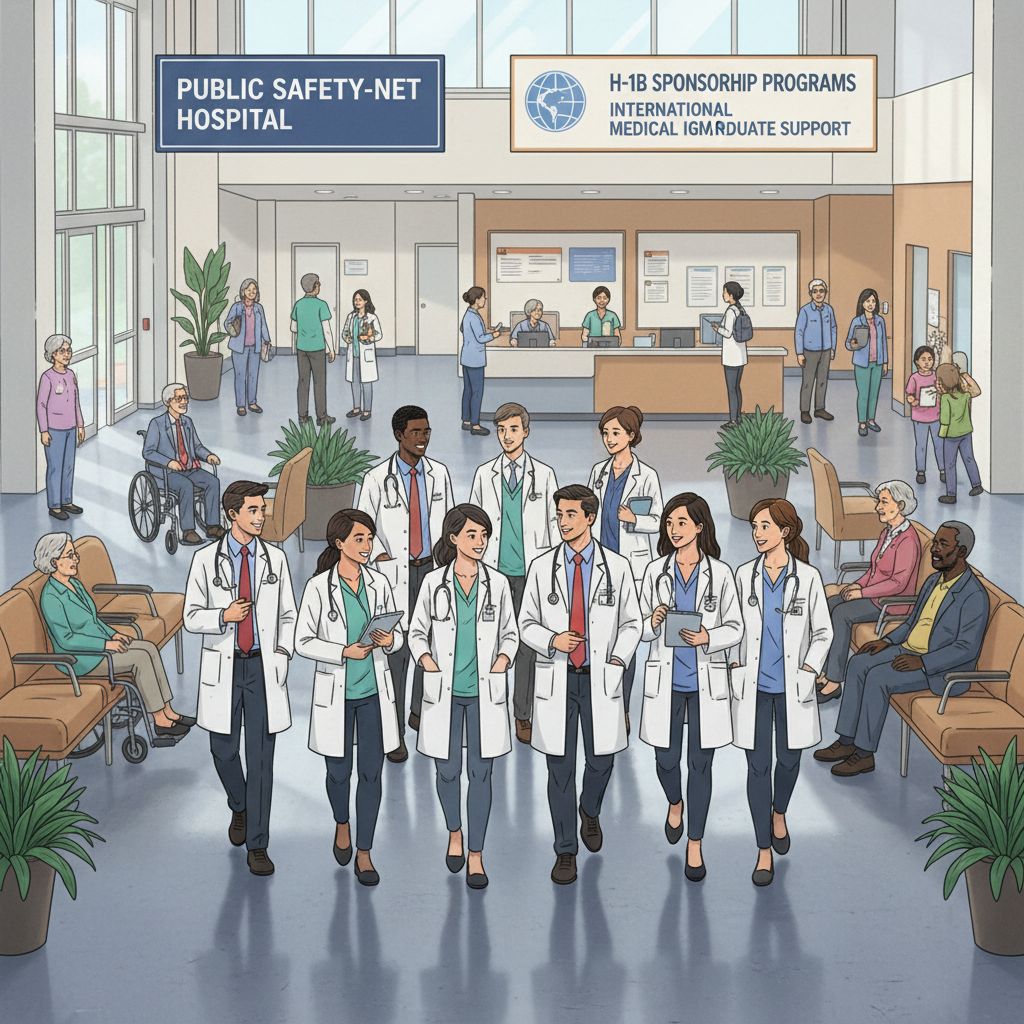
Understanding H-1B Sponsorship for Caribbean IMGs in the Tri-State Area
Caribbean international medical graduates (IMGs)—including graduates of SGU, AUC, Saba, Ross, and other Caribbean medical schools—are a major part of the residency workforce in the Tri-State Area (New York, New Jersey, Connecticut). For many, securing a residency that offers H-1B sponsorship is a top priority, especially if long-term practice in the United States is the goal.
This article focuses specifically on H-1B sponsorship programs for Caribbean IMGs in the Tri-State Area, how they differ from J-1 options, and how to strategically build an application to improve your chances of matching into an H-1B–friendly residency—particularly in internal medicine, family medicine, pediatrics, psychiatry, and other core specialties.
Throughout, you’ll also see how this ties into the Caribbean medical school residency landscape, and what it means if you’re coming from an institution like SGU and thinking about the SGU residency match in New York, New Jersey, or Connecticut.
H-1B vs J-1 for Residency: What Caribbean IMGs Need to Know
Before targeting programs, it’s essential to understand the basics of H-1B residency programs and how they compare with J-1.
Key Differences: H-1B vs J-1 for Residency
J-1 Visa (ECFMG-sponsored)
- Most common visa for residency and fellowship.
- Sponsored by ECFMG, not the hospital directly.
- Requires a two-year home-country physical presence after training (unless you obtain a waiver, e.g., via underserved/Conrad 30 jobs).
- More widely accepted—many community and academic programs readily take J-1 IMGs.
- Generally simpler for programs because ECFMG handles much of the process.
H-1B Visa (Employer-sponsored)
- Temporary worker visa in a specialty occupation (residency qualifies as such).
- Sponsored directly by the residency program/hospital.
- No automatic two-year home-residency requirement.
- Often preferred by IMGs who want more flexibility to remain in the U.S. after training.
- Requires:
- Passing USMLE Step 3 before starting residency.
- A valid ECFMG certificate.
- More administrative burden for programs (legal fees, paperwork, wage rules).
- Not all programs are willing/able to sponsor H-1B.
For Caribbean IMGs in the Tri-State Area, this choice feeds directly into career planning. Many Tri-State institutions are H-1B cap exempt due to their affiliations with universities or nonprofit organizations, making them particularly valuable targets.
How H-1B Residency Sponsorship Works in the Tri-State Area
Cap-Exempt vs Cap-Subject: Why Tri-State Academic Centers Are Strategic
The standard H-1B system has an annual cap on new visas. However, many residency programs in New York, New Jersey, and Connecticut fall into H-1B cap exempt categories:
- Institutions of higher education (universities)
- Nonprofit organizations related to or affiliated with universities
- Nonprofit or governmental research organizations
Most large academic centers and their teaching hospitals in the Tri-State Area are cap exempt, meaning:
- They can file H-1B petitions at any time of year—no lottery.
- They can hire more H-1B physicians without worrying about the overall national cap.
For you as a Caribbean IMG, this matters because it broadens the H-1B sponsor list of potential programs. While you won’t find a universal public list, academic hospitals and large health systems are often the most reliable sources of cap-exempt H-1B residency programs.
Typical Requirements for H-1B Sponsorship in Residency
Most Tri-State residency programs that sponsor H-1B will expect:
USMLE Step 3 passed
- Must be completed before the H-1B petition is filed (typically before residency start date, e.g., July 1).
- Many programs will not rank H-1B-seeking applicants unless they have Step 3 done or scheduled.
ECFMG Certification
- For Caribbean IMGs, ensure your credentials are verified and your ECFMG certificate is active.
Graduation within a reasonable timeframe
- Many programs prefer recent graduates (within 3–5 years), but this varies by specialty and institution.
Commitment to training length
- Programs may want assurance you can stay for the full duration of residency on H-1B (and possibly a fellowship after, if relevant).
Visa history clarity
- If you already hold another status (e.g., F-1, J-1, or prior H-1B), you must understand how that will interact with a new petition.
- If you previously held a J-1 that triggered a two-year home requirement, that must be addressed before an H-1B can be issued.

Tri-State Residency Landscape for Caribbean IMGs: Where H-1B is More Likely
The Tri-State region (New York, New Jersey, Connecticut) is one of the most IMG-dense areas in the United States. Many programs have long histories of working with Caribbean IMGs, especially in internal medicine, family medicine, pediatrics, psychiatry, and preliminary surgery.
Below is a strategic overview of where H-1B sponsorship is more likely, along with how this connects to Caribbean medical school residency outcomes.
New York: The Core of Tri-State H-1B Opportunities
New York State—especially New York City and its surrounding counties—is the largest hub of IMG-friendly programs in the U.S. Many large systems historically sponsor H-1B for GME positions.
In New York, you will find:
- University-affiliated academic medical centers that are H-1B cap exempt.
- Community-based programs with academic affiliations that may still be willing to sponsor H-1B, especially if they rely heavily on IMGs.
From a Caribbean IMG perspective, many New York programs have robust Caribbean medical school residency track records. An SGU residency match list, for example, will highlight numerous Tri-State internal medicine, pediatrics, and family medicine programs, including some that do H-1B sponsorship.
New Jersey: Community and Hybrid Programs with IMG Demand
New Jersey has a mix of:
- Community hospitals with high IMG enrollment
- University-affiliated systems with multiple training sites
- Some institutions that historically sponsor H-1B for fields like internal medicine, family medicine, and psychiatry
While J-1 remains more common, New Jersey is still a strong state for Caribbean IMGs seeking visas, including H-1B. You’ll see many Tri-State Caribbean alumni (SGU, Ross, AUC, Saba) matching into NJ internal medicine and family medicine residencies; some of these will support H-1B petitions, especially where there’s a documented pattern of visa sponsorship.
Connecticut: Smaller but Strategically Important
Connecticut has fewer residency programs overall compared with New York and New Jersey, but includes:
- Major academic centers (highly competitive, but often H-1B cap exempt).
- A few community-based programs that have taken IMGs regularly.
For Caribbean IMGs, Connecticut may serve as a selective but valuable target—especially for those with stronger USMLE scores, research, and U.S. clinical experience. Programs here may be very policy-driven, so verifying H-1B openness is critical.
Building Your Personal H-1B Strategy as a Caribbean IMG
Wanting an H-1B–sponsoring program is not enough; you need a structured approach to your application strategy, especially in a competitive region like the Tri-State.
1. USMLE Strategy for H-1B-Oriented Applicants
Because H-1B requires Step 3, your exam strategy should look different from applicants who are open to J-1:
Target timeline:
- Step 1 (pass/fail) and Step 2 CK done early enough to be ECFMG certified by the start of application season.
- Take Step 3 before or during the early application cycle if possible—ideally by January of the application year, so programs know you’re serious about H-1B.
Scoring expectations:
- There is no universal cutoff, but H-1B programs—especially in the Tri-State—often expect solid to strong Step 2 CK scores.
- Internal medicine programs in NYC that sponsor H-1B may look more closely at academic metrics, especially for Caribbean IMGs.
Actionable tip:
If you’re at SGU or another Caribbean school with a large alumni network, talk to recent graduates who matched into Tri-State H-1B residency programs. Ask what Step scores they had and how early they took Step 3.
2. Researching H-1B-Friendly Programs in NY/NJ/CT
There is no single official H-1B sponsor list for residency programs, but you can assemble a custom list using several methods:
Program websites
- Many now include visa policy details, e.g.:
- “We sponsor J-1 and H-1B visas”
- “We accept J-1 only”
- “We do not sponsor visas”
- Always confirm directly; websites may lag behind actual policy.
- Many now include visa policy details, e.g.:
Email the program coordinator
- Keep it short, professional, and specific:
- Indicate you are a Caribbean IMG.
- Ask: “Does your program sponsor H-1B visas for residency applicants?”
- Ask whether Step 3 completion is required before ranking or simply before starting.
- Keep it short, professional, and specific:
FREIDA and other databases
- FREIDA (AMA) and similar resources often include visa policy fields, but they may be incomplete—use as a starting point, not as your only source.
Alumni networks and social media
- Contact Caribbean alumni in Tri-State residency programs.
- LinkedIn, school alumni groups, and IMG-focused forums can help you identify real-world visa histories.
Practical example:
If you see from SGU’s residency outcomes that a specific New York internal medicine program regularly matches SGU grads, you can:
- Check their website for “H-1B” or “visa” language.
- Ask a recent SGU grad if the program sponsors H-1B or only J-1.
- Email the coordinator for confirmation.
- If they confirm H-1B support, add it to your H-1B cap exempt target list.
3. Balancing Your Application List: H-1B vs J-1
For Caribbean IMGs, the most common successful strategy is:
- Apply to a mix of:
- H-1B-sponsoring programs in the Tri-State and beyond.
- J-1–friendly programs where you’d still be happy to train.
Why:
- Limiting yourself to H-1B only can significantly restrict your options.
- You may receive interviews from J-1-only programs that are strong academically and can still lead to a good career, especially if you later secure a J-1 waiver in an underserved area.
If H-1B is your absolute priority, consider:
- Applying more heavily to Tri-State residency programs known to sponsor H-1B (particularly university-affiliated or cap-exempt academic centers).
- Still reserving a reasonable number of J-1–friendly applications to avoid an all-or-nothing outcome.
4. Strengthening Your Profile for Tri-State H-1B Programs
H-1B-sponsoring programs—especially in New York City—often receive high volumes of applications from strong IMGs. To stand out:
U.S. Clinical Experience (USCE)
- Aim for hands-on rotations (sub-internships, electives) in the Tri-State area when possible.
- Prioritize institutions that have a history of working with Caribbean students (e.g., SGU-affiliated sites).
Letters of Recommendation
- Secure at least 2–3 U.S. letters from internal medicine, family medicine, or other core specialties, depending on your target.
- Letters from Tri-State attendings who are familiar with Caribbean IMGs are particularly helpful.
Research and Scholarly Activity
- For more academic H-1B cap exempt programs, even small contributions (case reports, QI projects, poster presentations) can help.
Personal Statement and Interview
- Clearly explain:
- Why you want to train in the Tri-State region (mention New York New Jersey Connecticut residency interests).
- Your long-term goals in U.S. healthcare.
- Be prepared to discuss your visa needs clearly and confidently—but not as the first topic you bring up. Let them raise visa policies or wait until the end if it hasn’t been addressed.
- Clearly explain:

Practical Considerations: Contracts, Timelines, and Long-Term Planning
Once you’ve identified Tri-State H-1B–friendly programs and strengthened your profile, you need to understand the practical logistics of matching and starting residency on an H-1B visa.
Matching and H-1B Petition Timeline
A typical timeline for an IMG aiming for H-1B sponsorship:
By ERAS Opening (September)
- Step 1: pass
- Step 2 CK: score available
- ECFMG certification in progress or complete
- Some applicants may already have Step 3 done (ideal).
Interview Season (October–January)
- Discuss visa options only when appropriate, usually when the program indicates they sponsor or when they ask about your status.
- If you haven’t passed Step 3 yet, communicate your testing plans.
Rank List & Match (February–March)
- Confirm with programs that they’re comfortable sponsoring H-1B if you match with Step 3 pending but scheduled.
- Some programs require Step 3 results before they submit your H-1B petition.
Post-Match (March–June)
- Once matched, work closely with GME office and immigration/legal to file the H-1B petition.
- Ensure your H-1B approval is obtained before residency start date (usually July 1).
Contract and Policy Details to Clarify
When you match into an H-1B–friendly residency in New York, New Jersey, or Connecticut, clarify:
Who covers legal and filing fees?
- Many academic institutions pay these costs fully; some may ask for partial contribution.
Duration of the initial petition
- Typically covers the full PGY-1 year, renewed annually, or sometimes a multi-year petition.
Moonlighting restrictions
- H-1B is employer-specific. To moonlight outside the primary institution, you often need:
- An amended or concurrent H-1B petition.
- Permission from GME.
- H-1B is employer-specific. To moonlight outside the primary institution, you often need:
Transition after residency
- If you move to a non–cap-exempt employer (e.g., private practice), you may fall under the regular H-1B cap and lottery.
- If you continue in a cap-exempt environment (e.g., Tri-State academic fellowship), you remain cap exempt.
Long-Term Planning for Caribbean IMGs on H-1B
Your long-term pathway after training might include:
- Fellowship in a cap-exempt setting (academic center in NY/NJ/CT).
- Employment in an underserved or J-1 waiver-eligible area (for those who originally went J-1 rather than H-1B).
- Permanent residency (green card) sponsorship by an employer after residency or fellowship, often easier for those who stayed in H-1B status without the J-1 two-year home requirement.
For Caribbean IMGs committed to a long career in U.S. medicine, this is why H-1B residencies—especially in Tri-State academic systems—are so highly valued.
Connecting the Dots: Caribbean Schools, SGU Match, and Tri-State H-1B Opportunities
If you’re from a Caribbean school, especially one with a large U.S. presence, you have a distinct advantage: a visible track record of alumni outcomes. This is particularly true for schools like SGU, where the SGU residency match data often shows:
- Dozens to hundreds of placements each year in New York New Jersey Connecticut residency programs.
- A concentration in internal medicine, family medicine, pediatrics, and other IMG-heavy specialties.
- Many matches in large health systems that are known or likely to be H-1B cap exempt.
You can leverage this in several ways:
Identify alumni currently in Tri-State residencies and ask explicitly:
- Is your program H-1B friendly?
- Did any of your co-residents get H-1B sponsorship?
- What Step scores did they have?
Target core rotations in Tri-State teaching hospitals that have historically accepted your school’s students and graduates. Demonstrating your abilities on-site is often the strongest “audition” for a future H-1B position.
Frame your Caribbean background as a strength:
- Emphasize adaptability, experience with diverse patient populations, and comfort with multicultural, multilingual environments—assets in New York, New Jersey, and Connecticut.
The Caribbean medical school residency path to a Tri-State H-1B program is well-trodden but still highly competitive. A deliberate strategy, grounded in realistic expectations and solid planning, makes the difference.
FAQs: H-1B Sponsorship for Caribbean IMGs in the Tri-State Area
1. Is it realistic for a Caribbean IMG to match directly into an H-1B-sponsoring residency in NY/NJ/CT?
Yes, it is realistic—many Caribbean IMGs do this every year—but it is competitive. Your chances are highest if you:
- Have strong Step 2 CK scores and Step 3 passed by application or early match season.
- Apply widely to H-1B cap exempt academic centers and known H-1B-friendly community programs.
- Use your Caribbean school’s alumni network to identify which specific Tri-State programs truly support H-1B for residents.
2. Do I absolutely need Step 3 before applying if I want H-1B?
Not always—but it is strongly recommended. Many H-1B-sponsoring programs in the Tri-State area prefer or require Step 3:
- Before they rank you, or
- Before filing the H-1B petition.
If Step 3 is not complete by application time, you should at least:
- Have a clear plan and scheduled exam date.
- Communicate your timeline to programs transparently.
3. How can I find out if a specific program in New York, New Jersey, or Connecticut sponsors H-1B?
Use a three-step approach:
- Check the program’s official website under “Eligibility” or “Visa Sponsorship.”
- Email the program coordinator with a concise question about visa options, specifying you are an IMG and interested in H-1B.
- Ask alumni from your Caribbean school—they often know the real policy, even when websites are outdated.
Document your findings to build your own H-1B sponsor list of Tri-State programs.
4. If I can’t secure an H-1B residency, is J-1 still a viable option for a long-term U.S. career?
Yes. Many IMGs successfully build long careers in the U.S. after training on a J-1 visa by:
- Obtaining a J-1 waiver job in an underserved area (e.g., through Conrad 30).
- Transitioning from J-1 to H-1B in that waiver job.
- Later pursuing a green card through employer sponsorship.
If you’re focused on the Tri-State Area, keep in mind that many waiver jobs may be outside NYC proper, but still within commuting distance or in other states. J-1 is not a dead end—but if you can secure H-1B sponsorship early in Tri-State residency, it often gives you more flexibility.
By planning early, understanding the H-1B requirements, and leveraging the unique strengths of your Caribbean medical education and networks, you can position yourself competitively for H-1B sponsorship programs in the Tri-State Area and build a sustainable, long-term medical career in the United States.