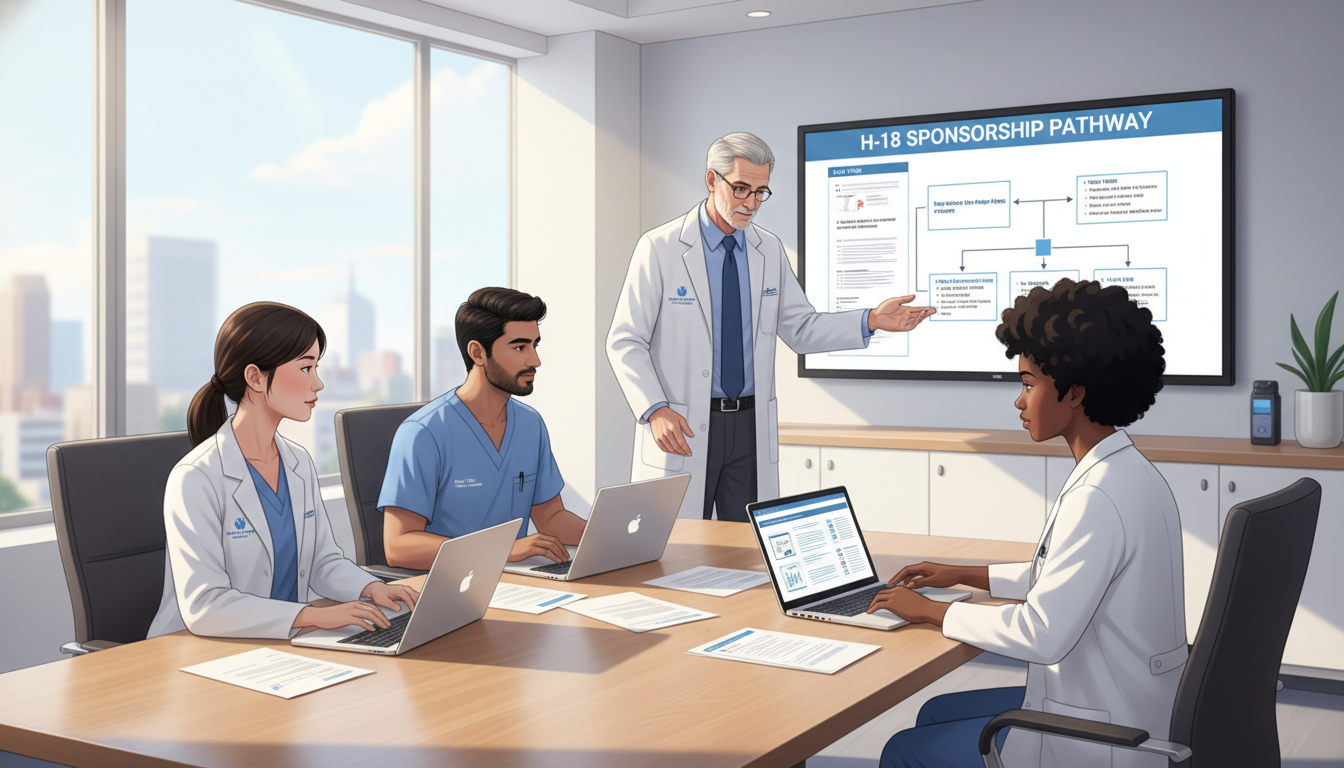
Understanding H-1B Sponsorship in Internal Medicine Residency
For an international medical graduate (IMG) pursuing internal medicine residency in the United States, visa strategy is not a side issue—it is central to your entire career plan. Among visa options, the H-1B is often viewed as the “career-track” pathway because it allows dual intent (training plus long-term immigration planning) and is more compatible with direct progression to fellowship and eventual permanent residency.
This IMG residency guide focuses specifically on H-1B sponsorship programs in internal medicine, how they differ from J-1 options, how to identify and target H-1B–friendly institutions, and how to align your exam timeline and application strategy with H-1B requirements. The aim is to help you build a targeted plan for the IM match rather than relying on guesswork or outdated anecdotes.
J-1 vs H-1B for IMGs in Internal Medicine
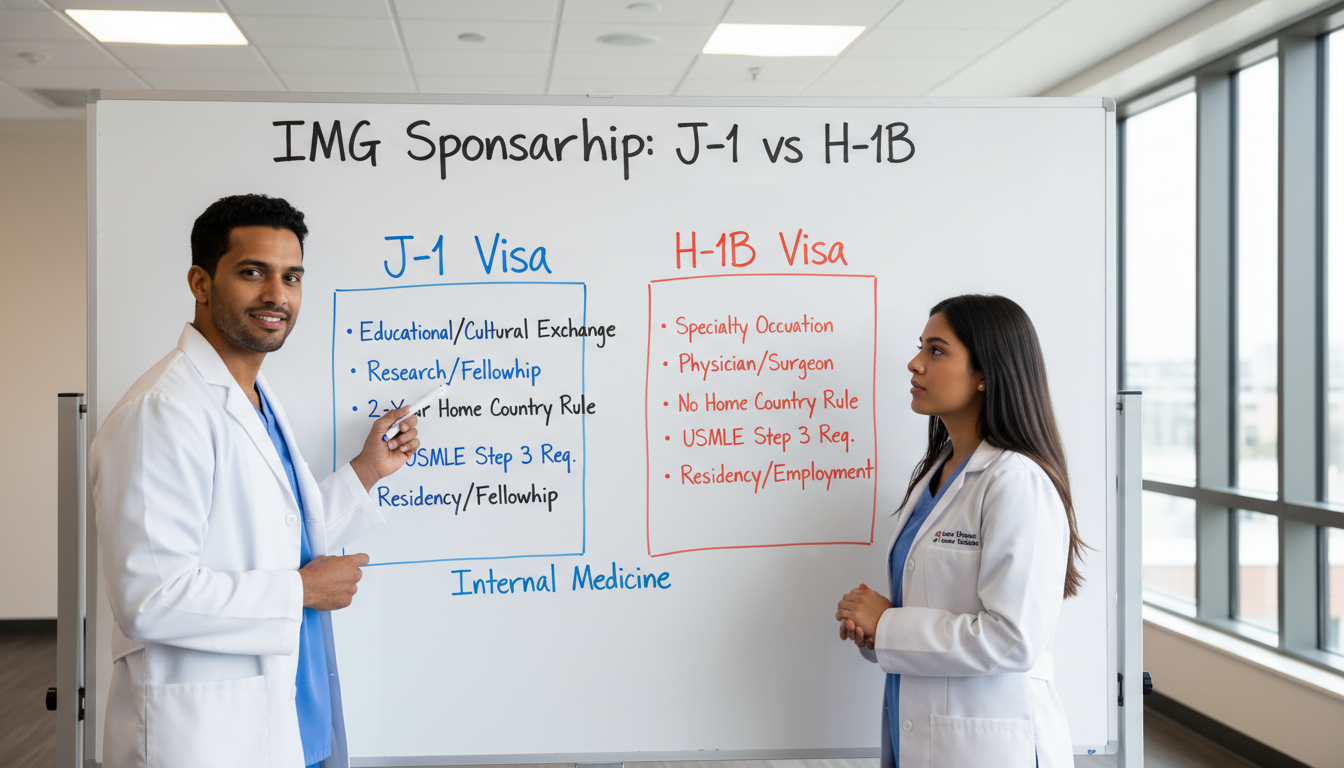
Before focusing on H-1B residency programs, you need a clear comparison of your main training visa options: J-1 (ECFMG-sponsored) and H-1B (employer-sponsored).
J-1 Visa: The Default Route
Most IMGs in internal medicine residency train on a J-1 visa, because:
- More programs are familiar and comfortable with J-1
- Administrative process is standardized through ECFMG
- Institutions do not need to act as H-1B sponsors or manage USCIS filings
Key features of J-1 for IMGs:
- Sponsored by ECFMG, not by the program directly
- Requires return to home country for 2 years after training, unless you obtain a J-1 waiver (e.g., Conrad 30, hardship, persecution)
- Limited to the duration of training, with some extensions possible for fellowship
- Does not directly support dual intent for long-term US immigration
H-1B Visa: The Career-Track Option
The H-1B is a temporary work visa (specialty occupation) that can be used for residency and fellowship.
Key features of H-1B for residency:
- Employer-sponsored: the residency program is your H-1B petitioner
- Dual intent: you can pursue permanent residency (green card) while on H-1B
- No 2-year home residency requirement
- Typically granted in up to 3-year increments (often 3 + 3 years for training + early career)
- Requires:
- USMLE Step 3 passed before H-1B petition filing
- Full ECFMG certification
- State medical training license (or temporary license) eligibility
Many IMGs prefer H-1B because it avoids the J-1 waiver obligation and offers a clearer path to long-term US practice. However, far fewer internal medicine residency programs sponsor H-1B compared with J-1.
Why Some Internal Medicine Programs Sponsor H-1B (And Others Do Not)
Understanding why certain institutions appear on informal H-1B sponsor lists while others avoid H-1B is critical for strategy. Program policies are shaped by legal, financial, and logistical realities.
Common Reasons Programs Avoid H-1B
Administrative burden and legal costs
- H-1B petitions require:
- Labor Condition Application (LCA)
- Detailed USCIS filings
- Ongoing compliance monitoring
- Many residency programs do not have in-house immigration lawyers or budget for outside counsel.
- H-1B petitions require:
Preference for standardization (J-1)
- Via ECFMG, the J-1 process is well-defined and relatively uniform.
- Program coordinators are trained for J-1 workflows; switching to H-1B adds complexity.
Institutional policy, not program-level choice
- Large health systems or universities may have a central “J-1 only” policy.
- Even a program director who is IMG-friendly may be constrained by institutional rules.
Concerns about time and risk
- H-1B processing times and potential RFEs (Requests for Evidence) can cause anxiety about residents starting on time.
- Programs worry about delayed start dates and coverage gaps on inpatient services.
Why Some Internal Medicine Programs Do Offer H-1B
Despite the challenges, a subset of internal medicine residency programs—especially at major academic centers—do sponsor H-1B, often on a case-by-case basis.
Common motivators:
- Highly competitive, research-oriented IMGs
Programs want to recruit top candidates who strongly prefer H-1B for long-term career reasons. - Institutional experience with H-1B
Hospitals employing many foreign-trained physicians often already use H-1B for staff; extending this to residents is a smaller step. - Retention strategy
Training IMGs on H-1B allows smoother transition to faculty or hospitalist roles within the same system. - H-1B cap exempt status
University-affiliated, nonprofit academic centers are typically H-1B cap exempt, which means:- They can file H-1Bs year-round
- They are not limited by the annual “H-1B lottery”
- This makes H-1B use for residents much more manageable
When you see “H-1B residency programs” mentioned online, most are cap-exempt, university or major teaching hospitals where H-1B petitions are routine for faculty and postdocs, and sometimes extended to residents and fellows.
Building a Targeted Strategy for H-1B in Internal Medicine
To maximize your chances of training on H-1B instead of J-1, you need to treat this as a structured project, not a wishlist. Below is a step-by-step IMG residency guide tailored to H-1B–seeking IMGs.
Step 1: Understand Non-Negotiable H-1B Requirements
For almost all internal medicine residency programs that sponsor H-1B:
USMLE Step 3 is mandatory before the Match
- The program must file the H-1B petition months before your start date (typically in spring after Match).
- Many institutions will not even rank IMGs for H-1B unless Step 3 is passed and documented.
ECFMG certification
- Required for GME credentialing and, in many states, for training license eligibility.
Eligibility for a training license
- Each state has its own rules (number of exam attempts, recency of graduation, etc.).
- If you do not meet training license criteria, you are not H-1B-eligible in that state, even if the program sponsors H-1B.
Implication:
If your primary goal is H-1B, your top operational task is early completion of USMLE Step 3 with enough time for score reporting before application season.
Step 2: Time Your Exams for an H-1B–Friendly Profile
A typical H-1B-focused exam timeline for an IMG planning for an internal medicine residency:
Year -2 to -1 before application
- Complete USMLE Step 1 and Step 2 CK
- Gain US clinical experience (USCE), ideally in academic internal medicine
12–18 months before Match
- Take USMLE Step 3 (if possible)
- This gives you:
- Time to re-take if needed
- A strong signal to programs that you are H-1B-ready
ERAS Application (September)
- List Step 3 as “Completed” with score available
- Highlight this early in your CV and in your personal statement if you are specifically seeking H-1B
If you are unable to complete Step 3 before the Match, your realistic H-1B options shrink significantly. Some programs may consider sponsoring J-1 with the idea of switching to H-1B later in fellowship or in a hospitalist position, but for residency itself, Step 3 before Match is a near-universal requirement for H-1B.
Step 3: Identify Likely H-1B Residency Programs in Internal Medicine
There is no single, official, constantly updated H-1B sponsor list for internal medicine residency. Instead, you need to use multiple sources to build a personal, research-based list each season.
Practical ways to identify H-1B–friendly internal medicine programs:
Program websites
- Look under “International Medical Graduates,” “Visa Information,” or “Eligibility.”
- Phrases to look for:
- “We sponsor J-1 and H-1B visas”
- “H-1B sponsorship considered for exceptional candidates”
- “H-1B sponsorship may be available for applicants who have completed USMLE Step 3”
FREIDA (AMA Residency Database)
- Many programs list visa types allowed.
- Filter for internal medicine; manually check visa information and program notes.
Program informational sessions / webinars
- Many IM programs host Q&A sessions before application season.
- Ask clear, concise questions:
- “Do you sponsor H-1B visas for categorical internal medicine residents?”
- “Is USMLE Step 3 required at the time of application or by Match rank list certification?”
Current and former residents
- Look for LinkedIn or program alumni pages:
- If you see IMGs with “H-1B” mentioned, reach out politely:
- “I am an IMG planning to apply in IM and am particularly interested in H-1B–sponsoring programs. Would you mind sharing whether your program is currently sponsoring H-1B for residents, and whether Step 3 is required before the Match?”
- If you see IMGs with “H-1B” mentioned, reach out politely:
- Look for LinkedIn or program alumni pages:
Institutional context
- University-affiliated teaching hospitals are often H-1B cap exempt, making them more flexible and experienced with H-1B.
- Purely community-based programs may be less likely to sponsor H-1B (though there are important exceptions).
Over a few weeks of research, you can build a spreadsheet including:
- Program name and location
- Visa policy (J-1 only / J-1 + H-1B / unclear)
- Step 3 requirement timing
- Notes from residents or coordinators
- Whether institution is H-1B cap exempt
This becomes your personal H-1B-focused target list for the IM match.

Crafting Your Application for H-1B–Sponsoring IM Programs
Once you know which programs are open to H-1B, you should tailor your application materials and communication style to address both their academic and immigration-related concerns.
Highlight H-1B Readiness Directly (But Professionally)
CV / ERAS Application
- Include under “Examinations”:
- “USMLE Step 3: Passed, [Month Year], [Score]”
- Under “Additional Information” (or equivalent):
- “Eligible for H-1B visa sponsorship (USMLE Step 3 passed; ECFMG certified; no prior J-1 subject to home residence requirement).”
- Include under “Examinations”:
Personal Statement (Short Mention Only)
- Don’t make your entire personal statement about visas. Focus on your motivation for internal medicine, clinical strengths, and long-term goals.
- A single, tactfully placed sentence is enough, e.g.:
- “As an international medical graduate already licensed to sit for independent practice board-style exams (USMLE Step 3 passed), I am fully prepared for the demands of residency and eligible for H-1B sponsorship where available.”
Email Communication with Programs (If Needed)
- If contacting a coordinator about missing documents or logistics, you may append a simple note:
- “For your information, I have passed USMLE Step 3 and am eligible for H-1B sponsorship if your institution offers that option.”
- If contacting a coordinator about missing documents or logistics, you may append a simple note:
Avoid sounding as if the only thing you care about is the visa; programs want to see that you are committed to internal medicine training and patient care first.
Strengthen the Parts of Your Profile H-1B Programs Value
H-1B–sponsoring internal medicine residencies often are more competitive (larger academic centers, research-oriented). To be a realistic candidate, you should:
- Maintain strong exam scores
- Step 2 CK is particularly important after Step 1 became pass/fail.
- Obtain substantial US clinical experience
- Preferably in academic IM settings or teaching hospitals.
- Aim for hands-on experiences (sub-internships, acting internships, or observership+notes that show real engagement).
- Secure strong letters of recommendation
- At least 2–3 letters from US internal medicine attendings.
- If possible, from the same type of institutions you’re targeting (university or major teaching hospitals).
- Show academic and research involvement
- Even small projects (case reports, QI projects, retrospective reviews) can demonstrate academic engagement.
- Programs often see H-1B as a long-term investment; research and scholarly interest make you an attractive prospect.
Addressing Potential Concerns During Interviews
Expect questions that indirectly relate to your visa status and long-term plans:
- “Where do you see yourself in 5–10 years?”
- “Do you plan to stay in academic medicine or community practice?”
- “Are you interested in fellowship?”
Sample response that aligns with H-1B sponsorship interests:
“My long-term goal is to complete internal medicine residency, then pursue a fellowship in cardiology, ideally within an academic medical center. I enjoy both patient care and teaching. I am currently on track for H-1B eligibility with Step 3 completed, which I hope will allow me to build a stable, long-term career within a US institution.”
This addresses:
- Your seriousness about internal medicine and fellowship
- Your compatibility with academic, H-1B-sponsoring environments
- Your visa readiness without making it the focal point of the conversation
Common Pitfalls and How to Avoid Them
Even strong IMGs sometimes derail their own chances of matching into H-1B–sponsoring internal medicine programs. Recognize these risks early.
Pitfall 1: Delaying Step 3 “Until After the Match”
- Consequence:
- Most H-1B programs will simply not rank you for H-1B if Step 3 is pending.
- Strategy:
- If your goal is H-1B, treat Step 3 as essential before the application season, not optional.
Pitfall 2: Narrowing Your List Too Much
Some applicants only apply to a small handful of H-1B residency programs they find on an old H-1B sponsor list (often outdated). This is risky.
- Many programs change visa policies over time.
- A program listed as H-1B-friendly five years ago may now be J-1 only and vice versa.
Better approach:
- Apply broadly to:
- H-1B–friendly programs confirmed for the current season
- A reasonable number of J-1–only programs as a safety net
- Decide after interviews whether you prioritize matching anywhere (on J-1) or only in an H-1B program.
Pitfall 3: Ignoring State License and Attempt Limits
Even if a program is willing to sponsor H-1B, state regulations may block you:
- Some states have:
- Maximum attempt limits for USMLE Steps
- Time limits from graduation to training license
- If you exceed these limits, the state board may not grant a training license, and the program cannot sponsor your H-1B.
Solution:
- Before targeting an H-1B program, check the state medical board requirements:
- Attempts allowed
- Years since graduation
- Need for Step 3 (some states require it for licensing; others do not)
Pitfall 4: Overemphasizing Visa in Interviews
Discussing your visa is appropriate when programs ask, but:
- Do not steer every conversation back to H-1B.
- Do not give the impression that you would choose any program solely based on H-1B, regardless of clinical quality or fit.
Instead:
- Present yourself as a well-rounded internal medicine applicant.
- Reference H-1B logically and concisely when relevant.
Planning Beyond Residency: H-1B, Fellowship, and Long-Term Options
When you choose between J-1 and H-1B, you are also choosing between different long-term career maps.
H-1B Pathway After Internal Medicine Residency
If you complete internal medicine residency on H-1B:
Fellowship
- Many fellowship programs (especially at academic, cap-exempt institutions) sponsor H-1B.
- Your existing H-1B can often be:
- Extended under the same cap-exempt category, or
- Transferred between cap-exempt institutions.
Employment after training
- You may move into:
- Hospitalist roles
- Academic faculty positions
- Subspecialty practice after fellowship
- If your new employer is cap-exempt (university/hospital), they can file a cap-exempt H-1B transfer.
- If your new employer is a private practice or non–cap-exempt hospital, you may need to:
- Go through the H-1B cap lottery at some point, unless you remain with a cap-exempt employer.
- You may move into:
Permanent residency (Green Card)
- Many IM physicians on H-1B eventually pursue:
- PERM labor certification and EB-2/EB-3 pathways
- NIW (National Interest Waiver) for some with strong academic or underserved area work
- The major advantage: you do not have to deal with J-1 waiver restrictions.
- Many IM physicians on H-1B eventually pursue:
Comparing to the J-1 Waiver Path
On a J-1:
- After training, you typically must:
- Obtain a waiver (e.g., Conrad 30) and
- Work for 3 years in a designated underserved area
- After the waiver job:
- You may proceed to other positions or seek a green card.
For some IMGs, especially those open to rural service, the J-1 waiver path is workable. For others seeking more flexibility in fellowship and location, the H-1B route is more attractive—even if it is harder to secure initially.
FAQs: H-1B Sponsorship Programs for IMGs in Internal Medicine
1. Do I absolutely need Step 3 before applying if I want an H-1B internal medicine residency?
You can technically apply without Step 3, but for almost all practical purposes, Step 3 before rank list certification is essential. Most H-1B–sponsoring programs require a passed Step 3 before they can commit to ranking you for an H-1B position, because they must file your petition shortly after Match. If H-1B is a priority, plan to complete Step 3 early enough for scores to be available in ERAS.
2. How can I find a reliable H-1B sponsor list for internal medicine residency programs?
There is no single, official, always-accurate H-1B sponsor list. Instead, combine:
- FREIDA entries (visa information field)
- Individual program websites (search for “visa” or “international medical graduates”)
- Direct email questions to coordinators
- Information from recent residents or alumni
Use this to create your own, up-to-date H-1B residency guide for internal medicine programs you’re interested in.
3. If I match into a J-1 internal medicine program, can I later convert to H-1B?
Sometimes, but it is complicated:
- Once you enter the US on a J-1 for GME, you are typically subject to the 2-year home residency requirement.
- Switching to H-1B generally requires you to first obtain a J-1 waiver.
- A minority of residents switch mid-training, but this is usually linked to extraordinary circumstances and strong institutional legal support.
For planning purposes, assume that choosing J-1 means following a J-1 waiver pathway rather than a simple switch to H-1B later.
4. Are all H-1B internal medicine residency programs H-1B cap exempt? Why does that matter?
Most, but not all, H-1B–sponsoring IM residency programs are associated with:
- Universities
- Nonprofit teaching hospitals
- Research institutions
These are typically H-1B cap exempt, meaning: - They can file H-1B petitions at any time of year
- They are not subject to the annual H-1B lottery
This makes using H-1B for residency and fellowship much safer. If you later join a private, non–cap-exempt employer, you may then need to enter the H-1B cap process unless you remain with a cap-exempt institution.
By understanding the structure of H-1B sponsorship in internal medicine, aligning your exam timeline (especially Step 3), and strategically targeting H-1B–friendly, cap-exempt IM programs, you can significantly improve your chances of building a long-term US career without the constraints of a J-1 waiver. As an international medical graduate, informed planning is your most powerful advantage in the IM match.