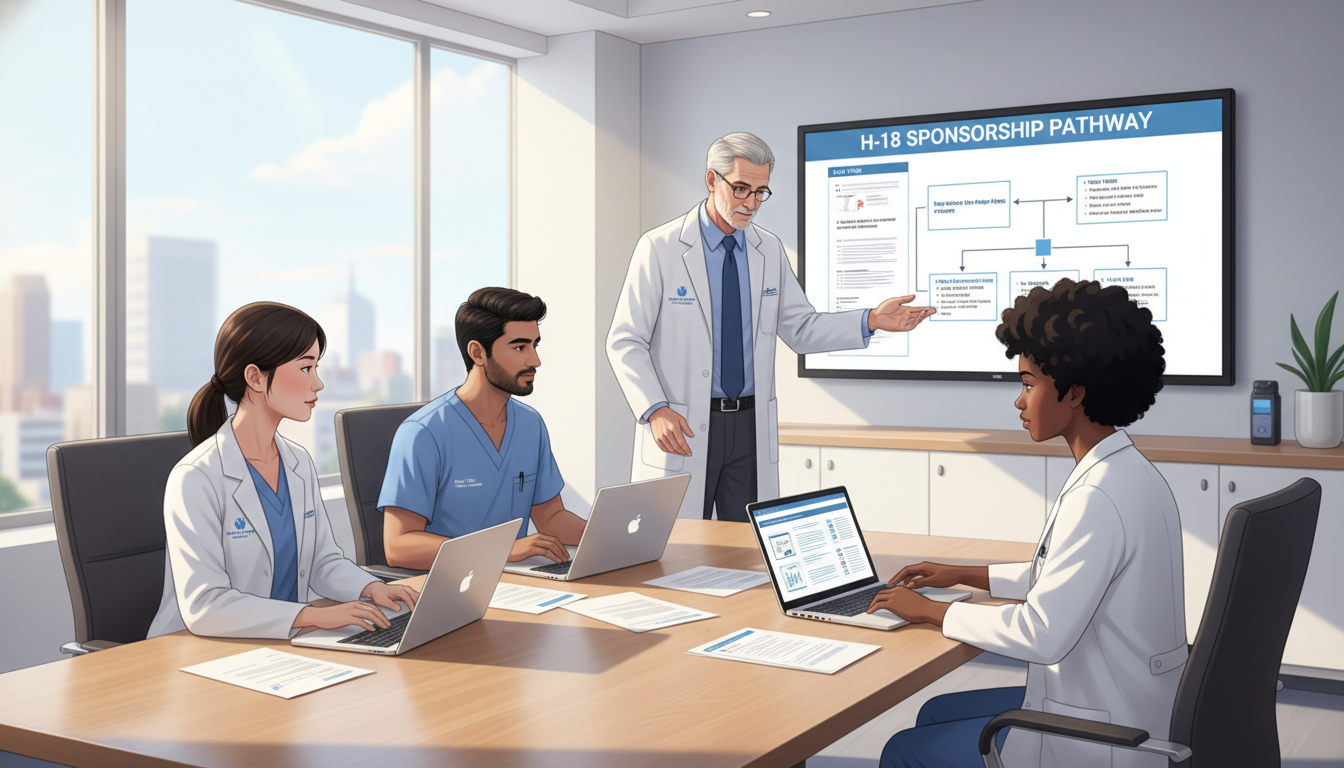
Understanding H-1B Sponsorship in Medicine-Psychiatry Programs
For an international medical graduate (IMG), navigating H-1B sponsorship in a medicine-psychiatry combined residency can feel especially complex. You are targeting a niche specialty and a relatively small number of programs, while also dealing with strict visa rules, USMLE timelines, ECFMG certification, and institutional policies that may not always be transparent.
This IMG residency guide focuses specifically on H-1B sponsorship programs for IMGs interested in Medicine-Psychiatry (Med-Psych) residency. You will learn how H-1B works, which types of institutions are more likely to sponsor, how “H-1B cap exempt” status helps, and concrete strategies to identify H-1B-friendly med psych residency programs and improve your chances.
Throughout, keep in mind that program policies change year to year, and visa decisions are often case-by-case. Always verify information directly with programs and your institution’s GME office or legal counsel.
H-1B Basics for IMGs in Medicine-Psychiatry
What Is the H-1B Visa for Residents?
H-1B is a temporary work visa for specialty occupations that require at least a bachelor’s degree (for physicians, this is typically an MD/MBBS equivalent plus ECFMG certification). In graduate medical education (GME), H-1B allows you to:
- Work as a resident or fellow in a US training program
- Be employed and paid directly by the institution
- Potentially transition later to H-1B attending roles without changing visa category
For many IMGs who plan a long-term US career, an H-1B from residency can simplify the future pathway to employment and possibly permanent residency (green card), compared with J-1’s additional requirements and waiver process.
J-1 vs H-1B for Medicine-Psychiatry Trainees
Most IMGs train on J-1 (ECFMG-sponsored) visas. However, there are specific reasons some IMGs strongly prefer H-1B:
Advantages of H-1B for Med-Psych IMGs:
- No mandatory two-year home residency requirement after training
- More flexibility to move directly into a job or fellowship after residency
- Fewer geographic and employer restrictions after training compared to J-1 waiver jobs
- Potentially smoother path for a partner or spouse who is also a professional
Potential downsides of H-1B:
- Not all residency programs sponsor H-1B – many are J-1 only
- H-1B requires passing USMLE Step 3 before H-1B petition filing, which is challenging given timelines
- Some institutions develop internal policies limiting H-1B to higher-need specialties or attending-level positions
- Filing fees, legal costs, and paperwork are higher (often covered by the institution, but not always)
In medicine-psychiatry combined programs, which are small and heavily academic, the default visa category is frequently J-1. H-1B sponsorship exists, but it is usually a minority of programs and sometimes limited to exceptional cases.
Understanding “H-1B Cap” vs “H-1B Cap Exempt”
For residency training, the concept of H-1B “cap exempt” is critical.
- The US government issues a limited number of new H-1Bs each year (the “cap”), selected via lottery.
- However, most residency programs are at institutions considered H-1B cap exempt, meaning they are not subject to the lottery.
You are typically cap exempt if your H-1B is sponsored by:
- A nonprofit academic institution (e.g., university hospital)
- A nonprofit research institution affiliated with a university
- A government research organization
Most university-affiliated med psych programs fall into these categories. That means:
- No lottery uncertainty
- You can apply at any time of year (subject to institutional processing timelines)
- Extensions and transitions to fellowship at similar cap-exempt institutions are usually straightforward
However, if you later move to a private, for-profit hospital or clinic that is not cap exempt, you may need to obtain a “cap-subject” H-1B—which can involve the lottery.

Eligibility and Timing: Preparing for H-1B as a Med-Psych IMG
Core Requirements for H-1B in Residency
To be eligible for H-1B as an IMG in medicine-psychiatry, you typically need:
- ECFMG Certification (or verification that you will have it before residency start)
- A foreign medical degree equivalent to MD or DO
- USMLE Step 3 passed before the H-1B petition is filed
- A valid medical license or training (limited) license in the state of the residency
- A residency contract or official offer from a sponsoring program
- Proof of English proficiency and no visa violations or status issues
The Critical Step 3 Timing Problem
The most common barrier for IMGs hoping for H-1B in med psych residency is USMLE Step 3 timing.
- Many H-1B residency programs require Step 3 by rank list deadline or at least by the time they file your petition (often March–May before a July 1 start).
- If you are applying directly from medical school or with limited US time, scheduling and passing Step 3 early is challenging.
Actionable strategy:
- Plan to take Step 3 as early as possible, ideally before or during the main application cycle (September–December).
- If you have already completed an internship or residency outside the US, use that experience to support your Step 3 preparation and expedite your timeline.
- If you are already in the US on another status (e.g., F-1, J-1 research), start Step 3 preparation early and coordinate exam scheduling to avoid delays in your H-1B residency programs.
Programs often state, “We sponsor H-1B only if Step 3 is passed before Rank Order List certification.” If Step 3 is pending, some will not risk ranking you highly due to visa uncertainty.
Institutional and State-Level Requirements
Beyond Step 3, other regulations can affect your H-1B eligibility:
- State licensing requirements differ: some states require additional documentation for a training license, and processing times vary widely.
- Some GME offices have internal policies (occasionally unwritten) such as:
- “H-1B only for US graduates or US citizens/green card holders” (rare but exists)
- “J-1 is preferred; H-1B only for exceptional circumstances”
- “No H-1B for preliminary or transitional years”
As a medicine-psychiatry applicant, your residency is categorical and five years, making it easier to justify H-1B sponsorship than for short preliminary training, but you still need to clarify policy early.
How to verify:
- Check the program’s website and GME office page for visa policy.
- Email the program coordinator or program director with a precise, concise question:
- “Do you sponsor H-1B visas for international medical graduates in the Medicine-Psychiatry combined residency, provided USMLE Step 3 is completed before ranking?”
- Ask if their H-1B policy differs between IM and Med-Psych tracks—sometimes internal medicine will sponsor, but combined programs have different rules.
Identifying H-1B-Friendly Medicine-Psychiatry Programs
Because there are relatively few medicine-psychiatry combined programs in the US, your strategy should be targeted and methodical.
Understanding the Medicine-Psychiatry Combined Landscape
Medicine-psychiatry (often called “Med-Psych” or “Medicine-Psychiatry combined”) is an ACGME-approved five-year training program that leads to board eligibility in both internal medicine and psychiatry.
These programs are typically:
- Based at academic medical centers
- Small (often 2–4 residents per year)
- Focused on complex comorbidity, integrated care, and academic or leadership careers
Because they sit within larger internal medicine and psychiatry departments, visa policies are often influenced by the parent IM and psychiatry programs, but not always identical.
Using Public Information to Build a Targeted List
To build an H-1B sponsor list for med psych, you will need to combine several resources:
ERAS/NRMP program directories
- Filter for “Internal Medicine/Psychiatry” combined programs.
- Visit each program’s website and check the “International Medical Graduate” or “Visa” section.
Institutional GME / Graduate Medical Education site
- Search “[Institution Name] GME H-1B J-1 visa.”
- Many university hospitals publish clear guidelines, such as:
- “Our institution sponsors both J-1 and H-1B for residents who meet eligibility requirements including USMLE Step 3.”
Program-specific FAQs or IMG pages
- Some med psych programs explicitly mention visa types:
- “We sponsor J-1 and H-1B visas for qualified IMGs.”
- “We only sponsor J-1 visas; we do not support H-1B.”
- Some med psych programs explicitly mention visa types:
Alumni and current residents
- Search LinkedIn, Doximity, or program alumni pages.
- Look for graduates or current residents who are IMGs and check if they mention H-1B.
- Politely reach out (when appropriate) for clarification: “I’m an IMG interested in your med psych program and H-1B sponsorship; could you share whether the program has supported H-1B residents in the past?”
Past GME reports or institutional H-1B disclosures
- Some universities publish annual H-1B statistics or public access files that may show H-1B residents/fellows.
Typical Patterns in H-1B-Friendly Institutions
While specific policies change, certain patterns often hold:
Large, research-intensive academic centers are more likely to have:
- Established legal teams managing H-1Bs
- Cap-exempt status
- Prior experience sponsoring H-1B for residency
Institutions that already sponsor H-1B for other specialties (e.g., internal medicine, neurology, psychiatry) are more likely to extend it to med psych, though not guaranteed.
Programs strongly committed to diversity and global health are often more open to international medical graduate applicants and may be more flexible on visa categories.
When building your personal H-1B sponsor list:
- Create a spreadsheet of all med psych programs
- Add columns for:
- Visa types allowed (J-1, H-1B, both)
- Step 3 requirement timing
- Evidence (website link, email confirmation)
- Notes from conversations or alumni

Application Strategy: Maximizing Your Chances as an IMG Seeking H-1B
Balancing H-1B Preference with Match Realities
As an IMG in a competitive niche specialty, you should recognize two parallel realities:
- H-1B residency programs are fewer than J-1 programs overall.
- Medicine-psychiatry programs are already few in number and competitive.
This means you must balance your H-1B preference with realistic match strategies:
- Consider applying to a mix of H-1B-friendly and J-1-only med psych programs, especially if you are early in your US career or your Step 3 timeline is uncertain.
- Evaluate whether your long-term goals (e.g., academic, rural practice, global work) might be compatible with J-1 plus a waiver, if H-1B options are too limited.
Strengthening Your Profile for H-1B-Sponsoring Programs
Because sponsoring H-1B involves more cost and paperwork for programs, H-1B residency programs may expect a stronger overall application. To stand out:
Academic and Exam Performance
- Solid USMLE scores (including Step 3) and minimal attempts
- Evidence of consistent clinical performance and strong letters of recommendation
- If you have postgraduate training abroad, highlight specialties like internal medicine, psychiatry, or combined care
Clear Commitment to Medicine-Psychiatry
- Med psych programs want applicants who truly understand and value this integrated path.
- Show this through:
- Combined internal medicine and psychiatry electives or clerkships
- Rotations on consultation-liaison psychiatry, addiction medicine, or psychosomatic medicine
- Research or quality improvement projects at the medicine-psychiatry interface (e.g., depression in heart failure, metabolic monitoring in severe mental illness)
US Clinical Experience (USCE)
- Aim for hands-on USCE in both medicine and psychiatry, ideally in academic centers that know Med-Psych.
- Strong US letters that mention your suitability for medicine psychiatry combined training are powerful.
Professionalism and Communication
- For H-1B sponsorship, programs need confidence that you will clear licensing, immigration, and credentialing hurdles.
- Demonstrate:
- Meticulous documentation
- Clear, concise communication
- Reliability (e.g., early exam completion, responsiveness during application)
Communicating About H-1B with Programs
How you discuss visas can either reassure or worry programs.
Do:
- Mention your visa needs succinctly in your ERAS application (under “Personal Information” and, if relevant, in personal statement).
- Emphasize that you have or will have:
- ECFMG certification
- Step 3 (if already passed) or scheduled date
- In interviews, if asked:
- Briefly explain your preference for H-1B (e.g., long-term US career, family planning) without sounding inflexible or demanding.
- Show you understand J-1 vs H-1B and that you appreciate the program’s constraints.
Avoid:
- Leading with visa demands before the program expresses interest.
- Long, emotional explanations about visa dissatisfaction.
- Implied ultimatums such as “I will only rank programs that sponsor H-1B” in communications with programs (you can make that decision privately in your rank list).
It is reasonable to ask clear questions after interview invitations or during interviews:
- “Does your medicine-psychiatry combined program sponsor H-1B visas for IMGs, assuming Step 3 is completed?”
- “Is your institution H-1B cap exempt?”
The key is to be polite, concise, and informed.
Planning for Contingencies
Even with a strong profile and careful planning, you may face:
- Programs changing visa policies late in the season
- Delays in Step 3 results
- Institutional risk aversion to H-1B
To protect your future:
- Apply broadly within your specialty, especially if your H-1B options are limited.
- Consider applying to internal medicine and psychiatry categorical programs that sponsor H-1B as a parallel plan, in case med psych options narrow.
- Have a plan for reapplication if you do not match (e.g., research positions, observerships, or non-ACGME fellowships that maintain your clinical engagement and visa status).
Long-Term Career Planning: Beyond Residency on H-1B
Transition from Med-Psych Residency to Fellowship or Practice
Completing a medicine-psychiatry combined program on H-1B can provide multiple advantages:
- You can transition to:
- Attending roles in internal medicine, psychiatry, or integrated care
- Fellowships (addiction, consultation-liaison, geriatrics, psychosomatic medicine, etc.)
- If you remain in cap-exempt institutions, extending or transferring your H-1B is generally straightforward.
If you plan to move to a private practice or non-academic hospital after residency:
- Check whether your new employer is cap exempt or cap subject.
- If cap subject, you (or they) may need to apply in the next H-1B cap season/lottery.
- Some physicians transition to J-1 waiver jobs after a J-1; with H-1B, you typically do not have a home-return requirement but still need an employer willing to sponsor.
Green Card Considerations
Many IMGs ultimately pursue a green card (permanent residency), often through:
- Employment-based categories (EB-2/EB-3)
- National Interest Waiver (NIW), especially for those working in underserved areas or with significant academic contributions
- Family-based sponsorship (if applicable)
An advantage of starting on H-1B as a resident is that you might:
- Already be in a status compatible with dual intent (H-1B allows immigrant intent, unlike some other statuses).
- More easily transition to an employer-sponsored green card without a visa category change.
However, residency programs rarely sponsor green cards; this typically happens after you transition to an attending role.
Special Value of Med-Psych Training
Your medicine-psychiatry combined background can be a strategic asset in:
- Integrated care clinics
- Academic roles focusing on psychosomatic medicine or collaborative care
- Leadership positions in community mental health centers that integrate primary care
- Addiction medicine and hospital-based behavioral health services
From an immigration standpoint, showing a unique, high-need skill set can support arguments for NIW or employment-based sponsorship, especially if you work in underserved areas where dual-trained physicians are rare and highly valuable.
FAQs: H-1B Sponsorship for IMGs in Medicine-Psychiatry
1. Do all medicine-psychiatry programs sponsor H-1B visas?
No. Many med psych residency programs accept IMGs, but only a subset sponsor H-1B. Others are J-1 only. Because med psych is small, you must check each program individually—via websites, GME offices, and direct email—before assuming they will sponsor H-1B.
2. Is it mandatory to have USMLE Step 3 for H-1B in med psych residency?
In practice, yes. For H-1B sponsorship as a resident, most states and institutions require that you have passed Step 3 before they can file the petition. Many programs require Step 3 before rank list submission. Without Step 3, you are usually limited to J-1 for residency.
3. Are medicine-psychiatry H-1B residencies subject to the H-1B cap/lottery?
Most med psych residencies are at university-affiliated teaching hospitals, which are typically H-1B cap exempt. That means your H-1B for residency is not subject to the lottery, and you can start outside the regular H-1B season. However, if you later move to a non–cap-exempt employer, you may need a cap-subject H-1B.
4. Should I avoid J-1 if I want a long-term US career in medicine-psychiatry?
Not necessarily. While H-1B offers more flexibility after training, many IMGs complete med psych residency on J-1 and build successful US careers. They often fulfill the two-year home requirement or obtain a J-1 waiver job in underserved areas. If your H-1B options are very limited, being open to both J-1 and H-1B residency programs can improve your chances of matching into medicine-psychiatry, and you can still pursue a long-term US career with careful planning.
By understanding how H-1B residency programs work, how H-1B cap exempt institutions operate, and how to strategically target medicine psychiatry combined programs that support IMGs, you can make informed decisions and build a realistic, effective pathway into this unique and rewarding specialty as an international medical graduate.