Understanding H‑1B Sponsorship for IMGs in Alaska & Hawaii
For an international medical graduate, the idea of training in Alaska or Hawaii can be especially appealing—unique patient populations, stunning geography, and smaller, often tight‑knit medical communities. But when your immigration path depends on H‑1B sponsorship, the equation becomes more complex.
This IMG residency guide focuses specifically on H‑1B sponsorship programs in Alaska and Hawaii, explaining how they work, what’s realistically available, and how to position yourself to secure a spot.
We’ll cover:
- How H‑1B residency programs work for IMGs
- The landscape of graduate medical education in Alaska and Hawaii
- Types of institutions that are most likely to sponsor H‑1B visas
- Practical strategies to find an H‑1B sponsor list and evaluate H‑1B cap exempt options
- Application tips tailored to these two states
Throughout, remember that policies and positions change frequently. Always verify current information directly with programs and your immigration counsel.
H‑1B Basics for International Medical Graduates
Before zooming in on Alaska residency and Hawaii residency programs, you need a clear foundation on how H‑1B works in graduate medical education.
H‑1B vs J‑1 for Residency
Most IMGs in US residency train on J‑1 visas sponsored by ECFMG. However, some programs, especially in underserved areas or at academic centers, are open to H‑1B sponsorship.
Key contrasts:
J‑1 visa
- Sponsored by ECFMG, not the residency program
- Requires home country return for 2 years after training unless a waiver is obtained
- Typically more common and easier for programs administratively
- Limited moonlighting and other employment flexibility
H‑1B visa
- Sponsored directly by the employer/program
- No automatic 2‑year home residence requirement
- Can be extended up to 6 years (with some exceptions for green card processes)
- Often preferred by IMGs who plan to stay in the US long‑term and pursue permanent residency
For residency, H‑1B visas must still meet general H‑1B criteria:
- You must have USMLE Step 3 passed (before H‑1B approval, often before rank list is certified)
- You must already hold or be eligible for a full, unrestricted state medical license or, in some states, an institutional training or limited license that satisfies H‑1B professional requirements (rules vary)
- The program must pay at least the required wage per Department of Labor standards
Cap‑Subject vs H‑1B Cap Exempt
For IMGs, one of the most critical distinctions is cap‑subject vs cap-exempt H‑1B:
Cap‑subject H‑1B
- Numerically limited (regular cap + advanced degree cap)
- Requires participation in the H‑1B lottery
- Petitions generally filed in March for an October start
- Risk of not being selected → no H‑1B for that cycle
H‑1B cap exempt
- Not subject to the annual numerical cap or lottery
- Can file any time of year
- Typically includes:
- Nonprofit entities affiliated with a university
- Governmental research organizations
- Certain non‑profit research institutions
For residency, programs at university‑based or university‑affiliated teaching hospitals are often H‑1B cap exempt, which is a huge advantage for IMGs.
In Alaska and Hawaii, understanding which institutions qualify as cap‑exempt is essential, because smaller states may have fewer employers willing or able to navigate the cap-subject process.
Graduate Medical Education Landscape in Alaska & Hawaii
Both Alaska and Hawaii are geographically isolated and medically underserved in several specialties. They rely heavily on visiting specialists and mainland training pathways, but they also host important training programs that may be relevant to IMGs seeking H‑1B sponsorship.
Residency and GME in Alaska
Alaska does not have the same density of freestanding residency programs as larger states, but it participates in regional training models, especially in family medicine and primary care. Over the past years, Alaska has:
- Supported family medicine residencies and rural training tracks
- Host sites for University‑affiliated rotations and fellowships
- Clinical sites that partner with Pacific Northwest academic centers
Programs in Alaska may be:
- Directly sponsored by local health systems (community-based)
- Affiliated with mainland universities (e.g., University of Washington connections)
- Participating sites in rural training tracks (RTTs)
From an H‑1B standpoint:
- University‑affiliated teaching hospitals or clinics may qualify for H‑1B cap exempt status.
- Independent hospitals, critical access hospitals, or community programs may be cap-subject and therefore less likely to sponsor H‑1B (especially for initial residency), given their smaller administrative resources and the lottery uncertainty.
Residency and GME in Hawaii
Hawaii has a more established GME presence, anchored by the John A. Burns School of Medicine (JABSOM) at the University of Hawaii and its teaching hospitals. Historically, Hawaii residency programs exist or have existed in:
- Internal Medicine
- Family Medicine
- Psychiatry
- General Surgery
- Obstetrics & Gynecology
- Pediatrics
- Various fellowships in internal medicine–related subspecialties and others
Key implications for IMGs:
- Many Hawaii residency programs are university‑affiliated, which often makes them H‑1B cap exempt.
- Programs may have longstanding experience with IMGs and visa sponsorship, particularly J‑1, but some also consider H‑1B depending on institutional policy and funding.
- Hawaii’s geographic isolation and physician shortage can make it more open to international physicians committed to serving the local population, though competition remains significant.
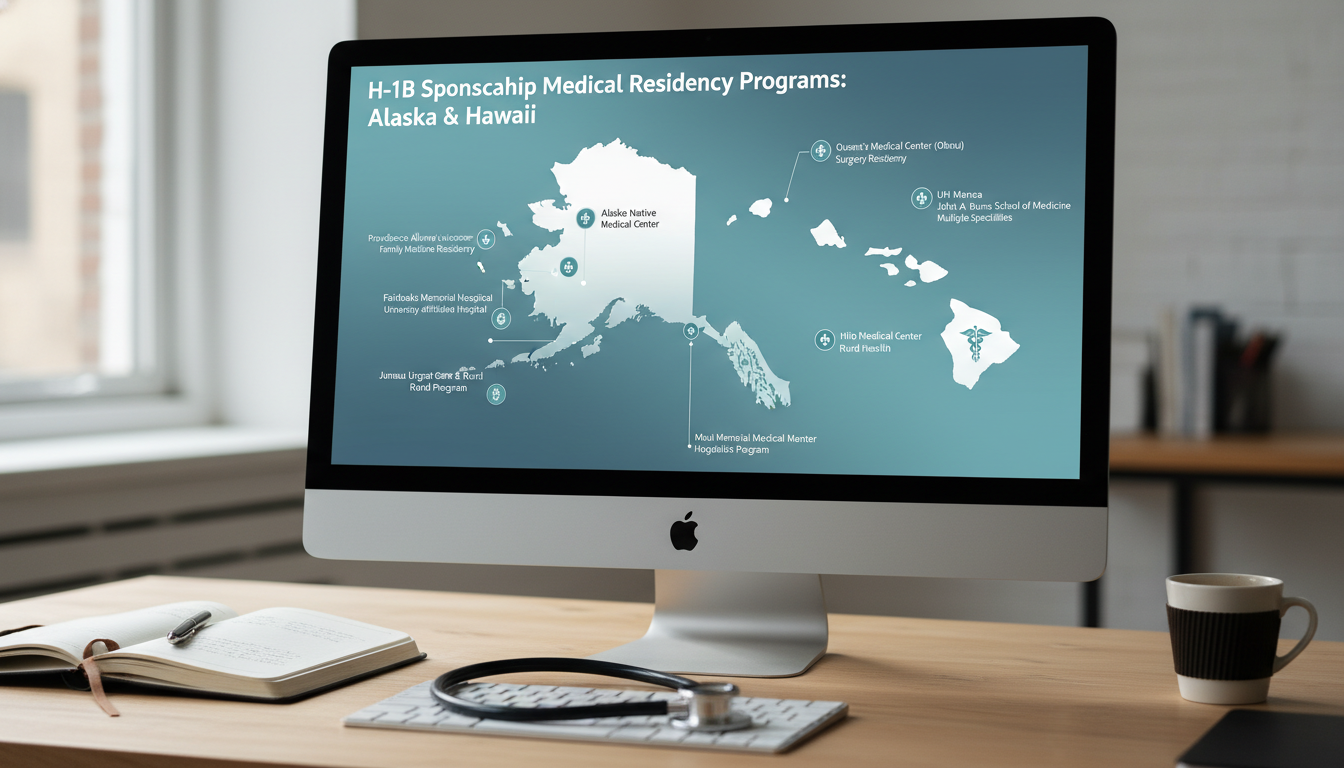
Where H‑1B Sponsorship Is Most Likely in Alaska & Hawaii
Given that individual program policies shift often, it’s more realistic to learn how to recognize likely H‑1B sponsors than to memorize a static H‑1B sponsor list. Use the following framework for both Alaska residency and Hawaii residency programs.
1. University and Medical School–Affiliated Hospitals
Hospitals or programs affiliated with University of Hawaii (JABSOM) or other accredited medical schools are prime candidates for H‑1B cap exempt status. This can dramatically simplify the sponsorship process.
Characteristics:
- Affiliated with a public university or medical school
- Host multiple residency and fellowship programs
- Have GME offices with experience processing visas
- Frequently list “J‑1 and sometimes H‑1B visas considered” on their websites
In Hawaii, examples include major teaching hospitals in Honolulu that serve as primary JABSOM training sites. While you must verify current policies, such institutions are your best starting point if you’re targeting H‑1B residency programs in the state.
In Alaska, smaller numbers of university‑affiliated GME sites exist, but any program that explicitly partners with a US medical school for GME is a potential H‑1B cap exempt sponsor.
2. Large Non‑Profit Health Systems and Consortia
In both states, larger non-profit health systems that run or host training programs may qualify for cap exemption if they have formal academic affiliations.
Look for language on:
- Academic partnerships (e.g., “clinical campus for X University School of Medicine”)
- Sponsorship of residency programs with ACGME accreditation
- Statements like “We sponsor J‑1 and consider H‑1B visas for qualified graduates”
These systems often appear on national H‑1B sponsor lists compiled from public immigration filing data, reflecting prior use of H‑1B for physicians, nurses, or allied health staff.
3. Federally Qualified Health Centers and Underserved Sites (Post‑Residency)
While not usually direct residency sponsors, many clinics in Alaska and Hawaii that serve underserved populations offer positions for attending physicians, including those on H‑1B visas after residency or in J‑1 waiver roles.
These positions may be:
- With H‑1B cap exempt status, if affiliated with a university or qualifying non-profit research entity
- Attractive to IMGs seeking to stay in Alaska or Hawaii long-term
This becomes important if:
- You complete residency elsewhere (e.g., mainland US on J‑1 or H‑1B)
- Later choose to move to Alaska or Hawaii for post‑residency employment and possible permanent settlement.
4. Community Hospitals Without University Affiliation
Purely community-based hospitals in Alaska or Hawaii:
- Are typically cap‑subject if they sponsor H‑1B
- May be reluctant to engage in the lottery process for incoming residents
- Often default to J‑1 visas if they accept IMGs at all
However, if a community hospital has a close teaching or research affiliation or is part of a larger system that already uses H‑1B for other staff, it might be open to case‑by‑case H‑1B sponsorship.
How to Research H‑1B Residency Options in Alaska & Hawaii
Because there isn’t a single official “H‑1B sponsor list” for residency programs, you’ll need a methodical approach. Below is a step‑by‑step strategy tailored for IMGs targeting these states.
Step 1: Identify All ACGME‑Accredited Programs
Start with the ACGME public program search:
- Go to ACGME’s accreditation data system (public search).
- Filter by state (Alaska or Hawaii).
- Note all specialty programs and sponsor institutions:
- Internal Medicine
- Family Medicine
- Psychiatry
- Surgery, Pediatrics, etc.
- Create a spreadsheet listing:
- Program name
- Specialty
- City
- Sponsoring institution
- Website
This gives you a baseline IMG residency guide for what actually exists in each state.
Step 2: Scan Program Websites for Visa Policies
For each program:
- Visit the residency program’s website.
- Look for pages/tabs titled:
- “Eligibility & Requirements”
- “International Medical Graduates”
- “Visa Information” or “Sponsorship”
- Specifically search (CTRL+F) for:
- “visa”
- “J‑1”
- “H‑1B”
- “IMG”
You’ll often see one of these patterns:
- “We accept J‑1 visas only” → H‑1B unlikely
- “We accept J‑1 and may consider H‑1B visas for exceptional candidates” → potential opportunity
- “We can sponsor H‑1B visas” → clear H‑1B‑friendly signal
Note down the exact wording. Policies can be nuanced; for example:
- “We do not sponsor visas” (no J‑1, no H‑1B) → US citizens/GC only
- “We can accept residents already on H‑1B transfer but do not initiate new H‑1Bs” → relevant for those already in the US with H‑1B status.
Step 3: Identify Cap‑Exempt Potential
Cross‑check program sponsors:
- If sponsored by University of Hawaii or another public university / academic medical center, they’re likely H‑1B cap exempt.
- If the sponsor is a standalone community hospital with no clear academic affiliation, they’re likely cap‑subject.
You can sometimes confirm cap exemption by:
- Looking for “non-profit, university‑affiliated” language on institutional pages
- Reviewing the hospital’s IRS nonprofit status (501(c)(3))
- Checking immigration forums or databases that show H‑1B cap exempt filings
Cap‑exempt status is a major advantage because it avoids the lottery, important for a time‑sensitive residency start date.
Step 4: Use Public H‑1B Data as a Cross‑Check
Several third‑party platforms aggregate public H‑1B filing data. While not official sponsor lists for residency, they help you see if an institution has:
- Previously filed H‑1B petitions for any occupation (doctors, nurses, researchers)
- Filed “H‑1B cap exempt” petitions
Search for hospitals and universities in Alaska and Hawaii by name. If you find multiple approved H‑1Bs for physicians or residents/fellows, that’s a strong indicator that they have experience with the process.

Application Strategies for IMGs Seeking H‑1B in Alaska & Hawaii
Even if only a subset of programs in these states sponsor H‑1B visas, well‑planned strategy can significantly improve your chances.
Academic and Exam Preparation
Because H‑1B sponsorship requires extra paperwork and cost for programs, they tend to reserve it for candidates who stand out.
To be competitive:
USMLE Scores
- Aim for strong Step 1 (if applicable) and Step 2 CK scores well above the program’s typical cutoffs.
- Pass Step 3 early, ideally before rank list deadline. This is non‑negotiable for most H‑1B residency programs.
Clinical Experience
- Obtain US clinical experience (USCE); for Alaska/Hawaii interest:
- Electives or rotations in rural health, community medicine, or underserved clinics
- Rotations in states/regions with similar patient populations (e.g., Pacific Northwest, West Coast)
- Obtain US clinical experience (USCE); for Alaska/Hawaii interest:
Letters of Recommendation
- Secure strong US letters, especially from:
- Academic faculty
- Program directors
- Physicians with known connections to Hawaii or Alaska GME
- Secure strong US letters, especially from:
Early and Direct Communication with Programs
Because Alaska and Hawaii have smaller GME ecosystems, personal communication can matter more.
Action steps:
Email programs early (several months before ERAS opens) and ask:
- Whether they currently sponsor H‑1B visas
- Whether they require Step 3 by interview or by rank list
- Whether they accept IMGs on H‑1B or prefer J‑1 only
Attach:
- A concise CV
- Step scores
- Brief statement of your interest in Hawaii or Alaska specifically, highlighting:
- Commitment to underserved populations
- Cultural sensitivity and adaptability
- Long‑term interest in practicing in the region
Be very specific and respectful:
- Programs appreciate clarity; they do not want last‑minute surprises about visa needs.
Tailoring Your Personal Statement and Application
For an IMG targeting Alaska residency or Hawaii residency programs, your narrative matters:
Emphasize why these states:
- Interest in rural, remote, or island medicine
- Connection to Pacific/Asian/Indigenous populations if relevant
- Desire to work in underserved communities long-term
Showcase adaptability:
- Previous experience in remote or resource‑limited settings
- Comfort with cross‑cultural communication and diverse patient populations
Clarify your visa plan:
- You can indicate that you are seeking H‑1B sponsorship due to long‑term career plans in the US.
- Make it clear you understand the requirements (Step 3, licensing) and that you’re taking proactive steps to meet them.
Number of Applications and Backup Planning
Given the limited number of programs in Alaska and Hawaii:
- Do not restrict your entire match strategy to these two states.
- Apply broadly across other H‑1B-friendly programs nationally, especially:
- University‑based internal medicine, family medicine, psychiatry, and pediatrics residencies
- States with known IMG-friendly H‑1B policies
Consider multiple pathways:
- Primary Strategy: Apply widely to H‑1B residency programs, including those in Alaska and Hawaii.
- Secondary Strategy: Be open to J‑1 in a strong program elsewhere, then move to Alaska or Hawaii later under:
- J‑1 waiver (e.g., Conrad 30) in underserved areas
- Post‑training H‑1B cap exempt positions if affiliated with qualifying institutions.
Special Considerations for Alaska & Hawaii as an IMG
Beyond visa logistics, training and practicing in these states has unique aspects worth anticipating.
Cultural and Community Integration
Both states have rich cultural diversity:
Hawaii
- Large Native Hawaiian and Pacific Islander populations
- Significant Asian communities (Japanese, Filipino, Chinese, Korean, etc.)
- Emphasis on local culture, ohana (family), and community ties
Alaska
- Indigenous communities (Alaska Native populations) with distinct cultures and health needs
- Many remote villages accessible only by air or water
- High value on clinicians who are adaptable and respectful of local traditions
Programs will evaluate whether you:
- Can integrate respectfully into local communities
- Are willing to stay for several years and contribute to long‑term health outcomes
- Appreciate the geographic isolation and lifestyle differences
Geographic and Lifestyle Realities
Distance from mainland US:
- Travel to and from home country may be longer and more expensive.
- Visiting family, conferences, or away rotations might require advanced planning.
Cost of Living:
- Hawaii has a high cost of living (housing, food).
- Some parts of Alaska (especially remote areas) also have elevated living costs and limited services, although certain locations may have lower housing costs than Honolulu.
Weather and Environment:
- Alaska: long winters, limited daylight in some regions, potential impact on mood and lifestyle.
- Hawaii: tropical climate, but also risks of natural events (storms, volcanic activity).
Programs may informally assess whether you’ve realistically considered these factors and still express strong interest and commitment.
Frequently Asked Questions (FAQ)
1. Are there many H‑1B residency programs in Alaska and Hawaii?
The absolute number is limited compared to larger states, because both Alaska and Hawaii have fewer ACGME‑accredited residency programs overall. However, in Hawaii, several university‑affiliated programs may be H‑1B cap exempt and thus more open to H‑1B sponsorship for strong candidates. Alaska has fewer standalone residencies, but some programs and training tracks connected to mainland universities may consider H‑1B on a case‑by‑case basis. You must verify current policies directly with each program.
2. Do I need to have USMLE Step 3 completed to get H‑1B for residency?
Yes. For nearly all H‑1B residency programs, USMLE Step 3 is required before H‑1B approval, and many insist that Step 3 be passed before ranking you. If you are an IMG specifically targeting H‑1B residency in Alaska or Hawaii, plan to take and pass Step 3 early, ideally in time for interviews or at least before the rank order list deadline.
3. How can I find an “H‑1B sponsor list” for Alaska and Hawaii residency programs?
There is no single official H‑1B sponsor list for residency. Instead, you should:
- Use the ACGME program search to list all programs in Alaska and Hawaii.
- Check each program’s website for visa policies.
- Email programs directly to confirm whether they currently sponsor H‑1B.
- Use public H‑1B databases to see which hospitals and universities in these states have historically filed H‑1B petitions (for residents, fellows, or other physicians).
This combined approach is far more reliable than relying on outdated lists.
4. If I match on a J‑1 visa elsewhere, can I still work in Alaska or Hawaii later?
Yes. Many IMGs complete residency on a J‑1 visa in another state, then move to Alaska or Hawaii for:
- J‑1 waiver employment (e.g., under Conrad 30 or other waiver programs) in underserved areas.
- H‑1B cap exempt positions at university‑affiliated or qualifying non‑profit institutions.
- Other H‑1B roles if employers are willing to sponsor.
If long‑term practice in Alaska or Hawaii is your goal, consider J‑1 waiver opportunities and H‑1B cap exempt positions in these states as part of your overall career planning, even if your residency itself is not there.
This IMG residency guide should serve as a starting framework for understanding H‑1B sponsorship programs in Alaska and Hawaii. Your next steps should be to identify specific programs of interest, verify their most recent visa policies, and align your exam timing, application strategy, and long‑term goals with the realities of H‑1B, J‑1, and cap‑exempt opportunities in these unique US states.