Understanding H-1B Sponsorship for IMGs in the US–Mexico Border Region
For an international medical graduate, the US–Mexico border region offers a unique combination of high clinical need, culturally rich communities, and relatively IMG-friendly training environments. If you are specifically interested in H-1B sponsorship programs rather than J-1 visas, you are already thinking strategically about long-term immigration and career planning.
This IMG residency guide will walk you through:
- How H-1B visas work for residency and fellowship
- Why Texas border residency and other border region programs can be favorable
- How to identify and evaluate H-1B residency programs
- Typical H-1B sponsor list characteristics in the border region
- Strategy to maximize your chances as an IMG in this high-need area
Throughout, remember: policies change frequently. Always verify specific program and institutional rules each application cycle.
H-1B Basics for International Medical Graduates
Before looking at border region options, you need a solid grasp of what H-1B really means for graduate medical education.
What Is the H-1B for Physicians?
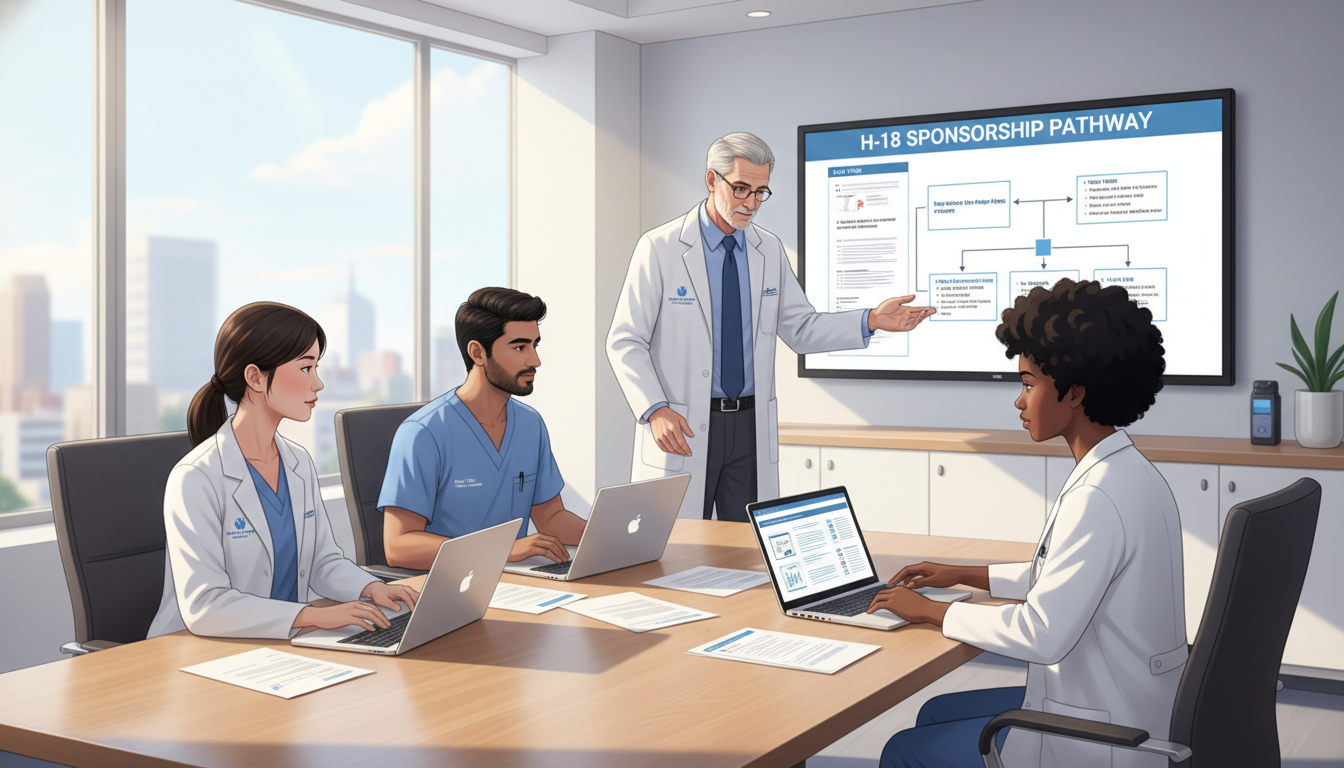
The H-1B is a temporary specialty occupation visa that allows US employers to hire qualified foreign professionals. For physicians in residency or fellowship:
- The employer is usually the teaching hospital or academic medical center.
- The job is “resident physician” or “fellow,” which qualifies as a specialty occupation.
- The visa is typically granted in increments (often 3 years, can be extended up to 6 years total for most physicians).
Key points for IMGs:
- H-1B is a work visa, not an exchange visitor visa (like J-1).
- It usually does not require a home-country return requirement.
- It can be more straightforward to transition from H-1B to another employment-based visa or green card later.
H-1B Requirements Specific to Physicians
To be eligible for an H-1B residency or fellowship role, IMGs generally must have:
USMLE Exams and Certification
- USMLE Step 1 and Step 2 CK passed
- ECFMG certification completed by the time of H-1B filing
- Some institutions also require Step 3 before they will sponsor H-1B (this is very common)
State Medical Board Eligibility
- You must qualify for at least a training license in the state where the program is located
- The hospital’s legal team will check state rules before filing the petition
Institutional Willingness
- The hospital must have:
- A process for H-1B sponsorship
- Budget for attorney and filing fees
- Internal policy allowing H-1B for residents (some limit H-1B to fellows or faculty only)
- The hospital must have:
H-1B Cap vs. Cap-Exempt: Critical Distinction
For residency, cap-exempt H-1B status is crucial:
- Many academic hospitals and affiliated nonprofits are H-1B cap exempt, meaning:
- They can sponsor H-1B any time of year
- They are not limited by the national H-1B annual cap lottery
- Typical cap-exempt employers:
- Non-profit hospitals affiliated with a US university
- Public or non-profit academic medical centers
- Some community-based programs with academic or governmental affiliation
For you as an IMG:
- Most large residency programs in the US–Mexico border region are H-1B cap exempt, which is advantageous.
- This allows a more predictable transition directly from match to H-1B without competing in the general lottery.
Why the US–Mexico Border Region Is Strategic for H-1B-Seeking IMGs
The US–Mexico border region includes parts of California, Arizona, New Mexico, and Texas. It has unique healthcare needs and, for the right candidate, can be a favorable environment for H-1B residency programs.
High Clinical Need and Underserved Communities
Border communities often face:
- High rates of chronic disease (diabetes, obesity, hypertension)
- Limited access to primary and specialty care
- Large segments of uninsured or underinsured patients
- Higher proportion of Spanish-speaking or bilingual populations
Because of this:
- Programs frequently struggle to recruit enough physicians.
- They may be more open to IMGs and more flexible about visa sponsorship.
- These factors make the region particularly relevant for an IMG residency guide focused on H-1B sponsorship.
Cultural and Linguistic Advantages for Many IMGs
If you:
- Speak Spanish, or
- Have experience in Latin American healthcare systems, or
- Are an international medical graduate familiar with cross-border health issues
…then border region programs may see you as an especially valuable candidate. Your language skills and cultural understanding can directly improve patient care and patient satisfaction scores.
For H-1B sponsorship:
- Programs are more likely to invest in visa costs for candidates who clearly provide unique added value in their patient population.
- Bilingual applicants are often preferred in Texas border residency programs and in California’s Imperial Valley, for example.
Types of Border Region Programs That Commonly Sponsor H-1B
While every institution differs, certain patterns appear:
Large Academic Medical Centers in Border States
- Examples include major university systems in Texas and California that have satellite campuses or affiliated hospitals near the border.
- These are frequently H-1B cap exempt institutions.
- They often have established legal departments and well-defined visa policies, including an institutional H-1B sponsor list.
Community-Based Teaching Hospitals Serving Border Cities
- Hospitals in cities like El Paso, Brownsville, McAllen, Laredo, and some communities in Arizona and California.
- These programs frequently rely heavily on IMGs in internal medicine, family medicine, pediatrics, and psychiatry.
- Will often have prior experience with both J-1 and H-1B physicians.
Federally Qualified Health Centers (FQHCs) with Teaching Programs
- While less common, some FQHCs collaborate with residency programs and may be part of the employment relationship.
- They may later offer post-residency H-1B or J-1 waiver opportunities, creating a longer-term professional path in the border region.

Texas Border Residency Programs and H-1B Sponsorship
Texas is central to any discussion about H-1B sponsorship in the US–Mexico border region. A significant portion of border-adjacent residency positions are in Texas, and many are historically IMG-friendly.
Why Texas Is Especially Important for IMGs
Several factors make Texas border residency programs attractive to IMGs:
- Large, diverse patient populations with high Spanish-speaking percentages
- Lower cost of living compared to coastal metro areas
- Multiple public university systems with strong academic affiliations
- A long track record of employing IMGs in both community and academic roles
From a visa perspective:
- Many Texas teaching hospitals are non-profit, university-affiliated, and H-1B cap exempt.
- They have standardized visa procedures, including internal H-1B sponsor lists and defined criteria.
Common H-1B Patterns in Texas Border Programs
While actual policy varies by institution and specialty, some common patterns include:
Specialties More Likely to Sponsor H-1B
- Internal Medicine
- Family Medicine
- Pediatrics
- Psychiatry
- Some subspecialty fellowships (cardiology, GI, ID) at larger centers
Conditions Frequently Applied
- USMLE Step 3 often required before H-1B petition
- Evidence of strong ties to underserved practice or commitment to border communities
- Language proficiency (Spanish) as a strong plus
Contracts and Timing
- Programs often match you first, then file the H-1B in spring/early summer.
- You must have ECFMG certification and meet state licensing deadlines for the H-1B petition to be filed before July 1 start date.
Practical Example: Hypothetical Texas Border Program
Imagine a community-based internal medicine residency in a Texas border city affiliated with a state university:
- The hospital is a non-profit university affiliate → H-1B cap exempt.
- Historically, 40–60% of residents are IMGs.
- Visa policy:
- J-1 sponsorship for all qualified IMGs
- H-1B sponsorship only for:
- IMGs who already passed Step 3
- Candidates with strong Spanish skills or prior US clinical experience
- Outcome:
- Each year, a subset of incoming IMGs joins on H-1B status.
- Graduates sometimes remain in the region working in FQHCs or hospitals on extended H-1B or Conrad 30 waivers (if they were J-1 fellows later).
This type of pattern is increasingly common along the Texas–Mexico border.
Building and Evaluating a Targeted H-1B Sponsor List
To maximize your chances, create an organized H-1B sponsor list focused on border region programs. This list should evolve as you research and contact programs.
Step 1: Identify Border Region Programs
Focus your search on:
- Texas: El Paso, Laredo, Brownsville, Harlingen, McAllen, Edinburg, and nearby cities along the Rio Grande Valley
- California: Imperial County (e.g., El Centro), San Diego affiliated programs that rotate in border communities
- Arizona: Tucson, Yuma, and southern Arizona community hospitals with teaching programs
- New Mexico: Las Cruces and other southern New Mexico sites if involved in graduate medical education
Use:
- ACGME program search tools
- FREIDA (AMA) database
- State medical association and university system websites
Step 2: Filter by Visa Policy
For each program, classify their visa stance:
Explicit H-1B Friendly
- Website clearly states: “We sponsor both J-1 and H-1B visas for eligible applicants.”
- Or FAQ lists H-1B residency programs or H-1B cap exempt status.
J-1 Only
- Statements like: “We only sponsor J-1 visas through ECFMG.”
- These should be lower priority if you are set on H-1B, though policies occasionally change.
No Clear Information
- Requires direct contact via email or virtual open house.
When contacting programs, phrase your question professionally:
“As an international medical graduate planning to complete USMLE Step 3 before July, I am very interested in your program’s work in underserved border communities. Could you please confirm whether your institution can sponsor H-1B visas for residency trainees, or whether you restrict sponsorship to J-1 visas only?”
Maintain a spreadsheet with columns for:
- Program name
- City, state (border or near-border)
- Specialty
- Website comment on visa
- Email response (H-1B yes/no/conditional)
- Step 3 requirement
- Notes on IMG-friendliness (percentage of IMGs, past residents, etc.)
Step 3: Evaluate Institutional Strength and Long-Term Fit
While your immediate goal is to match with H-1B sponsorship, also think long-term:
- Does the program’s mission align with your interest in underserved, bilingual, or border health?
- Are there post-residency opportunities in the same region (hospitalist jobs, FQHC, academic positions)?
- Is the institution large and stable enough to support multiple visa transitions if needed?
Programs that see IMGs as long-term colleagues rather than short-term labor are more likely to invest in H-1B sponsorship and, later, permanent residence support.

Application Strategy for IMGs Seeking H-1B in the Border Region
To stand out as an IMG asking for H-1B sponsorship in competitive border region programs, you must present both immigration readiness and clinical-cultural value.
Maximize Your H-1B Readiness
Take and Pass USMLE Step 3 Early (If Possible)
- Many H-1B residency programs require Step 3 before petition filing.
- Sit for Step 3 during your application year or earlier, especially if you are on another US visa type (e.g., F-1 OPT).
Complete ECFMG Certification Early
- Don’t leave this to the last minute.
- Programs are more comfortable sponsoring when all credentials are cleanly in place.
Understand Your Own Visa History
- If you have ever held a J-1 before (for research, observerships, etc.), verify whether you have a home residency requirement.
- This may affect whether H-1B is feasible immediately or requires a waiver.
Be Transparent but Strategic in Communication
- In your ERAS application and in interviews:
- Clarify that you are willing to accept J-1 if that is true, but that you prefer H-1B.
- If a program categorically does not sponsor H-1B, pushing too hard on the issue may be counterproductive.
- For programs that are open to both, highlight your Step 3 completion and capacity to start on H-1B without delays.
- In your ERAS application and in interviews:
Highlight Border-Relevant Skills and Experience
To appeal to Texas border residency and other border region programs:
- Emphasize:
- Spanish language proficiency (indicate level honestly)
- Experience working in resource-limited settings
- Research or volunteer work in:
- Diabetes, maternal health, mental health, infectious diseases, or migrant health
- Any cross-cultural patient care experiences
In your personal statement, tie your story to border region health priorities:
- Acknowledge issues such as access barriers, binational care, social determinants of health, or migrant/refugee health.
- Present your commitment as long-term, not just a way to obtain H-1B and leave.
Targeting Specialties Strategically
In the RESIDENCY_MATCH_AND_APPLICATIONS phase, IMGs often have the best H-1B chances in:
- Primary care specialties: Internal Medicine, Family Medicine, Pediatrics
- Psychiatry
- Occasionally OB/GYN in border regions with critical shortages
Subspecialties and competitive fields (Dermatology, Plastic Surgery, Orthopedics) rarely sponsor H-1B for residency, especially for IMGs, and are not typically concentrated in border communities.
If your long-term goal is a competitive specialty:
- Consider a stepping-stone approach:
- Secure an H-1B-friendly primary care residency in the border region.
- Then pursue fellowships or specialty tracks later from a stronger position as a US-trained physician already in cap-exempt H-1B.
Long-Term Planning: Beyond Residency on H-1B in the Border Region
If you start residency on H-1B in a border region, you should think ahead about:
- Your time limit (generally 6 years total on H-1B)
- Transition to fellowship, faculty, or community practice
- Potential green card routes
H-1B Time Management
A typical timeline:
- 3 years of internal medicine residency + 3 years of fellowship = 6 years total H-1B
- If you do a 4-year psychiatry program, you may only have 2 additional years for a subspecialty unless:
- You later change to another visa type
- You become eligible for H-1B extension via green card processes (I-140 approved, etc.)
In planning your career path:
- If you want both residency and fellowship on H-1B, ensure the total training duration fits within or close to 6 years.
- Some physicians later move to H-1B cap-subject community jobs, but that typically requires entering the lottery unless the employer is also cap exempt.
J-1 vs H-1B Trade-Offs in the Border Region
The border region is rich in J-1 waiver opportunities, especially in underserved areas. Paradoxically, this can make J-1 more attractive in some scenarios:
- If you do residency on J-1:
- You can later use a Conrad 30 waiver or other federal waivers in the same border region.
- Many rural or border communities actively recruit J-1 waiver physicians.
On H-1B:
- You skip the two-year home country requirement but:
- Lose access to the Conrad 30 J-1 waiver framework.
- Must find employers willing to sponsor H-1B directly and, often, a green card.
A hybrid approach some IMGs take:
- Do residency on H-1B in an H-1B cap exempt border region program.
- Move to a cap-subject or cap-exempt job that directly sponsors a green card after residency or fellowship.
Ultimately, the choice depends on your:
- Immigration priorities (speed to green card vs flexibility)
- Willingness to work in very underserved areas post-training
- Personal ties to home country or to the border region
FAQs: H-1B Sponsorship for IMGs in the US–Mexico Border Region
1. Are most border region residency programs H-1B friendly for IMGs?
Not “most,” but a meaningful subset are. Many border region institutions are IMG-friendly in general, but each program’s visa policy is specific. Some sponsor both J-1 and H-1B; others are J-1 only. Your best approach is to build a targeted list, check program websites, and email coordinators to confirm H-1B availability and Step 3 requirements.
2. Do I need USMLE Step 3 to get an H-1B residency position in Texas border programs?
In practice, yes for most programs. While not a universal legal requirement, many hospitals and their immigration attorneys insist on Step 3 before they will file an H-1B petition. As an international medical graduate aiming for H-1B in a Texas border residency, plan to complete and pass Step 3 before Match Day or at least before spring when petitions are typically filed.
3. Are H-1B residency programs in the border region H-1B cap exempt?
Most major teaching hospitals in border states (e.g., university-affiliated hospitals in Texas and California) are H-1B cap exempt, meaning you do not go through the annual H-1B lottery. However, a few community-based programs may be tied to cap-subject institutions. Always confirm with the program whether the position is cap exempt and how that affects your longer-term job search.
4. How can I find a reliable H-1B sponsor list for border region residencies?
There is no official, complete H-1B sponsor list specifically for border region residency programs. You will need to:
- Start with ACGME- and FREIDA-listed programs near the US–Mexico border
- Check each program’s website for visa statements
- Email coordinators or attend virtual open houses to clarify their stance on H-1B for IMGs
- Keep your own updated spreadsheet of “H-1B friendly,” “J-1 only,” and “uncertain” programs
Over a few weeks of systematic research, you can build a powerful, personalized H-1B-focused IMG residency guide tailored to the US–Mexico border region.
By understanding the H-1B framework, focusing strategically on border region institutions, and presenting yourself as a clinically strong, culturally aligned candidate, you can significantly improve your chances of securing an H-1B-sponsored residency as an international medical graduate along the US–Mexico border.