Understanding H-1B Sponsorship for IMGs in Chicago
For an international medical graduate (IMG), Chicago is one of the most attractive U.S. cities for residency and fellowship training. Major academic centers, diverse patient populations, and relatively IMG-friendly policies make it a key destination. If your goal is an H-1B residency program rather than a J-1 visa, you need a focused strategy and an accurate understanding of how Illinois residency programs in Chicago handle visa sponsorship.
This IMG residency guide explains:
- How H-1B works for medical residency and fellowship
- Chicago and Illinois-specific trends and constraints
- Which types of programs are more likely to sponsor H-1B
- How to identify H-1B sponsor lists and H-1B cap-exempt opportunities
- Application strategies, timelines, and common pitfalls for IMGs
While policies change yearly, the principles and planning strategies in this guide will help you make informed, realistic decisions.
H-1B Basics for International Medical Graduates
What is the H-1B for Resident Physicians?
The H-1B is a temporary professional worker visa used to employ physicians in “specialty occupations.” For residency and fellowship, it allows you to train and get paid as a house officer, provided:
- The position is educational (residency or fellowship) and meets the definition of a specialty occupation
- You are appropriately licensed (usually via Illinois temporary license or full license)
- You have passed required exams (discussed below)
Unlike the J-1 (ECFMG-sponsored) visa, your employer (the residency program’s institution) is the petitioner. You are the beneficiary.
Key features for IMGs:
- Dual intent: You can pursue permanent residency (green card) later without violating status.
- No home-country 2-year return requirement, unlike J-1.
- Employer- and position-specific: Changing hospitals or programs often requires a new petition.
Core Eligibility Requirements for H-1B Resident Physicians
Most Chicago residency programs that sponsor H-1B will expect the following before they can file:
USMLE/COMLEX
- USMLE Step 1, Step 2 CK passed required for ECFMG certification.
- USMLE Step 3 passed BEFORE H-1B filing is a near-universal requirement for H-1B residency programs.
- Many Chicago programs will not rank H-1B-seeking IMGs without Step 3 already completed or scheduled with strong confidence of passing.
ECFMG Certification
- Required for any IMG entering U.S. GME.
- Must be fully certified by the time residency begins; for H-1B, programs often want certification before they initiate the petition.
Illinois Medical License or Permit
- Illinois usually issues a Temporary Training License for residents.
- Program’s GME office uses this license/permit information in the H-1B petition.
- You must meet Illinois requirements (education, exams, background checks).
Employment Terms
- You must be a paid resident/fellow with a contract or official offer letter.
- The program must meet “prevailing wage” rules for the position.
For you as an IMG, the practical implication is simple:
If you are even considering an H-1B pathway, schedule and pass Step 3 as early as possible, ideally before ERAS applications open.
Chicago and Illinois Context: Where H-1B Fits In
Why Chicago is Attractive for IMGs
Chicago’s graduate medical education ecosystem includes:
- Large academic centers: University of Chicago, Northwestern, University of Illinois at Chicago (UIC), Rush.
- Major safety-net and teaching hospitals: Cook County Health (Stroger), Advocate Health, Ascension, AMITA-legacy sites, Sinai, etc.
- Community-based Chicago residency programs that traditionally recruit many IMGs.
This diversity translates into variable policies on visas:
- Some academic centers are J-1 only.
- Some community-based programs are IMG-heavy and more open to H-1B.
- A subset of institutions are H-1B cap-exempt, making them structurally more H-1B friendly.
H-1B Cap vs. Cap-Exempt in the Chicago Setting
The general H-1B system includes a numerical cap (usually 65,000 + 20,000 for U.S. master’s degree holders) with a lottery each fiscal year. However, many academic and hospital-based residency programs are H-1B cap-exempt.
Cap-exempt employers typically include:
- University-affiliated hospitals
- Non-profit hospitals affiliated with institutions of higher education
- Certain public or nonprofit research organizations
In Chicago, this means many major teaching hospitals are H-1B cap exempt, allowing them to:
- File H-1B petitions any time of year (no lottery)
- Extend or transfer H-1B residents more flexibly
- More easily sponsor fellows after residency
When you research Chicago residency programs, prioritize those linked to:
- University medical centers (e.g., UIC, Northwestern, UChicago, Rush)
- Large nonprofit teaching hospitals integrated with universities
These institutions are usually part of an H-1B cap-exempt ecosystem, which is much more favorable for IMGs.
Types of Chicago Programs More Likely to Sponsor H-1B
There is no single official H-1B sponsor list for Chicago or Illinois residency programs. Policies change, chairs and program directors rotate, and GME offices update rules yearly. However, you can reasonably classify programs by how likely they are to support H-1B:
1. Large Academic Medical Centers
These institutions are often H-1B cap exempt and accustomed to employing international physicians:
- University of Illinois at Chicago (UIC) and its affiliated hospitals
- Northwestern Memorial Hospital / Feinberg School of Medicine
- University of Chicago Medicine
- Rush University Medical Center
Trends:
- Frequently support H-1B for fellows more than for first-year residents.
- May have strict IMG filters (higher exam scores, recent graduation, robust research).
- Some departments (e.g., Internal Medicine, Pathology) may be relatively more open to IMG H-1Bs than others (e.g., certain surgical fields).
Action point:
Review each institution’s GME office website for visa policies. Many explicitly state if they accept J-1 only, J-1 plus H-1B, or case-by-case.
2. Community-Based Chicago Residency Programs with University Affiliations
These are often the best H-1B options for IMGs, especially in specialties like Internal Medicine, Family Medicine, Pediatrics, and Psychiatry.
Examples (representative types, not an endorsement of specific programs):
- Community hospitals in the Chicago metro area under larger systems (Advocate, Ascension, Sinai, etc.) with university ties
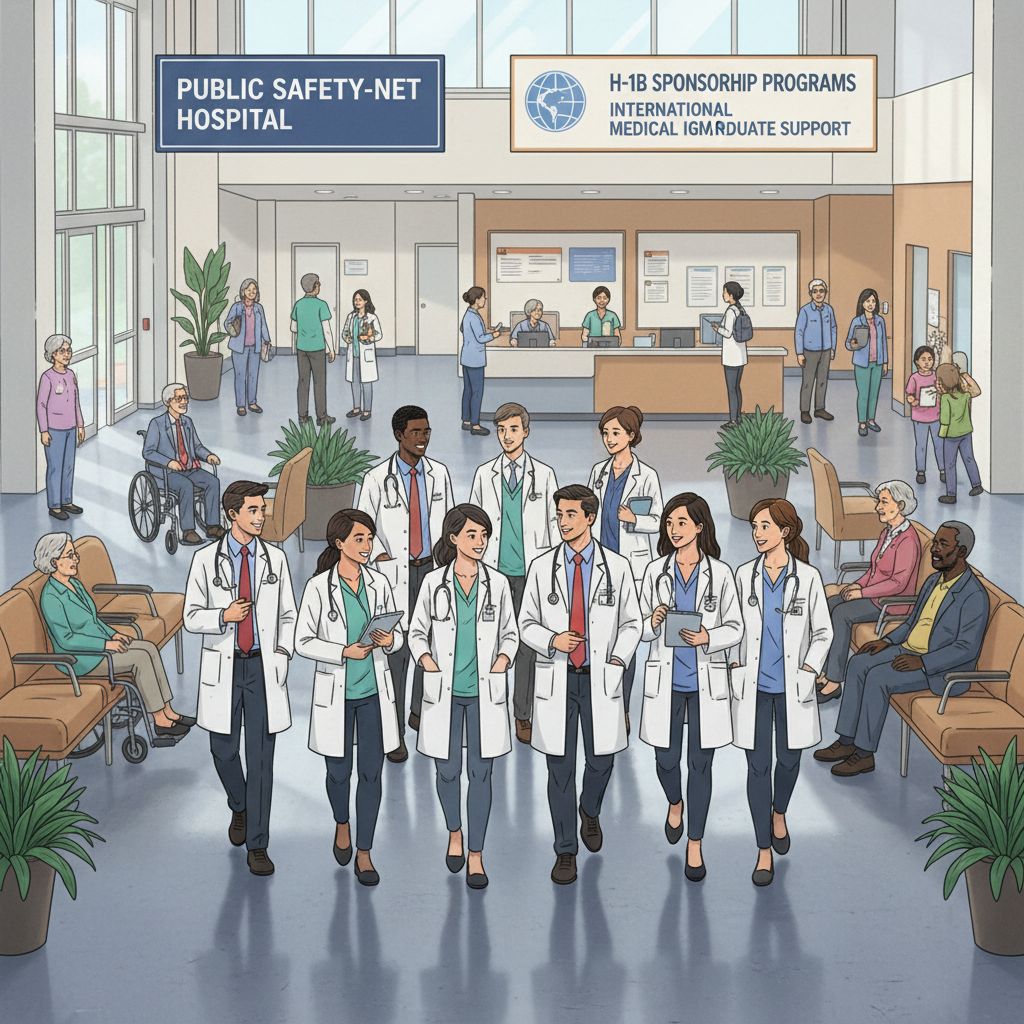
- Safety-net hospitals and county-affiliated centers
- Suburban teaching hospitals (e.g., in Oak Park, Evanston, Berwyn, Maywood) with Chicago university affiliations
Common patterns:
- Historically higher proportion of IMGs
- More experience handling ECFMG-related issues
- Sometimes more flexible on visa types, including H-1B for strong candidates
Action point:
When exploring Illinois residency options, search each program’s website for “Visa”, “H-1B”, or “Sponsorship”; if unclear, email the program coordinator before applying.
3. Programs Typically Unfriendly to H-1B
Certain programs in Chicago may be poor H-1B prospects:
- Small community programs with limited administrative capacity
- Departments that officially list “J-1 only” on their websites
- Programs that state “No visa sponsorship” or “Must be U.S. citizen or permanent resident”
Do not assume they might “make an exception.” In most cases, they will not.
Building an H-1B-Focused Application Strategy
Decide Early: H-1B vs. J-1
For an IMG, a clear priority decision is essential:
- If you strongly prefer H-1B (due to family, long-term U.S. plans, or J-1 waiver concerns), your program list must reflect that, even if it narrows your options.
- If you are open to both H-1B and J-1, you will have a wider pool of Chicago residency programs, but must understand the long-term implications (e.g., J-1 waiver jobs, Conrad 30).
Align this with:
- Your country’s J-1 waiver and return policies
- Your spouse/partner’s visa or career needs
- Your willingness to work in underserved or rural areas later (common for J-1 waivers)
Time Your Exams Strategically (Especially Step 3)
For H-1B sponsorship, USMLE Step 3 is critical. To maximize your competitiveness:
- Target Step 3 completion before ERAS opens (typically September).
- If that is not possible, at least have a scheduled Step 3 date and be prepared to discuss it in interviews.
- Aim for a solid Step 3 score, but passing is the key threshold for visa purposes.
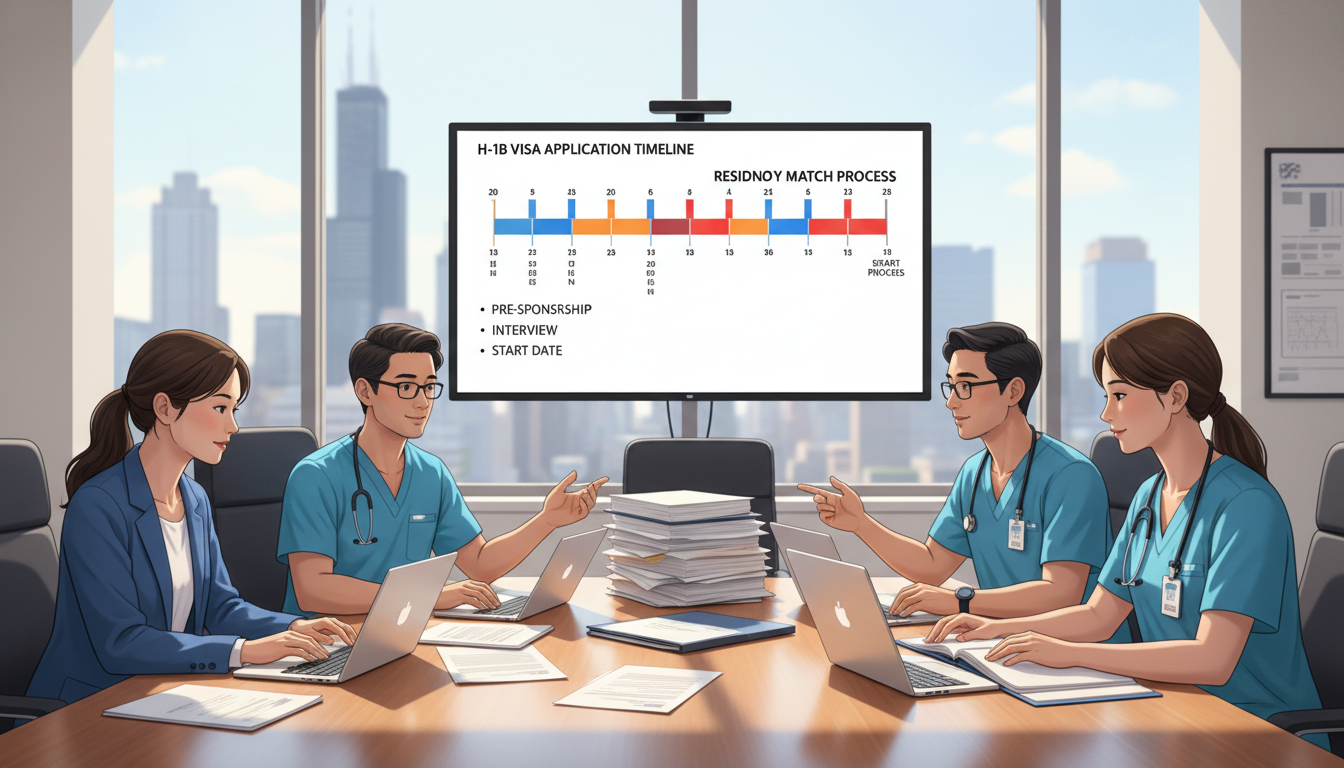
Programs must file H-1B petitions several months before your residency start date (July 1). If your Step 3 result is delayed, it may jeopardize timely filing.
Crafting a Chicago-Focused ERAS Application
If Chicago is your target region, tailor your application to highlight:
- Regional ties: Prior U.S. clinical experience (USCE) in Chicago or the Midwest, family in Illinois, prior degrees from local universities.
- Commitment to underserved care: Many Chicago hospitals serve diverse, underserved communities.
- Adaptability and communication: Programs worry about visa-related delays and communication barriers; provide evidence (LORs, personal statement) that you integrate quickly and communicate well.
Within your personal statement and experiences:
- Explicitly mention your interest in Chicago residency programs and your professional goals in Illinois.
- Clarify your visa preference concisely: e.g., “I am currently on F-1 OPT and am seeking an H-1B sponsoring program” or “I am open to J-1 or H-1B sponsorship.”

Identifying H-1B-Friendly Programs in Chicago: Practical Methods
Because there is no universally updated official H-1B sponsor list, you’ll need a structured approach to data-gathering. Here are reliable strategies tailored for IMGs targeting Chicago and Illinois:
1. Use Official Program Websites and GME Pages
Go beyond the program’s ERAS listing:
Visit the institution’s GME office website (e.g., “Rush GME visa policy”).
Look for specific language:
- “We sponsor J-1 and H-1B visas for eligible residents and fellows.”
- “This program does not sponsor H-1B. We accept J-1 only.”
- “J-1 visa only through ECFMG.”
If the policy is ambiguous (e.g., “We may consider H-1B in exceptional cases”), interpret cautiously. Clarify via email:
- Ask: “For the upcoming Match cycle, do you anticipate sponsoring H-1B visas for PGY-1 residents in [specialty]?”
- Keep your email concise, including your Step 3 status and planned visa category.
2. Search Public Databases and Past Petitions
Although not Chicago-specific, you can look at:
- USCIS public H-1B data: Shows historical H-1B filings by employer (e.g., specific Chicago hospitals).
- Third-party sites that aggregate H-1B data (e.g., MyVisaJobs, h1bdata.info): Search for Chicago hospitals or systems to see if they have sponsored H-1Bs in the past (for residents or other positions).
If you see a hospital repeatedly appearing as an H-1B petitioner for physicians, this suggests a culture and infrastructure for H-1B sponsorship, even if not all departments participate.
3. Network with Current Residents and Fellows
Networking is one of the most powerful tools, especially for IMGs:
- Use LinkedIn and specialty-specific Facebook or WhatsApp groups.
- Search for “Internal Medicine Resident, [Hospital Name], Chicago” and check the physician’s profile:
- If they list “H-1B visa holder” or “International medical graduate,” they might be a helpful contact.
- Politely message:
“I am an IMG applying this year and very interested in your program. Would you be able to share whether your program currently sponsors H-1B visas for incoming residents?”
Residents are often candid about:
- Whether their program actually files H-1Bs
- How difficult the process is
- Whether policies have recently changed
4. Use Specialty and State-Level IMG Networks
Consider:
- Illinois medical societies or IMG committees
- Specialty-specific national organizations with IMG sections (e.g., ACC, ACP, AAFP, APA)
- Online forums (Reddit, Student Doctor Network) for “H-1B Illinois residency” or “Chicago H-1B IMGs”
Be cautious and verify forum information with official sources, but these can provide leads.
Common Pitfalls and How to Avoid Them
Pitfall 1: Assuming All “Visa Sponsoring” Programs Offer H-1B
Many ERAS entries or websites simply state “Visa: Yes” or “ECFMG J-1 Visa Only.” This does not guarantee H-1B. Some programs:
- Accept only J-1
- Sponsor H-1B only for fellowship, not residency
- Sponsor H-1B only for U.S. graduates, not IMGs
Solution:
Insist on explicit confirmation that they sponsor H-1B for your level (PGY-1 vs. PGY-2/3, etc.) and specialty.
Pitfall 2: Applying Without Step 3
Programs might still interview you, but when it comes time to rank and file visas, they may deprioritize applicants who do not yet have Step 3 results.
Solution:
- Take Step 3 early, ideally in the spring or summer before ERAS.
- If you must apply without Step 3, be honest in interviews about timeline and readiness, and focus heavily on J-1-friendly programs as a backup.
Pitfall 3: Overly Narrow List Focused Only on H-1B
Chicago is competitive. If you restrict yourself to a very small number of H-1B-only programs, you risk not matching at all.
Solution:
- Combine:
- A core list of clearly H-1B-friendly Chicago residency programs
- A broader set of J-1 or H-1B programs in Chicago, Illinois, and possibly nearby states
- Decide in advance how much you’re willing to compromise on:
- Location vs. visa type
- Specialty competitiveness vs. visa flexibility
Pitfall 4: Misunderstanding H-1B Cap-Exempt Benefits
While Chicago’s large teaching hospitals are often H-1B cap exempt, not all Illinois hospitals are. Some community sites, even if affiliated academically, may not qualify, making timing and cap issues more complex.
Solution:
- Clarify with programs: “Is your institution H-1B cap exempt?”
- Consider the long-term path:
- Residency in a cap-exempt hospital may allow you to move to another cap-exempt institution easily.
- Moving to a cap-subject employer (e.g., private practice) later may require lottery participation unless using another status such as O-1 or a green card.
Long-Term Planning: Beyond Residency in Chicago
Transition to Fellowship on H-1B
If you complete residency on H-1B in a Chicago or Illinois residency program:
- Many fellows remain within the same health system (easier visa continuation).
- If you move to another Chicago academic center (also cap-exempt), H-1B portability is usually feasible.
- Some subspecialties (e.g., cardiology, GI, heme/onc) may prefer or require prior H-1B experience for candidates who cannot or will not use J-1.
H-1B vs. J-1 Waiver Career Paths
If you choose J-1:
- You must typically complete a J-1 waiver job (e.g., in a medically underserved area) for 3 years before applying for permanent residence.
- Illinois has a Conrad 30 program offering J-1 waivers for physicians willing to work in underserved locations, sometimes outside Chicago.
If you are already on H-1B:
- You can seek employer-sponsored permanent residency (EB-2, EB-3) directly, without a J-1 waiver.
- Many Chicago-area systems sponsor green cards for high-performing physicians, especially in high-need specialties.
Planning tip:
When you are close to finishing residency or fellowship, talk early with potential employers about:
- Green card sponsorship timelines
- Whether they have previously sponsored IMGs
- How they typically sequence H-1B and permanent residence processes
Practical Checklist for IMGs Seeking H-1B-Sponsoring Programs in Chicago
Use this as a working roadmap:
12–18 months before ERAS
- Decide your visa preference (H-1B vs. J-1 vs. open to both).
- Book USMLE Step 3 (if eligible) for before ERAS opening.
- Begin building Chicago or Midwest clinical experience if possible (observerships, electives).
9–12 months before ERAS
- Identify target specialties and create a preliminary list of Chicago and Illinois residency programs.
- Start reading GME and program websites for visa policies.
- Email unclear programs to ask specifically about H-1B sponsorship for PGY-1.
- Start networking with current residents via LinkedIn or alumni connections.
6 months before ERAS
- Take and pass Step 3; keep documentation ready.
- Finalize the list of:
- Clearly H-1B-friendly Chicago programs
- J-1-only or J-1/H-1B-flexible programs (if you are open to J-1).
- Draft your personal statement with Chicago/Illinois motivation highlighted.
ERAS Application Period
- Explicitly mention on your CV and ERAS application that you have:
- ECFMG certification (or timeline)
- Step 3 passed, with date and score
- Consider a concise, factual note in your personal statement or ERAS “additional information” on your visa preference.
- Explicitly mention on your CV and ERAS application that you have:
Interview Season
- Ask programs (tactfully and late in the interview, or by follow-up email):
- “Does your program sponsor H-1B visas for incoming residents?”
- “Is your institution H-1B cap exempt?”
- Keep a spreadsheet recording each program’s response and your impression of their openness.
- Ask programs (tactfully and late in the interview, or by follow-up email):
Ranking and Post-Match
- Rank in order of training quality + visa feasibility.
- After Match, work closely with the program’s GME and HR teams on:
- Timely H-1B filing
- Providing all needed documents (ECFMG certificate, Step 3 transcript, license papers)
- Respond quickly to all immigration document requests.
FAQs: H-1B Sponsorship Programs for IMGs in Chicago
1. Do most Chicago residency programs sponsor H-1B visas for IMGs?
No. Many Chicago programs are J-1 only, especially for PGY-1. However, a meaningful subset—especially university-affiliated and cap-exempt institutions—do sponsor H-1B, often for selected applicants who already have Step 3 and strong academic profiles. You must verify program-by-program; there is no universal Chicago-wide policy.
2. Is it realistic to aim only for H-1B residency programs as an IMG?
It can be realistic if you have a strong profile (high USMLE scores, recent graduation, solid U.S. clinical experience, strong letters) and you apply broadly to H-1B-friendly institutions across the U.S., not just Chicago. If you restrict your list to a small set of Chicago H-1B programs only, your risk of not matching increases significantly. Many IMGs keep both J-1 and H-1B options open.
3. Do I absolutely need USMLE Step 3 for an H-1B residency in Illinois?
Practically, yes. For almost all H-1B residency programs in Chicago and Illinois, Step 3 is a non-negotiable requirement before they can file your H-1B petition. Without Step 3, your chances of obtaining H-1B sponsorship are extremely low. Plan to complete Step 3 before ERAS or as early in the application cycle as possible.
4. Are H-1B cap-exempt programs always better for IMGs?
They are often more flexible because they:
- Avoid the annual H-1B lottery
- Can file petitions at any time
- Are used to employing international physicians
However, “better” depends on your goals. Some cap-exempt institutions are very competitive and may favor U.S. graduates. Also, transitioning later from a cap-exempt environment to a cap-subject employer (e.g., private practice) may require additional planning. For many IMGs, though, cap-exempt Chicago programs are among the most practical ways to train and remain in the U.S. on H-1B.
By understanding how H-1B residency programs operate in Chicago, recognizing which Illinois residency sites are more likely to support your visa, and planning exams and applications strategically, you can significantly improve your odds as an international medical graduate. Use this IMG residency guide as a starting framework, then keep refining your target list and strategy as you gather real-time information from programs, residents, and GME offices.