Understanding H‑1B Sponsorship for Urology Residency as an IMG
International medical graduates who want to match into urology in the United States face two simultaneous challenges: breaking into one of the most competitive specialties and navigating a complex visa landscape. For many, U.S. residency is the primary immigration pathway—and H‑1B sponsorship programs are often the most appealing option.
This IMG residency guide focuses specifically on H‑1B sponsorship opportunities in urology residency and early fellowship. You’ll learn how H‑1B works in the GME context, what makes urology unique, which program types are more likely to sponsor, and how to strategically target H‑1B residency programs while building a competitive urology application.
1. H‑1B vs J‑1 for Urology: Why Visa Choice Matters
For most international medical graduates, the first major decision is whether to pursue programs that sponsor J‑1 visas, H‑1B visas, or both.
1.1 Quick comparison: J‑1 vs H‑1B for IMG urology applicants
J‑1 (ECFMG-sponsored)
- Very common in GME; many urology programs accept only J‑1.
- Requires returning to home country for 2 years after training OR obtaining a J‑1 waiver (e.g., underserved area jobs).
- Simpler for programs to manage administratively.
- Doesn’t directly count toward employment‑based permanent residency (green card).
H‑1B (employer-sponsored)
- Less common; more administrative and cost burden on programs.
- Dual intent visa: you can pursue a green card while in training.
- No mandatory 2‑year home return requirement.
- Requires all USMLE Steps passed (including Step 3) and state license eligibility before start date.
- Salary must meet prevailing wage requirements.
For an international medical graduate interested in urology, H‑1B can be particularly attractive because:
- Urology residency is relatively short (5–6 years at most programs, including research), so you have more time afterward to build career stability without the constraints of a J‑1 waiver.
- Urology jobs are often in high demand, and many employers are willing to continue or transfer your H‑1B status and later sponsor a green card.
- Long-term subspecialty training or academic careers may be easier to plan on H‑1B.
2. How H‑1B Works in Urology Residency and the Match
H‑1B rules in residency differ in important ways from corporate H‑1B. Understanding these details will help you read program policies correctly and ask the right questions.
2.1 H‑1B basics relevant to residency
Key aspects of H‑1B residency programs for IMGs:
- Employer = sponsoring hospital or university, not the program director personally.
- Position = resident physician (GME) with a fixed start and end date.
- Cap‑exempt status: Most teaching hospitals affiliated with universities or nonprofit research institutions are H‑1B cap exempt, meaning they can file H‑1Bs at any time of year and are not limited by the national annual cap lottery.
Because of this cap‑exempt status, many residency‑sponsoring institutions can:
- File an H‑1B petition whenever needed (no April filing constraint).
- Extend H‑1B for the full duration of training (often up to 6 years, sometimes more with special circumstances).
- Transition residents into fellows or faculty on new H‑1B petitions, still under cap‑exempt rules.
Programs that are not affiliated with cap‑exempt institutions will either:
- Not sponsor H‑1B at all, or
- Sponsor only J‑1, because a standard “cap‑subject” H‑1B is inflexible for residency.
When you see “H‑1B cap exempt” on a hospital or university site, that’s usually good news for IMG urology applicants.
2.2 The role of H‑1B in the urology match timeline
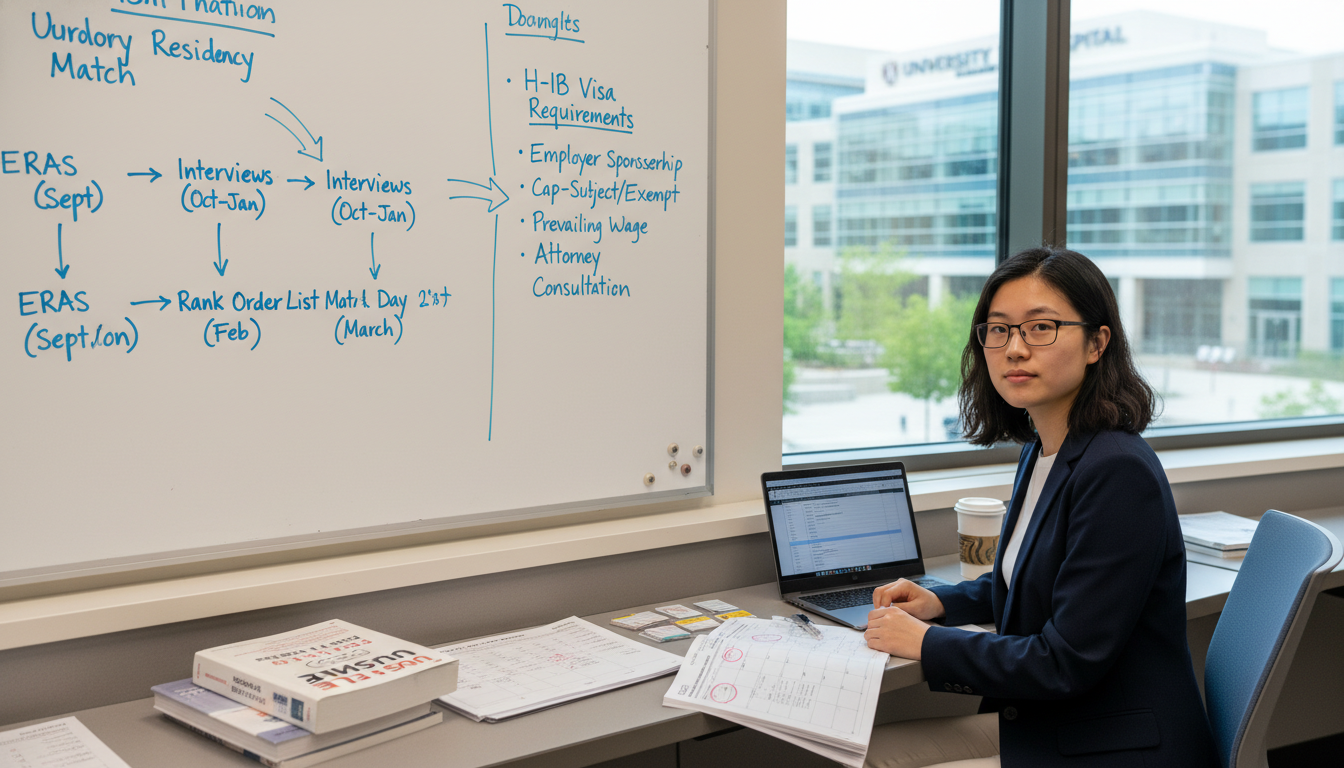
Urology uses an early match through the American Urological Association (AUA), which means your timeline differs from categorical NRMP specialties:
- Applications typically open in early fall (via ERAS).
- Interviews occur from late fall into early winter.
- Rank list deadline and match results are earlier than the NRMP Main Match.
For H‑1B applicants, this timeline has several implications:
USMLE Step 3 timing is critical.
- Most H‑1B residency programs require you to have Step 3 passed before they can file your H‑1B petition.
- Ideally, take Step 3 before or during the application season, so results are available by late winter/early spring.
Credentialing and state licensing deadlines.
- Urology residents must meet state medical board requirements for a training license.
- Many state boards require Step 3 and verified credentials several months before July 1.
Immigration processing window.
- Once matched, the institution works with their legal/visa office to prepare your H‑1B petition.
- With premium processing, many petitions are decided within weeks, but delays can occur.
- Strong communication and early planning are essential.
If you’re committed to H‑1B over J‑1, build your whole urology match strategy around having Step 3 and primary source verification completed as early as possible.
3. Types of Urology Programs and Their H‑1B Sponsorship Behavior
Unlike some primary care specialties, urology has a smaller number of residency positions and programs. Each institution has its own visa policy, but patterns do exist.
3.1 Large academic medical centers and university hospitals
These are the most likely H‑1B-sponsoring urology residency environments:
- Typically affiliated with a medical school and designated teaching hospital.
- Almost always H‑1B cap exempt as nonprofit educational or research institutions.
- Often have an in‑house GME office and a dedicated international services or immigration team.
- More likely to have prior experience sponsoring H‑1B for residents or fellows in other specialties.
Examples of features you might see on their websites:
- “We sponsor J‑1 and H‑1B visas for eligible applicants.”
- “H‑1B sponsorship available for highly qualified candidates who have passed USMLE Step 3.”
- “Our institution is H‑1B cap exempt.”
These programs may still limit H‑1B sponsorship due to cost or policy, but when an institution sponsors H‑1Bs in internal medicine, surgery, or subspecialty fellowships, they are more likely to consider it in urology as well.
3.2 Mid‑sized university affiliates and community‑based academic programs
These programs may:
- Sponsor H‑1B selectively (e.g., only in exceptional cases, or when departmental leadership strongly supports it).
- Prefer J‑1 due to lower administrative burden.
- Have institutional caps on the number of H‑1B visas allowed in the GME pool.
Read their policies with care. Common wording includes:
- “We accept J‑1 visas through ECFMG. H‑1B sponsorship is considered on a case‑by‑case basis.”
- “Due to institutional policy, the urology residency currently sponsors J‑1 visas only.”
When you see “case‑by‑case basis,” assume you must be significantly above average for that program and be prepared to advocate clearly and professionally.
3.3 Pure community programs and independent hospitals
Purely community‑based urology programs are less common, but some institutions:
- Have limited or no experience with H‑1B sponsorship.
- May not be H‑1B cap exempt, which makes sponsorship more difficult logistically.
- Rely heavily on J‑1 or U.S. citizenship/permanent residents.
If a community program does sponsor H‑1B, it may be more common at:
- Large regional referral centers affiliated informally with universities.
- Systems that have historically used H‑1B for hospitalist or subspecialty roles.
3.4 What “H‑1B sponsor list” means in practice
Many IMGs search for a “urology residency H‑1B sponsor list” or generalized “H‑1B sponsor list for residency.” A few key points:
- There is no official, universal list of H‑1B‑sponsoring urology programs maintained by a central body.
- Some commercial or community‑created lists compile historical data from:
- FREIDA and AUA program descriptions
- Institutional visa policies
- Residents’ anecdotal reports
- Departmental websites.
Use these lists as starting points only, and always:
- Verify current policy directly on the program’s website or FREIDA listing.
- Cross‑check with the institution’s GME/International Office visa page.
- Confirm politely with the program coordinator if necessary.
Policies can change year to year based on institutional leadership, legal advice, or budget constraints.
4. Building a Target List: Strategic Search for H‑1B-Friendly Urology Programs
You can significantly improve your chances in the urology match by systematically identifying programs that are realistically open to H‑1B sponsorship.
4.1 Step‑by‑step process to identify potential H‑1B residency programs
Start with the full AUA urology program list.
- Create a spreadsheet of all urology residencies (program name, city, state, ACGME code).
Use FREIDA and program websites.
For each program:- Check “Visa” section on FREIDA (J‑1 only, H‑1B, both, or “none”).
- Visit the program’s own webpage and the institution’s GME/Graduate Medical Education office page.
- Look for explicit visa language:
- “We sponsor H‑1B visas for eligible candidates.”
- “Only J‑1 visas are sponsored.”
- “We do not sponsor visas.”
Check institutional immigration/HR sites.
- Search “[hospital name] H‑1B cap exempt,” “[university name] international office,” or “[institution] visa sponsorship residents.”
- If the institution globally supports H‑1B for house staff, that’s a positive sign even if urology’s page doesn’t explicitly mention it.
Use external H‑1B databases.
- U.S. Department of Labor and private sites sometimes list employers that have filed H‑1B petitions historically.
- Search the hospital/university name. If they’ve sponsored H‑1Bs for physicians, faculty, or residents, they appear more H‑1B‑friendly.
Network with current residents and alumni.
- Reach out via LinkedIn, conferences, or alumni groups. Ask directly yet respectfully:
- “Does your program currently have residents on H‑1B?”
- “Has your urology department sponsored H‑1B in recent years?”
- Reach out via LinkedIn, conferences, or alumni groups. Ask directly yet respectfully:
Contact coordinators strategically.
When information is unclear, you can send a concise email:- Introduce yourself briefly (name, IMG status, graduation year).
- Ask a specific question:
- “Could you please confirm whether your urology residency program sponsors H‑1B visas for incoming residents?”
- Avoid long personal stories or requests to “make an exception” at this stage.
4.2 Categorizing your list
Once you gather data, categorize programs into three tiers:
Tier A – Clearly H‑1B friendly
Programs that:- Explicitly state H‑1B sponsorship in their GME or urology pages, and/or
- Confirm via coordinator that they sponsor H‑1B regularly.
Tier B – Conditional or case‑by‑case
Programs that:- State J‑1 preferred but H‑1B considered for exceptional candidates, or
- Have sponsored H‑1B historically but no clear written policy currently.
Tier C – J‑1 only or no visa support
Programs that:- Explicitly say “J‑1 only,” “we do not sponsor H‑1B,” or “no visa sponsorship.”
For an IMG strongly committed to H‑1B, prioritize Tier A, apply selectively to Tier B (if your profile is strong), and generally avoid Tier C.
4.3 Balancing competitiveness and H‑1B availability
Urology is one of the most competitive specialties for any applicant—IMG or otherwise. Restricting your list only to H‑1B‑friendly programs makes it even more competitive.
You should:
- Apply broadly within Tier A and B; 40–60 applications is common for IMG urology candidates.
- Ensure your academic and clinical profile is strong enough to be considered by academic H‑1B‑friendly centers (research, publications, strong US letters).
- Consider whether you’re absolutely fixed on H‑1B. Some high‑tier programs may offer only J‑1 but provide exceptional training and later career opportunities.

5. Strengthening Your Application for H‑1B-Sponsoring Urology Programs
Because H‑1B adds cost and administrative work, programs are more selective about which IMG candidates they will sponsor. You must demonstrate that you’re worth that investment.
5.1 Core academic metrics
For competitive H‑1B residency programs in urology, aim for:
USMLE Step scores
- Step 1: While now Pass/Fail, program directors will still look at your exam history. Several failures can be a major obstacle.
- Step 2 CK: Preferably well above the national average for urology applicants.
- Step 3: Passed on first attempt before rank list deadlines or at least before contract issuance.
Medical school performance
- Strong class rank or honors (if applicable).
- Some urology programs pay attention to membership in honor societies or equivalent international distinctions.
5.2 Urology‑specific exposure and research
Most competitive urology programs expect:
- Multiple urology rotations in the U.S., ideally at academic centers.
- Strong letters of recommendation from U.S. urologists who know you well.
- Evidence of true commitment to urology:
- Urology‑related research projects.
- Posters and abstracts at urology conferences (AUA, regional meetings).
- Publications (even case reports) in urology journals.
When programs consider whether to invest in an H‑1B petition, these specialty‑specific achievements can tip the balance.
5.3 Communication and professionalism around visa issues
How you handle visa discussions can influence a program’s willingness to sponsor H‑1B:
Be clear and honest on your ERAS application.
- Accurately state your citizenship and visa needs.
- If you already hold a different U.S. status (e.g., F‑1 OPT), explain it briefly.
Prepare concise answers for interviews.
- “I am eligible for H‑1B sponsorship and will have USMLE Step 3 completed by [date]. I am also open to discussing institutional policies and timelines to ensure a smooth onboarding process.”
Avoid sounding demanding or entitled.
- Phrase questions as: “Could you share how your institution handles visa sponsorship for urology residents?” rather than “You will sponsor my H‑1B, right?”
Have documentation ready.
- Step 3 pass report.
- ECFMG certificate.
- Up‑to‑date CV with clear graduation dates and clinical experience.
- If applicable, evidence of prior legal U.S. status (F‑1, J‑1, etc.).
5.4 Backup strategies if H‑1B in urology doesn’t work out immediately
Despite strong preparation, some IMGs may not secure a urology position with H‑1B sponsorship during their first application cycle. Consider:
Preliminary surgery or transitional year (often on J‑1 or H‑1B) while reapplying to urology.
Research fellowships in urology at academic centers, which can:
- Give you U.S. research credentials and publications.
- Connect you with urology faculty who may advocate for you in the next cycle.
- Sometimes lead to clinical positions later (though this is not guaranteed).
Alternate path specialties that are more H‑1B‑friendly, followed by urology fellowships abroad or later transitions.
The best approach depends on your risk tolerance, financial situation, and long‑term goals.
6. Practical Visa and Legal Considerations for IMG Urologists
Once a program agrees to sponsor your H‑1B, the process becomes highly legal and technical. While their attorneys handle the details, you should understand the framework.
6.1 Duration and extensions
- Standard H‑1B is granted for up to 3 years initially, renewable up to a typical maximum of 6 years.
- Many urology residencies last 5 years; with potential research time or chief year, you may approach the 6‑year cap.
- Because most teaching hospitals are H‑1B cap exempt, some exceptions and extension mechanisms may exist, particularly if you transition to faculty or continue in research.
Always discuss long‑term planning with:
- The GME office or international office.
- The hospital’s immigration attorney, once your program accepts you.
6.2 Changing institutions: fellowship or first job
To pursue a urology fellowship (e.g., oncology, endourology, pediatric urology) or your first post‑residency job:
- If you remain within a cap‑exempt institution, your new employer can generally file a cap‑exempt H‑1B transfer or new petition.
- If you move to a private practice or non‑exempt hospital, they may need to file a cap‑subject H‑1B, which is lottery‑based under the national cap—unless you already hold cap‑subject time from prior employment.
Strategic tip: Many IMGs complete urology residency and fellowship in cap‑exempt academic settings and then transition to a cap‑subject role later, once they are on the pathway to permanent residency (e.g., after I‑140 approval and H‑1B extensions beyond 6 years).
6.3 H‑1B and permanent residency (green card) planning
One of the biggest advantages of H‑1B over J‑1 for IMG urologists is the ability to pursue a green card without a home‑return obligation. Common routes:
- EB‑2 or EB‑1 immigrant petitions sponsored by academic employers.
- National Interest Waiver (NIW) in some subfields, particularly with significant research output and service in underserved populations.
You cannot self‑petition a green card easily at the residency stage, but:
- Track your research, teaching, and leadership roles.
- Build a portfolio that could support future EB‑1/NIW evaluations.
- Choose fellowships and jobs with institutional willingness to sponsor permanent residency.
FAQs: H‑1B Sponsorship for IMG Urology Residency
1. Is it realistic for an IMG to match into urology on an H‑1B visa?
Yes, but it is challenging. Urology is already competitive, and only a subset of programs sponsor H‑1B. Successful candidates usually have:
- Strong Step scores with Step 3 passed early.
- Significant U.S. clinical exposure in urology.
- Research output and strong U.S. letters.
- Well‑targeted applications to known or likely H‑1B‑friendly programs.
2. Do all academic urology programs sponsor H‑1B for residents?
No. Even among large academic centers, some GME offices choose to sponsor J‑1 only due to cost and administrative burden. Others may sponsor H‑1B only for certain specialties. Always verify current policies through official institutional sources and, if needed, directly with the program coordinator.
3. Can I apply to urology programs before passing Step 3 if I want H‑1B?
You can apply, but it weakens your H‑1B case. Many programs will not rank an IMG for H‑1B sponsorship without a Step 3 pass, because they need it for the H‑1B petition and state training license. For serious H‑1B pursuit in urology, plan to have Step 3 completed with results available by the middle of interview season or earlier.
4. Where can I find a reliable H‑1B sponsor list for urology residency programs?
There is no official, static H‑1B sponsor list specific to urology. Your best approach is:
- Use FREIDA and AUA program data as a starting point.
- Review each institution’s GME and international office visa policies.
- Use public H‑1B employer data to confirm prior sponsorship.
- Network with current residents or alumni to confirm real‑world practices.
Because policies change frequently, always treat any list you find online as approximate and verify directly with programs.
By understanding the structure of H‑1B cap‑exempt residency programs, identifying realistic targets, and presenting a highly competitive urology profile, an international medical graduate can significantly improve the chances of securing an H‑1B‑sponsored urology residency and building a sustainable surgical career in the United States.