Understanding H-1B Sponsorship for Non‑US Citizen IMGs in the Sun Belt
For a non-US citizen IMG, landing a residency in the Sun Belt with H-1B sponsorship can feel like solving a puzzle with moving pieces: visa rules, state licensing, USMLE timelines, and program preferences. The good news is that many southern residency programs actively train international graduates and several offer H-1B residency programs, particularly in larger academic centers and safety‑net hospitals.
This guide explains how H-1B sponsorship works specifically for foreign national medical graduates, how it differs from J-1, and how to strategically target Sun Belt residencies that are more likely to sponsor H-1B visas.
We’ll focus on practical, step‑by‑step strategies you can use right now, with special attention to:
- Which types of Sun Belt programs tend to sponsor H-1B
- How to time your USMLE exams and ECFMG certification
- How to read between the lines of program websites
- How to build your own “H-1B sponsor list” and maximize match chances
H-1B vs J-1: What Foreign National Medical Graduates Must Know
Before you look at specific southern residency programs, you need a clear picture of the visa landscape as it affects a non-US citizen IMG.
J-1 vs H-1B in Residency
J-1 (ECFMG-sponsored exchange visitor visa)
- Most common visa route for IMGs in residency
- Sponsored by ECFMG, not by each hospital
- Requires you to return to your home country for 2 years after training, unless you secure a J-1 waiver (e.g., Conrad 30, VA, or federal waivers)
- Typically easier to obtain than H-1B, and many community programs only support J-1
H-1B (temporary worker in specialty occupation)
- Sponsored directly by the residency program (employer)
- No automatic 2-year home residency requirement after training
- Can be a smoother bridge to long-term work authorization and potential green card
- Requires USMLE Step 3 passed before the visa petition is filed (often before Rank Order List deadline)
- More paperwork, higher cost, and stricter legal requirements for the institution
For a non-US citizen IMG planning to eventually work long-term in the US, H-1B residency programs can be very attractive—especially if you prefer to avoid the uncertainties of J-1 waivers.
What “Cap-Exempt” Means—and Why Residency Matters
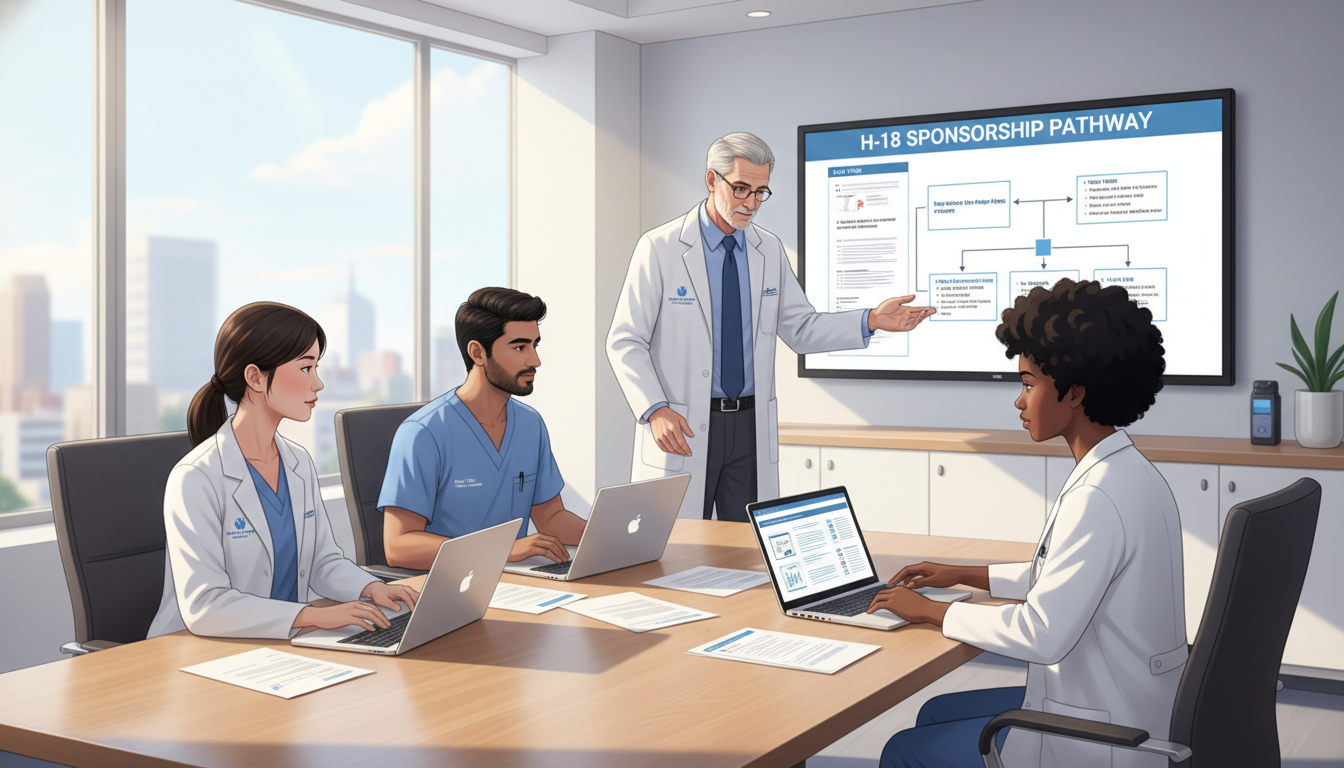
Most teaching hospitals that sponsor H-1B for residency are H-1B cap exempt, meaning they are:
- Institutions of higher education (e.g., universities)
- Non-profit organizations affiliated with such institutions
- Certain research organizations
Why this matters:
- They can file H-1B petitions any time of the year (no April lottery)
- You are not counted against the annual H-1B cap while in training
- This flexibility is crucial for matching timelines, which don’t line up well with the regular H-1B lottery
Later, if you move from a cap-exempt residency to a private practice or non-teaching hospital (usually cap-subject), you will need to navigate the H-1B cap at that time. But for residency itself, cap-exempt institutions simplify the process.
The Sun Belt Landscape: Where H-1B-Friendly Programs Are Found
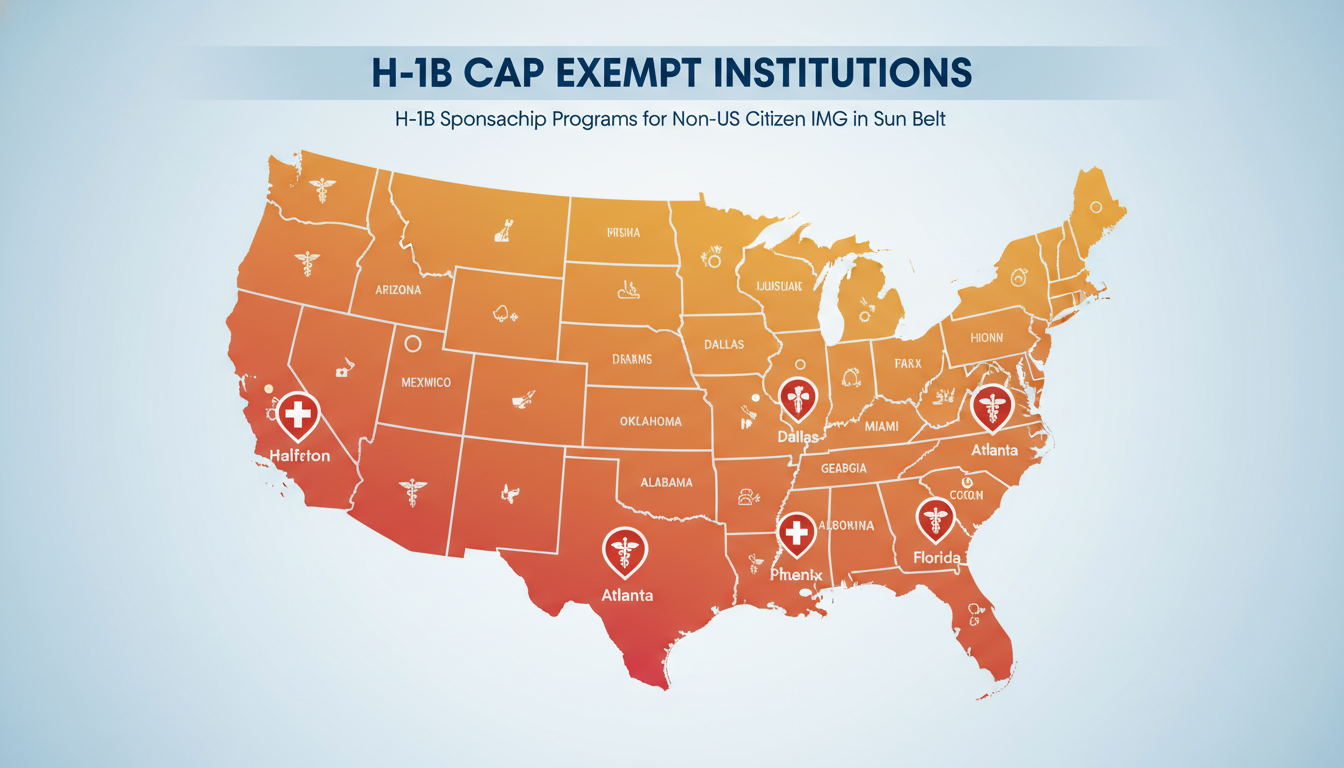
The “Sun Belt” typically includes southern and southwestern states with warmer climates and growing populations, such as:
- Texas, Florida, Georgia, Alabama, Mississippi, Louisiana, South Carolina, North Carolina
- Arizona, New Mexico, Nevada
- Parts of California (often grouped in because of climate and population trends)
These regions host a mix of large academic centers, safety-net hospitals, and rapidly expanding community programs, many of which are accustomed to training international medical graduates.
Where H-1B Sponsorship Is More Likely in the Sun Belt
While each program must be checked individually, you’ll typically see stronger H-1B sponsorship patterns in:
Large Academic Medical Centers
- University hospitals in cities like Houston, Dallas, San Antonio, Austin, Phoenix, Tucson, Miami, Tampa, Atlanta, Birmingham, New Orleans, and others
- Often clearly marked as H-1B cap exempt and have established immigration/legal departments
- More likely to have transparent policies on IMGs and visa types on their GME websites
Public and Safety-Net Hospitals
- County/municipal systems and large non-profit hospitals that serve diverse immigrant communities
- Often already sponsor H-1B for faculty and may extend that to residents and fellows
Established Programs with High IMG Presence
- Internal medicine, family medicine, pediatrics, neurology, and psychiatry in certain cities with strong IMG networks
- Programs that regularly list “ECFMG certified IMGs welcome” or show many IMGs among current residents are more likely to be open to H-1B discussion
Where H-1B Is Less Common
- Small, new community-based programs in rural areas may:
- Only sponsor J‑1
- Explicitly state “We do not sponsor H‑1B visas” on their websites
- Osteopathic (DO) programs that only recently integrated into the ACGME system may have less experience with visa sponsorship
- Some state-funded programs may have restrictive policies based on state law or institutional policy
This doesn’t mean you must avoid them, but if your priority is H-1B, they should not be the foundation of your strategy.
Building Your Own H-1B Sponsor List in the Sun Belt
There is no single official, updated public H-1B sponsor list for residency programs, so a non-US citizen IMG must build a practical, personalized list. Here’s a step‑by‑step approach.
Step 1: Start with the Right Program Types
Focus your initial search on:
- University-based programs in:
- Texas (multiple UT campuses, Baylor, etc.)
- Florida (UF, UM, USF, UCF, FIU, etc.)
- Georgia (Emory, Augusta, etc.)
- Arizona (University of Arizona, Mayo Arizona, etc.)
- California (UC system, large county/university-affiliated hospitals)
- Large community programs that are:
- Affiliated with universities
- Known for strong IMG representation
Use the ACGME or FREIDA database to identify all programs in your desired specialty in these states, then narrow down.
Step 2: Analyze Program Websites Carefully
On each program’s website, look for:
- A “Visa” or “International Medical Graduates” section
- Statements like:
- “We sponsor J‑1 and H‑1B visas”
- “H‑1B visas considered for highly qualified candidates with USMLE Step 3 completed”
- “We only accept J‑1 visas sponsored by ECFMG” (this means no H‑1B)
Pay close attention to GME office pages at the institutional level (not just the individual department). Sometimes:
- The GME office policy governs all programs
- The department page may be silent, but the GME page will clearly state visa options and requirements
Record results in a spreadsheet:
- State
- Institution
- Program (Specialty)
- H‑1B: Yes / No / Case‑by‑case / Unknown
- Requirements noted (Step 3 deadline, ECFMG certification timing, etc.)
Step 3: Verify Using H-1B Databases and FOIA Resources
To supplement what programs state publicly, you can:
- Search for the hospital or university in public H‑1B disclosure data (e.g., US Dept of Labor-certified LCA data or community-built databases).
- If you see frequent H‑1B petitions for Resident Physician, Medical Resident, or Graduate Medical Trainee, that hospital is almost certainly an H‑1B sponsor.
- Remember that not all positions listed will be residents; some may be faculty, but it’s still a positive sign that the institution has H‑1B infrastructure.
You don’t need to become an immigration expert; the purpose is to identify institutions that are already used to H‑1B.
Step 4: Directly Email Programs When Information Is Missing
If it’s unclear, send a short, professional email to either the program coordinator or the GME office. For example:
Subject: Visa Sponsorship Question – [Your Name], IMG Applicant
Dear [Coordinator/Program Director/GME Office],
I am a non‑US citizen IMG interested in applying to your [Specialty] residency program in the upcoming ERAS cycle. Could you please clarify whether your program sponsors H‑1B visas for residency trainees, or if you accept only J‑1 visas?
I hold/plan to hold ECFMG certification by [month, year] and plan to complete USMLE Step 3 by [month, year].
Thank you very much for your guidance.
Sincerely,
[Full Name]
[Medical school, graduation year]
Keep a record of responses as you build your personal Sun Belt H-1B sponsor list.
Timing and Requirements: How to Be Eligible for H‑1B Residency
Many non-US citizen IMGs lose out on H‑1B options simply because they don’t prepare the basic requirements early enough. If you are targeting H‑1B residency programs in the Sun Belt, you must plan ahead.
USMLE Step 3: Your Critical Gatekeeper
Nearly all H‑1B residency programs require USMLE Step 3 passed BEFORE filing the H‑1B petition. Each institution sets its own internal deadline, but common patterns include:
- Step 3 must be passed by the time rank lists are submitted (February)
- Or by early spring so paperwork can begin before July 1
- Occasionally, a program may interview you with Step 3 pending but will insist that it be passed before the match or before issuing a contract
Practical advice:
- Aim to complete Step 3 no later than December–January of the application season in which you’re interviewing.
- If you know you want H‑1B, schedule Step 3 early once you’re eligible (i.e., USMLE Step 1, Step 2 CK, and ECFMG certification requirements met).
ECFMG Certification and State License Requirements
For H‑1B, many states and institutions require:
- ECFMG certification at the time of visa filing
- Occasionally, evidence that you qualify for a training license (or equivalent) under that state’s medical board rules
States in the Sun Belt may differ slightly in their rules, but in general:
- You should aim to be ECFMG certified before applying via ERAS or at least by early in the interview season.
- Do not assume late certification will be acceptable for H‑1B programs; some may rank you conditional on timely certification but it is a risk.
Other Documentation Typically Needed
Programs’ legal teams usually handle the formal H‑1B petition, but they will ask you for:
- Passport identification page
- Medical degree and translated diploma
- ECFMG certificate
- Detailed CV and sometimes employment history
- Step 1, Step 2 CK, and Step 3 score reports
- Evidence of medical school accreditation as required for ECFMG
Having these documents organized and ready will speed up H‑1B processing and show programs you are serious and well prepared.

Application Strategy: Maximizing Match Chances as a Non‑US Citizen IMG
Even with a strong H‑1B sponsor list, you still must compete academically and professionally. Sun Belt programs can be very competitive, especially in popular cities. Here is how to optimize your approach.
1. Balance H‑1B-Preferred Programs with a Realistic Safety Net
If your only acceptable option is H‑1B, you must be prepared for a smaller pool of programs and higher competition. Consider:
- Apply broadly to all H‑1B-friendly programs in your specialty and geography of interest
- Include some J‑1 accepting programs if you are willing to consider that pathway as a backup (many IMGs successfully transition from J‑1 through waivers)
- If your scores or profile are not top-tier, over-concentrating on a few highly competitive H‑1B programs in big cities (e.g., Miami, Houston, Los Angeles) may be risky. Balance them with mid-sized cities and less saturated markets.
2. Highlight Why You’re a Strong Investment for H‑1B Sponsorship
For a program, H‑1B means extra cost and administration. You need to present yourself as a candidate worth that investment:
- Strong USMLE scores, especially Step 2 CK and Step 3 if available
- Solid US clinical experience (USCE)—ideally hands-on rotations in the US during or after medical school
- Letters of recommendation from US faculty in your chosen specialty
- Evidence you can communicate effectively with diverse patients, which is important in many Sun Belt communities
- A clear, professional explanation in your personal statement of your:
- Long-term commitment to practicing in the US
- Connection or interest in the region (e.g., family in Texas, prior observership in Florida, language skills relevant to local populations)
3. Tailor Your Application to Southern Residency Programs
Sun Belt states often have rapidly growing, diverse populations and significant health disparities. In your application:
- Emphasize interest in:
- Serving underserved or immigrant communities
- Primary care (if applicable) or specialties where local need is high
- Long-term retention in the region (programs prefer trainees likely to stay)
- If you speak Spanish or another language widely used in the region, highlight this as a clinical asset. This is especially relevant in Texas, California, Florida, Arizona, New Mexico, and parts of Georgia.
4. Use Interviews to Clarify Visa Policies Professionally
During interviews, visa questions are common for non-US citizen IMGs. Approach them thoughtfully:
- When to ask:
- If visa policy is clear on the website (e.g., “We sponsor H‑1B”), you may not need to ask again.
- If unclear, ask politely near the end of an interview:
“I am a non‑US citizen IMG and USMLE Step 3 eligible/complete. Could you clarify whether your program sponsors H‑1B visas for residents, or is J‑1 the only option?”
- How to present yourself:
- Reassure them you understand the Step 3 and documentation timelines.
- Show readiness: “I have scheduled Step 3 for [month, year] and expect to have results by [month, year], in time for your HR paperwork.”
Programs appreciate candidates who are informed and organized rather than vague or demanding.
Common Pitfalls and How to Avoid Them
Even strong candidates make avoidable mistakes when pursuing H‑1B residency programs in the Sun Belt.
Pitfall 1: Taking Step 3 Too Late
- Relying on a hope that “maybe this program will exempt me from Step 3” usually fails.
- Many institutions have strict policies they cannot bend, regardless of how much they like you.
Fix:
Schedule Step 3 early enough so results are available before ranking deadlines for the cycle in which you apply.
Pitfall 2: Assuming All Big-Name Programs Sponsor H‑1B
Some prestigious institutions in the South only support J‑1 visas for residents, despite having many IMGs. Program reputation does not guarantee H‑1B.
Fix:
Always confirm via program or GME website, or by email. Don’t rely solely on reputation or anecdotal stories.
Pitfall 3: Not Being Flexible on Geography or Specialty
If you insist on:
- Only one city (e.g., just Miami or just Houston), or
- A highly competitive specialty (e.g., dermatology, plastic surgery)
And you also require H‑1B, the probability of matching drops sharply.
Fix:
- Consider less competitive specialties (e.g., internal medicine, family medicine, pediatrics, psychiatry, neurology) for a stronger H‑1B match strategy.
- Be open to mid-sized cities in the Sun Belt where programs may be more accommodating and eager to attract applicants.
Pitfall 4: Ignoring J‑1 Pathways Completely
Some non-US citizen IMGs fixate on H‑1B and overlook realistic and successful routes through J‑1 plus waiver in the same Sun Belt region later. While your preference for H‑1B is understandable, a rigid “H‑1B only” rule can significantly limit your options.
Fix:
Even if your primary strategy is H‑1B:
- Keep an informed understanding of J‑1 waiver options in Sun Belt states (especially for primary care and psychiatry).
- Consider including a few high-quality J‑1-friendly programs as a backup layer in your application strategy.
FAQs: H‑1B Sponsorship Programs for Non‑US Citizen IMGs in the Sun Belt
1. Do most southern residency programs sponsor H‑1B, or is it rare?
In the Sun Belt, H‑1B sponsorship is not rare but is far from universal. Large academic centers and some safety‑net hospitals commonly offer H‑1B for residents, especially in internal medicine, family medicine, pediatrics, psychiatry, and neurology. However, many smaller community programs are J‑1 only. Overall, you should identify a targeted subset of programs rather than expect that every southern residency program will be an H‑1B residency program.
2. Can I match into a residency on a J‑1 and later change to H‑1B during training?
Switching from J‑1 to H‑1B during residency is generally difficult and often not allowed by institutional policy or by ECFMG rules. Most programs expect you to remain on the same visa status throughout residency. If you start on J‑1, you should plan for:
- Completing your 2‑year home residency requirement afterward, or
- Obtaining a J‑1 waiver through options like Conrad 30, VA facilities, or federal programs.
If you want H‑1B for residency itself, you must plan for that from the start and choose programs accordingly.
3. If a program is H‑1B cap exempt, does that mean I never have to worry about the H‑1B cap?
No. During residency at a cap-exempt institution (such as a university hospital), your H‑1B is not subject to the annual quota. But if, after residency, you move to a cap-subject employer (like a private practice or non-teaching hospital), you may then need to go through the regular H‑1B lottery and be subject to the cap. Many physicians navigate this successfully, but you should understand this long-term planning issue when thinking about your career beyond training.
4. What is the single most important thing I can do now if I want an H‑1B-sponsored residency in the Sun Belt?
The most impactful step is to plan and complete USMLE Step 3 early enough for H‑1B filing in your application year. In parallel, start building a personalized list of Sun Belt programs that clearly sponsor H‑1B, confirm their requirements, and then apply broadly. Combining early Step 3 completion, a strong academic profile, and a strategic list of H‑1B-friendly southern residency programs gives you the best chance of matching as a non-US citizen IMG.
By understanding where H‑1B residency programs exist in the Sun Belt, what they require from foreign national medical graduates, and how to time your preparation, you can turn a confusing process into a structured, achievable plan—and significantly improve your chances of securing a training position that aligns with both your immigration and career goals.