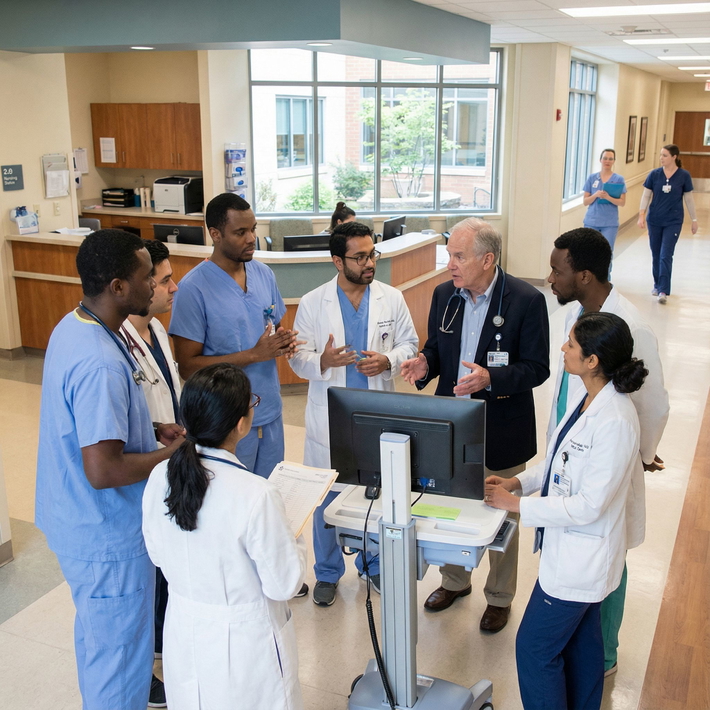
Understanding H‑1B Sponsorship for Non‑US Citizen IMGs
For a non-US citizen IMG, finding residency programs that sponsor H‑1B visas can feel like navigating a maze. You need to balance visa strategy, exam timing, documentation, and a realistic program list—while competing with thousands of applicants.
This article breaks down how H‑1B residency programs work, how they differ from J‑1, and specific strategies to identify and match into H‑1B sponsor programs as a foreign national medical graduate. The focus is practical and step‑by‑step, so you can integrate visa planning into your overall residency application strategy.
H‑1B Basics for Residency
The H‑1B is a temporary work visa for “specialty occupations” that usually requires at least a bachelor’s degree, and in medicine, typically an MD/MBBS or equivalent plus licensing exams.
Key points tailored to non‑US citizen IMGs:
- Employer‑sponsored: The residency program (hospital/health system) is the petitioner; you are the beneficiary.
- Dual intent: Unlike J‑1, H‑1B allows you to pursue a green card without formally violating visa intent.
- Duration: Commonly issued in 3‑year increments, up to a typical maximum of 6 years, though academic centers may have pathways for extensions in certain cases.
- Full‑time employment: You must have a full‑time, paid position. Observerships, externships, and research fellowships generally do not qualify.
Why H‑1B Is Attractive to Non‑US Citizen IMGs
Compared with the J‑1, H‑1B sponsorship has several advantages that are particularly important for foreign national medical graduates:
- No J‑1 home‑residency requirement: You avoid the 2‑year home-country return requirement often attached to J‑1 visas.
- Flexibility for long‑term US careers: Easier to transition to fellowships, academic jobs, or community practice without waiver obligations.
- Green card pathways: Commonly used to transition toward permanent residency, especially if you plan to stay in the US long‑term.
- Family considerations: Spouses and children can come as H‑4 dependents (though work authorization for H‑4 spouses is limited and situation‑dependent).
However, H‑1B also comes with challenges:
- Stricter requirements: Many programs will sponsor J‑1 but not H‑1B.
- Timing pressure: You must have all USMLE Steps required for full ECFMG certification (including Step 3 at most programs) before H‑1B filing.
- Higher administrative burden and cost for programs: Some community hospitals avoid H‑1B sponsorship for this reason.
Understanding these trade‑offs is essential for building a realistic strategy.
H‑1B vs J‑1: Strategic Choices for IMGs
Before targeting H‑1B residency programs, you need a clear stance on whether H‑1B is your priority or just one of several options.
Core Differences in Simple Terms
J‑1 (ECFMG‑sponsored):
- Most common visa for IMGs in residency.
- Sponsored by ECFMG, not directly by the hospital.
- Requires return to home country for 2 years after training OR a formal J‑1 waiver (e.g., underserved area service).
- Generally easier and cheaper for programs to handle.
- No need for USMLE Step 3 before starting residency.
H‑1B (Employer‑sponsored):
- Sponsored directly by the employing hospital/health system.
- No automatic home-country requirement.
- Often requires USMLE Step 3 passed before the visa petition is filed.
- Involves more legal/financial burden for the hospital.
- Often limited to certain specialties and institutions.
When Targeting H‑1B Makes the Most Sense
For a non‑US citizen IMG, prioritizing H‑1B residency programs is particularly logical if:
- You are certain you want to build a permanent career in the US.
- Your home country’s political or economic situation makes returning challenging.
- You aim for competitive fellowships or a long academic career where multiple transitions are easier without J‑1 waiver constraints.
- You already passed USMLE Step 3 (or have a strong plan to do so early).
However, if you are still early in exams or need to apply as soon as possible, keeping J‑1 options open can significantly widen your potential program pool.
Practical Recommendation:
If H‑1B is your first choice but you are not certain you will have Step 3 in time, structure your program list into tiers:
- Tier 1: Programs that offer H‑1B and explicitly accept applicants on J‑1 as a backup.
- Tier 2: H‑1B‑friendly programs (for which Step 3 is mandatory and non‑negotiable).
- Tier 3: Strong J‑1 options (in case Step 3 or H‑1B timing doesn’t work out).

Core Requirements for H‑1B Residency Sponsorship
Most residency‑based H‑1B petitions share a set of baseline requirements. As a foreign national medical graduate, you should shape your preparation timeline around these.
1. ECFMG Certification and USMLE Exams
To be eligible for residency and subsequently for H‑1B, you must:
- Pass USMLE Step 1.
- Pass USMLE Step 2 CK.
- Complete OET Medicine (or the current ECFMG English requirement).
- Obtain ECFMG certification.
For H‑1B specifically, many programs additionally require:
- USMLE Step 3 passed before H‑1B petition filing.
- Some programs will interview you without Step 3 but will require a passing score by rank list deadline or contract signing.
- Others will filter out applicants without Step 3 at the application review stage.
Actionable advice:
If H‑1B is your priority, aim to complete Step 3 at least 4–6 months before July 1 (the typical start of residency). That allows the program enough time to file the H‑1B petition and respond to any USCIS requests.
2. US State Medical Board Requirements
H‑1B petitions for residency must comply not just with USCIS rules but also with state regulations. Some states require:
- A limited training license (often easier to get).
- Or full/temporary medical licensure, which may have:
- Minimum USMLE score thresholds.
- Attempt limits (e.g., no more than 3 attempts per Step).
- Addressed “gaps” in clinical training.
- Verification of foreign internship/house job.
Programs in states with stricter licensing rules may be more selective about H‑1B sponsorship because the licensing timeline is tied to the visa petition.
Practical step:
Once you build your H‑1B sponsor list of target programs, cross‑check the states’ medical board websites for:
- Licensing requirements for international medical graduates.
- Specific language about “eligibility for H‑1B sponsorship” or Step 3 timing.
3. Employer’s Willingness and Policy
Even if legally possible, not every hospital wants to sponsor H‑1B for residents. Common program‑level policies include:
- J‑1 only (no H‑1B sponsorship).
- J‑1 preferred, H‑1B considered for exceptional candidates or special circumstances.
- H‑1B for certain specialties only (e.g., Internal Medicine and Psychiatry, but not transitional year).
- H‑1B allowed only for US graduates or specific visa histories.
Understanding these nuances early saves you wasted applications and fees.
Building and Using an H‑1B Sponsor List
One of the biggest mistakes non‑US citizen IMGs make is assuming a program sponsors H‑1B based on outdated forum posts or one past resident’s experience. Policies change frequently. You need a dynamic and verified H‑1B sponsor list tailored for the current application cycle.
Step 1: Start with Public Databases and Filters
Use a combination of resources to create an initial long list:
- FREIDA (AMA Residency & Fellowship Database):
- Filter by “Accepts IMGs/Requires US citizenship” (filter out US‑citizens‑only programs).
- Carefully read the “Visa” or “Eligibility” section.
- Program websites:
- Look for “Visa Sponsorship,” “International Medical Graduates,” or “Eligibility & Requirements” pages.
- Note language like:
- “We sponsor J‑1 and H‑1B visas.”
- “We sponsor only J‑1 visas through ECFMG.”
- “We do not sponsor visas.”
- ECFMG and institutional GME websites:
Some GME offices publish centralized visa policies for all residency programs within a hospital system.
Generate a spreadsheet with columns such as:
- Program name
- Specialty
- City/State
- Visa policy (J‑1 only / J‑1 & H‑1B / No visa)
- Step 3 required? (Y/N, and by when)
- Notes (e.g., “prefers US clinical experience,” “H‑1B only for categorical residents,” etc.)
Step 2: Confirm H‑1B Cap Exempt Status
Most residency programs are H‑1B cap exempt, which means they are not limited by the annual general H‑1B lottery. This is good news for IMGs.
Cap‑exempt employers typically include:
- Nonprofit hospitals affiliated with universities.
- Academic medical centers.
- Certain nonprofit research organizations.
Why this matters:
- No need to win the April H‑1B lottery.
- Petitions can be filed year‑round.
- Less risk of visa denial purely due to annual cap limits.
Action point:
When you see a program listed as H‑1B‑friendly, confirm that the institution is a nonprofit academic center or hospital. This strongly suggests H‑1B cap exempt status, which is the norm for residency programs.
Step 3: Direct Confirmation by Email
Even after compiling your H‑1B sponsor list, you must verify policies for the current cycle. Program policies can change quickly with:
- New program directors or coordinators.
- Institutional budget changes.
- Prior negative experiences with visa petitions.
Sample email (polite and concise):
Subject: Visa Sponsorship Question for [Residency Program Name]
Dear [Program Coordinator/Program Director],
I am an international medical graduate planning to apply to your [Specialty] residency program in the upcoming ERAS cycle. I am a non‑US citizen IMG and currently hold [no US visa / F‑1 / J‑1, etc.].
Could you please let me know whether your program sponsors H‑1B visas for incoming residents, and if so, whether USMLE Step 3 is required prior to ranking or contract issuance?
Thank you very much for your time and guidance.
Sincerely,
[Your Name], MD (or equivalent)
[Medical School, Graduation Year]
Log each response in your spreadsheet. Programs that reply “Yes, we sponsor H‑1B” with clear Step 3 guidance should be marked as high‑priority H‑1B residency programs.

Application and Interview Strategies for H‑1B Residency Programs
Once you identify a realistic set of H‑1B‑friendly programs, you must align your overall profile and communication with their expectations.
1. Timing Your Steps and ERAS Application
For a non‑US citizen IMG seeking H‑1B sponsorship, timing is critical.
Best‑case timeline example:
- Year 1–2: Complete Step 1 and Step 2 CK.
- Year 3 (before ERAS opening):
- Take and pass Step 3 (ideally by March–June before September ERAS season).
- Obtain fresh US clinical experience, letters of recommendation (LoRs).
- ERAS submission (September):
- Apply with Step 3 passed already displayed in your transcript.
- Explicitly mention Step 3 in your CV and personal statement for H‑1B matching.
If you cannot complete Step 3 before ERAS:
- Aim to take Step 3 before interviews or before rank list deadlines.
- Inform programs about your scheduled Step 3 date in your ERAS application or during interviews.
- Ask during interviews whether they will still consider H‑1B petitions if Step 3 is passed by a specific cut‑off date.
2. Highlighting H‑1B Readiness in Your Application
Residency programs that sponsor H‑1B visas want reassurance that you are a low‑risk, low‑administrative‑burden hire. Emphasize:
- Clear visa status and history:
- Current immigration status (e.g., abroad, F‑1 OPT, J‑1 research).
- Previous US visas and compliance history (if any).
- Exam consistency and professionalism:
- Strong scores or upward trend.
- Minimal attempts; if there were multiple attempts, a well‑framed, honest explanation.
- Readiness for licensure:
- Step 3 passed.
- No licensing red flags (e.g., unaddressed gaps, disciplinary issues).
You don’t need to write an entire paragraph about H‑1B in your personal statement, but you can subtly signal readiness:
“Having completed all USMLE Steps including Step 3 and pursued additional supervised clinical experience in the US, I am fully prepared for the licensing and visa requirements associated with residency training.”
3. How to Discuss Visa and H‑1B During Interviews
Discussing visas can feel awkward, but residency programs are used to it. The goal is to be:
- Transparent
- Professional
- Non‑demanding
Questions you can ask politely:
- “I understand your program sponsors H‑1B for residents. Are there any additional expectations you have for non‑US citizen IMGs regarding licensing or documentation?”
- “Is there a specific deadline by which you require Step 3 to be passed for H‑1B applicants?”
- “Does your institution file H‑1B petitions under cap‑exempt status?”
Avoid sounding like your only interest is the visa. Link it to your long‑term commitment to the program and community:
“I’m very interested in building a long‑term career in academic medicine in the US, and I want to ensure I fully understand the visa steps so I can plan responsibly and be a stable member of your residency cohort.”
4. Tailoring Your Program List by Competitiveness
Not all H‑1B residency programs are equally accessible. Some are ultra‑competitive academic centers with thousands of applications; others are mid‑size community‑academic hybrids with more flexibility for IMGs.
When building your H‑1B sponsor list, consider:
- Your USMLE scores and number of attempts.
- Year of graduation and gaps in training.
- Amount and quality of US clinical experience.
- Specialty competitiveness (e.g., Internal Medicine vs Dermatology).
As a non‑US citizen IMG targeting H‑1B:
- Apply broadly to Internal Medicine, Family Medicine, Pediatrics, Psychiatry, and Neurology if these align with your interests.
- Use more selective applications for highly competitive specialties (e.g., Radiology, Ophthalmology) unless your profile is exceptionally strong.
- Include several safety options—smaller or more IMG‑friendly hospitals that explicitly list history of sponsoring H‑1B for previous IMGs.
Common Pitfalls and How to Avoid Them
Many capable foreign national medical graduates miss out on H‑1B residency opportunities due to avoidable errors. Here are key pitfalls and how to avoid them.
Pitfall 1: Assuming Past Sponsorship Guarantees Future Sponsorship
A program that sponsored H‑1B for one resident 5 years ago may now be J‑1‑only. Relying solely on:
- Old forum posts
- Outdated spreadsheets shared among IMGs
- Word‑of‑mouth from one alum
…is risky.
Solution:
Always verify with up‑to‑date, documented information—preferably an email response or a current GME website statement.
Pitfall 2: Ignoring Step 3 Timing
Applying to H‑1B‑friendly programs without a realistic Step 3 plan is one of the most common issues.
Solution:
- Map out test dates backward from the July 1 start date.
- Allow time for score reporting (typically 3–4 weeks).
- Respect any internal deadlines the program might set (e.g., by February for rank list finalization).
Pitfall 3: Weak Communication About Visa Status
Some applicants simply write “Need visa” in ERAS and never clarify what they are eligible for or prefer.
Solution:
- Use the ERAS CV and supplemental application to clearly note:
- “Non‑US citizen IMG; requires visa sponsorship.”
- “Open to J‑1 or H‑1B; Step 3 passed.”
- Or if H‑1B is essential (e.g., due to J‑1 ineligibility), state:
- “Non‑US citizen IMG; eligible for H‑1B cap exempt sponsorship; USMLE Step 3 passed.”
Pitfall 4: Over‑restricting to Only H‑1B Programs
In some cases, candidates insist on H‑1B only and drastically reduce their match chances, especially if:
- They have borderline exam scores.
- There are significant gaps since graduation.
- They lack strong US clinical experience.
Solution:
Be honest about your competitiveness. For some IMGs, a J‑1 pathway plus a later waiver may be more realistic than holding out for a limited set of H‑1B programs.
FAQs: H‑1B Sponsorship for Non‑US Citizen IMGs
1. Do all H‑1B residency programs require USMLE Step 3 before applying?
No. Policies vary:
- Many programs require Step 3 before ranking or contract (not necessarily before the interview).
- A minority may accept you into the match and allow you to take Step 3 shortly after—but this is increasingly rare due to licensing timelines.
- A few very IMG‑friendly programs may sponsor J‑1 first and convert to H‑1B later for fellowships or advanced positions.
Always check each program’s Step 3 policy directly.
2. What does “H‑1B cap exempt” really mean for me as a resident?
For most residency positions, your employer (a nonprofit hospital or academic center) will be H‑1B cap exempt, meaning:
- They can file your H‑1B petition at any time of the year.
- You are not subject to the national lottery held every spring.
- This significantly reduces the visa risk compared to private employers hiring in other industries.
Later, if you move to a private practice (non‑exempt employer), you may need to navigate the H‑1B cap or alternative pathways, but this typically happens after residency/fellowship.
3. I’m currently on an F‑1 visa in the US. Should I use OPT first or go directly to H‑1B for residency?
Options depend on your situation:
- Some IMGs on F‑1 (e.g., US medical school graduates or US master’s students) may use OPT for preliminary years and H‑1B later.
- Many international graduates still go directly to H‑1B for residency, especially if the program prefers a simple, consistent visa path.
- You should discuss individually with the program’s GME office and possibly an immigration attorney, since using OPT has specific timelines and work limits.
As a non‑US citizen IMG applying from abroad, OPT is usually not relevant; H‑1B or J‑1 are the principal routes.
4. Is it harder to match into H‑1B residency programs as a non‑US citizen IMG?
In general, yes:
- The pool of programs willing to sponsor H‑1B is smaller than those sponsoring J‑1.
- Programs that do sponsor H‑1B often set higher academic and documentation standards (especially regarding Step 3).
- However, strong candidates (good scores, recent graduation, solid US clinical experience, clear communication) do match regularly into H‑1B‑sponsoring programs.
Your goal is to maximize your competitiveness and apply strategically—balancing ambition with a realistic understanding of the available H‑1B sponsor list.
By understanding how H‑1B residency programs operate, aligning your exam timing and documentation, and strategically targeting genuinely H‑1B‑friendly institutions, you significantly increase your chances as a non‑US citizen IMG of launching—and sustaining—a medical career in the United States.