Understanding H-1B Sponsorship for Non-US Citizen IMGs in the Great Lakes Region
For a non-US citizen IMG, the Great Lakes region—Illinois, Indiana, Michigan, Minnesota, Ohio, Wisconsin, and sometimes Western Pennsylvania and Upstate New York—is one of the most promising areas to find residency programs that sponsor H-1B visas. Many large academic centers and community-based teaching hospitals here have long experience with international trainees and understand the complexities of H-1B processing.
This guide explains how H-1B residency programs work, what “H-1B cap exempt” means, how to interpret an H-1B sponsor list, and how to strategically target midwest residency programs and great lakes residency options as a foreign national medical graduate.
1. H-1B Basics for Non-US Citizen IMGs
1.1 What is the H-1B Visa in the Residency Context?
The H-1B is a temporary work visa for “specialty occupations” that require at least a bachelor’s degree, and in medicine, effectively a medical degree plus all required exams and licensure. In graduate medical education, an H-1B allows you to work as a resident physician or fellow while being paid as a hospital employee.
For a non-US citizen IMG, H-1B offers some distinct advantages over J-1:
- No two-year home country residency requirement
- Potentially easier transition to employment after residency/fellowship
- Dual intent is permitted (you can pursue a green card while on H-1B)
However, H-1B is more complex and expensive for the sponsoring institution, and not every program will sponsor it.
1.2 Key Requirements for H-1B Residency Programs
In nearly all H-1B residency programs, you must:
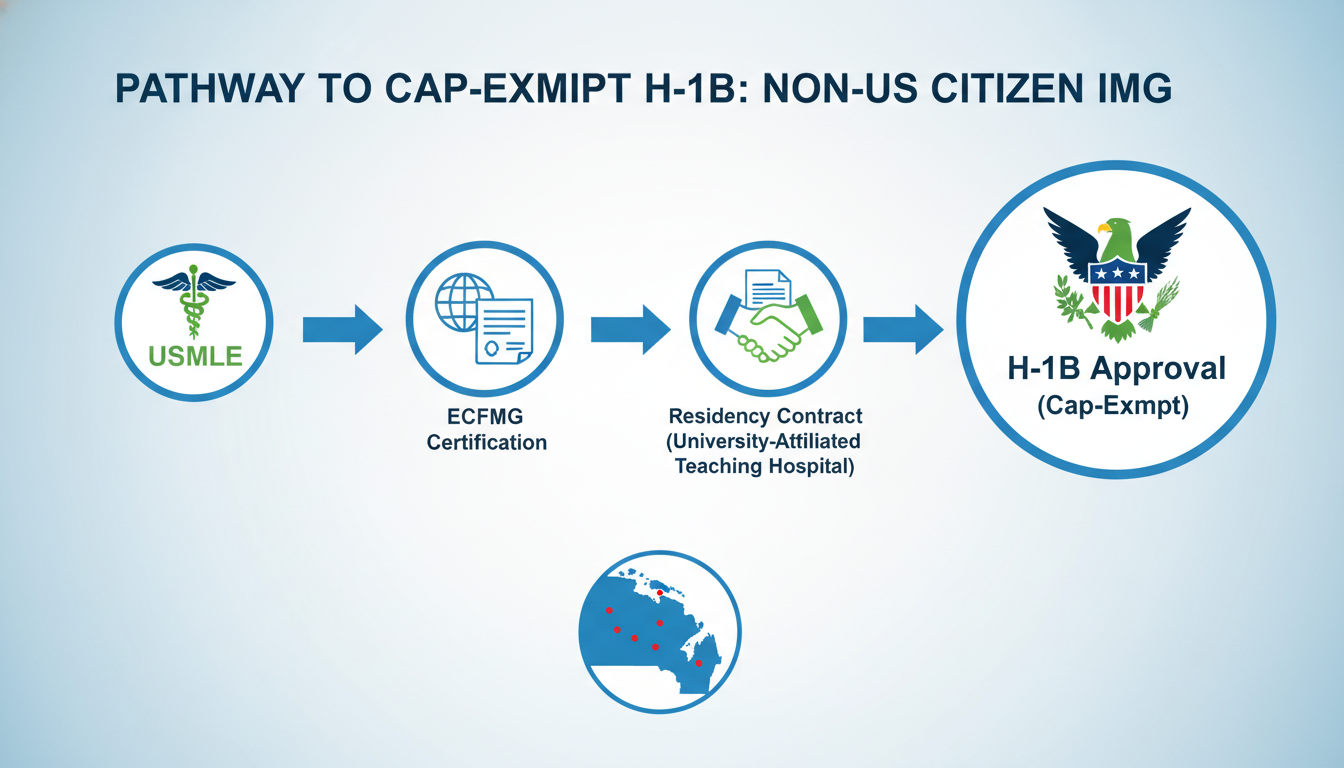
Pass all USMLE Steps required by the state before the start date
- Usually Step 1, Step 2 CK, and Step 3 must be passed.
- Some states allow Step 3 later, but many H-1B sponsoring institutions in the Great Lakes region insist on Step 3 before filing the petition.
Hold ECFMG Certification
- Must be fully certified; not just having passed exams but also verified credentials.
Meet State Medical Board Requirements
- Each Great Lakes state has its own licensing rules (e.g., Michigan vs. Illinois vs. Ohio).
- Programs typically require you to be eligible for a training license; this can depend on number of clinical years, school accreditation, etc.
Have a Valid Job Offer
- You cannot self-petition.
- The residency program/hospital must agree to be your H-1B sponsor.
Maintain Status
- If you are in the US, you must maintain lawful status until your H-1B starts (e.g., F-1, J-1, B-1/B-2, or no US presence yet).
1.3 H-1B Cap-Exempt vs. Cap-Subject
Understanding H-1B cap exempt is crucial:
Cap-subject H-1B
- Most private employers.
- Limited number of new H-1Bs each fiscal year, requiring a lottery.
- Not ideal for residency timelines.
H-1B cap exempt
- Universities, university-affiliated nonprofits, and certain research institutions.
- Many teaching hospitals in Great Lakes academic centers fall into this category.
- No lottery, can apply year-round, which aligns much better with residency start dates (usually July 1).
Most large Great Lakes residency programs with H-1B sponsorship are cap exempt because they are part of a university or major teaching hospital.
2. Why the Great Lakes and Midwest are Attractive for H-1B-Sponsoring Programs
2.1 Strong Academic Centers and Teaching Hospitals
The Great Lakes region hosts multiple major academic health systems and midwest residency programs that often appear on an H-1B sponsor list year after year. These institutions:
- Run multiple residency and fellowship programs across specialties.
- Have established GME and legal departments that understand H-1B requirements.
- Are often university-affiliated and cap exempt.
Examples of well-known types of institutions in the region (described generically, not as a formal sponsor list):
- Large university hospitals in cities like Chicago, Cleveland, Detroit, Minneapolis, Milwaukee, Columbus, and Ann Arbor.
- Community-based teaching hospitals affiliated with these universities.
- Systems that consistently recruit foreign national medical graduates for IM, FM, Neurology, Pathology, Psychiatry, and other fields.
2.2 Historical Openness to IMGs
The Great Lakes and broader Midwest have a long history of:
- Higher IMG representation in internal medicine, family medicine, pediatrics, and some subspecialties.
- Filling workforce needs in both urban underserved and rural areas.
- Working with non-US citizen IMG trainees who later stay in the region to practice.
As a result, many great lakes residency programs are already familiar with H-1B sponsorship logistics and are more comfortable onboarding a foreign national medical graduate.
2.3 Balanced Competition
While some programs are extremely competitive (e.g., top-tier academic centers), many midwest residency programs strike a balance:
- Reasonably competitive but not as saturated as certain coastal cities.
- More total positions per program in IM and FM.
- Some programs actively seek internationally trained candidates with strong clinical backgrounds and research.
If you are a non-US citizen IMG targeting H-1B residency programs, the Great Lakes states offer a broad range of options where your application is more likely to be seriously considered.
3. Identifying H-1B Sponsorship Programs in the Great Lakes
3.1 How to Recognize an H-1B-Friendly Program
To determine if a great lakes residency program sponsors H-1B:
Check the Program Website (GME or Residency Page)
- Look for a section titled “Visa Sponsorship,” “GME Policies for IMGs,” or “International Medical Graduates.”
- Common phrasing:
- “We sponsor J-1 and H-1B visas.”
- “We sponsor only J-1 visas.”
- “No visa sponsorship available.”
Use FREIDA and AAMC Resources
- FREIDA (AMA’s residency database) sometimes indicates visa types.
- Confirm directly with the program, as information may be outdated.
Contact the Program Coordinator or GME Office
- Ask a short, specific question:
- “I am a non-US citizen IMG requiring visa sponsorship. Does your program sponsor H-1B for residency trainees, and is USMLE Step 3 required before ranking?”
- Keep it professional and concise.
- Ask a short, specific question:
Talk to Current or Recent Residents
- Look for resident lists with photos/bios.
- If you see many IMGs, especially with non-US medical schools listed, the program is likely IMG-friendly and may appear on informal H-1B sponsor lists shared among applicants.
3.2 Typical Policies in Great Lakes H-1B Sponsorship Programs
Many Great Lakes H-1B residency programs share similar patterns:
- Require USMLE Step 3 before contract issuance or before H-1B filing.
- Prefer recent graduation (within 5–7 years), although some specialties are more flexible.
- Want US clinical experience (USCE)—observerships, externships, or sub-internships.
- Often limit H-1B to categorical tracks, not preliminary-only positions.
- Some will:
- Sponsor H-1B only for highly qualified candidates (e.g., strong scores, advanced degrees).
- Limit H-1B to certain specialties where recruitment is harder (e.g., FM, IM, Psychiatry).
3.3 Examples of Great Lakes States & Typical Program Types
Below is a conceptual overview (not a definitive H-1B sponsor list; always verify current policies):
- Illinois
- Large academic centers in Chicago often H-1B cap exempt.
- Multiple community-based internal medicine and family medicine programs sponsor H-1B for strong candidates.
- Ohio
- Major teaching hospitals in Cleveland, Columbus, and Cincinnati frequently have experience with H-1B residency sponsorship.
- Community hospitals affiliated with universities may also be H-1B friendly.
- Michigan
- Detroit and Ann Arbor area institutions; several IM and FM programs historically sponsor H-1B.
- Minnesota & Wisconsin
- Academic centers and selected community hospitals sponsor H-1B, especially in internal medicine, psychiatry, and family medicine.
- Indiana & Western Pennsylvania
- University-affiliated systems and some mid-sized community teaching hospitals with IMG-heavy programs.
Treat this as a starting point when building your target list of great lakes residency options.
4. Strategizing Your Application as a Non-US Citizen IMG
4.1 Building a Targeted H-1B Sponsor List
Constructing your own H-1B sponsor list focused on midwest residency programs:
List All Programs in Your Specialty in Great Lakes States
- Use FREIDA, NRMP directory, or specialty society listings.
Filter for Historical IMG Representation
- Look at current residents’ medical schools.
- Check program websites or alumni lists.
Investigate Visa Policies
- Website statements.
- Direct email to coordinators.
- Resident contacts through LinkedIn or alumni networks.
Categorize Programs
- Category A: Clearly sponsor H-1B, cap exempt.
- Category B: J-1 only (if you are strictly H-1B focused, keep as backup or exclude).
- Category C: Policy unclear—require confirmation or treat cautiously.
Prioritize by Alignment with Your Profile
- Match your Step scores, YOG, research, and USCE with each program’s competitiveness.
4.2 Maximizing Your H-1B Competitiveness
Since H-1B is a higher administrative burden, H-1B residency programs will usually expect stronger overall profiles from foreign national medical graduates. Focus on:
USMLE Performance
- Competitive Step 2 CK score (given Step 1 is pass/fail).
- Pass Step 3 early if you are firmly committed to H-1B.
Timing of Step 3
- Aim to pass Step 3 before or early in the application season (ideally before interviews).
- This signals seriousness and removes one barrier for programs considering H-1B.
US Clinical Experience
- At least 2–3 months of hands-on USCE in your intended specialty is ideal.
- Try to secure letters of recommendation from US faculty, especially from Great Lakes institutions or other midwest residency programs.
Clear Career Narrative
- In your personal statement, explain:
- Why you prefer H-1B (e.g., long-term US practice plans, avoidance of J-1 waiver obligations).
- How your background fits their patient population and regional needs (e.g., multilingual, experience in resource-limited settings).
- In your personal statement, explain:
Professional Communication
- When you email for visa clarification or observerships, be concise, polite, and well-formatted.
- Avoid asking for legal advice; instead, ask about program policy.
4.3 Balancing H-1B and Other Options
While your primary goal may be H-1B, it’s wise to:
- Keep J-1 programs on your radar if:
- Your Step 3 timing is uncertain.
- You’re applying to competitive specialties with fewer H-1B sponsorship programs.
- Understand that:
- A J-1 entails a two-year home-country return requirement unless you obtain a waiver (e.g., Conrad 30 programs, VA, federal agencies).
- Many Great Lakes states have strong Conrad 30 programs, making it feasible to complete residency on J-1 and still remain in the US afterward.
4.4 Example Application Strategy
Imagine you are a foreign national medical graduate from South Asia with:
- Step 1: Pass
- Step 2 CK: 244
- Step 3: Passed in August
- YOG: 2021
- 3 months USCE in internal medicine (2 months in Ohio, 1 month in Illinois)
A practical strategy:
- Compile a list of Great Lakes internal medicine programs.
- Separate:
- ~25 programs that clearly sponsor H-1B (Category A).
- ~40 programs that are J-1 only (Category B).
- ~20 unclear (Category C).
- Apply broadly to:
- All Category A (H-1B-friendly) programs.
- A subset of Category B where your profile is competitive, as J-1 backups.
- Selected Category C after emailing to clarify visa policy.
- During interviews:
- When appropriate, ask, “Does your program currently sponsor H-1B for foreign national medical graduates, and is there any limit on duration or renewals?”
- Emphasize your readiness: Step 3 already passed, ECFMG certified, strong interest in remaining in the region.
5. Practical and Legal Considerations of H-1B in Residency
5.1 Duration and Renewals
- Standard H-1B duration: up to 6 years total (often initially granted for 3 years, then extended).
- For residency:
- Most categorical programs are 3–4 years.
- Additional years may be used for fellowship or early attending work.
- If you later work in a non-cap-exempt job, prior cap-exempt H-1B time can influence how you transition; consult an immigration attorney.
5.2 Salary and Prevailing Wage
Residency programs must pay at least the prevailing wage for the position:
- GME salary scales typically meet or exceed this requirement.
- You are paid as a resident employee, not as a student.
- The hospital handles the wage determination as part of the H-1B filing.
5.3 Licensing and Credentialing in Great Lakes States
Each state has slightly different training license rules:
- Some may require certain minimum postgraduate years or specific documentation of medical school curriculum.
- Credentialing and primary source verification can take time, especially for foreign national medical graduates.
- Start compiling:
- Transcripts
- Degree certificates
- Translations and notarizations
- Internship/house job certificates
5.4 Legal Support and Costs
- Employer (program) typically pays:
- H-1B filing fees (including fraud prevention and training fees).
- Attorney fees for employer-side representation (through their institution’s law firm or in-house counsel).
- You may pay:
- Personal expenses (e.g., visa stamping at a consulate, travel).
- Occasionally, additional attorney fees for personal consultations about long-term immigration strategy (outside the employer’s scope).
Always remember: only an immigration attorney can provide legal advice; programs and GME offices can explain their internal policy but not give you individualized legal counsel.
6. Action Plan for Non-US Citizen IMGs Targeting Great Lakes H-1B Programs
To convert the above information into a step-by-step roadmap:
6.1 12–18 Months Before Match
- Take and pass Step 1 and Step 2 CK.
- Plan USCE in Great Lakes states if possible:
- Observerships at midwest residency programs.
- Sub-I’s or electives if you’re still a student.
- Start researching:
- List of all great lakes residency programs in your specialty.
- Identify those historically friendly to IMGs.
6.2 9–12 Months Before Match (Before ERAS Opens)
Complete Step 3 if aiming strongly for H-1B.
Request strong letters of recommendation from US faculty, ideally in the Great Lakes region.
Prepare:
- CV and personal statement emphasizing your commitment to the region and long-term US practice.
- ERAS application entries carefully (no errors, consistent dates).
Build your H-1B sponsor list:
- Categorize programs by visa policy.
- Plan an application strategy with a mix of H-1B and J-1 programs based on your risk tolerance.
6.3 ERAS Season and Interview Period
- Apply broadly across your target list:
- Do not restrict yourself to only a few famous academic centers.
- During interviews:
- Ask about the current visa policy politely and clearly.
- Confirm if they are an H-1B cap exempt institution affiliated with a university or non-profit, especially for long-term planning.
- Follow up professionally:
- Send brief thank-you emails.
- If a program indicates flexibility with H-1B policies, note this carefully.
6.4 Post-Match: Preparing for H-1B Filing
If you match into an H-1B residency program in the Great Lakes region:
- Respond quickly to all GME and HR requests for documents.
- Provide:
- ECFMG certification proof.
- USMLE Step 3 score report.
- Passport copies and prior visa approval notices (if applicable).
- Stay in regular communication with your program’s international office or legal department about:
- Start date
- Consular processing vs. change of status
- Any travel you plan before residency begins
Timely and organized responses help avoid delays that could impact your H-1B start date and onboarding.
FAQs: H-1B Sponsorship Programs in the Great Lakes Region
1. Do all Great Lakes residency programs that accept IMGs sponsor H-1B?
No. Many great lakes residency programs are open to IMGs but sponsor only J-1 visas. Some sponsor both J-1 and H-1B, and a smaller subset may not sponsor any visas at all. You must verify each program’s policy through their website or by contacting the program.
2. Is Step 3 absolutely required for an H-1B residency in the Great Lakes region?
In practice, almost all H-1B residency programs in the US, including the Great Lakes region, require Step 3 before they will file an H-1B petition. A few states allow some flexibility legally, but institutional policy is usually stricter. If you are a non-US citizen IMG serious about H-1B, you should plan to pass Step 3 before or early in interview season.
3. Are H-1B cap-exempt programs better than cap-subject programs for residency?
For residency, cap-exempt H-1B programs are usually far more practical:
- They can file at any time, without lottery constraints.
- Most major academic centers and teaching hospitals in the Great Lakes region are cap exempt.
- You avoid the risk of missing a start date due to lottery issues.
However, you still need to meet all program and licensure requirements.
4. Can I switch from a J-1 residency to an H-1B job in the Great Lakes after completion?
Yes, but only after you fulfill the J-1 two-year home residency requirement or obtain a J-1 waiver (e.g., Conrad 30, VA, or federal program). Many Great Lakes states have robust Conrad 30 programs, and midwest employers often recruit J-1 waiver physicians. Once you have a waiver job, you can move to H-1B status for that employment, which may or may not be cap exempt depending on the employer type.
By understanding the landscape of H-1B residency programs in the Great Lakes region, planning your exams and USCE strategically, and building a focused H-1B sponsor list, you can significantly improve your chances of matching as a non-US citizen IMG and building a long-term career in US medicine.