Understanding H‑1B Sponsorship for Non‑US Citizen IMGs in Miami
For a non‑US citizen IMG, Miami can be one of the most attractive—and realistic—gateways into US graduate medical education. The city’s large immigrant population, bilingual clinical environment, and high patient volume create a natural demand for international talent. Yet, to take advantage of Miami residency programs as a foreign national medical graduate, you must understand the crucial topic of H‑1B sponsorship.
This article will walk you through:
- How H‑1B residency programs work for IMGs
- Key Miami and South Florida institutions that may sponsor H‑1B
- How to assess whether a program is truly “H‑1B friendly”
- Strategic steps to increase your chances of obtaining an H‑1B residency spot
- Common pitfalls and frequently asked questions
The focus is specifically on non‑US citizen IMGs targeting Miami and broader South Florida residency opportunities.
H‑1B Basics for Non‑US Citizen IMGs
What is an H‑1B for Residency?
An H‑1B is a temporary, employment‑based visa for specialty occupations that require at least a bachelor’s degree (medicine easily qualifies). For a non‑US citizen IMG in residency or fellowship, the H‑1B category used is usually:
- H‑1B cap‑exempt, if the employer is an academic institution or affiliated non‑profit hospital
- H‑1B cap‑subject, if the employer is a private hospital or practice not connected to a qualifying academic or research institution
Most large Miami teaching hospitals are H‑1B cap exempt, which is a major advantage: they can file H‑1B petitions at any time of the year without being limited by the national annual cap lottery.
H‑1B vs. J‑1: Why Some IMGs Prefer H‑1B
Many non‑US citizen IMGs default to the J‑1 visa sponsored by the Educational Commission for Foreign Medical Graduates (ECFMG). However, the H‑1B route has distinct advantages:
Pros of H‑1B for residency:
- No 2‑year home‑country physical presence requirement
- Easier pathway to transition to independent practice in the US after training
- More straightforward progression to permanent residency (green card) if you secure an employer sponsor
- Better alignment with long‑term career plans for those intending to remain in the US
Cons/Challenges of H‑1B:
- Not all programs sponsor H‑1B (many are J‑1 only)
- More complex and expensive for the sponsoring institution (attorney fees, filing fees, etc.)
- Strict requirements on exam completion and ECFMG certification at the time of petition filing
- Potential need to change status from F‑1 or another status to H‑1B, which involves additional timing constraints
For a non‑US citizen IMG who is strongly committed to building a long‑term US career, identifying H‑1B residency programs early can be a strategic game‑changer.
H‑1B Requirements Specific to IMGs
Before you focus on the Miami residency landscape, you need to be sure you meet the typical H‑1B criteria for foreign medical graduates.
Core Eligibility Requirements
While exact policies vary by institution, most H‑1B residency programs in Miami and South Florida expect:
Valid ECFMG Certification
- Must be fully certified, not just having passed Step 1 and Step 2.
- Certification should be in hand before the program files the H‑1B petition (often by early spring).
USMLE or COMLEX Requirements
- USMLE Step 1 and Step 2 CK passed (many programs now score‑blind for Step 1 but still require a pass).
- Step 3 requirements vary:
- Some require Step 3 passed before they will sponsor an H‑1B (common in competitive or well‑resourced academic centers).
- Others allow you to start on H‑1B before Step 3 but require its completion during PGY‑1.
- As a non‑US citizen IMG, treating Step 3 as mandatory before Match is the safest strategy if you want H‑1B.
State Medical Licensure Requirements
- Florida Board of Medicine has specific criteria for training licenses. Programs will not file an H‑1B petition if you are unlikely to receive a valid training license in time.
English Proficiency and Clinical Readiness
- Particularly in Miami, bilingual English/Spanish skills are highly valued but not strictly required.
- Strong communication skills are essential because H‑1B is fundamentally an employment‑based category (you will be a paid physician employee).
Timing Considerations
H‑1B processing must align with GME (Graduate Medical Education) timelines:
- Match list certification: February–March
- Match results: mid‑March
- H‑1B petition preparation and filing: usually March–May
- Training start: around July 1
If you do not have ECFMG certification and (if required) Step 3 by the time the program is ready to file, you risk losing an H‑1B opportunity—even if you matched successfully.
Practical advice:
If you are a non‑US citizen IMG applying to Miami residency programs and targeting H‑1B, aim to:
- Complete Step 3 no later than December–January of the application year
- Have ECFMG certification finalized before rank lists are due
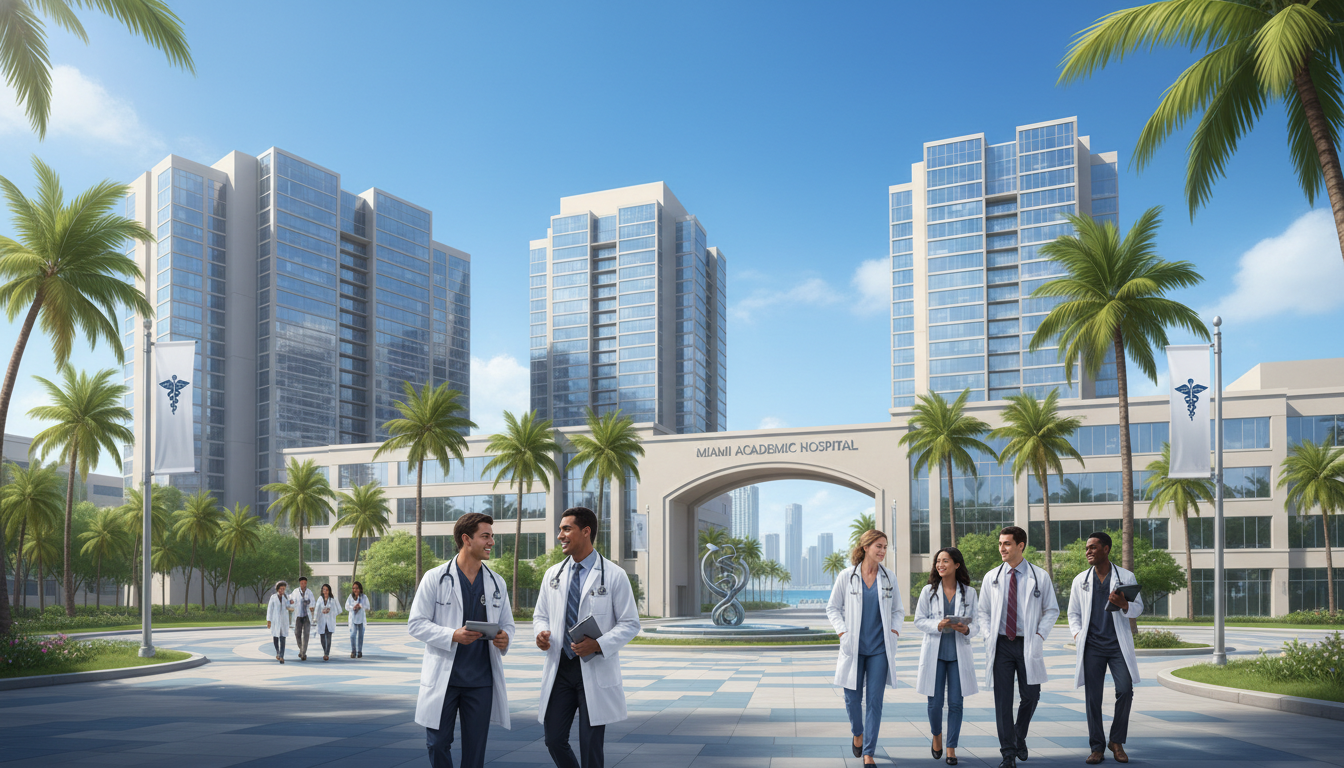
Miami & South Florida Landscape: Where H‑1B Sponsorship Is More Likely
Miami and the broader South Florida region host a significant cluster of academic and community-based residency programs, many of which have historically trained IMGs. For a non‑US citizen IMG, this is an advantage—especially if you know how to identify H‑1B‑friendly institutions.
Important note: Specific program policies can change each cycle. Always verify directly with the program or GME office. The descriptions below focus on patterns and typical institutional behavior, not guarantees.
1. Large Academic Medical Centers (Often H‑1B Cap Exempt)
Many academic centers in Miami qualify as H‑1B cap exempt because they are either part of, or closely affiliated with, non‑profit universities or research institutions. This means they can sponsor an H‑1B for a resident outside the national H‑1B lottery, making them more flexible.
Examples of major academic hubs in Miami and South Florida include (non‑exhaustive and not an official H‑1B sponsor list):
- University‑affiliated hospitals (e.g., major university medical centers in Miami)
- Academic teaching hospitals connected to regional medical schools
- Research‑oriented non‑profit hospitals with internal residency programs
Typical characteristics:
- Historically host many IMGs, including non‑US citizen IMGs
- More likely to have established legal and HR infrastructure to manage H‑1B filings
- May require USMLE Step 3 completion prior to H‑1B sponsorship
- Often sponsor H‑1B for higher‑demand specialties (e.g., internal medicine, family medicine, certain subspecialties) more than ultra‑competitive fields (e.g., dermatology)
Even if a major Miami institution is generally supportive of IMGs, individual departments may differ: for example, Internal Medicine may sponsor H‑1B while Psychiatry may be J‑1 only, or vice versa.
2. Community and Safety‑Net Hospitals in Miami
South Florida also has numerous community-based teaching hospitals and safety‑net institutions that serve large underserved and immigrant populations. These often have:
- High patient volume with diverse pathology
- Strong need for bilingual or culturally competent physicians
- A tradition of welcoming IMGs into their residencies
Their H‑1B sponsorship behavior varies:
- Some community hospitals are H‑1B cap exempt via academic affiliations and may sponsor H‑1B when they have the internal capacity and budget.
- Others rely almost exclusively on J‑1 visas due to cost considerations or internal policy.
You should consider:
- Reviewing their current and past residents’ profiles on program websites or LinkedIn. If you see many non‑US citizen IMGs who remained in the US after training, H‑1B or J‑1 waiver pathways are likely in play.
- Directly emailing the Program Coordinator or GME Office with a concise question about H‑1B sponsorship for non‑US citizen IMGs who have passed Step 3.
3. Private Hospitals and H‑1B Cap‑Subject Situations
A smaller subset of South Florida residency programs may be based in hospitals that are not connected to a non‑profit academic institution. These are often:
- Cap‑subject for H‑1B
- Less likely to sponsor H‑1B for residents, because of the unpredictability of the national lottery and timing constraints
As a non‑US citizen IMG, these programs are generally less reliable H‑1B options unless they explicitly state a strong history of sponsorship for residents.
How to Identify H‑1B‑Friendly Miami Programs (Step‑by‑Step)
Searching blindly is inefficient. Instead, approach H‑1B sponsorship strategically, combining your career goals with objective research.
Step 1: Build a Target List of Miami & South Florida Residency Programs
Use tools such as:
- FREIDA (AMA)
- NRMP’s Residency Explorer
- Program directories from specialty societies
Filter for location: Miami, South Florida, or Florida in general and then narrow down to the Miami–Dade/Broward/Palm Beach corridor if you want to stay tightly in the region.
Focus specialties where IMGs often match:
- Internal Medicine
- Family Medicine
- Pediatrics
- Psychiatry
- Neurology
- Pathology
- Transitional/Preliminary programs as stepping stones
Step 2: Screen for IMG‑Friendliness First
An IMG‑friendly environment increases your chances of secure H‑1B sponsorship later. Signs a program is IMG‑friendly:
- A significant percentage of current residents are IMGs
- Website explicitly mentions international graduates are welcome
- Past residents include multiple foreign national medical graduates
- Interview experiences shared online (forums, blogs, social media) mention positive treatment of IMGs
Programs with a strong track record of non‑US citizen IMG recruitment are more likely to have robust visa policies and institutional support.
Step 3: Clarify Visa Policies and H‑1B History
Once you have a shortlist of Miami and South Florida residency programs:
Check official websites
- Look for a “Visa” or “International Medical Graduates” section.
- Some programs clearly list:
- “J‑1 only”
- “J‑1 and H‑1B”
- “We do not sponsor visas”
Contact the Program Coordinator or GME Office
Write a short, professional email such as:Dear [Name],
I am a non‑US citizen IMG planning to apply to [Program Name] in the upcoming ERAS cycle. Could you please let me know if your residency program sponsors H‑1B visas for candidates who are ECFMG certified and have successfully passed USMLE Step 3 prior to Match?
Thank you very much for your time.
Sincerely,
[Your Name], MDThis wording is important because:
- You signal that you will likely meet the most stringent requirements (ECFMG + Step 3).
- You avoid sounding demanding and remain professional.
Ask Current or Recent Residents (if possible)
- LinkedIn, institutional “Residents” pages, and alumni networks are invaluable.
- Ask neutral, focused questions such as:
- “Does your program currently have residents on H‑1B?”
- “Did you notice any systematic preference for J‑1 vs. H‑1B during recruitment?”
Step 4: Evaluate Competitiveness vs. Practicality
Not every H‑1B sponsor is realistic for every candidate. While you aim for H‑1B residency programs, also assess:
- Your USMLE scores and number of attempts
- Recency of graduation
- US clinical experience (USCE) in inpatient or outpatient settings
- Strength of letters of recommendation
A high‑profile, research‑heavy academic center in Miami might sponsor H‑1B—but also expect academic publications, US research experience, or very strong scores.
Balance your list:
- A few reach programs (top academic centers)
- A strong core of realistic programs (IMG‑friendly institutions with known or likely H‑1B sponsorship)
- Some backup options (IMG‑friendly J‑1 programs in Miami/South Florida, if your priority is simply to train in the US and you are open to a J‑1 waiver later)

Maximizing Your Chances: Application & Interview Strategy for H‑1B in Miami
Being eligible for H‑1B is not enough; you must also make a compelling case to Miami residency programs that sponsoring you is worth their additional effort and cost.
Emphasize Value to South Florida Patient Populations
Miami’s patient demographics are unique:
- Large Spanish‑speaking and Haitian Creole‑speaking populations
- High prevalence of chronic diseases along with complex multisystem pathology
- High proportion of underserved or underinsured patients
As a non‑US citizen IMG, you can stand out by:
- Highlighting any bilingual capabilities (Spanish, Haitian Creole, Portuguese, etc.)
- Explaining prior experience in resource‑limited or multicultural settings
- Emphasizing your commitment to serve in South Florida long term, which aligns well with both H‑1B and later employment opportunities
Programs are more willing to include you in their H‑1B sponsor list if they perceive a strong return on investment: continuity of care, cultural competency, and patient satisfaction.
Complete Step 3 Early and Make It a Selling Point
Among all H‑1B‑relevant steps, passing USMLE Step 3 before application is your single most powerful credential.
Actionable advice:
- Schedule Step 3 6–9 months before ERAS opening, allowing time for a retake if necessary.
- Mention Step 3 status clearly in:
- ERAS application
- Personal statement (if relevant)
- Any pre‑interview communication with programs
- During interviews, if visa sponsorship comes up, confidently say:
- “I am fully ECFMG certified and have already passed Step 3, so I am ready for H‑1B sponsorship if the program is able to offer it.”
This reassures program directors that the legal process will be smoother and reduces risk for them.
Prepare for Visa‑Related Questions in Interviews
Common lines of questioning you may face:
- “Are you open to a J‑1 if H‑1B is not possible?”
- “What are your long‑term plans after residency?”
- “Do you intend to practice in Florida or elsewhere?”
There is no single correct answer, but you should:
- Be honest about your preference for H‑1B, while showing flexibility if you are open to J‑1.
- Frame your long‑term goals in a way that makes your continued presence in the region valuable (e.g., planning to work in underserved Miami or South Florida communities).
- Demonstrate understanding of the seriousness of visa processes without appearing anxious or demanding.
Document Organization and Legal Preparation
To avoid last‑minute delays that might jeopardize an H‑1B petition:
- Keep all USMLE score reports, ECFMG certificates, and medical school documents scanned and easily shareable.
- Maintain a clear record of:
- Name as it appears on passport
- Any previous US visas or SEVIS records (F‑1, J‑1 research, etc.)
- Consider a consultation with an immigration attorney specializing in physician visas if your situation is complex (prior J‑1, 212(e) issues, status changes, etc.).
Though the residency program’s attorney usually handles the main H‑1B petition, independent advice can help you anticipate issues and ask the right questions.
H‑1B Beyond Residency: Thinking Long Term in Miami
When you choose between J‑1 and H‑1B‑sponsoring residency programs, you’re also choosing between different long‑term pathways.
H‑1B and the Road to Independent Practice
After completing your residency (and possibly fellowship) on H‑1B:
- You can transition to an attending H‑1B job, often with an employer in South Florida who values your local training and language/cultural skills.
- Many H‑1B cap‑exempt residents move to cap‑subject H‑1B jobs later (e.g., private practices or community hospitals not affiliated with a university), which may involve entering the national H‑1B lottery.
- If an employer is willing, you can start an employment‑based green card process during or after your training.
For Miami‑based IMGs who plan to stay in the region:
- Demonstrating a clear commitment to local communities during residency can help you build networks that translate into job offers and sponsorship later.
- South Florida’s high demand for physicians in primary care and certain specialties gives H‑1B‑trained IMGs relatively good leverage in the job market.
Comparing With the J‑1 Waiver Route
If you end up on a J‑1 visa, you will likely need a J‑1 waiver job (commonly in underserved areas) to avoid returning home for two years. South Florida does have some J‑1 waiver opportunities, but competition exists and you may need to look beyond Miami proper.
By contrast, starting on H‑1B in a Miami residency means:
- No home‑country physical presence requirement
- Greater flexibility in where you work post‑training (subject to visa sponsorship availability)
For non‑US citizen IMGs who are certain about long‑term US practice, especially in Florida, securing an H‑1B residency program is a powerful strategic step.
FAQs: H‑1B Sponsorship Programs for Non‑US Citizen IMGs in Miami
1. Are all Miami residency programs H‑1B cap exempt?
No. Many large academic and non‑profit hospitals that host residency programs are H‑1B cap exempt, but not all. Some private hospitals may be cap‑subject. You must verify each institution’s status individually. Generally, university‑affiliated South Florida residency programs are more likely to be cap‑exempt and comfortable with H‑1B sponsorship.
2. Do all IMG‑friendly programs in Miami offer H‑1B sponsorship?
Not necessarily. An IMG‑friendly program may still be J‑1 only for financial, administrative, or policy reasons. That’s why you must treat “IMG‑friendly” and “H‑1B‑friendly” as separate dimensions. A good approach is to first identify IMG‑friendly Miami residency programs, then filter further based on explicit H‑1B policies confirmed via websites or direct communication.
3. Is USMLE Step 3 absolutely required for H‑1B in Miami residency programs?
While there are rare exceptions, most H‑1B‑sponsoring programs require Step 3 before filing the petition, and many expect you to have passed it before Match. Some might allow initial employment on another status (e.g., F‑1 OPT) with Step 3 pending, but relying on that is risky. As a non‑US citizen IMG targeting H‑1B, you should assume Step 3 is effectively required and plan accordingly.
4. How can I find an official H‑1B sponsor list for Miami residency programs?
There is no centralized, official “H‑1B sponsor list” for residency programs that is updated yearly. Public H‑1B databases show which employers have filed H‑1B petitions in the past, but they do not distinguish residents from other employees. The most reliable strategy is to:
- Use program websites for visa policy statements
- Email program coordinators or GME offices with precise questions about H‑1B for non‑US citizen IMGs
- Network with current residents and recent graduates
Combining these sources will give you an up‑to‑date, practical understanding of which Miami and South Florida residency programs are realistic H‑1B options.
By understanding how H‑1B works, preparing your credentials strategically, and targeting Miami programs with a history of supporting non‑US citizen IMGs, you can significantly improve your chances of entering a South Florida residency on the visa pathway that best serves your long‑term career.