Understanding H-1B Sponsorship for Non-US Citizen IMGs in the Mississippi Delta
For a non-US citizen IMG, combining a meaningful clinical career with U.S. immigration stability is often the central challenge of residency planning. This becomes even more complex when you are targeting a specific region—such as the Mississippi Delta—and specifically looking for H-1B residency programs that can sponsor you.
The Mississippi Delta and broader Deep South region offer unique advantages: relatively IMG-friendly institutions, strong need for physicians, and, in some cases, openness to H-1B sponsorship. However, information is fragmented and often not clearly stated on program websites.
This guide explains how H-1B sponsorship works for a foreign national medical graduate, what makes certain programs effectively H-1B cap exempt, and how you can strategically target Mississippi Delta residency and fellowship positions that may support your long‑term plan to remain and practice in the U.S.
H-1B Basics for the Foreign National Medical Graduate
Before focusing on Mississippi Delta residency opportunities, it’s crucial to understand how the H‑1B visa works in the context of graduate medical education.
J-1 vs H-1B: Why H-1B Matters
Most non-US citizen IMGs traditionally match into residency on a J‑1 visa. However, H‑1B has distinct advantages:
- No 2-year home residency requirement (unlike J‑1)
- Direct dual-intent path toward permanent residency (green card)
- More flexibility after training (can move to another H‑1B employer or apply for a green card)
For IMGs who are certain they want to remain in the U.S. long term—especially in underserved regions like the Mississippi Delta—H‑1B sponsorship can be strategically powerful.
Core H-1B Requirements for Residency
To be eligible for an H‑1B in a residency or fellowship post, you typically must:
Pass all USMLE Steps required for licensure
- Step 1 and Step 2 CK (and OET/Step 2 CS historical equivalents)
- Step 3 is often required before H-1B filing in many states and by many programs
- For Mississippi, Step 3 is strongly preferred and often essential for H‑1B sponsorship because state medical boards and institutional policies expect it for independent physician-in-training licensure.
Have ECFMG certification
- This is mandatory: completion of required exams, primary source verification, and certification.
Hold a valid job offer from a sponsoring institution
- You cannot self-sponsor; a residency or fellowship program must agree to file an H‑1B petition on your behalf.
Meet all state medical board criteria
- Mississippi Board of Medical Licensure requirements must be satisfied, including specific training, documentation, and exam thresholds.
Cap-Subject vs H-1B Cap Exempt
The “H‑1B cap” is a federal yearly quota limiting new H‑1B visas for most employers. However, many residency programs are effectively cap exempt, which is extremely important for IMGs.
Cap-subject H‑1B
- Mostly private practices, non‑teaching hospitals, tech companies, etc.
- Must win a lottery during the annual filing window (April for October 1 start).
H-1B cap exempt
- Institutions like:
- Nonprofit hospitals associated with universities
- Academic medical centers
- Nonprofit research institutions
- Some government/public entities
- These can often file H‑1B petitions year-round without a lottery.
- Institutions like:
Most university-affiliated residency programs in the Mississippi Delta or wider Deep South region fall into the H‑1B cap exempt category because they are:
- Nonprofit,
- Affiliated with medical schools or universities,
- Teaching hospitals.
This makes them highly attractive for non-US citizen IMGs who want a predictable immigration path without relying on the cap lottery.
The Mississippi Delta and Deep South Landscape for IMGs
The Mississippi Delta region (stretching roughly along the Mississippi River across parts of Mississippi, Arkansas, Louisiana, and sometimes extending conceptually into Tennessee and Alabama) is medically underserved, with many counties designated as Health Professional Shortage Areas (HPSAs).
This reality creates both need and opportunity for an IMG, especially a foreign national medical graduate seeking H‑1B sponsoring institutions.
Why the Mississippi Delta Is Strategically Important
Physician shortage and high clinical need
- Many communities have limited access to primary care, internal medicine, psychiatry, and subspecialty services.
- Programs and hospitals are often open to IMGs who are committed to staying in the region.
High acceptance of IMGs
- Historically, many Deep South residency programs, including those near or in the Mississippi Delta, rely significantly on IMGs.
- This makes them, informally, IMG-friendly compared with many competitive coastal programs.
Potential alignment with long-term practice opportunities
- After training, you may find:
- H‑1B‑friendly hospitalist positions
- Underserved community roles
- Opportunities to transition to permanent residency with employer support
- After training, you may find:
Intersection with J-1 waiver routes
- Even for colleagues on J‑1 visas, the region is popular for Conrad 30 waivers and other underserved-area waivers.
- This culture of relying on international doctors makes some institutions more familiar with immigration processes in general—including H‑1B sponsorship.
Identifying H-1B Residency Programs in the Mississippi Delta
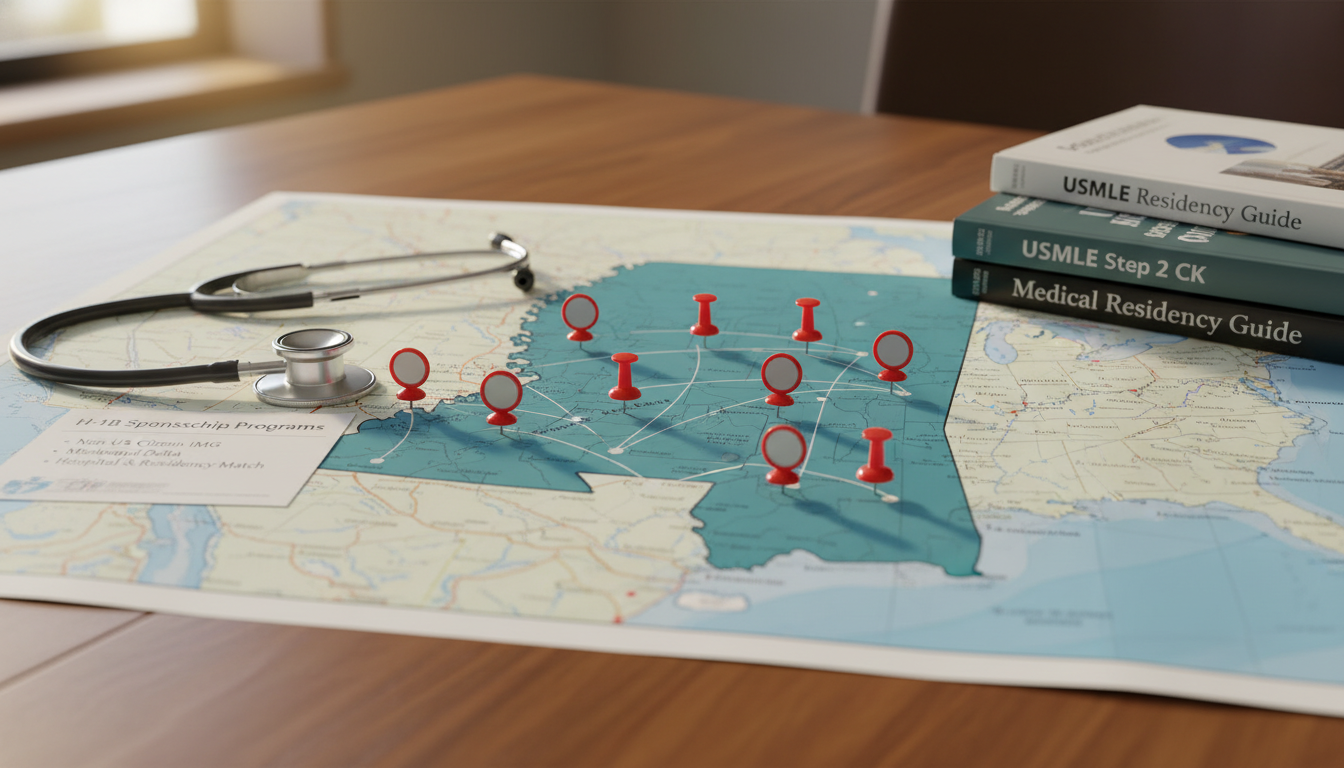
There is no official, complete, and reliable public H-1B sponsor list for residency programs in the Mississippi Delta. Instead, you must combine research, pattern recognition, and direct communication.
Below is a framework to identify potential H‑1B sponsors and evaluate their friendliness toward non-US citizen IMGs.
1. Start with Institutional Type (Cap Exempt Likelihood)
Programs more likely to be H‑1B cap exempt and relatively H‑1B friendly include:
- University-affiliated teaching hospitals, such as:
- Academic medical centers in Mississippi or nearby Deep South states
- University‑linked community programs with a strong teaching mission
- Nonprofit medical centers in underserved areas that:
- Have residency programs accredited by ACGME
- Clearly list visa sponsorship options on their websites or in FREIDA
If an institution is a nonprofit, teaching hospital with a university affiliation, it is almost certainly H‑1B cap exempt. That does not mean they will sponsor, but it means they can without lottery restrictions.
2. Use FREIDA and Program Websites Strategically
In FREIDA or program websites, look for:
- Visa types listed: “Sponsoring J‑1 and H‑1B” or similar wording
- IMG statistics:
- Percentage of IMGs currently enrolled
- Countries of medical schools represented
- Explicit statements like:
- “We consider H‑1B sponsorship for exceptionally qualified candidates”
- “We require USMLE Step 3 for H‑1B sponsorship”
If a Mississippi Delta residency program actively promotes international diversity and clearly lists H‑1B as an option, it should be in your priority list.
3. Contact Program Coordinators and GME Offices
Some programs do not update their websites regularly. You must verify:
Concrete example email template:
Subject: Inquiry Regarding H‑1B Sponsorship for Residency
Dear [Program Coordinator/Program Director],
My name is [Name], a non-US citizen IMG (ECFMG certified) interested in applying to your [Specialty] residency program. I am particularly drawn to training in the Mississippi Delta region and serving underserved communities.
Could you please clarify your current policy on visa sponsorship? Specifically:
– Do you sponsor H‑1B visas for incoming residents?
– If so, do you require USMLE Step 3 to be completed before ranking?I appreciate your time and any information you can share as I plan my ERAS application list.
Sincerely,
[Full Name, Credentials, AAMC ID]
This does several things:
- Positions you as a serious applicant with a specific geographic interest (Mississippi Delta, Deep South).
- Clarifies current H‑1B sponsorship policy.
- Helps you avoid wasting applications on programs that will not consider H‑1B for a foreign national medical graduate.
4. Use Word-of-Mouth and Alumni Networks
If you know:
- Senior IMGs in U.S. residencies
- Alumni from your medical school now in the Deep South
- Colleagues in online IMG communities
Ask specifically:
- “Does your program or institution sponsor H‑1B for residents?”
- “Do you know any non-US citizen IMG in your program currently on H‑1B?”
Programs with active H‑1B residents or fellows are your strongest possibilities, even if they don’t heavily advertise this online.
5. Sample Program Profiles (Hypothetical Types)
While specific names and policies frequently change, typical Mississippi Delta or Deep South program types that may sponsor H‑1B include:
University-based Internal Medicine residency in a mid-sized city close to the Delta:
- Nonprofit academic health system
- Large number of IMGs
- May list both J‑1 and H‑1B on FREIDA
- Strong need for residents committed to underserved care
Community-based Family Medicine residency in a rural Delta town affiliated with a state university:
- Focus on rural and underserved populations
- Historically J‑1 heavy, but open to H‑1B for highly qualified IMGs with Step 3
Psychiatry or Pediatrics residency in a Deep South academic center:
- IMG-friendly specialties in some institutions
- Training sites spread across Delta-adjacent communities
- H‑1B possible via cap-exempt university affiliation
You must always verify the current year’s policy, because GME leadership, funding, and immigration strategies change with time.
Optimizing Your Profile for H-1B Sponsorship in the Mississippi Delta
Even at institutions that can sponsor H‑1B, competition and internal criteria matter. Programs that sponsor H‑1B for residents often reserve it for stronger applicants or those with a compelling match to their mission.
1. Prioritize USMLE Step 3 Completion
For a non-US citizen IMG aiming for H‑1B in a Mississippi Delta residency:
- Treat Step 3 as mandatory, not optional.
- Plan to:
- Schedule Step 3 well before ERAS applications (ideally by late summer of the application year).
- Have scores available by interview season or at least by the rank list deadline.
Many programs will tell you:
- “We can only consider H‑1B applicants who have passed Step 3 by the time we submit the H‑1B petition.”
- Because H‑1B filing and state license processes are time-sensitive, a pre-residency Step 3 pass gives you a dramatic advantage.
2. Tailor Your Story to the Region’s Needs
Mississippi Delta and Deep South residency programs are often mission-driven. When they invest in H‑1B sponsorship for a foreign national medical graduate, they are hoping for long-term local impact.
Ways to align your application:
Highlight:
- Interest in rural or underserved care
- Previous work with marginalized or low-resource communities
- Research or quality improvement projects addressing health disparities, diabetes, cardiovascular disease, maternal health, mental health, or addiction—major issues in the region.
In your personal statement:
- Explicitly mention an interest in training and potentially staying in the Mississippi Delta or Deep South.
- Provide concrete examples of commitment to similar populations in your home country or elsewhere.
Programs are more willing to extend H‑1B sponsorship when:
- They believe you will stay in the region beyond residency, or
- You align with their mission of serving the underserved.
3. Show Reliability and “Low-Risk” Immigration Profile
Residency programs worry about:
- Delays or denials in visa processing
- Candidates failing Step 3 or otherwise being ineligible after match
To reassure them:
- Have clean immigration history (no status violations if currently in the U.S.).
- Keep documents ready:
- ECFMG certificate
- USMLE transcripts
- Passport, degree, and translation documents
- If applicable, mention:
- Previous U.S. training experience
- Observerships or research roles in American academic centers
A “low-risk” foreign national medical graduate with Step 3 completed, strong credentials, and clear documentation is much easier to sponsor.
4. Be Strategic with Specialty and Program List
Certain specialties and program types are more open to H‑1B for IMGs in the Deep South:
Often more open (varies by institution):
- Internal Medicine
- Family Medicine
- Pediatrics (in some centers)
- Psychiatry
- Hospital-based primary care tracks
Often more competitive/limited H‑1B:
- Dermatology, Ophthalmology, ENT, Plastic Surgery
- Highly competitive subspecialties with few IMG spots
For maximum chances:
- Build a balanced ERAS list with:
- Multiple IMG-friendly internal medicine or family medicine programs in the Mississippi Delta or broader Deep South that explicitly mention visas.
- A mix of university-based and community/university-affiliated programs.
- Backup programs where J‑1 could be acceptable if H‑1B is not possible (depending on your personal strategy).
Navigating the Match: Application, Interviews, and Rank Strategy
Once you understand the landscape and have optimized your profile, you need to execute a focused application strategy.
Application Strategy for Non-US Citizen IMGs Targeting H-1B
Filter programs by visa policy
- Use FREIDA, program websites, and email responses.
- Include programs stating:
- “H‑1B accepted”
- “H‑1B sponsorship possible”
- Or that have current H‑1B residents per word-of-mouth.
Prioritize Mississippi Delta/Deep South locations
- Look for residency programs based in or rotating through:
- Northern and central Mississippi
- Southern Arkansas
- Northern Louisiana
- Delta-adjacent parts of Tennessee or Alabama
- Search terms to combine:
- “Mississippi Delta residency”
- “Deep south residency”
- “Community-based internal medicine Mississippi”
- Together with “H‑1B residency programs” or “H‑1B sponsorship”.
- Look for residency programs based in or rotating through:
Communicate clearly in ERAS
- In your personal statement and experience descriptions:
- Emphasize your commitment to the region, underserved care, and long-term plans.
- In ERAS “Additional Information” or program-specific questions:
- Clearly state your visa preference: “I am a non-US citizen IMG seeking H‑1B sponsorship and have completed/passed USMLE Step 3.”
- In your personal statement and experience descriptions:
Interview Season: How to Discuss H-1B
During interviews:
When to bring it up:
- Ideally once you’ve established rapport and interest in the program.
- You can wait until the end of the interview or ask the program coordinator via email afterward.
How to phrase it:
- “I want to be transparent that as a non-US citizen IMG, my preferred visa is H‑1B. I have already passed Step 3. Could you share how your program typically handles H‑1B sponsorship for residents?”
This:
- Signals that you’re prepared and serious.
- Allows programs to clarify if:
- They routinely sponsor H‑1B.
- They sponsor only if they strongly want an applicant.
- They strictly limit to J‑1.
Rank List Strategy
When building your NRMP rank list:
Group programs by H‑1B policy:
- Tier 1: Confirmed H‑1B sponsoring programs (with Step 3 requirement met).
- Tier 2: Programs that are “sometimes H‑1B” or “case-by-case”.
- Tier 3: J‑1 only (or unclear) programs that you still like, if J‑1 is an acceptable backup for you.
Rank in true order of preference among those where H‑1B is possible
- Do not over-rank programs just for H‑1B if you dislike them clinically.
- But also recognize that, for many non-US citizen IMGs, immigration pathway is a major factor; it is reasonable to weigh that heavily.
Have contingency plans
- If you match J‑1 only:
- Consider using the J‑1 waiver pathway (like Conrad 30) later; the Mississippi Delta and Deep South are active areas for this.
- If you go unmatched:
- Strengthen your profile (USCE, research, Step 3 if not done yet).
- Improve regional ties and reapply strategically the next cycle.
- If you match J‑1 only:
Frequently Asked Questions (FAQ)
1. Are all residency programs in the Mississippi Delta H‑1B friendly?
No. While many Mississippi Delta and Deep South programs are IMG friendly, not all sponsor H‑1B. Some institutions:
- Only sponsor J‑1 through ECFMG.
- Have budget or legal constraints making H‑1B more difficult.
- Restrict H‑1B to fellowship or senior-level positions.
You must verify each program’s current policy via website, FREIDA, and direct emails to coordinators or GME offices.
2. Is the Mississippi Delta considered H‑1B cap exempt by itself?
The region itself is not what makes a job or residency H‑1B cap exempt. Cap exemption depends on:
- The type of employer (e.g., nonprofit hospital affiliated with a university, academic medical center, government institution).
- Whether the institution qualifies under H‑1B regulation as a nonprofit research or higher-education-affiliated organization.
Many University‑affiliated teaching hospitals and nonprofit centers in and around the Mississippi Delta are H‑1B cap exempt, which is why this region remains appealing to non-US citizen IMGs.
3. Do I absolutely need Step 3 to get H‑1B for residency in Mississippi?
In practice, yes, in almost all cases. While some states and institutions theoretically allow H‑1B without Step 3, most:
- Require Step 3 for independent physician-in-training license
- Or have internal policies insisting on Step 3 before H‑1B filing
For a non-US citizen IMG targeting H‑1B residency programs in the Mississippi Delta:
- Plan to pass Step 3 before applying or at least before ranking.
- This significantly increases your chances of both interview invites and successful H‑1B sponsorship.
4. If I can’t get H‑1B, is a J‑1 a bad option in the Mississippi Delta?
Not necessarily. Many IMGs complete residency on J‑1 in the Deep South and later:
- Obtain a Conrad 30 waiver or other underserved-area waiver.
- Work in rural or underserved communities (often in or near the Delta).
- Transition to H‑1B and then to permanent residency (green card).
However:
- J‑1 requires you to fulfill the two-year home country or waiver obligation.
- If your priority is to avoid that and have a more direct green-card path, H‑1B remains preferable.
By understanding H‑1B rules, carefully targeting cap-exempt and IMG-friendly programs, and crafting a profile tailored to the Mississippi Delta’s unique needs, you can significantly improve your chances of securing a residency that not only trains you well but also supports your long-term future in the United States as a non-US citizen IMG.