Understanding H-1B Sponsorship for Non-US Citizen IMGs in the Mountain West
For a non-US citizen IMG (international medical graduate), the Mountain West—Colorado, Utah, New Mexico, Arizona, Nevada, Idaho, Montana, and Wyoming—offers a distinctive mix of academic centers, growing community programs, and relatively less-saturated applicant pools. Many of these institutions are open to foreign national medical graduates and may sponsor H-1B visas, but policies vary dramatically.
This article provides a detailed, practical guide to:
- How H-1B residency sponsorship works for IMGs
- What “H-1B cap exempt” means and why teaching hospitals matter
- Mountain West regional trends in H-1B-sponsored residency training
- How to build a targeted, realistic H-1B sponsor list
- Application and interview strategies specifically for non-US citizen IMGs aiming for H-1B in the Mountain West
Throughout, the focus is on actionable steps rather than theory—what you can do this season to improve your odds.
1. H-1B Basics for Foreign National Medical Graduates
1.1 What is the H-1B for Residency?
The H-1B is a temporary work visa for “specialty occupation” workers. For physicians in residency or fellowship, it allows:
- Paid graduate medical education (GME) employment by the hospital
- Work authorization for the duration of training (usually in 1–3 year increments)
- Potential stepping stone toward long-term employment in the US
A foreign national medical graduate in residency on H-1B is not a student; you are an employee.
Key requirements for the H-1B in residency:
- Pass USMLE Step 3 before the petition is filed (and often before ranking)
- Hold an ECFMG certificate by the contract start date
- Have a valid offer from a residency program willing to sponsor H-1B
Because of Step 3 timing, H-1B tends to favor applicants who:
- Completed medical school several years ago
- Already have US clinical or research experience
- Have had enough time to prepare for and pass Step 3 prior to Match rank lists
1.2 H-1B vs J-1 for IMGs
Most non-US citizen IMGs are sponsored via the J-1 educational visa. J-1 is simpler for programs (ECFMG handles the sponsorship), but comes with the two-year home country residency requirement after training—unless waived.
The H-1B path:
Pros
- No automatic two-year home-country return requirement
- Easier to continue directly to fellowship or employment in the US
- More straightforward to pursue long-term immigration plans
Cons
- Requires Step 3 before visa filing (often before Match)
- Higher legal and filing costs for programs
- Some Mountain West states or institutions discourage H-1B for residents
- Not all specialties or programs will sponsor H-1B
If you are a non-US citizen IMG prioritizing long-term practice in the US—especially in the Mountain West—H-1B residency can be strategically advantageous, but more competitive and logistically complex.
1.3 What “H-1B Cap Exempt” Means for Residents
Most major residency programs are H-1B cap exempt:
- They are part of or affiliated with non-profit academic institutions or
- Non-profit research organizations or
- Governmental research/education entities
Being H-1B cap exempt means:
- You are not counted against the national H-1B numerical cap (65,000 + 20,000)
- Your visa petition can usually be filed any time of year
- No need to win the H-1B lottery that applies to many private-sector workers
For Mountain West residency programs, this is extremely important—nearly all university-based and many large community teaching hospitals are cap exempt, which makes H-1B sponsorship for residency more feasible.

2. Mountain West Landscape for H-1B Residency Sponsorship
The Mountain West is diverse—starting from large academic centers in Colorado and Arizona to smaller rural programs in Wyoming or Montana. For a non-US citizen IMG seeking H-1B residency programs, understanding the regional ecosystem is critical.
2.1 Major Academic Hubs
Larger academic centers are often more familiar with H-1B processes and may have existing institutional policies. In the Mountain West, major players include (non-exhaustive, policies change frequently):
Colorado
- University of Colorado (Anschutz Medical Campus)
- Denver-area community/university-affiliated programs
Utah
- University of Utah Health in Salt Lake City
Arizona
- University of Arizona (Tucson and Phoenix campuses)
- Mayo Clinic Arizona (though recruitment is highly competitive)
New Mexico
- University of New Mexico in Albuquerque
Nevada
- University of Nevada Reno School of Medicine
- University of Nevada Las Vegas (UNLV) School of Medicine
Many of these are cap-exempt and have prior experience with foreign national medical graduates. However, each department (Internal Medicine, Pediatrics, Surgery, etc.) may set its own visa policies.
Key reality: A university hospital can be IMG-friendly for one specialty and J-1 only for another. Always verify by program and specialty.
2.2 Community and Hybrid Programs
Some community hospitals in the Mountain West partner with academic centers for accreditation or teaching. These “hybrid” programs may:
- Be eligible for H-1B cap exemption through their academic affiliation
- Have less bureaucratic complexity than very large institutions
- Still be earlier in their experience with H-1B residency sponsorship
In states like Idaho, Montana, and Wyoming, many residencies are relatively new, often family-medicine-focused, and heavily invested in local and rural workforce needs. Some may prefer J-1 waivers (after training) that help staff underserved communities and may therefore limit H-1B.
2.3 General Trends by State (High-Level)
Policies change constantly, but broad patterns have been:
- Colorado residency programs: Among the more IMG-friendly in the Mountain West, with several departments that historically have accepted non-US citizen IMGs and supported H-1B. However, some programs restrict to J-1 only due to institutional policy.
- Utah residency programs: More selective; some programs are conservative with visa sponsorship. H-1B may exist, but you must confirm specialty by specialty.
- Arizona residency programs: Larger markets (Phoenix, Tucson) with several IMG-friendly programs. Some academic programs and large health systems have a known history of H-1B sponsorship.
- New Mexico residency programs: Strong focus on underserved care; many programs use J-1 and then rely on Conrad-30 waivers. H-1B may be more limited and reserved for strategic hires.
- Nevada residency programs: Growing GME presence; policies differ widely by institution and specialty.
- Idaho, Montana, Wyoming: Smaller GME footprint. Visa policies may be more conservative and oriented toward J-1; H-1B for residency is possible but generally less common.
Because of this variability, your H-1B sponsor list strategy must be program-specific, not just state-based.
3. Building a Targeted H-1B Sponsor List in the Mountain West
3.1 Why You Must Create Your Own H-1B Sponsor List
There is no official, up-to-date central H-1B sponsor list for residency. Many commercial lists:
- Are outdated
- Mix up J-1 and H-1B policies
- Generalize institutional policies without reflecting specialty differences
For a non-US citizen IMG targeting the Mountain West, you must construct a custom list of H-1B-friendly programs each application cycle.
3.2 Step-by-Step: How to Research H-1B Residency Programs
Step 1: Start with the official program website
Look for sections like:
- “International Medical Graduates”
- “Visa Sponsorship”
- “Eligibility Requirements”
You might find statements such as:
- “We sponsor J-1 and H-1B visas for eligible candidates.”
- “We only accept J-1 visa sponsorship through ECFMG.”
- “We do not sponsor work visas at this time.”
If H-1B is explicitly mentioned in the context of residents, add the program to your preliminary H-1B sponsor list.
Step 2: Cross-check with FREIDA and other official profiles
The AMA FREIDA database often includes a line about visa types accepted. Use it as a guide, but verify directly with the program, because FREIDA can be outdated.
Step 3: Email the program coordinator (PC)
For programs that do not clearly state their policy—or where information conflicts—send a short, direct email. For example:
Subject: Visa Sponsorship Clarification – [Your Name], IMG Applicant
Dear [Coordinator’s Name],
I am an international medical graduate (ECFMG certified) and a non-US citizen IMG planning to apply to your [specialty] residency program for the [20XX] Match. I am trying to organize my applications according to visa sponsorship.
Could you please let me know whether your program is able to sponsor H-1B visas for residents (assuming USMLE Step 3 is passed before Match)?
Thank you for your time and clarification.
Sincerely,
[Your Full Name]
[Medical School, Graduation Year]
Record responses in a spreadsheet with columns like:
- Program name
- State and city
- Specialty
- Visa policy (J-1 only, J-1 + H-1B, none)
- Special notes (Step 3 required before interview, etc.)
Step 4: Use alumni and current residents as information sources
Search LinkedIn or program websites for residents who:
- Are IMGs
- Completed medical school outside the US/Canada
- Appear to be non-US citizens (from bios or foreign medical schools listed)
They may list “H-1B” in work authorization fields on LinkedIn or personal websites. Politely reach out:
Dear Dr. [Name],
I am an IMG interested in applying to [Program] for residency. I noticed you trained there as an international graduate and wanted to ask whether the program is open to sponsoring H-1B visas for residents with Step 3 completed.
Any brief insight you can share would be greatly appreciated.
Best regards,
[Your Name]
Step 5: Watch for hospital system patterns
Some large systems (e.g., academic health systems in Colorado or Arizona) apply similar visa policies across their GME programs. If one department strongly supports H-1B, others may as well—but always confirm individually.
3.3 Prioritizing Programs on Your H-1B Sponsor List
Once you have your preliminary list, categorize programs:
Clearly H-1B friendly
- Explicit website statement + coordinator confirmation
- History of multiple IMG residents on H-1B
Conditional H-1B
- “We may consider H-1B for exceptional candidates with Step 3.”
- Requires Program Director approval on a case-by-case basis
J-1 only
- Consider if you are open to a J-1 visa and possible waivers in the Mountain West
Unclear / no response
- Decide based on your budget and risk tolerance whether to apply
To maximize your chances as a non-US citizen IMG in the Mountain West:
- Apply broadly to category 1 and 2 programs
- Add some J-1 programs if you’re willing to consider J-1
- Re-check all policies each new cycle—things can change quickly
4. Application Strategy for H-1B-Seeking IMGs in the Mountain West
4.1 Timing: USMLE Step 3 and ECFMG Status
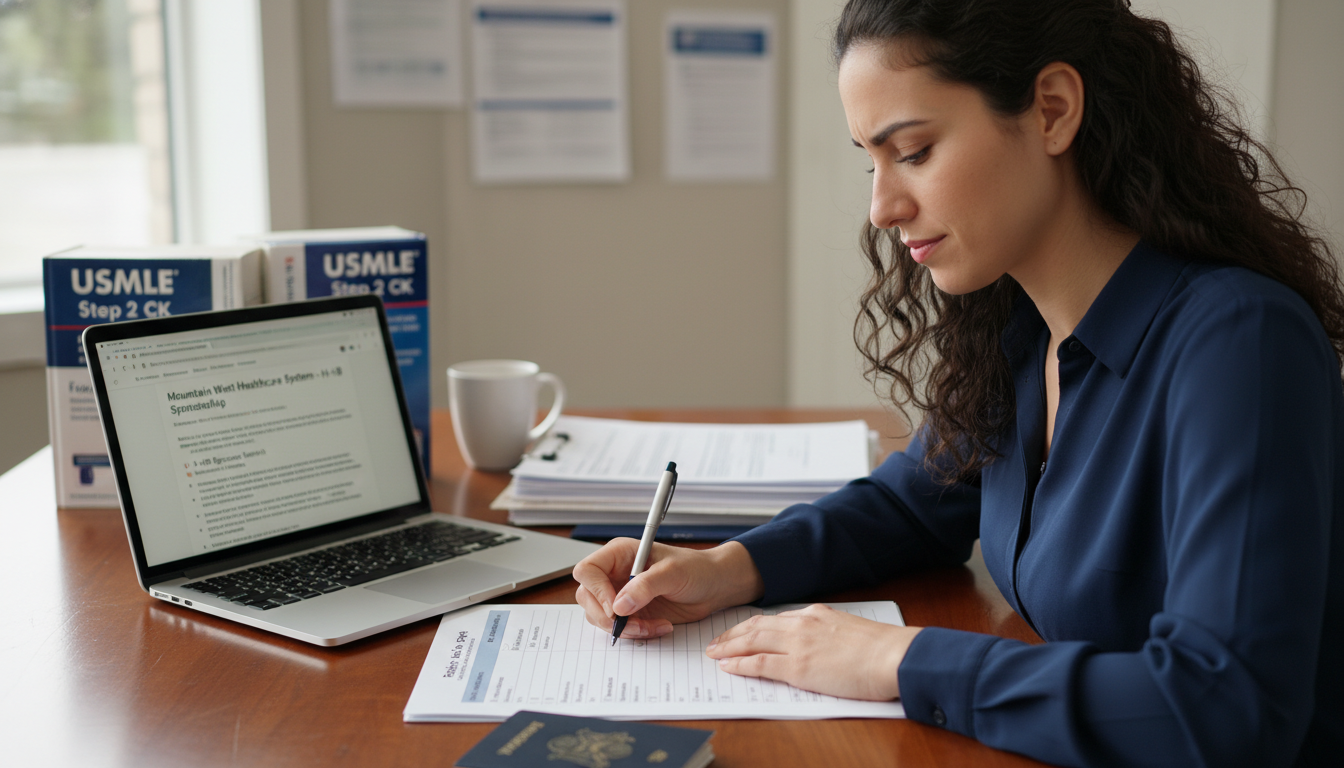
For H-1B residency positions, Step 3 is central.
Ideal timeline for H-1B-focused applicants:
Before ERAS opens (June–September):
- Complete and pass USMLE Step 3
- Obtain or be near completion of ECFMG certification
By Interview Season:
- Have Step 3 score report ready
- Include it in your ERAS application and CV
Programs may say:
- “We require Step 3 by rank list certification” or
- “We require Step 3 by the time of H-1B application”
Because internal deadlines differ, having Step 3 done before applications makes you much easier to sponsor and strengthens your case.
4.2 Documenting Your “H-1B Readiness” in ERAS
To signal seriousness and readiness as a non-US citizen IMG:
- Include Step 3 in the USMLE section as soon as available
- In the Personal Statement (briefly), you can mention:
- You are a foreign national medical graduate
- You have completed Step 3 in preparation for potential H-1B sponsorship
Example (1–2 lines only, near the end):
As a non-US citizen IMG with USMLE Step 3 completed, I am prepared for H-1B sponsorship should your institution support this pathway.
- Update your CV and, if appropriate, ERAS Experiences with US clinical experience or quality improvement work, especially in underserved or rural settings, which is highly valued in the Mountain West.
4.3 Specialty Selection and Competitiveness
For the Mountain West, H-1B availability and competitiveness vary by specialty:
More feasible (generally):
- Internal Medicine
- Family Medicine
- Pediatrics
- Psychiatry
- Some Pathology and Neurology programs
More challenging, especially for H-1B:
- Dermatology, Orthopedics, Neurosurgery, ENT
- Radiology, Ophthalmology
- Certain surgical subspecialties
As a non-US citizen IMG who is H-1B dependent, applying predominantly to very competitive specialties in the Mountain West can be high-risk. Consider:
- Applying to a mix of specialties or including more primary-care-oriented programs
- Focusing on those with a clear track record of foreign national medical graduate recruitment
4.4 Addressing Visa Topics During Interviews
When interviewing, you need to balance honesty and timing:
Early in the process (pre-interview):
Your application already reveals you are a non-US citizen IMG. Programs that dislike visas rarely invite such applicants.
During the interview (PD or APD session):
- If the program’s website explicitly says they sponsor H-1B and the coordinator confirmed, you may not need to highlight it extensively—just mention Step 3 and readiness if asked.
- If the policy is unclear or conditional, consider a polite, concise question, especially near the end of the day or by email afterward:
“I also wanted to clarify whether your program is able to sponsor H-1B visas for residents who have completed Step 3 before Match. This information will help me plan my visa pathway appropriately.”
Keep the focus on:
- Your commitment to the region (e.g., interest in Colorado residency or rural New Mexico/Arizona practice)
- Your long-term goals in the Mountain West
- Your suitability for the specialty and program culture
Visa is important, but it should never be the only thing you talk about.
4.5 After Match: H-1B Petition Logistics
Once you match into an H-1B-sponsoring residency in the Mountain West:
The program’s GME office and its immigration lawyers will guide the process.
You will likely need to provide:
- Valid passport
- ECFMG certificate
- USMLE transcripts (including Step 3)
- Medical school diploma and translations (if applicable)
Institutions typically file:
- A Labor Condition Application (LCA) with the US Department of Labor
- An H-1B petition (Form I-129) with USCIS
Because most residency programs are H-1B cap exempt, they are not competing in the April lottery. H-1B approval should ideally arrive before your July start date.
5. Navigating Long-Term Planning: Fellowship, Jobs, and Waivers in the Mountain West
5.1 H-1B During Fellowship
If your residency and fellowship are both at cap-exempt institutions, you can usually remain in cap-exempt H-1B status across training:
- Residency (e.g., Internal Medicine in Colorado)
- Fellowship (e.g., Cardiology at a university in the Mountain West)
If you later move to a purely private (cap-subject) employer, you may need to:
- Enter the H-1B cap lottery, or
- Use special cap-exempt/cap-subject transfer strategies (with immigration counsel)
5.2 Comparing H-1B to J-1 Waivers for Mountain West Jobs
Many rural and underserved areas in the Mountain West rely on J-1 waiver programs like Conrad-30 to recruit physicians after residency. With an H-1B background:
- You are not constrained by a J-1 home-country requirement
- You may accept positions without a waiver, but you still need a work visa or permanent residency pathway
For jobs in rural Colorado, New Mexico, Arizona, or Wyoming, employers may prefer J-1 waiver candidates due to existing state-level waiver slots. However:
- Some employers also sponsor H-1B directly
- A physician already in H-1B status (especially in a cap-exempt role) can sometimes transition more easily than one navigating J-1 waiver + H-1B from scratch
For your strategic planning, it’s useful to:
- Learn each state’s Conrad-30 waiver priorities, even if you’re on H-1B
- Monitor how rural and underserved employers in the Mountain West handle physician visas
5.3 When H-1B Might Not Be the Best Option
Even as a foreign national medical graduate, there are cases where insisting on H-1B could limit you:
- You are applying very broadly across the US and are flexible with geographic location; J-1 opens many more doors.
- Your profile is already borderline (low scores, major gaps, older YOG) and programs that do offer H-1B are extremely competitive.
- You are strongly committed to underserved care and prepared to pursue a J-1 waiver job in the Mountain West after training.
For some non-US citizen IMGs, especially those aiming to stay long-term in rural areas, J-1 followed by a waiver job in the same state can be a viable route. The key is coherence between your visa strategy and your career goals.
6. Practical Checklist for Non-US Citizen IMGs Targeting H-1B in the Mountain West
Use this as a concise action plan:
12–18 months before Match
- Decide whether your primary goal is H-1B or J-1.
- If H-1B-focused:
- Schedule and prepare intensively for USMLE Step 3.
- Work on strong US clinical experience in the Mountain West if possible (electives, observerships, or research).
6–12 months before Match
- Take and pass Step 3.
- Finalize ECFMG certification.
- Begin researching programs in Colorado, Utah, Arizona, New Mexico, Nevada, Idaho, Montana, and Wyoming.
- Construct the first version of your H-1B sponsor list through websites and FREIDA.
3–6 months before ERAS submission
- Email coordinators to confirm H-1B sponsorship policies.
- Reach out to alumni or current residents from your medical school in Mountain West programs.
- Categorize programs into:
- H-1B friendly
- Conditional H-1B
- J-1 only
ERAS and Interview Season
- Highlight Step 3 completion in your application.
- Tailor personal statements to Mountain West themes:
- Interest in rural or underserved care
- Enjoyment of outdoor or mountain lifestyles
- Commitment to primary care or needed specialties
- Ask tactful questions about H-1B during or shortly after interviews where policies are unclear.
Post-Match
- Collaborate promptly with GME and immigration counsel on your H-1B petition.
- Keep copies of all immigration documents well-organized.
- Begin long-term planning for either fellowship (ideally also cap-exempt) or post-residency jobs in the Mountain West.
FAQs: H-1B Sponsorship Programs for Non-US Citizen IMGs in the Mountain West
1. Is it realistic for a non-US citizen IMG to secure an H-1B residency position in the Mountain West?
Yes, it is realistic but competitive. Certain Colorado residency programs, as well as some in Arizona, Utah, Nevada, and New Mexico, have a history of sponsoring H-1B for foreign national medical graduates. Success depends heavily on:
- Having USMLE Step 3 done early
- Strong overall application (scores, clinical experience, letters)
- Applying broadly to confirmed H-1B-friendly programs
Many smaller or rural programs lean more heavily on J-1, so you must research carefully.
2. Do all Mountain West university programs sponsor H-1B visas for residents?
No. Even at large academic centers, visa policy is often specialty-specific. One department (e.g., Internal Medicine) might sponsor H-1B, while another (e.g., Surgery) might be J-1 only. Always:
- Check the program website
- Confirm with the program coordinator
- Update your own H-1B sponsor list each cycle
Assume nothing based purely on institutional name.
3. If a program says “we prefer J-1,” can they still sponsor H-1B?
Sometimes. “Prefer J-1” often means:
- J-1 is their default and administratively easier
- H-1B may be possible for outstanding candidates with Step 3 completed
- Final decision rests with the Program Director and GME office
If you are a strong applicant, it can be worth applying and then clarifying: “If I match and have Step 3, would H-1B sponsorship be possible?” But do not rely on these programs as the core of your H-1B strategy—focus on those clearly open to H-1B.
4. Does being H-1B cap exempt during residency help me when I look for jobs after training?
Indirectly. Being in cap-exempt H-1B status during residency/fellowship:
- Allows you to train without the H-1B lottery
- May simplify transitions to another academic (cap-exempt) employer in the Mountain West
- Demonstrates you already meet licensing and exam standards
However, if your first post-training job is with a cap-subject private employer, you may still need to go through the H-1B lottery or use careful visa planning with an immigration lawyer. Long-term, your strategy might involve:
- Remaining in cap-exempt academic or safety-net institutions in the Mountain West, or
- Pursuing permanent residency (green card) through an employer willing to sponsor you.
By combining a clear visa strategy, early Step 3 completion, and targeted research into H-1B-friendly programs, a non-US citizen IMG can build a realistic path to training and long-term practice in the Mountain West region.