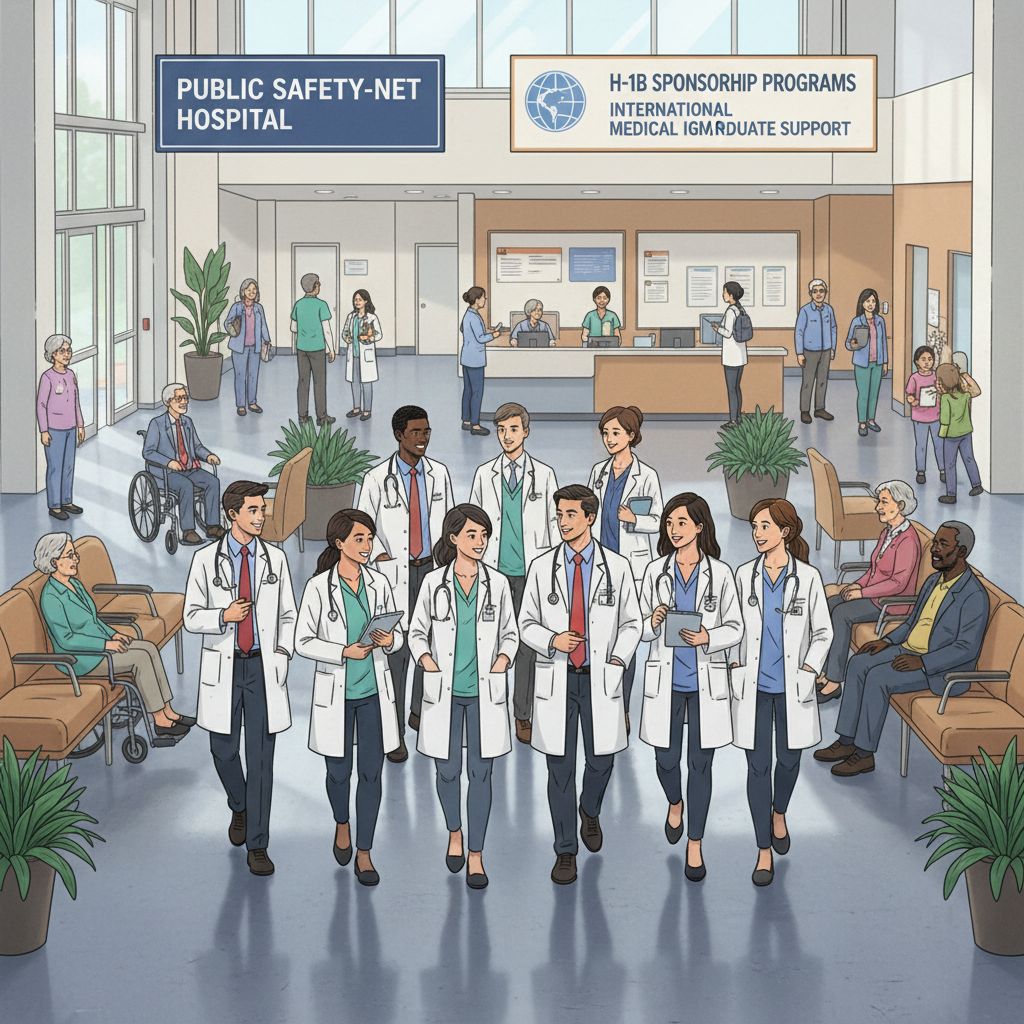
Understanding H‑1B Sponsorship for Non‑US Citizen IMGs in Pediatrics
For a non-US citizen IMG or foreign national medical graduate aiming for pediatrics residency in the United States, the question is no longer just “Can I match?” but “Can I find a program that will sponsor an H‑1B?”
Pediatrics is generally more J‑1–oriented than H‑1B–oriented, but there are H‑1B residency programs and institutional policies that can support you—especially at large academic children’s hospitals and university-affiliated centers. Knowing how the H‑1B system works, how it differs from the J‑1, and which pediatrics programs are most likely to help is critical for building a smart peds match strategy.
This article will walk you through:
- The basics of H‑1B sponsorship in graduate medical education (GME)
- Why some pediatrics programs do (or don’t) sponsor H‑1B visas
- Where to look for H‑1B-friendly pediatrics residency programs
- How to present yourself as a strong H‑1B candidate during the application and interview process
- Practical steps, common pitfalls, and FAQs for non‑US citizen IMGs
H‑1B vs J‑1 in Pediatrics: What Non‑US Citizen IMGs Need to Know
1. Core differences relevant to pediatrics
For residency, international medical graduates usually train on either a J‑1 visa (sponsored by ECFMG) or an H‑1B visa (sponsored by the hospital or university). Each has implications for your long-term career in pediatrics.
J‑1 (ECFMG-sponsored) for residency:
- Most common for pediatric residencies, especially community or mid-sized university programs.
- Requires a two-year home-country physical presence after training (unless you obtain a waiver).
- Waiver often requires:
- Practice in a medically underserved area (often rural or inner city)
- Service commitment (commonly 3 years)
- Simpler and cheaper for residency programs:
- Centralized through ECFMG
- Predictable processes and timelines
H‑1B for residency:
- Dual intent (you may intend to stay permanently, compatible with later green card).
- No two-year home return requirement.
- More complex and costly for programs:
- Legal fees
- Prevailing wage considerations
- Strict documentation and timing
- Requires:
- USMLE Step 3 passed before H‑1B filing (practically, before beginning residency)
- Valid state medical license eligibility (varies by state)
For a foreign national medical graduate in pediatrics who wants to stay in the US long-term, H‑1B can be an attractive path—if you can secure a sponsoring program.
2. Cap-exempt vs cap-subject H‑1B in residency
H‑1B visas are typically subject to an annual numerical cap. However, most pediatric residencies are H‑1B cap-exempt because they are sponsored by:
- Nonprofit hospitals affiliated with universities
- Institutions of higher education
- Nonprofit research organizations
This is a huge advantage. A cap-exempt H‑1B allows:
- Filing any time of year (not restricted to April lottery)
- No competition in the annual H‑1B lottery
- More flexibility for start dates and extensions
When exploring pediatric H‑1B residency programs, prioritize those that are H‑1B cap exempt (most major academic children’s hospitals are), but always confirm with the program or GME office.

Why H‑1B Sponsorship Is Less Common in Pediatrics (and How to Work Around It)
1. Structural reasons pediatrics leans J‑1
Compared with internal medicine, neurology, or pathology, pediatrics has:
- Fewer overall H‑1B residency programs
- A long-standing culture of using J‑1 for IMGs
- Lower income relative to some specialties, which can influence institutions’ appetite for extra immigration costs
Common reasons pediatric programs avoid H‑1B:
Cost and administrative burden
- Filing fees, potential legal costs
- HR and GME time to maintain compliance
Policy standardization
- Many institutions choose “J‑1 only” or “J‑1 preferred” policies for all their GME programs, regardless of specialty, to simplify administration.
Step 3 requirement
- Many non-US citizen IMGs don’t have Step 3 at application time.
- Programs don’t want to risk a matched applicant failing to meet H‑1B requirements by July 1.
Misconceptions or risk-avoidance
- Some programs incorrectly believe H‑1B is always cap-subject.
- Others fear audits or compliance issues and opt out entirely.
2. The workaround: targeting H‑1B-friendly environments
H‑1B sponsorship in pediatrics is not uniform, but patterns exist. Non-US citizen IMGs improve their odds by targeting:
- Large university-based programs with high IMG representation.
- Major children’s hospitals attached to medical schools.
- Hospital systems with known H‑1B policies in other specialties (internal medicine, surgery, radiology).
If a system sponsors H‑1B residents in any department, it is more likely (not guaranteed) to extend similar options to pediatrics, especially for highly competitive candidates.
Identifying H‑1B-friendly Pediatrics Residency Programs
There is no official, up-to-date H‑1B sponsor list specifically for pediatrics programs, so you must combine multiple strategies and signals. This section focuses on practical, step-by-step methods.
1. Use program websites strategically
On each pediatrics residency website, look for:
- “International Medical Graduates” or “Visa Sponsorship” sections
- GME “Policies for IMGs” pages
- FAQ sections for applicants
Common wordings and what they mean:
“We sponsor J‑1 visas only”
→ Practically excludes H‑1B; you can deprioritize this program for an H‑1B strategy.“We sponsor J‑1 and H‑1B visas”
→ Strong positive signal. Still, confirm details, as some only use H‑1B for fellows or special cases.“We sponsor visas on a case-by-case basis”
→ Mixed. Sometimes this means they are open to H‑1B for exceptional non-US citizen IMGs. This is worth exploring if the rest of the program aligns with your goals.
If the website is unclear, check the GME office or institution-wide visa policy (usually under Human Resources or International Services).
2. Learn from other specialties and institutional patterns
Because institutional policy often applies across all programs, you can use other specialties to infer pediatrics-friendly settings:
- Search:
"[Hospital Name] H-1B visa internal medicine residency" - If their internal medicine or pathology residency clearly sponsors H‑1B:
- The institution is more likely to be comfortable with H‑1B paperwork.
- The pediatrics residency might be persuadable, especially for top candidates.
Note: Some institutions restrict H‑1B to fellowships only (e.g., pediatric subspecialties such as NICU, heme-onc), so always confirm specifically for pediatrics residency.
3. Use NRMP and FREIDA wisely
FREIDA (AMA Residency & Fellowship Database):
- Some programs list visa types accepted.
- Filter pediatrics programs, then check individual program pages for J‑1 vs H‑1B.
NRMP Program Descriptions:
- When available, review the supplemental information; some PDs mention visa policies.
While these databases are helpful, they may be outdated or incomplete—cross-check with the program website or GME office.
4. Ask targeted questions—without raising red flags
If you email or speak with the program coordinator, be precise and respectful. For example:
“I am a non-US citizen IMG with USMLE Step 3 completed and ECFMG certification. Could you please let me know if your pediatrics residency program is able to sponsor an H‑1B visa for qualified applicants, or if you accept only J‑1 visas?”
Key points:
- Mention Step 3 if you’ve passed—it signals seriousness and readiness.
- Avoid sounding like visa is your only interest; acknowledge fit and interest in the program’s strengths in your opening paragraph.
5. Look for IMGs currently on H‑1B in pediatrics
- Search LinkedIn for phrases like:
"Pediatric resident H-1B","Pediatrics PGY-2 H1B", or similar combinations.
- When you find residents in US programs, check:
- Where they trained
- Their visa status (often listed or implied)
- If appropriate, send a brief, polite message:
- Ask generally about the program’s visa sponsorship (don’t ask for personal legal details).

How to Maximize Your Chances for H‑1B in Pediatrics
Once you identify pediatrics programs that potentially support H‑1B, you need to present yourself as a low-risk, high-value applicant. H‑1B sponsorship is a business and legal decision; your job is to make it easy for them to say “yes.”
1. Time USMLE Step 3 strategically
For an H‑1B residency pathway, Step 3 is a non-negotiable requirement for most institutions. Practical recommendations:
Ideal timing:
- Take Step 3 before the application season (June–August) in the year you apply.
- This lets programs know early that you’re H‑1B-eligible.
If you can’t do that:
- Aim to pass Step 3 by December–January of interview season at the latest.
- Inform programs promptly when you pass; some may reconsider their sponsorship options.
Avoid cutting it too close:
- Remember that H‑1B processing (even at cap-exempt institutions) takes weeks to months.
- Programs are reluctant to risk a visa delay past July 1.
2. Build a pediatrics-focused US profile
To persuade a program to sponsor an H‑1B, you must show you’re worth the effort. For a non-US citizen IMG in pediatrics, this means:
Substantial US clinical experience (USCE) in pediatrics:
- Rotations, observerships, sub-internships in pediatric departments
- Letters from US pediatric faculty who can comment on:
- Clinical competence
- Communication skills with children and families
- Teamwork in multidisciplinary pediatric teams
Research or QI projects in pediatrics:
- NICU outcomes, vaccine uptake studies, pediatric asthma management, etc.
- Poster presentations at pediatric conferences (AAP, PAS) strengthen your profile.
Evidence of commitment to working with underserved children:
- Volunteering in clinics, schools, refugee health programs, foster care environments
- This aligns you with many children’s hospitals’ missions and improves your appeal regardless of visa type.
3. Address visa issues professionally in your personal statement and interviews
You do not need to center your whole application on visas, but you should:
Signal clarity and preparedness:
- Briefly mention in your ERAS application or personal statement that:
- You are ECFMG-certified (or will be by X date)
- You have completed or scheduled Step 3 (if applicable)
- You understand visa requirements and intend to pursue either J‑1 or H‑1B (depending on your strategy)
- Briefly mention in your ERAS application or personal statement that:
In interviews:
- Don’t open with visa questions.
- Wait for a natural moment or ask at the end:
- “May I ask how your program handles visa sponsorship for non-US citizen IMGs? I’m especially interested in understanding whether H‑1B is a possibility for highly qualified candidates.”
Key is to appear flexible and well informed, not demanding or unaware of constraints.
4. Consider a flexible strategy: J‑1 now, H‑1B later
Not every foreign national medical graduate will secure an H‑1B pediatrics residency slot. For many, a hybrid strategy works:
- Train in pediatrics on a J‑1 visa.
- Pursue a J‑1 waiver job in pediatrics (often in underserved locations).
- Transition to an H‑1B through the waiver employer.
- Later apply for permanent residency (green card) if eligible.
This path:
- Removes the pressure of finding an H‑1B pediatrics residency upfront.
- Still leads to long-term US practice in pediatrics.
- Leverages the more plentiful J‑1 pediatric positions while preserving your future options.
Practical Application Plan for Non‑US Citizen IMGs Targeting H‑1B in Pediatrics
Bringing it all together, here is a concrete action roadmap.
1. 18–24 months before the match
- Complete USMLE Step 1 and Step 2 CK with strong scores.
- Start planning Step 3:
- Book it early if possible, especially if you’ve already done some US clinical work.
- Seek USCE specifically in pediatrics:
- Aim for 2–3 months in US pediatric departments (university or large community).
2. 12–18 months before the match
Finalize Step 3 scheduling; begin dedicated study.
Identify potential H‑1B pediatric institutions:
- Large academic centers
- Children’s hospitals with strong IMG presence
- Hospitals where other specialties sponsor H‑1B residents
Create a spreadsheet tracking:
- Program name and location
- Visa policy (J‑1 only / H‑1B & J‑1 / case-by-case)
- Source of info (website, email, FREIDA)
- Contact person and notes
3. 6–12 months before the match
Take Step 3 and aim to pass before submitting ERAS, if possible.
Request strong letters from US pediatric attendings.
Refine your personal statement:
- Emphasize your passion for pediatrics, work with children, long-term goals.
- Keep visa mentions brief and factual.
Finalize your program list:
- Core: Programs that explicitly or strongly imply H‑1B sponsorship.
- Secondary: Quality pediatrics programs that at least accept IMGs (even if J‑1 only), in case you adjust strategy.
4. Application and interview season
- Submit ERAS early in the season.
- Tailor your interests:
- Highlight alignment with each program’s pediatric strengths (NICU, community health, global child health, etc.).
- During interviews:
- Focus first on clinical and educational discussions.
- Ask about visa policies in a professional, concise way near the end.
If multiple programs are open to H‑1B:
- Consider factors like:
- Board pass rates
- Fellowship match history (if you aim for subspecialization)
- Institutional stability and IMG culture
- Location and cost of living
Key Takeaways for Non‑US Citizen IMGs Targeting H‑1B in Pediatrics
- H‑1B sponsorship in pediatrics residency exists but is limited; pediatrics relies heavily on J‑1 visas.
- Most pediatric H‑1B residency positions are in H‑1B cap-exempt academic institutions, such as university-affiliated children’s hospitals.
- For a foreign national medical graduate, having USMLE Step 3 completed early and strong pediatrics-specific USCE significantly boosts H‑1B feasibility.
- There is no single official H‑1B sponsor list for pediatrics, so you must:
- Research program websites
- Review institutional GME policies
- Network with current residents
- Ask targeted, respectful questions
- A flexible mindset—open to J‑1 with later H‑1B via waiver jobs—can ensure you still achieve a US pediatrics career even if H‑1B residency doesn’t work out immediately.
FAQs: H‑1B Sponsorship in Pediatrics Residency for Non‑US Citizen IMGs
1. Is it realistic for a non‑US citizen IMG to get an H‑1B pediatrics residency?
It is possible but competitive and limited. Compared to internal medicine or pathology, there are fewer pediatrics programs openly sponsoring H‑1B. You need strong USMLE scores, preferably Step 3 passed early, solid US pediatrics clinical experience, and careful targeting of institutions with known H‑1B comfort. For many non‑US citizen IMGs, a J‑1 pediatrics residency followed by an H‑1B waiver job is more common.
2. Do all H‑1B residency programs require Step 3 before ranking me?
Policies vary, but most H‑1B pediatrics sponsorships require Step 3 passed before the H‑1B petition is filed—which practically means before you start residency. Some programs will rank you contingent on passing Step 3 by a certain date; others may prefer or require Step 3 completed by the time of application. Passing Step 3 early makes you a far safer and more attractive H‑1B candidate.
3. Are pediatrics residents on H‑1B affected by the regular H‑1B lottery?
Usually no, because most pediatrics residency programs are hosted by H‑1B cap-exempt institutions (nonprofit hospitals affiliated with universities or research organizations). This means they can file H‑1B petitions at any time of the year without going through the lottery. However, if you later move to a purely private practice or non-affiliated employer, that new H‑1B may become cap-subject, and you would need to navigate the lottery at that point.
4. Should I avoid J‑1 altogether if I eventually want a green card in pediatrics?
Not necessarily. Many pediatricians who are foreign national medical graduates successfully transition from J‑1 to permanent residency via J‑1 waivers and H‑1B jobs. J‑1 can actually give you more options at the residency level, because more peds programs support it. If you can secure an H‑1B pediatrics residency with a good long-term institutional pathway, that’s convenient—but a J‑1 route followed by a waiver in pediatrics is a perfectly valid and widely used path to a US pediatric career and eventual green card.
By understanding the landscape of H‑1B residency programs in pediatrics, planning Step 3 early, and targeting the right institutions, a non‑US citizen IMG can build a realistic, strategic route to a long-term career in US pediatrics—whether that starts directly on H‑1B or through a J‑1 with a thoughtful transition plan.