Understanding H-1B Sponsorship for Non-US Citizen IMGs in General Surgery
For a non-US citizen IMG aiming for general surgery residency in the United States, visa strategy can be as important as board scores and letters of recommendation. Among the available options, H-1B sponsorship is often seen as the “gold standard” for those who want to minimize disruption in training and transition more smoothly to fellowship or practice.
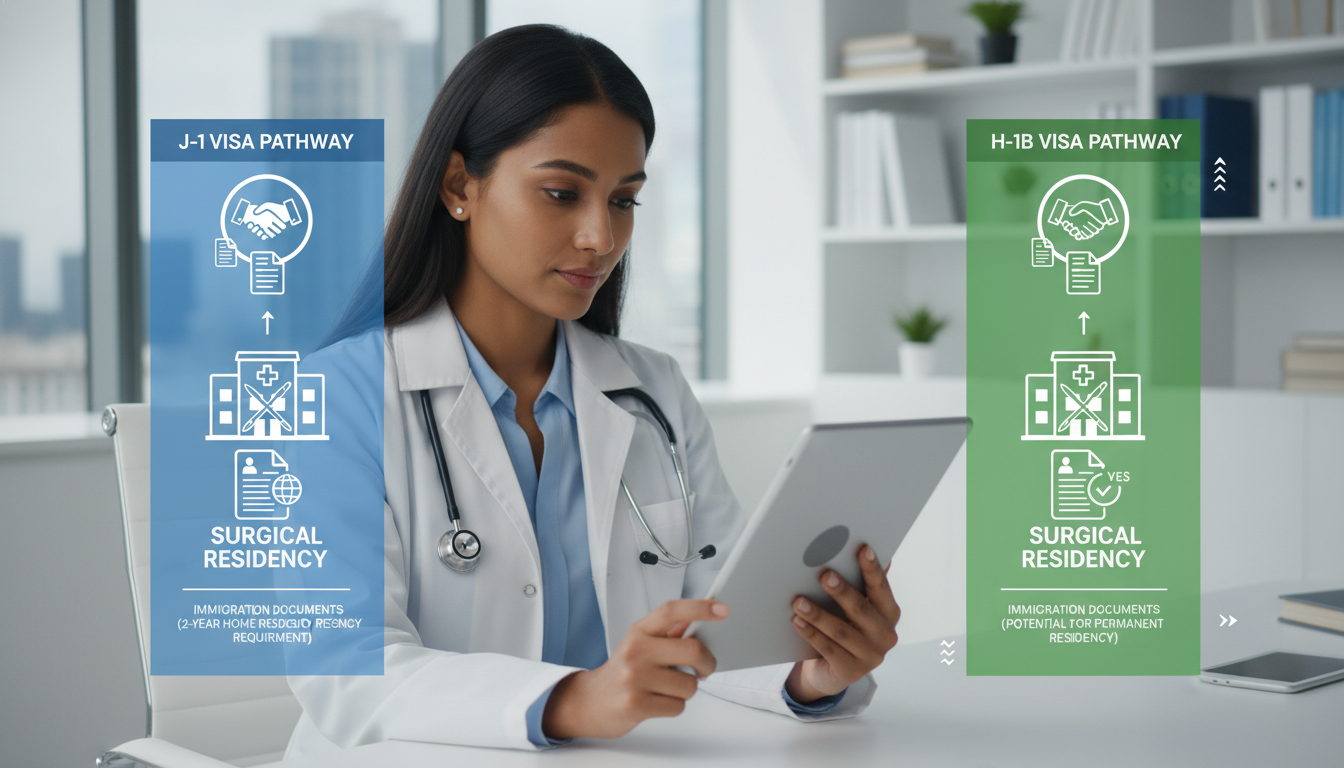
Unlike the J-1 visa, which is administered through the ECFMG and requires a two-year home-country return (or a waiver) after training, the H-1B is an employment-based visa that ties you directly to your sponsoring hospital. But it is also more complex, more expensive for programs, and not universally offered across surgery residency programs.
This article provides a detailed, practical guide to H-1B residency programs in general surgery for the foreign national medical graduate, with a focus on how to target programs, what to expect, and how to optimize your application strategy.
1. J-1 vs H-1B for General Surgery: What Non-US Citizen IMGs Must Know
Before focusing on H-1B residency programs, it is essential to understand why the H-1B matters and how it compares to the J-1 for a foreign national medical graduate.
1.1 Basic Differences
J-1 (ECFMG-sponsored Exchange Visitor Visa)
- Sponsor: ECFMG (not the hospital)
- Main use: Graduate medical education (residency and fellowship)
- Duration: Typically up to 7 years (with possible exceptions)
- Key downside: Two-year home-country physical presence requirement after training, unless you obtain a waiver
- Pros:
- Widely accepted; many surgery programs are familiar and comfortable with J-1
- Less institutional cost and legal burden for programs
H-1B (Temporary Specialty Occupation Worker Visa)
Sponsor: The employer (hospital/university)
Main use in GME: Residency and fellowship employment
Duration: Up to 6 years total, including any prior H-1B time (fellowship years are counted)
No automatic home return requirement
Pros for a non-US citizen IMG in surgery:
- No two-year home residency requirement
- Often smoother path to subsequent employment, as many hospitals already use H-1B for attending positions
- More straightforward transition to green card sponsorship in many settings
Challenges:
- Costly in legal fees and filing costs for the institution
- Requires passing USMLE Step 3 before visa filing
- Not all programs or hospitals will sponsor; some are J-1 only
1.2 Why H-1B Is Attractive for Aspiring Surgeons
For general surgery, long-term career planning is critical:
- Many surgeons pursue fellowship (e.g., vascular, colorectal, surgical oncology, trauma/critical care). H-1B can make the transition more seamless, especially if you stay within the same institution or network.
- If you plan to remain in the US & seek permanent residence, H-1B status often integrates better with employer-sponsored green card processes.
- Some fellowship programs prefer or require H-1B, or are located at institutions that do not sponsor J-1 waivers.
In short, the H-1B can significantly reduce immigration-related uncertainty during the crucial early years of your surgical career.
2. How H-1B Residency Programs Work in General Surgery
Understanding the structure of H-1B sponsorship within the surgery residency match process will help you target programs intelligently.
2.1 H-1B Cap-Exempt Status for Residency Programs
Most university-affiliated residency programs are considered H-1B cap exempt because they are:
- Non-profit institutions related to higher education, or
- Governmental research organizations, or
- Affiliated with institutions of higher education.
Why this matters:
- They are not subject to the annual H-1B lottery cap that affects private employers.
- They can file H-1B petitions any time of year, not just in April.
- As a non-US citizen IMG, this makes general surgery H-1B residency programs far more predictable and accessible than typical corporate H-1B pathways.
Some community-based programs can also be cap-exempt if they have a formal affiliation with a university; others are cap-subject and much less likely to use H-1B for residents. Always confirm with the specific program or their GME office.
2.2 Key Requirements for H-1B Sponsorship in Surgery Residency
Most H-1B residency programs share some common requirements:
USMLE Step 3
- Must be passed before the H-1B petition is filed (often before a set deadline, such as May or June prior to residency start).
- Some programs will consider you in the surgery residency match if you are scheduled to take Step 3, but will only finalize H-1B sponsorship once you pass.
ECFMG Certification
- Completed, with all primary-source verification and Step exams done.
- Without full certification, you usually cannot start residency, regardless of visa type.
State Medical Board Eligibility
- H-1B petitions for residents typically require a state training license (or temporary license).
- You must meet that state’s specific criteria (e.g., number of USMLE attempts allowed, time since graduation).
Program and Institutional Policy
- The residency program and the sponsoring hospital must both allow H-1B employment for residents.
- Some institutions cap the number of H-1B residents per year for cost or administrative reasons.
2.3 Institutional vs Program Decisions
Two layers affect whether a general surgery residency offers H-1B:
- Institution-level (GME and legal office): Sets global visa policies, decides whether H-1B for residents is allowed at all, and under which conditions.
- Program-level (PD and department): May choose, as a smaller policy, to accept or decline H-1B candidates even if the institution allows it (e.g., “We sponsor H-1B only for exceptionally competitive applicants”).
When researching H-1B residency programs, always distinguish between:
- “Institution sponsors H-1B for GME”
- “General surgery residency actually uses H-1B sponsorship for non-US citizen IMGs”
The second is more important for your specific goal.
3. Building a Targeted H-1B Sponsor List in General Surgery
There is no single, official, public “H-1B sponsor list” for general surgery residency programs. However, you can systematically assemble your own list of H-1B-friendly programs and prioritize them in your surgery residency match strategy.
3.1 Where to Start: Core Data Sources
Use a combination of the following:
Program Websites
- Many surgery residencies now explicitly state their visa policy under “Eligibility” or “International Medical Graduates.”
- Look for phrases like:
- “We sponsor H-1B and J-1 visas”
- “We only sponsor J-1 visas through ECFMG”
- “We do not sponsor visas for residents”
- Some distinguish between categorical and preliminary positions.
Institutional GME Websites
- Large academic centers often have a central Graduate Medical Education visa policy page.
- This may list:
- Whether H-1B sponsorship is available for residents
- Specific requirements (e.g., Step 3 deadline, USMLE attempt limits)
NRMP and AAMC FREIDA
- FREIDA profiles sometimes mention visa support, though data may be incomplete or outdated.
- Use FREIDA to identify programs, then cross-check via website or direct contact.
Program Coordinator / GME Office
- Email is particularly useful when the website is unclear.
- Ask precise questions to get precise answers.
3.2 How to Phrase Your Inquiry
When you contact a program or GME office, keep your message focused and professional. For example:
“I am a foreign national medical graduate, ECFMG-certified, and plan to take USMLE Step 3 before the upcoming Match. Could you please confirm whether your general surgery residency program sponsors H-1B visas for categorical residents, and if so, what additional requirements or deadlines I should be aware of?”
You can add:
- Your year of graduation
- Whether you are already in the US (e.g., on F-1, J-1 research, or other status)
- A very brief summary of your background (e.g., surgical research, publications)
3.3 Prioritizing Programs: Strategy for a Non-US Citizen IMG
When building your personal H-1B sponsor list, categorize programs into tiers based on both visa friendliness and IMG friendliness:
Tier A: H-1B-friendly & IMG-friendly
- Academic or large community programs that openly sponsor H-1B and routinely match IMGs in general surgery.
- Often in less competitive geographic areas or smaller cities.
- Ideal core targets for your application list.
Tier B: H-1B-friendly but highly competitive or less IMG-friendly
- Prestigious university programs that sponsor H-1B but rarely take IMGs.
- Worth applying if your profile is particularly strong (high scores, substantial research, strong US LORs).
Tier C: “Case-by-case” H-1B, unclear IMG track record
- Programs that state they “may sponsor H-1B under certain circumstances.”
- Consider applying if your profile is strong, but do not rely on these as your main H-1B pathway.
Tier D: J-1 only or no visa sponsorship
- Fine to apply if you’re open to J-1, but if you require H-1B, you should deprioritize these.
3.4 Example: How an IMG Might Build a Realistic List
Imagine you are a non-US citizen IMG with:
- YOG: 2020
- USMLE: 245/248/Passed Step 3
- 6 months of US surgical observerships
- 2 US surgeon letters, 1 home-country mentor letter
- 2 publications in surgical journals
A reasonable strategy:
- Apply to 80–100 general surgery programs total.
- Ensure 20–30 of these are confirmed H-1B residency programs with documented IMG matches (Tier A).
- Add 10–20 H-1B-friendly but more competitive programs (Tier B).
- Fill the remaining spots with J-1-accepting, IMG-friendly programs to increase your interview chances (if you’re flexible on the final visa).

4. Strengthening Your Application for H-1B-Sponsoring Surgery Programs
Because H-1B is more resource-intensive, programs often reserve it for especially strong candidates. As a foreign national medical graduate, your aim is to show that investing in your sponsorship is clearly worthwhile.
4.1 Academic Metrics and Exam Performance
H-1B sponsors tend to favor candidates with evidence of strong exam performance and reliability:
- USMLE Step 1 & 2 CK: Competitive scores (often 230+ for many general surgery programs, higher for university centers).
- USMLE Step 3:
- Aim to pass with a solid margin on first attempt.
- Take Step 3 early enough that results are available by late fall or early winter of the Match year.
Many institution-level policies have strict attempt limits (e.g., no more than 2 attempts per Step) for granting a training license or for H-1B eligibility. Always check state board requirements.
4.2 Clinical Experience and Letters of Recommendation
For general surgery, programs value:
- Hands-on US clinical experience in surgical services:
- Sub-internships, electives, acting internships, or strong observerships with meaningful exposure.
- Letters of recommendation from US surgeons:
- Ideally from academic surgeons who can comment on your technical aptitude, work ethic, and ability to function as part of a team.
- At least 2 letters should be from US-based faculty (3 is better if possible).
Programs taking on the cost and complexity of H-1B will want strong reassurance that you can handle the intensity and demands of a surgical residency from day one.
4.3 Research, Publications, and Academic Engagement
While not mandatory for all H-1B sponsor programs, research can significantly strengthen your profile, especially for academic centers:
- Peer-reviewed publications in surgery or surgical subspecialties
- Presentations at meetings (ACS, regional surgical societies, specialty conferences)
- Quality improvement projects or outcomes research related to surgery
Highlight in your personal statement and CV how your research experience aligns with that program’s strengths or faculty interests.
4.4 Demonstrating Commitment to Surgery and the Institution
In your application materials (ERAS personal statement, program-specific communications):
- Emphasize your long-term commitment to a surgical career in the US, not just “any” residency.
- Show familiarity with the program’s case mix, teaching structure, and faculty interests.
- For institutions known to sponsor H-1B:
- Convey that you understand visa requirements and have already completed or scheduled Step 3.
- You do not need to overemphasize your visa needs, but you should not hide them either.
4.5 Timing: Coordinating Step 3, Match, and H-1B Filing
A typical timeline for a non-US citizen IMG targeting an H-1B general surgery residency:
January–June (before Match year):
- Prepare and take USMLE Step 3.
- Aim for a test date that gives you results by September/October.
September:
- ERAS opens; submit with Step 1/2 CK scores and, if possible, Step 3 passed.
October–January:
- Interviews. Clarify visa policies directly with programs where necessary.
March:
- Match results. Once matched to an H-1B residency program, the institution’s GME/legal office starts the petition process.
Spring–Early Summer:
- H-1B petition filing and approval.
- Attend US consulate appointment in your country (if you are outside the US) for visa stamping.
Starting Step 3 too late is one of the most common mistakes for non-US citizen IMGs who hope for H-1B. Plan backward from desired residency start date.
5. Common Pitfalls and Practical Tips for H-1B-Oriented Applicants
Targeting H-1B residency programs in general surgery is feasible, but there are recurring issues that harm IMG chances. Being aware of these can save you time and effort.
5.1 Overly Narrow Application List
Some candidates apply only to H-1B-sponsoring programs and limit themselves to 20–30 applications. This is usually risky in general surgery, where competition is high.
Unless you have an exceptional profile and are absolutely unwilling to consider a J-1, it is often wiser to:
- Apply broadly (including some J-1-friendly, IMG-friendly programs).
- Keep your H-1B sponsor list as a priority subset, rather than the entire application list.
5.2 Confusion Between Institutional and Program Policy
A hospital may sponsor H-1B for fellows or attendings but not for residents. Conversely, a GME office may allow H-1B, but a specific surgery program might not utilize it.
Do not rely on second-hand online lists without cross-checking:
- Always confirm directly with the general surgery residency program or their GME office.
- Re-check policies in the year you apply; they can change from cycle to cycle.
5.3 Late Step 3 or Multiple Failed Attempts
For H-1B:
- A late Step 3 can push the H-1B petition into time pressure or make programs hesitant to sponsor you in the first place.
- Multiple Step failures can make it harder to obtain the required training license in some states.
If you have prior failures:
- Research state board requirements carefully.
- Target states that are more flexible on attempts.
- Highlight subsequent strong performance (e.g., high Step 3 score after a prior fail).
5.4 Ignoring State Licensing Nuances
Residency H-1B sponsorship is usually tied to a specific state license. Some boards have:
- Strict limits on years since graduation
- Caps on exam attempts
- Additional documentation requirements for foreign national medical graduates
Before you finalize your H-1B sponsor list:
- Check state board rules in states where your target programs are located.
- If you are a “non-traditional” IMG (older YOG, multiple attempts), you may want to prioritize states with more flexible regulations.
5.5 Not Leveraging Networks and Mentors
Many IMGs underestimate the importance of networking:
- Use alumni from your medical school who matched into US general surgery (even if on J-1) to ask which programs were IMG-friendly and how visa discussions went.
- If you are doing research in the US, talk to your PI or surgery faculty about which institutions they know to be H-1B-friendly.
- Join surgical societies’ IMG or trainee sections and attend webinars or virtual info sessions that sometimes touch on visa policy.
6. Long-Term Planning: From H-1B Residency to Fellowship and Beyond
When targeting H-1B residency programs, keep your entire surgical training pathway in mind—not just PGY-1.
6.1 Duration Limits and Fellowship Planning
Remember that the H-1B has a 6-year total limit, including:
- All years of general surgery residency
- Any years spent on H-1B before residency (e.g., research jobs)
- Subsequent fellowship training
For a typical track:
- 5 years of categorical general surgery residency
- 1–2 years of fellowship (e.g., critical care, MIS, vascular, surgical oncology)
If you start residency already having used H-1B time (for example, in a research position), you and your program will need to think ahead:
- Some surgeons transition to O-1 visas (for individuals of extraordinary ability) for fellowship.
- Others start the green card process during residency or early fellowship, which can allow further extensions beyond the 6-year H-1B cap in certain circumstances.
6.2 Transitioning Institution or Visa Status
Moving to a new institution for fellowship may involve:
- Transferring your existing cap-exempt H-1B to another cap-exempt institution, or
- Changing from H-1B to J-1 for fellowship, which reintroduces the home return requirement unless waived, or
- Transitioning to O-1 (for well-published or academically distinguished candidates).
When choosing H-1B residency programs, consider:
- Does this institution also sponsor H-1B for surgical fellowships?
- Does it have a track record of helping foreign national medical graduates with O-1 or green card transitions?
6.3 Attending-Level Employment and Immigration
As a foreign national surgeon nearing the end of training:
- Many US hospitals and groups sponsor H-1B for attending surgeons.
- Your prior H-1B residency experience can make credentialing and employment smoother.
- If you plan to remain in academics, your residency/fellowship institution may sponsor your EB-2 or EB-1 green card.
The main message: Choosing an H-1B-friendly general surgery residency is not just about the next 5 years; it can set the foundation for your entire career trajectory in the US.
Frequently Asked Questions (FAQ)
1. Is it realistic for a non-US citizen IMG to match into a general surgery residency on an H-1B visa?
Yes, it is realistic but competitive. Many foreign national medical graduates do secure categorical general surgery positions on H-1B each year, particularly in H-1B cap exempt academic centers and IMG-friendly programs. You need strong exam scores, early Step 3 completion, solid US clinical experience, and a broad, well-researched application list with a clear H-1B sponsor focus.
2. Do I need to have USMLE Step 3 passed before I apply through ERAS?
Not strictly, but it is strongly recommended. Some programs will interview you without Step 3 but will only sponsor H-1B once you pass. Having Step 3 already passed at the time of application makes you more attractive to H-1B residency programs because it reduces institutional risk and time pressure. At minimum, schedule Step 3 early enough to get results by fall or early winter of the Match cycle.
3. Where can I find a definitive H-1B sponsor list for general surgery residency programs?
There is no single authoritative public “H-1B sponsor list.” You must build your own by:
- Checking each program’s and institution’s official websites
- Reviewing GME visa policy pages
- Using NRMP/FREIDA as a starting point
- Contacting program coordinators or GME offices directly
Over time, you can maintain a personal spreadsheet of programs confirmed to sponsor H-1B and update it each cycle.
4. If I match on a J-1 visa in general surgery, can I later switch to H-1B in the same program?
In most situations, once you start training on a J-1, you are expected to complete your GME on J-1 under ECFMG sponsorship, and then either return home for two years or obtain a J-1 waiver. Converting from J-1 to H-1B during the same residency is generally difficult and uncommon, and often blocked by policy. If H-1B is important to you, target programs that are prepared to sponsor it from the start of your training.
By understanding how H-1B residency programs function, carefully building your own H-1B sponsor list, and optimizing your profile as a non-US citizen IMG, you can substantially enhance your chances of entering and successfully completing a general surgery residency in the United States on an H-1B visa.