Understanding H-1B Sponsorship for IMGs in Philadelphia
For an international medical graduate, Philadelphia is one of the most strategic cities in the United States to pursue residency training with H-1B sponsorship. The city hosts several major academic health systems, well-known teaching hospitals, and multiple Penn residency programs, all concentrated within a relatively small geographic area. This density creates a high-yield environment for IMGs seeking H-1B residency programs.
This IMG residency guide focuses on:
- How H-1B sponsorship works for residency and fellowship
- Specific opportunities and patterns in Philadelphia
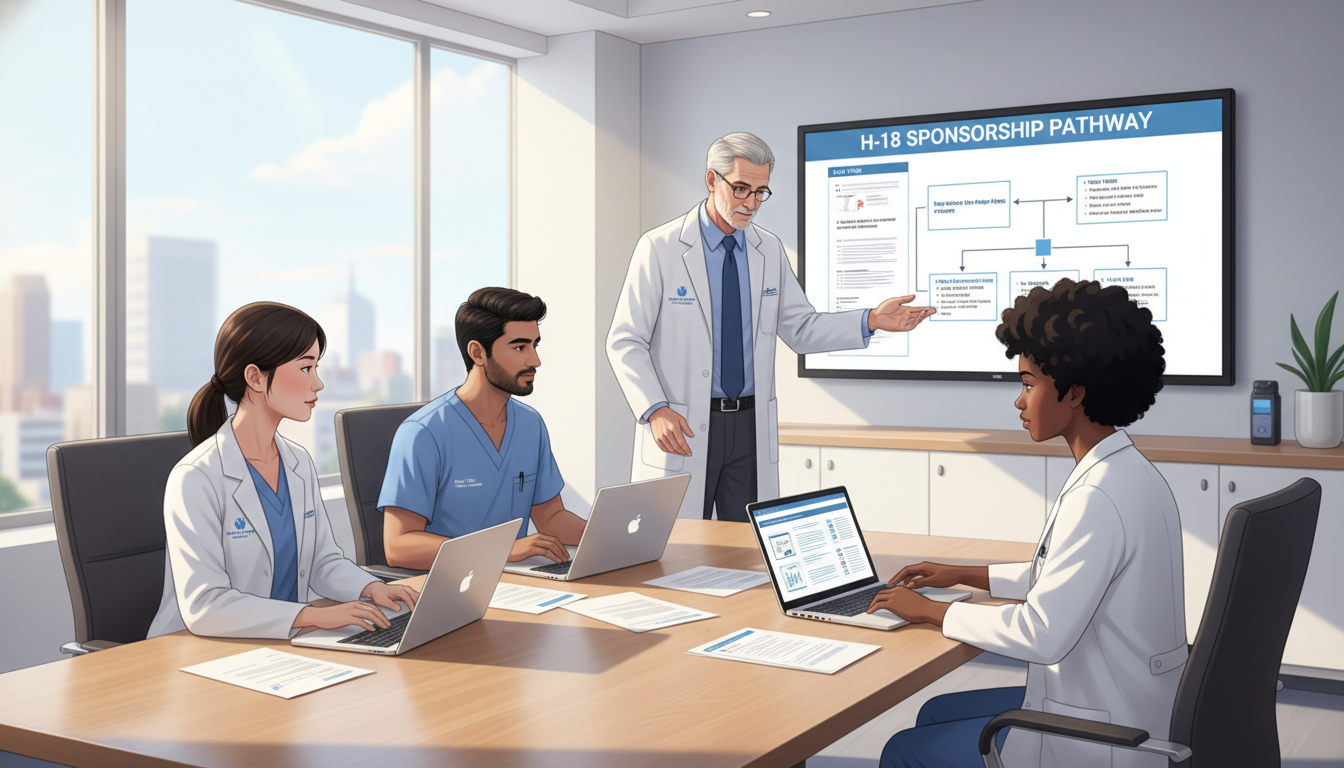
- Practical steps to target H-1B–friendly programs
- How to interpret and use an H-1B sponsor list (and why you must verify it each year)
By the end, you should understand how to strategically approach H-1B residency applications in the Philadelphia region and how to realistically plan your pathway as an IMG.
Basics of H-1B Sponsorship for Residency
What is an H-1B for Physicians?
The H-1B is a temporary work visa for specialty occupations requiring at least a bachelor’s degree or higher. For physicians, it allows you to:
- Work in a specific residency or fellowship position
- Be paid as an employee (unlike J-1, which is an exchange visitor visa)
- Potentially transition more directly to permanent residency (green card) without the J-1 “home residency” requirement
For graduate medical education (GME), an H-1B is usually requested for clinical training in ACGME-accredited programs, such as internal medicine, surgery, pediatrics, or subspecialty fellowships.
Core Requirements for H-1B in Residency
Most Philadelphia programs that sponsor H-1B visas for IMGs require:
USMLE Exams
- Step 1 and Step 2 CK passed before ranking (ideally on first attempt)
- Step 3 passed BEFORE H-1B petition filing
- Many programs require Step 3 results by rank list deadline
- Some may allow slightly later but before visa filing—always confirm with programs
ECFMG Certification
- Required before residency start date
- You can apply via ERAS before final certification, but you must be certified for H-1B processing and onboarding
State Medical Training License Eligibility
- Pennsylvania State Board of Medicine or Board of Osteopathic Medicine requirements must be met
- Program coordinators and GME offices typically verify this before filing the petition
Sufficient English Language Proficiency
- Usually demonstrated through ECFMG processes and interviews
- Not an explicit H-1B rule, but programs need confidence in your clinical communication
Non–cap-exempt vs. Cap-exempt Status
- Many teaching hospitals are H-1B cap exempt due to their affiliation with universities or nonprofit research institutions
- This is a major advantage for Philadelphia programs serving as H-1B sponsors: they can file H-1Bs year-round, not limited by the general H-1B lottery
H-1B vs. J-1 for IMGs
As an international medical graduate, you must understand the trade-offs:
Advantages of H-1B Residency Programs:
- No 2-year home-country physical presence requirement
- Easier to start certain employment-based green card paths during or soon after training
- Spouses on H-4 may eventually obtain work authorization if you reach specific stages of green card processing
Limitations and Challenges:
- H-1B requires passing Step 3 early, which is demanding while preparing for ERAS
- Not all specialties or programs offer H-1B; some are J-1 only
- Some fellowships may not offer H-1B even if your residency did
- You must remain with the sponsoring employer unless you transfer H-1B
For Philadelphia, the presence of large academic centers increases the availability of J-1 and H-1B, but you still need to be highly selective and well-prepared.
Philadelphia Landscape: Major Systems and Program Patterns
Philadelphia and its surrounding area host multiple academic centers that historically sponsor H-1B for at least some IMGs. While policies may change yearly, understanding the general landscape helps you target the right programs.
Important disclaimer: The information below is a guide based on typical structures and commonly known patterns. Always confirm the current year’s policy directly on each program’s website or via email. Do not rely solely on any static H-1B sponsor list.

1. Penn Medicine (University of Pennsylvania Health System)
Penn Medicine anchors several highly competitive Penn residency programs and fellowships:
- Hospital of the University of Pennsylvania (HUP)
- Penn Presbyterian Medical Center
- Pennsylvania Hospital
- Children’s Hospital of Philadelphia (CHOP – pediatric training, closely affiliated though a separate entity)
Historically, many Penn programs have sponsored both J-1 and H-1B for qualified IMGs. As an IMG residency guide, certain patterns are often reported:
Common characteristics:
- High USMLE score expectations, usually multiple attempts are discouraged
- Very strong emphasis on research and academic potential in many specialties
- Preference for recent graduates or those with advanced clinical/research experience
Potential H-1B–relevant notes (to verify each season):
- Internal medicine, some subspecialties, and certain surgical specialties have, in the past, supported H-1B visas for exceptional candidates
- H-1B guidelines are often published on GME or program-specific pages (check “Visa” or “International Medical Graduates” sections)
Because Penn Medicine and its main hospitals are nonprofit academic institutions, most of their H-1B petitions are H-1B cap exempt, a huge advantage for IMGs who avoid the lottery.
2. Thomas Jefferson University Hospitals / Jefferson Health
Jefferson Health includes:
- Thomas Jefferson University Hospital
- Jefferson Methodist Hospital
- Einstein Medical Center Philadelphia (now part of Jefferson Health)
- Jefferson Health–Northeast, etc.
Historically, several Jefferson residency programs have sponsored H-1B for IMGs in certain specialties. Key points:
- Generally more IMG representation compared to some Ivy-level institutions, depending on program
- Some programs historically accept both J-1 and H-1B; others may be J-1 only
- Einstein Medical Center programs (now under Jefferson) have long been known to match IMGs and have occasionally sponsored H-1B depending on specialty and year
You must check each specific program (e.g., Internal Medicine, Family Medicine, Anesthesiology, General Surgery) for current visa policies.
3. Temple University Health System
Temple University Hospital and related training sites often provide robust clinical exposure, particularly in inner-city and underserved settings.
Past and typical patterns:
- Many programs are IMG-friendly in terms of accepting international graduates with strong applications
- Visa policies vary by program: some may sponsor H-1B, others J-1 only
- Temple is an academic university–affiliated health system, so H-1Bs are usually H-1B cap exempt when they sponsor
Temple can be excellent for IMGs interested in high-acuity medicine, community service, and urban health.
4. Drexel / Tower Health (and Associated Hospitals)
Drexel University historically partnered with different clinical sites (e.g., Hahnemann University Hospital before its closure; now with other affiliated hospitals). In the broader Philadelphia region, Tower Health and other Drexel-affiliated hospitals host GME programs.
Visa sponsorship may vary:
- Some programs historically accepted IMGs with J-1 or H-1B
- Hospital closures and restructuring have changed some affiliations; always verify current status
- Some of these institutions are academic teaching hospitals that may be H-1B cap exempt
5. Children’s Hospital of Philadelphia (CHOP)
For pediatric residency and subspecialty training, CHOP is one of the premier programs in the U.S.:
- Very competitive, but does include IMGs with outstanding backgrounds
- Historically has offered J-1 and sometimes H-1B depending on role/program
- H-1B is more commonly associated with certain fellowships and advanced training roles
If you’re an IMG aiming for pediatrics with H-1B in Philadelphia, you must:
- Achieve top-tier USMLE scores
- Demonstrate strong pediatric research or international pediatric training
- Clarify CHOP’s current visa sponsorship policy for each specific program
How to Identify H-1B-Friendly Philadelphia Programs
Relying on a static “H-1B sponsor list” is risky. Policies change, GME offices update policies, and program leadership transitions can lead to different practices. Use the list only as a starting point, then verify.
Step 1: Use Official Program Websites
For each target program in Philadelphia:
Visit the GME Office or Residency Program webpage
Look for sections titled:
- “International Medical Graduates”
- “Visas” or “Immigration”
- “Eligibility & Requirements”
Look for explicit statements such as:
- “We sponsor J-1 visas through ECFMG and H-1B visas for qualified applicants.”
- “We only sponsor J-1 visas.”
- “We do not sponsor any visas.”
If the website is unclear, proceed to Step 2.
Step 2: Directly Email Program Coordinators
Send a concise, professional email asking about visa policy. For example:
Subject: “Visa Sponsorship Inquiry – [Specialty] Residency Program”
Body (paraphrased):
- Introduce yourself (name, IMG from [country], graduation year)
- State that you’re planning to apply via ERAS for the upcoming cycle
- Ask specifically:
- “Does your program sponsor H-1B visas for residency?”
- “Is USMLE Step 3 required by the rank order list deadline for H-1B consideration?”
- “Are there any recent changes in your visa sponsorship policy?”
Keep it short and respectful; coordinators receive many such queries.
Step 3: Cross-Check with Past Residents and Alumni
Use social media and professional networks:
- LinkedIn: Search “[Program Name] internal medicine resident” or similar
- Alumni pages on department websites
- Physician forums and IMG communities
Look for IMGs who explicitly list “H-1B” or “H1-B sponsored” in their experience, or ask politely via private messages:
- Whether the program sponsored their H-1B
- If policies changed during or after their time
- Any practical tips for H-1B applicants
Example: You find a former internal medicine resident at a Philadelphia hospital who notes “H-1B sponsored resident physician” on LinkedIn. This suggests the hospital has the infrastructure and experience to file physician H-1Bs, even if policies may evolve each year.
Step 4: Understand Hospital-Level vs Program-Level Sponsorship
Even if a hospital appears on an H-1B sponsor list (through USCIS data or commercial databases), this doesn’t guarantee:
- Every residency program there accepts IMGs
- Every program with IMGs also offers H-1B (some may be J-1 only)
- Every year’s intake will include H-1B
Therefore, think of “hospital sponsors H-1B” as meaning:
- The GME office has the capacity and legal experience to file H-1Bs
- Some residency or fellowship roles may use H-1B each year
You still must confirm at the program level.
Strategizing Your Application as an IMG Seeking H-1B in Philadelphia

1. Decide Early: H-1B Only, or J-1 Also?
In planning your residency strategy, ask yourself:
- Are you strictly H-1B only?
- Are you open to both J-1 and H-1B?
- Is your long-term plan strongly dependent on avoiding the J-1 home country requirement?
If you are strictly H-1B-only:
- Your effective program list becomes much smaller
- You must pass Step 3 early (often by December–January of the application year)
- You should apply more broadly to maximize chances
- Philadelphia can be a major cluster of options but should not be your only geographic focus
If you are open to both:
- You can rank both J-1 and H-1B residency programs
- Philadelphia still offers you a strong mix, but you’ll have less pressure regarding Step 3 timing
- You can later explore J-1 waiver and H-1B options after residency
2. Step 3 Timing and Strategy
Most H-1B residency programs require Step 3 before filing the petition. Some will consider you during interviews only if you plan to take Step 3 soon, but many insist on a passed score before ranking.
Practical recommendations:
- Aim to take Step 3 between ERAS submission and interview season (e.g., October–January), or even earlier if possible
- Schedule Step 3 in a state where you meet eligibility requirements (some require a certain amount of postgraduate training or credentials validation)
- Document your Step 3 status clearly in ERAS:
- If scheduled: include the planned date
- Once passed: update the score and mention in communication with H-1B-friendly programs
3. Building a Philadelphia-Focused Program List
Use a three-tier system:
Core H-1B Target Programs (Philadelphia area)
- Programs with explicit website confirmation of H-1B sponsorship
- Programs where current/past residents confirm H-1B use
- Typically Penn, Jefferson, Temple, CHOP, and other academic affiliates where policies align with your profile
Extended H-1B-Friendly Programs (Northeast and nearby states)
- New Jersey, New York, Delaware, Maryland, etc.
- Many IMGs cluster in the Northeast corridor due to dense academic centers and cap-exempt institutions
Safety and Contingency Programs (Including J-1)
- Decide whether you will add J-1 programs as a backup
- Philadelphia still has multiple J-1-heavy programs that are IMG-friendly even if they do not offer H-1B
Target at least 30–50 programs if you are primarily H-1B-focused, including both Philadelphia and other U.S. regions, adjusting based on your competitiveness (scores, YOG, research, etc.).
4. Highlighting Yourself as a Strong H-1B Candidate
Residency programs that sponsor H-1B invest more time, legal resources, and institutional effort. You need to demonstrate you are worth the investment:
Key elements to emphasize:
USMLE Performance
- Strong Step 1/Step 2 CK scores
- Clear evidence of Step 3 completion or schedule
- Minimal or no fails; if any, explained thoughtfully
Clinical Readiness
- US hands-on experience (sub-internships, observerships, externships)
- Strong letters of recommendation from U.S. physicians in your applied specialty
- Evidence of working in high-acuity or academic settings
Academic and Research Credentials
- Publications, posters, QI projects, especially linked to Philadelphia institutions if possible
- Interest in academic medicine, teaching, or quality improvement
Commitment to the Region and Specialty
- Personal statement and interviews should clearly explain:
- Why Philadelphia?
- Why this specialty at this institution?
- How you intend to contribute long term (e.g., research, community health, underserved populations)
- Personal statement and interviews should clearly explain:
Programs want to feel confident you will complete training successfully and add value to their institution during your H-1B period.
H-1B Cap Exempt Status and Long-Term Planning
Many Philadelphia teaching hospitals are H-1B cap exempt because they are:
- Nonprofit entities
- Affiliated with universities or research institutions
- Focused on education and research
Why H-1B Cap Exempt Matters
For you as an IMG:
- Your residency H-1B does not depend on the national H-1B lottery
- The hospital can file your petition any time of year
- You can extend H-1B up to typical maximums (usually 6 years total, sometimes more with green card processing)
However, once you complete residency/fellowship and transition to a private practice or non-academic setting, you may:
- Need to enter the H-1B cap if moving to a standard private employer
- Or remain in a cap-exempt institution for continued flexibility
Planning a Philadelphia-Centered Career Path
A realistic long-term path might look like:
- Residency at a cap-exempt Philadelphia academic hospital on H-1B
- Fellowship at a similar institution (possibly in Philadelphia or another academic center)
- Faculty position or hospitalist role at an academic hospital (still cap exempt)
- Initiate or continue green card process under EB-2/EB-1 categories based on your profile
- After receiving permanent residency, you are no longer constrained by the H-1B cap or NIV limitations
If your goal is eventually to work in private practice in the U.S., you must coordinate with an immigration attorney early in your training so that you do not get “stuck” in cap-exempt settings without a plan.
Practical Tips and Common Pitfalls for IMGs Seeking H-1B in Philadelphia
Practical Tips
Track Policies Annually
- Create a spreadsheet with each Philadelphia program
- Record: visa policy, Step 3 requirement, contacts, and notes from email communications
- Update each cycle as policies can change
Apply Early in ERAS
- Submitting in September with a complete application maximizes your chance for early interview invitations
Use Geographic Advantage
- Once in Philadelphia for interviews, try to schedule multiple interviews in the same region if possible
- Engage with regional IMG networks and hospital tours
Engage Program Directors Professionally
- After you confirm H-1B sponsorship, a short, well-structured email highlighting your strengths and genuine interest can help your application stand out
Consult an Immigration Attorney
- Doing this before Match (or immediately after) helps you avoid rookie mistakes, especially related to:
- H-1B timing
- Dependents (spouse/children)
- Future transitions to other employers or green card strategies
- Doing this before Match (or immediately after) helps you avoid rookie mistakes, especially related to:
Common Pitfalls
Waiting Too Long for Step 3
- Many IMGs miss H-1B opportunities simply by not having Step 3 done early enough
Over-Reliance on Old H-1B Sponsor Lists
- A program that sponsored H-1B in 2018 may now be J-1 only; always verify current policy
Too Narrow Program List
- Applying to only a handful of Philadelphia programs with H-1B and nowhere else is extremely risky unless you are extraordinarily competitive
Ignoring Financial and Processing Timelines
- While the employer covers most H-1B costs, you must be prepared for delays, premium processing decisions, and document collection (e.g., diplomas, ECFMG certificates)
Assuming Fellowship Sponsorship Will Be Automatic
- Some fellowships will not sponsor H-1B even if your residency did; always clarify in advance as you move through training
FAQs: H-1B Sponsorship Programs for IMGs in Philadelphia
1. Which Philadelphia residency programs definitely sponsor H-1B for IMGs?
There is no permanent, official public “H-1B sponsor list” for residency programs that can be fully relied upon year after year. Many Penn residency programs, Jefferson Health programs, Temple University Hospital, CHOP, and other academic centers in the region have historically sponsored H-1B visas for certain specialties and candidates. However, you must check each individual program’s current policy on its website or by direct email, because sponsorship can change with leadership, budgets, and institutional strategy.
2. Do I need USMLE Step 3 before I apply to H-1B programs in Philadelphia?
You can submit your ERAS application without Step 3, but for H-1B residency programs, most Philadelphia institutions will require a passed Step 3 before they can file an H-1B petition, and many require it before ranking you. Practically, if you are targeting H-1B residency programs, plan to complete Step 3 by December–January of the application cycle, and confirm each program’s exact deadline.
3. Are Philadelphia hospitals H-1B cap exempt?
Most major academic and university-affiliated hospitals in Philadelphia are H-1B cap exempt, meaning their physician H-1B petitions are not subject to the annual H-1B lottery. This typically includes large non-profit teaching hospitals tied to universities. Cap-exempt status allows them to file H-1Bs throughout the year, which is particularly beneficial for residency and fellowship training timelines.
4. Should I limit myself only to H-1B residency programs, or also consider J-1 in Philadelphia?
That depends on your long-term goals and risk tolerance. Limiting yourself to only H-1B residency programs significantly narrows your options and increases the risk of not matching, even in a city like Philadelphia with multiple academic centers. Many IMGs choose a mixed strategy: targeting H-1B-friendly programs strongly, while also applying to selected J-1 programs as a backup. If avoiding the J-1 home residency requirement is absolutely critical for you, then a broader national H-1B-focused application (not just Philadelphia) plus early Step 3 becomes essential.
By understanding how H-1B residency programs operate in Philadelphia, carefully verifying sponsorship policies, and strategically planning your USMLE and application timeline, you can position yourself as a strong candidate for competitive training opportunities in this high-yield academic city.