Understanding H‑1B Sponsorship in Neurology Residency
For international medical graduates (IMGs) aiming for neurology residency in the United States, visa strategy is now almost as critical as exam scores. Neurology programs vary widely in their willingness and ability to sponsor an H‑1B visa, and misunderstanding the rules can cost you interviews or even a residency position.
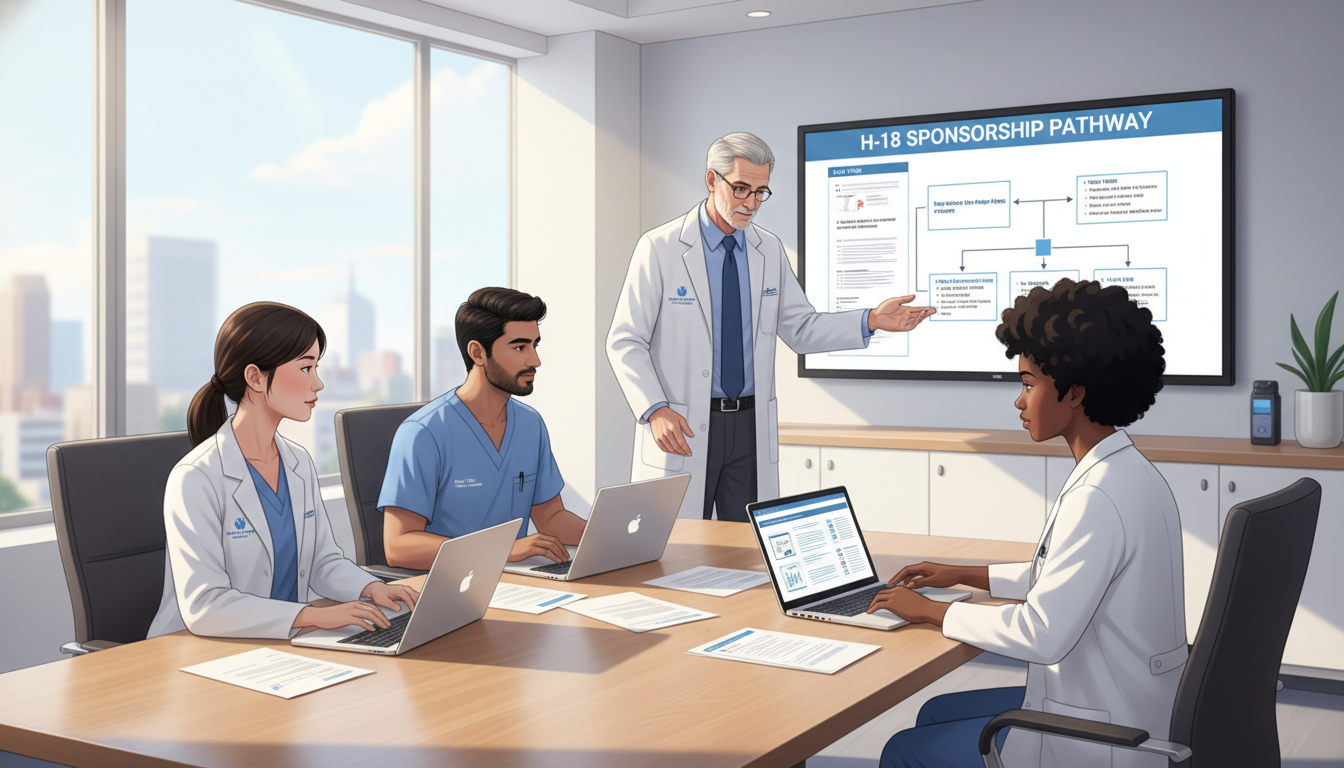
This guide explains how H‑1B sponsorship works specifically for neurology residency, how it differs from the J‑1 route, how to find H‑1B residency programs, and how to create a targeted strategy for the neuro match as an IMG.
We will focus on:
- Key concepts: H‑1B basics, cap vs H‑1B cap exempt, and neurology-specific considerations
- How neurology residency programs view H‑1B vs J‑1
- Building an H‑1B‑focused neuro match list and H‑1B sponsor list
- Application tactics, timelines, and documentation
- Practical scenarios and common pitfalls
1. H‑1B Basics for Neurology Applicants
1.1 What is the H‑1B Visa in the Residency Context?
The H‑1B is a temporary work visa for specialty occupations. For residency and fellowship:
- You are classified as a full‑time employee (house staff), not a trainee on an exchange visa.
- Your neurology residency program is your H‑1B petitioner/sponsor.
- Your status is tied to that specific institution and role.
For neurology residents, the H‑1B is attractive because:
- It does not require a two‑year home country return (unlike many J‑1 visas).
- It can be extended up to 6 years (and beyond in certain green card stages), giving continuity through residency and fellowship.
- It aligns better with long‑term U.S. career and immigration plans, such as moving into hospitalist neurology, subspecialty practice, or academics.
However, it comes with stringent requirements that directly affect neurology residency eligibility.
1.2 Key Requirements for H‑1B Neurology Residents
Most neurology residency programs that sponsor H‑1B will expect:
USMLE Requirements
- Step 1 and Step 2 CK passed at the time of ranking (many require at the time of interview).
- Step 3 often required before H‑1B petition filing—and some programs require it before ranking you.
- Competitive neurology programs may set minimum score thresholds.
ECFMG Certification
- You must be ECFMG certified (including OET) to start neurology residency.
- Many H‑1B‑friendly neurology programs require certification before ranking you.
Licensure/Permit Eligibility
- States usually require passing Step 3 and ECFMG certification for training permits that are compatible with H‑1B.
- Neurology programs must comply with state medical board rules; in certain states, this makes H‑1B more complicated or delayed.
Employment Relationship
- The neurology residency program (or its parent university/hospital) must:
- Pay a salary meeting prevailing wage standards.
- File a Labor Condition Application (LCA) and H‑1B petition.
- Assume legal/employer responsibilities.
- The neurology residency program (or its parent university/hospital) must:
This means that not all neurology programs can or will sponsor H‑1B, even if they welcome IMGs on J‑1.
2. H‑1B vs J‑1 in Neurology: Pros, Cons, and Program Perspectives
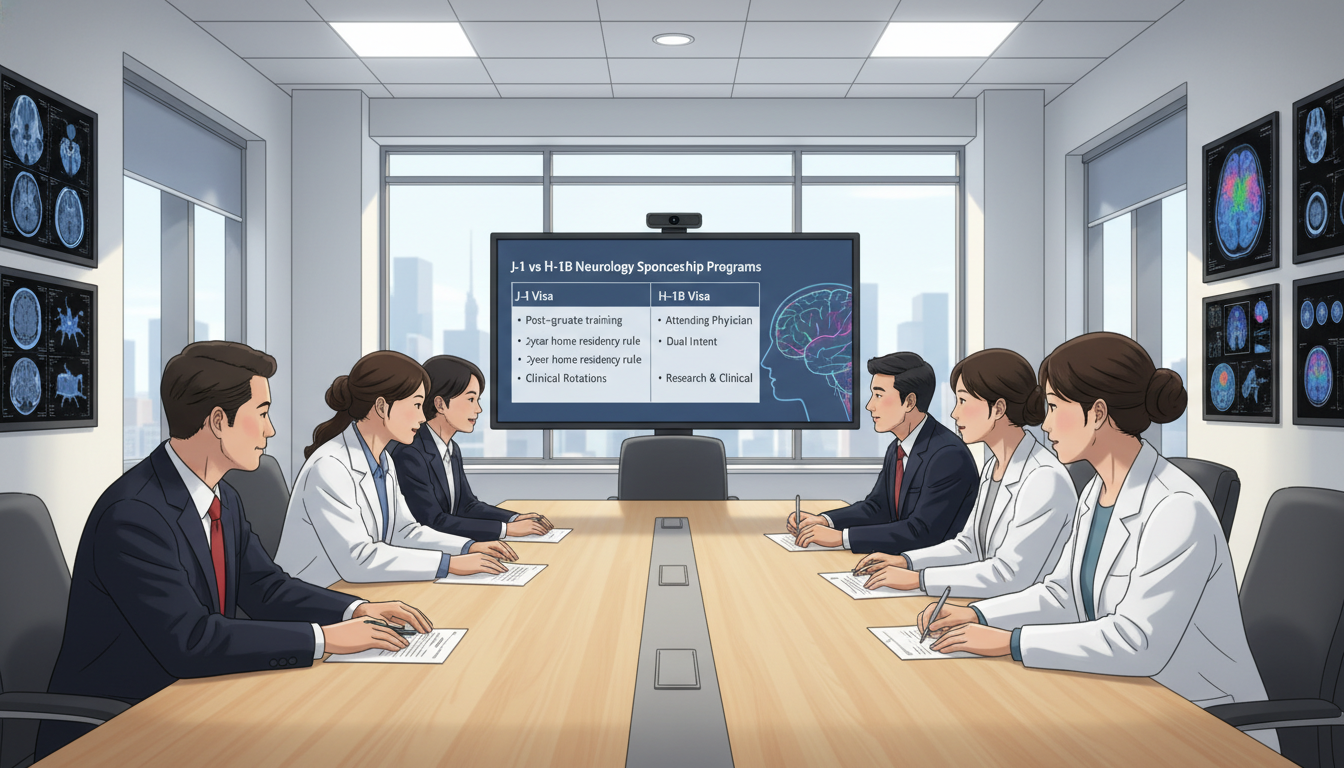
2.1 How Neurology Programs View J‑1 vs H‑1B
From a program director’s perspective:
J‑1 Visa (via ECFMG)
- ECFMG handles most regulatory issues.
- Program is relatively shielded from immigration complexity.
- Widely accepted and familiar, especially in neurology.
- Often preferred when programs are neutral about visa types.
H‑1B Visa
- Requires more institutional legal and HR involvement.
- Higher administrative cost (attorney fees, filing fees, internal approvals).
- Must ensure compliance with wage and employment rules.
- Often restricted by university or hospital policy, not just PD preference.
As a result:
- Many neurology programs are J‑1 only.
- A smaller but significant group are “J‑1 preferred, H‑1B considered in exceptional cases.”
- A subset, often large academic centers, are consistently H‑1B‑friendly and H‑1B cap exempt.
2.2 Pros and Cons for the Applicant
Advantages of H‑1B for Neurology Residents
No J‑1 two‑year home requirement
You are not forced to return home or obtain a J‑1 waiver to stay in the U.S. after training.Cleaner transition to fellowships and jobs
- Easier to transition to an H‑1B‑based neurology fellowship.
- You may continue with the same cap‑exempt employer (university hospital).
- Often simpler for long‑term U.S. careers in neurology.
Pathway toward Green Card
- Many academic neurology departments sponsor EB‑2 or EB‑1 green cards.
- H‑1B allows dual intent (you can pursue permanent residency without violating status).
Disadvantages/Challenges
Step 3 requirement:
You must pass Step 3 earlier, usually before rank list or at least before H‑1B filing. This compresses your preparation timeline.Limited neurology residency options:
Many programs will not sponsor H‑1B, reducing your application pool.Up‑front complexity and cost:
- Programs may hesitate due to legal fees.
- Some institutions require applicants to cover certain expenses (e.g., premium processing)—though paying core filing fees is typically the employer’s responsibility by law.
Less flexibility for transitions during residency:
Mid‑residency transfers or changes in employer can be more complex than with J‑1.
2.3 Neurology-Specific Considerations
Neurology has some distinct trends:
- High IMG representation in many programs, especially community‑based and some university hospitals.
- Growing subspecialty demands (stroke, epilepsy, neurocritical care) create incentives to retain physicians long-term—favorable for H‑1B/green card pathways.
- Academic centers with strong research often host multiple H‑1B physicians and are already H‑1B cap exempt, making repeated sponsorship easier.
This creates a landscape where a subset of neurology residency programs are structurally well-positioned to be H‑1B friendly.
3. Cap vs H‑1B Cap Exempt: Why It Matters for Neurology
3.1 Regular H‑1B Cap vs Cap-Exempt Positions
The standard employment‑based H‑1B is subject to an annual numerical cap (currently 65,000 + 20,000 for U.S. Masters), allocated via a lottery. But most neurology residency positions fall under the H‑1B cap exempt category, which is crucial.
You are H‑1B cap exempt if your employer is:
- A nonprofit institution of higher education, or
- A nonprofit entity affiliated with an institution of higher education, or
- A nonprofit or governmental research organization.
Many U.S. neurology residency programs are based at:
- University hospitals (e.g., “University of X Medical Center”)
- Academic‑affiliated teaching hospitals
- VA hospitals tightly affiliated with universities
These are typically H‑1B cap exempt, meaning:
- No lottery; petitions can be filed any time.
- Higher reliability that you can start neurology residency on time if approved.
However, some neurology residencies are in:
- Community hospitals without strong university affiliation
- For‑profit health systems
Those may not be cap exempt, meaning a new H‑1B would fall into the lottery system, which is extremely risky for residency planning.
3.2 Why IMGs Should Prefer H‑1B Cap Exempt Neurology Programs
When building your neurology H‑1B sponsor list, you should:
- Prioritize cap‑exempt academic neurology programs.
- Clarify whether a community or hybrid program is truly cap exempt or not.
Benefits of targeting H‑1B cap exempt neurology positions:
- No lottery risk: Your ability to start residency depends on approval, not chance.
- Future flexibility: You can move between multiple cap‑exempt employers (e.g., residency → fellowship) more easily.
- Long‑term feasibility: Many academic neurology jobs are also cap exempt, so your visa situation remains more stable over time.
3.3 Example: Two Hypothetical Neurology Programs
University Neurology Residency (Cap Exempt)
- Affiliated with a major university.
- Explicitly states: “We sponsor H‑1B for eligible IMGs; Step 3 required before ranking.”
- You can enter on H‑1B cap exempt, then move to an H‑1B‑based neurocritical care fellowship at another academic center.
Community Neurology Residency (Cap Subject)
- Independent non‑university hospital.
- Offers H‑1B but must enter the regular lottery.
- If your H‑1B is not selected, you cannot start residency as planned.
For neurology IMGs, this difference can determine whether an H‑1B‑based strategy is safe.
4. Building an H‑1B-Focused Neurology Match Strategy
4.1 Decide Early: J‑1 vs H‑1B Goal
Before assembling your neuro match list, decide:
- Are you strongly committed to staying in the U.S. long-term without J‑1 waiver hurdles?
- Are you realistically able to pass Step 3 before rank order list deadlines?
You can still apply broadly, but your primary strategy should lean either:
- H‑1B centric: Prioritize neurology residency programs that sponsor H‑1B and are H‑1B cap exempt.
- Visa flexible: Apply widely to J‑1‑friendly programs and a smaller set of H‑1B sponsors.
For many IMG neurology applicants:
- A hybrid approach is safest: J‑1 + H‑1B applications, clearly signaling to H‑1B‑friendly programs that you meet their criteria.
4.2 Identifying H‑1B Neurology Residency Programs
There is no official central H‑1B sponsor list for neurology, so you must build it manually.
Use multiple sources:
Individual Program Websites
- Look under “International Medical Graduates,” “Eligibility,” or “FAQ.”
- Phrases to look for:
- “We sponsor H‑1B visas for eligible candidates.”
- “Step 3 required for H‑1B.”
- “We only sponsor J‑1 visas via ECFMG.”
FREIDA (AMA Database)
- Many neurology programs indicate visa types they accept.
- Cross‑check data with program websites (FREIDA can be outdated).
Program Coordinator Emails
- Send a brief, professional email:
- Confirm whether they sponsor H‑1B.
- Ask if they require Step 3 by the time of ranking.
- Clarify H‑1B cap exempt status, if unclear.
- Send a brief, professional email:
Current Residents and Alumni
- Look at program resident rosters.
- Use LinkedIn or Doximity to see if neurology graduates are on H‑1B or have transitioned to H‑1B jobs.
Institutional Policies
- Some universities publish a general GME visa policy listing acceptable visa categories across specialties.
Create a spreadsheet with columns:
- Program name and ACGME ID
- Institution type (university, community, hybrid)
- Visa policy (J‑1 only / H‑1B + J‑1 / case‑by‑case)
- Step 3 requirement (when)
- H‑1B cap exempt? (Y/N/unclear)
- Notes & last confirmed date
This becomes your personalized H‑1B sponsor list for neurology residency.
4.3 How Many H‑1B-Friendly Neurology Programs to Target?
If your profile is strong (high USMLE scores, recent clinical experience, strong letters):
- Aim to include at least 20–30 neurology residency programs that have historically sponsored H‑1B.
If your profile is moderate:
- Combine:
- 10–20 clearly H‑1B‑friendly neurology programs
- A broader set of J‑1‑friendly programs, being honest about your visa flexibility.
The goal is to balance ambition and realism: prioritize neurology programs where H‑1B is feasible, but don’t over‑restrict your options.
4.4 Timing and Step 3 Strategy
Because H‑1B sponsorship often hinges on Step 3:
- Plan to take USMLE Step 3 at least 6–9 months before residency start, ideally before or during application season.
- If you’re entering the neuro match in September:
- Taking Step 3 by June–August of the prior year is ideal, so you can include “Step 3 passed” in your ERAS.
If Step 3 results are pending:
- Some programs will still interview and rank you with a contingency.
- Others will not consider H‑1B at all until they see a passing score.
5. Strengthening Your Application for H‑1B Neurology Programs

5.1 Highlighting Neurology Commitment
H‑1B‑sponsoring neurology programs often invest more administrative resources into visa processing. They want reassurance that:
- You are deeply committed to neurology.
- You are likely to complete residency and pursue a neurology career, not switch specialties.
Ways to show this:
- Neurology-related electives in U.S. hospitals (especially at academic centers).
- Substantial neurology or neuroscience research, with posters or publications.
- Strong neurologist letters of recommendation (ideally at least one U.S. letter).
- A personal statement that clearly explains:
- Why neurology specifically
- Your long‑term goals within neurology (e.g., epilepsy, stroke, movement disorders)
- Why training in the U.S. academic system matters for those goals
5.2 Communicating About Visa Status in ERAS
In ERAS:
- Answer visa questions honestly and clearly:
- “Will you require visa sponsorship?” → Yes.
- Specify prior U.S. visa history accurately (F‑1, J‑1, B‑1/B‑2, etc.).
In your personal statement or CV, you do not need to lead with visa needs. But in follow‑up emails or interviews with H‑1B‑friendly programs, it is appropriate to say:
- You already passed Step 3 (if true).
- You are familiar with H‑1B requirements and appreciate programs that support this path.
- You intend to stay in neurology long‑term in the U.S.
5.3 Visa Questions in Neurology Residency Interviews
Common interview questions or topics:
- “What is your visa status?”
- “Are you open to J‑1, or are you only seeking H‑1B?”
- “When did you/when will you take Step 3?”
Tips:
Be transparent but flexible where possible:
- If you prefer H‑1B but are open to J‑1 for the right program, say so clearly.
- If you must have H‑1B (due to personal or legal reasons), explain calmly and briefly without sounding demanding.
Reassure programs that you understand:
- H‑1B sponsorship is a significant institutional commitment.
- You have done your homework and will cooperate with administrative steps.
6. Practical Scenarios and Common Pitfalls
6.1 Scenario 1: IMG on F‑1/OPT Seeking Neuro H‑1B
You are graduating from a U.S. medical school on F‑1 visa with OPT and applying to neurology residency:
- You may start PGY‑1 on OPT, then convert to H‑1B for later years.
- Many academic neurology programs are comfortable with this pathway.
- Ensure your school’s international office and neurology GME office coordinate timelines.
6.2 Scenario 2: IMG on J‑1 Research Looking to Switch to H‑1B Residency
If you are currently in the U.S. on J‑1 for research, you must be cautious:
- Many J‑1 research visas carry the two‑year home requirement (212(e)).
- If subject to 212(e), you typically cannot change to H‑1B without:
- Spending two years in your home country, or
- Obtaining a J‑1 waiver (which is often tied to clinical J‑1, not research, and can be complex).
Before investing heavily in an H‑1B neurology strategy, consult an experienced immigration attorney to clarify your 212(e) status.
6.3 Scenario 3: Ranking Neurology Programs with Mixed Visa Policies
You receive interviews from:
- 4 neurology programs that openly sponsor H‑1B, cap exempt
- 6 J‑1‑only programs
- 3 programs that are “J‑1 preferred, rare H‑1B”
Ranking strategy:
- Place your most desirable H‑1B cap exempt neurology programs at the top, if they are good training environments.
- Consider where J‑1 may still work for your long‑term goals (e.g., if they’re in states with strong J‑1 waiver opportunities for neurology after residency).
- For mixed‑policy programs, clarify:
- Have they actually sponsored H‑1B for neurology residents in recent years?
- Or is H‑1B only used for attendings?
Use this information to build a rank list that aligns with both training quality and visa reliability.
6.4 Common Mistakes to Avoid
Assuming all university neurology programs sponsor H‑1B
Some are J‑1 only despite being academic centers.Taking Step 3 too late
Delaying Step 3 until after match makes you uncompetitive for many H‑1B neurology programs.Relying on outdated information
Visa policies change. Confirm every year, especially after major political or institutional shifts.Over‑restricting your options
Applying only to a handful of H‑1B‑friendly programs can be risky. Balance with high‑quality J‑1 options if your priority is to match into neurology.Not considering long‑term geography
If you choose J‑1, think about where neurology J‑1 waiver jobs are more available (e.g., underserved regions, smaller cities).
FAQs: H‑1B Sponsorship in Neurology Residency
1. Do most neurology residency programs sponsor H‑1B visas?
No. A minority of neurology residency programs sponsor H‑1B visas. Most are J‑1 only for IMGs, often due to institutional GME policies or administrative burden. However, among larger academic neurology departments—especially those affiliated with major universities—H‑1B residency programs are more common, and many are H‑1B cap exempt, which is advantageous.
2. Is USMLE Step 3 mandatory for H‑1B neurology residency?
In practice, yes for most programs. Many neurology programs that offer H‑1B sponsorship require a passing Step 3 score before they file the H‑1B petition, and some require it before ranking you in the neuro match. A few may allow you to match with Step 3 pending, but they will set a strict deadline for passing before your start date. If you are targeting H‑1B sponsorship programs in neurology, plan to complete Step 3 before or early in the application cycle.
3. How can I find out if a neurology program is H‑1B cap exempt?
Check:
Institution type:
- University or university‑affiliated hospitals are usually cap exempt.
- Standalone community or for‑profit hospitals may not be.
Program or GME website:
- Some explicitly state “cap exempt” or describe affiliation with a university.
Direct communication:
- Email the program coordinator or GME office and ask:
- “Are your H‑1B neurology resident positions considered H‑1B cap exempt?”
- Email the program coordinator or GME office and ask:
Most neurology residency H‑1B positions at academic centers are indeed cap exempt, but verifying this reduces the risk of surprises.
4. If I match into neurology on J‑1, can I later switch to H‑1B for fellowship?
Often, yes—but it depends on your J‑1 status and waiver strategy. Typically:
- During neurology residency, you remain on J‑1 via ECFMG.
- To switch to H‑1B after residency, you usually need to:
- Obtain a J‑1 waiver job (commonly in underserved areas for certain specialties) and enter on H‑1B, or
- Complete your two‑year home country requirement.
For neurology, waiver opportunities exist but may be more limited and location‑dependent compared to primary care. If an H‑1B pathway is crucial for you, it is better to plan for H‑1B from the start of residency where possible, especially through H‑1B cap exempt academic neurology programs.
By understanding how H‑1B sponsorship intersects with neurology residency, the neuro match, and institutional policies, you can create a focused, realistic plan. Identify genuine H‑1B residency programs, verify H‑1B cap exempt status, time your Step 3 strategically, and communicate clearly with programs. With this structured approach, H‑1B sponsorship can become an achievable, not mysterious, part of your neurology career path in the United States.