
Understanding H-1B Sponsorship for Non-US Citizen IMGs in the US-Mexico Border Region
For a non-US citizen IMG aiming to train in the United States, the US-Mexico border region—particularly South and West Texas—offers unique opportunities. This area combines heavy clinical demand, large Spanish-speaking populations, and a growing ecosystem of academic and community programs that may be open to H-1B sponsorship.
H-1B residency programs are not the majority in the US, but the border region includes several institutions that have historically sponsored H-1B visas for residency or fellowship, especially for hard-to-fill specialties and locations. Understanding how these programs work, what “H-1B cap exempt” means, and how to strategically target border region residency programs is essential for a foreign national medical graduate who wants to avoid or transition away from J-1 constraints.
Below is a structured roadmap tailored specifically for non-US citizen IMGs interested in Texas border residency and other US-Mexico border region training opportunities with H-1B sponsorship.
1. Core Concepts: H-1B Visa Basics for IMGs
1.1 What is an H-1B for Residency?
The H-1B is a temporary work visa for specialty occupations, including physicians in US graduate medical education (GME). For residency and fellowship, H-1B sponsorship means:
- You are employed directly by the hospital or university
- You receive a prevailing wage for your position
- You are not bound by the J-1 two-year home residency requirement
- You may later transition more easily to employment-based green card pathways
For a non-US citizen IMG, holding an H-1B during residency can:
- Simplify future job searches, since many employers already know this category
- Allow easier transitions to H-1B transfer or permanent residency (EB-2/EB-3) after training
- Avoid the complexities of J-1 waivers (e.g., Conrad 30, hardship, persecution)
However, not all residency programs sponsor H-1B visas, and those that do often have very specific policies.
1.2 Cap-Subject vs H-1B Cap-Exempt
The term H-1B cap exempt is crucial for residency applicants:
- The usual H-1B category has an annual numerical cap (65,000 + 20,000 for US master’s and above) and a competitive national lottery.
- Cap-exempt H-1B means the position is not counted against this cap, and you can bypass the lottery.
Most university-affiliated teaching hospitals, especially in the Texas border residency ecosystem, are cap exempt because they are:
- Institutions of higher education
- Non-profit entities related or affiliated to higher education
- Non-profit research organizations
For you as a foreign national medical graduate, this means:
- You do not depend on the national cap lottery for your residency H-1B.
- You can often start on time in July if the petition is filed correctly and early.
- Later, if you move to a non–cap-exempt employer (e.g., private practice), you may then need to enter the regular H-1B lottery unless your future employer is also cap exempt.
1.3 Common Eligibility Requirements for H-1B Residency
While details vary by program, many H-1B residency programs require:
- USMLE Step 1 and Step 2 CK passed (often with minimum score thresholds)
- USMLE Step 3 completed and passed before H-1B petition filing (some require it before ranking)
- ECFMG certification
- A valid medical license or training license in the state (for Texas, often a Physician-in-Training [PIT] permit)
- Evidence that the candidate is not subject to a J-1 two-year home residency requirement (or that it has been properly waived, if applicable)
Because Step 3 and licensing take time, H-1B strategies usually require you to plan at least 12–18 months ahead of your target Match.
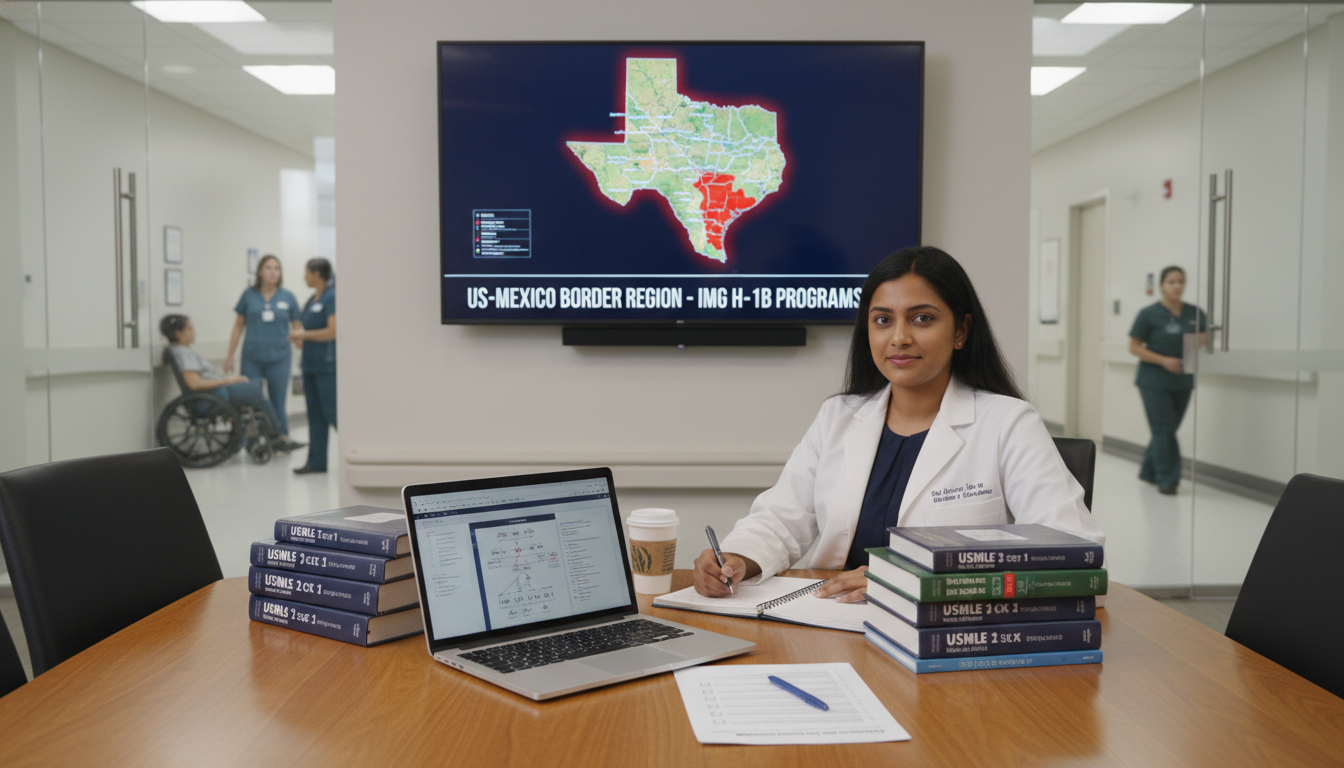
2. Why the US-Mexico Border Region is Unique for H-1B Sponsorship
2.1 High-Need, Underserved Areas
The US-Mexico border region, especially in Texas (e.g., El Paso, Laredo, McAllen, Brownsville, Harlingen), is characterized by:
- Medically underserved populations
- High proportions of Spanish-speaking patients
- Significant poverty and chronic disease burdens
- Persistent physician shortages, especially in primary care and certain specialties
Because of this, border region residency programs often:
- Have a strong need for reliable, long-term physicians
- Value IMGs with bilingual skills (English-Spanish) and cross-cultural competence
- May be more open to non-US citizen IMG applicants willing to commit to the region
These pressures can make some border programs more flexible or motivated to maintain H-1B sponsorship policies, particularly for candidates who show genuine commitment to the community.
2.2 Types of Programs in the Border Region
In the US-Mexico border region, you will typically find:
- University-based programs (e.g., part of UT System, Texas Tech)
- Community-based programs with university affiliation
- VA hospitals coupled with academic centers
- Newer residency programs created to meet local needs
Many of these institutions are non-profit and academically affiliated, making them good candidates for H-1B cap exempt status.
Examples (for orientation only—always verify current policies):
- Academic centers in El Paso
- Institutions in the Rio Grande Valley (McAllen, Harlingen, Brownsville)
- Programs linked with University of Texas–affiliated campuses
- Some Texas Tech–affiliated training sites
Program policies change frequently; do not rely on any static H-1B sponsor list you find online. Instead, treat it as a starting point, then verify directly with program coordinators or GME offices.
2.3 Border Region Advantages for Non-US Citizen IMGs
As a foreign national medical graduate considering Texas border residency or other US-Mexico border programs, you may benefit from:
- Linguistic alignment: Spanish fluency is a strong advantage and often a deciding factor.
- Mission fit: Programs value applicants who understand border health, migrant health, and binational health systems.
- Stronger IMG presence: Many border programs have a higher proportion of IMGs and may be more familiar with visa processes.
- Potential long-term pathways: Underserved areas may provide better chances for post-training employment and immigration sponsorship.
3. Identifying and Evaluating H-1B-Friendly Programs in the Border Region
3.1 How to Build Your Target List
There is no single official, up-to-date H-1B sponsor list specific to the US-Mexico border region. You will need to create your own H-1B sponsor list using multiple sources:
FREIDA (AMA) and Residency Explorer
- Search by region (Texas, New Mexico, Arizona, California) and then focus on border counties/cities.
- Review whether they accept non-US citizen IMG and whether they mention visa types.
Program Websites
- Navigate to “International Medical Graduates,” “Visa Policy,” or “FAQ” sections.
- Look for language such as “We sponsor H-1B visas” or “We sponsor J-1 only.”
Email or Call Programs
- Write a very concise, professional email to the program coordinator or GME office:
- Introduce yourself briefly
- State that you are a non-US citizen IMG
- Ask specifically if they sponsor H-1B visas for residency and whether Step 3 is required before ranking or before visa filing.
- Write a very concise, professional email to the program coordinator or GME office:
Network with Current Residents
- Use LinkedIn, program Instagram/Facebook pages, or alumni listings.
- Ask residents (especially those with foreign backgrounds) about:
- Current visa policies
- Whether any co-residents are on H-1B
- Any recent changes in policy
Past Match Data
- Where possible, see if Match lists or alumni pages show residents from your home country or other IMGs who may have required visas.
3.2 Red Flags and Green Flags in Program Policies
Green flags for an H-1B-seeking non-US citizen IMG:
- Clear statement: “We sponsor both J-1 and H-1B visas.”
- Mention of H-1B cap exempt or “university-affiliated H-1B positions.”
- History of residents who are foreign national medical graduates holding H-1B.
- Well-structured GME office with designated visa/immigration contact.
Red flags:
- “J-1 visa only” or “We do not sponsor H-1B.”
- Vague statements about “visa support” but no explicit mention of H-1B.
- Programs that used to sponsor H-1Bs but have recently stopped due to institutional policy or cost.
3.3 Example: Evaluating a Texas Border Residency Program
Imagine you’re reviewing a hypothetical Internal Medicine residency in a Texas border city:
- Website says:
- “We sponsor J-1 visas through ECFMG and may sponsor H-1B visas on a case-by-case basis.”
- Email reply from the coordinator:
- Confirms they can sponsor H-1B, but:
- Requires USMLE Step 3 passed before ranking
- Prioritizes candidates “fluent in Spanish”
- Confirms they can sponsor H-1B, but:
- Resident feedback:
- Confirms that 2 current residents are on H-1B
- States that the program is “supportive but strict with Step 3 timing”
This hypothetical program would be H-1B possible but competitive, with strong incentives for Spanish-speaking IMGs who can have Step 3 done early.
4. Step-by-Step Strategy to Secure an H-1B Residency in the Border Region
4.1 Timeline Planning
For a non-US citizen IMG targeting Match Year X:
18–24 months before Match:
- Pass USMLE Step 1 and Step 2 CK
- Start or complete US clinical experience if possible
- Begin Spanish improvement (if needed), especially medical Spanish
- Research border region residency and build initial H-1B sponsor list
12–18 months before Match:
- Take and pass USMLE Step 3 (ideally before ERAS opens)
- Obtain ECFMG certification
- Finalize your CV and personal statement, emphasizing:
- Commitment to border/underserved communities
- Spanish or bilingual skills
- Long-term interest in staying in the region
ERAS season (September–February):
- Apply broadly to border region programs that:
- Accept IMGs
- State or confirm H-1B sponsorship availability
- Send tailored communications to programs explaining:
- Why you are specifically interested in that border region
- Your language and cultural competencies
- During interviews, ask carefully phrased questions about visa policies.
Post-Match (if matched to an H-1B program):
- Work closely with the GME office and their immigration counsel
- Provide Step 3 scores report, ECFMG cert, and licensing documents promptly
- Ensure H-1B petition is filed early enough for July 1 start
4.2 Strengthening Your Profile for Border Region Programs
To stand out among non-US citizen IMG applicants:
Highlight Spanish and Cross-Cultural Skills
- Include any Spanish courses, certifications, or experience serving Spanish-speaking communities.
- In your personal statement, describe specific experiences with Latino or border populations.
Demonstrate Long-Term Commitment
- Border region programs are wary of applicants who see them as a “stepping stone” only.
- Mention interest in future primary care, hospital medicine, or specialty practice in underserved areas.
- Show awareness of local health issues (e.g., diabetes, obesity, migrant health, TB, maternal-child health, etc.).
Be Step 3 Ready
- Have Step 3 passed by the time you apply if your goal is H-1B.
- If not possible, at least signal a realistic plan and timeline to take it before ranking deadlines (but remember many programs will prefer completed Step 3).
Clinical and Research Experiences
- US clinical experience in safety net hospitals, community health centers, or border-like settings is a major plus.
- Any research or quality improvement projects related to:
- Health disparities
- Access to care
- Chronic disease in Hispanic or immigrant populations
4.3 Communicating About H-1B During Interviews
Many IMGs are nervous about discussing visas. The goal is to be transparent but strategic.
Recommended approach:
- Before the interview day, know the program’s official stance (from website or email).
- During the interview, ask a neutral, non-confrontational question like:
- “I am a non-US citizen IMG and will require visa sponsorship. Could you share how the program typically handles visas for residents?”
- If they mention H-1B:
- Follow-up gently:
- “Does the program currently sponsor H-1B visas for categorical residents?”
- “Is there any preference for applicants who already have Step 3 completed?”
- Follow-up gently:
Avoid sounding as if you care only about the H-1B. Combine your visa questions with strong expressions of interest in:
- Their patient population
- Training style
- Mentorship, research, or long-term practice opportunities locally
5. Practical Realities and Pitfalls of H-1B Sponsorship in the Border Region
5.1 Common Challenges
Institutional Policy Changes
- A Texas border residency program that sponsored H-1B last year might stop this year due to:
- Budgetary concerns
- Legal or HR policy shifts
- Administrative turnover
- Always verify for the current cycle.
- A Texas border residency program that sponsored H-1B last year might stop this year due to:
Step 3 Timing
- Many H-1B residency programs insist on Step 3 before ranking because:
- It simplifies the H-1B application
- It helps with state licensing requirements
- Delays in exam dates, results, or ECFMG processes can derail H-1B plans.
- Many H-1B residency programs insist on Step 3 before ranking because:
Licensing and Credentialing Delays
- Some border region states (including Texas) have detailed licensing rules.
- You may need notarized diplomas, transcripts, and translations—prepare these months in advance.
Dependents and Family Considerations
- H-1B holders’ spouses and children use H-4 status.
- Consider:
- School timelines if you have children
- Whether your spouse will need work authorization (H-4 EAD) (rules can change; check current regulations and seek legal advice)
5.2 Balancing J-1 vs H-1B in Your Strategy
While your focus is H-1B, you may not want to completely exclude J-1 opportunities during the Match, especially in high-quality border region residency programs that:
- Offer strong training
- Have good track records of helping IMGs secure J-1 waivers afterward (e.g., via Conrad 30 in Texas or neighboring states)
A pragmatic strategy for a non-US citizen IMG could be:
- Apply to a core group of H-1B-friendly Texas border residency programs.
- Also apply to select J-1-only programs that:
- Fit your long-term goals
- Are in or near the border region where future J-1 waiver jobs are likely to exist
- After interviews, decide how strongly to rank H-1B vs J-1 programs based on:
- Your visa preferences
- Quality of training
- Long-term job prospects
5.3 After Residency: Transitioning from H-1B in the Border Region
If you complete residency or fellowship on an H-1B in a border region:
- You may continue working for a cap-exempt employer (university, VA, or non-profit hospital) in the region with an H-1B extension or transfer.
- If you want to move to a private practice or for-profit hospital, you might need:
- To enter the H-1B lottery (if not in cap-exempt environment)
- Or find another cap-exempt employer (e.g., FQHC, academic affiliate) close to the border.
Many border communities have federally qualified health centers (FQHCs) and safety-net institutions that are cap exempt and may also sponsor H-1Bs or even permanent residency. This can make the region attractive for long-term career planning.
6. Action Plan Checklist for Non-US Citizen IMGs Targeting H-1B in the Border Region
Use this as a practical, sequential guide:
Clarify Your Goals
- Decide if H-1B is a must-have or a strong preference.
- Determine if you are willing to consider J-1 programs as a backup.
Academic and Exam Preparation
- Ensure competitive USMLE Step 1 and Step 2 CK scores.
- Schedule Step 3 early—ideally 12–18 months before Match year.
Credential and Document Preparation
- Obtain and secure:
- Medical school diploma and transcripts
- ECFMG certification
- Translations and notarizations as needed
- Research Texas medical board requirements for trainees.
- Obtain and secure:
Build Your Border Region H-1B Sponsor List
- Focus on:
- Texas border residency programs (Internal Medicine, Family Medicine, Pediatrics, Psychiatry, etc.)
- Other border states (NM, AZ, CA) if relevant.
- Confirm:
- Whether they sponsor H-1B
- Any Step 3 or licensing prerequisites
- Their stance toward non-US citizen IMG applicants
- Focus on:
Optimize Your Application Materials
- Personal statement:
- Emphasize border health interest, Spanish skills, underserved care.
- CV:
- Highlight relevant clinical experiences, especially with Hispanic communities.
- Letters of recommendation:
- Preferably from US physicians familiar with border/underserved settings.
- Personal statement:
Apply Strategically via ERAS
- Apply early in September.
- Tailor program-specific communications to high-priority border programs.
Interview Strategy
- Prepare to discuss:
- Why border medicine appeals to you
- How your background benefits their patient population
- Your long-term intent to practice in underserved areas
- Ask precise but respectful visa questions.
- Prepare to discuss:
Post-Match Visa Process
- If matched to an H-1B program:
- Respond immediately to requests from GME/HR.
- Provide all documents quickly to avoid delays.
- If matched to a J-1 program (by choice or necessity), begin planning your J-1 waiver strategy early if you still aim to remain in the region long term.
- If matched to an H-1B program:
FAQs: H-1B Sponsorship Programs for Non-US Citizen IMGs in the US-Mexico Border Region
Q1. Is it realistic for a non-US citizen IMG to match into an H-1B residency in the US-Mexico border region?
Yes, it is realistic, but competitive and requires careful planning. The border region has multiple H-1B-friendly institutions, especially large academic and community teaching hospitals in Texas. You must prioritize early Step 3 completion, strong clinical credentials, and a clear commitment to border and underserved populations.
Q2. Do all Texas border residency programs sponsor H-1B visas?
No. Some Texas border residency programs are J-1 only, some accept both J-1 and H-1B, and a few may not sponsor any visas at all. Policies can change from year to year. Always confirm directly with program websites, coordinators, or GME offices. Never assume sponsorship only because the hospital is academic or in a border area.
Q3. Is H-1B always better than J-1 for IMGs in the border region?
Not always. H-1B avoids the J-1 home residency requirement and can simplify long-term immigration plans, but J-1 can still be an excellent pathway, especially if:
- The program’s training quality is superior
- The region has strong J-1 waiver opportunities after training
- You are prepared to work in a designated underserved area (like many border communities) to satisfy the waiver
Your choice should balance visa preferences with training quality and long-term career goals.
Q4. How can I find an accurate, up-to-date H-1B sponsor list for border region programs?
There is no single official, up-to-date list exclusively for border region residency programs. The most reliable approach is to create your own list by:
- Searching in FREIDA and Residency Explorer
- Reviewing program websites for explicit visa policies
- Emailing or calling programs to confirm H-1B sponsorship
- Talking to current or former residents about their visa statuses
Treat any publicly available lists as historical references, not guarantees, and always verify for the current Match cycle.
By understanding the nuances of H-1B sponsorship, focusing on border-region-specific strengths such as Spanish language skills and commitment to underserved care, and planning early around Step 3 and documentation, a non-US citizen IMG can build a strong, realistic pathway into H-1B residency programs along the US-Mexico border.