Understanding H-1B Sponsorship for Non-US Citizen IMGs in Family Medicine
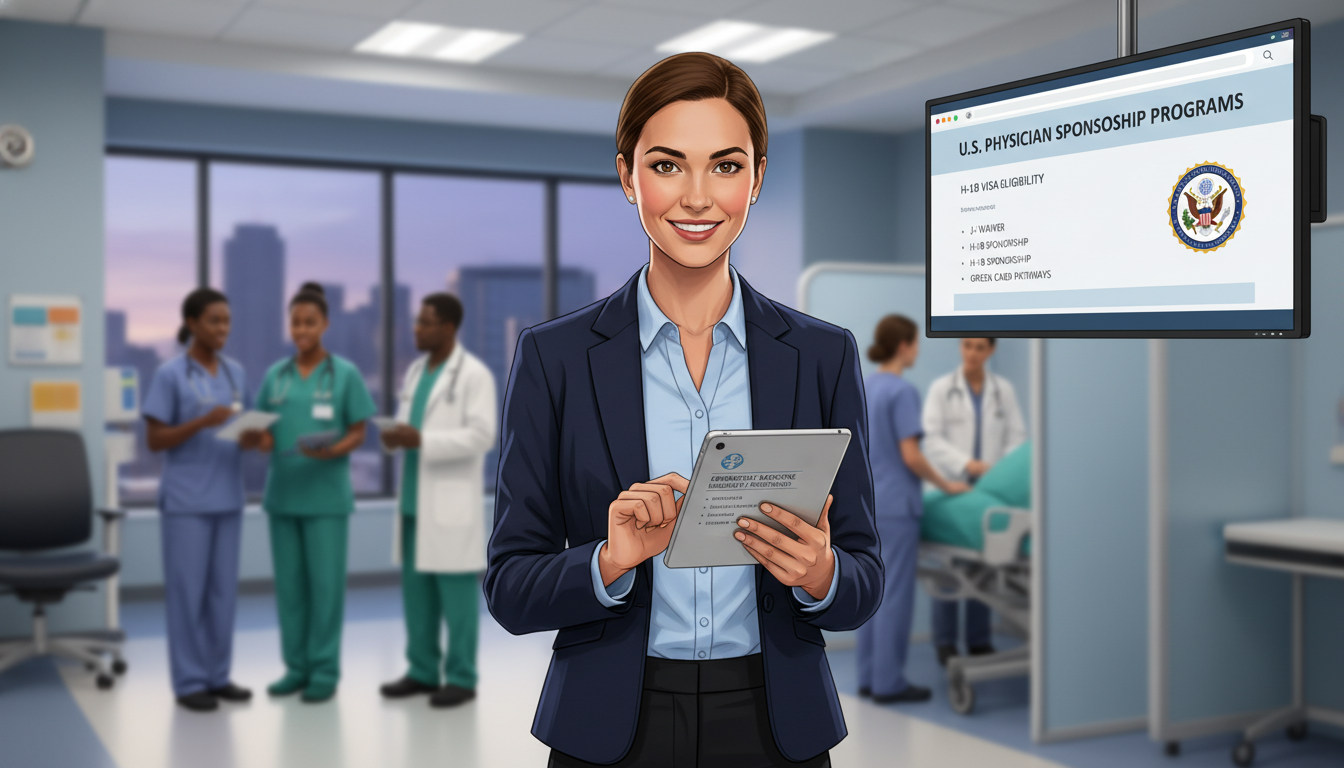
For a non-US citizen IMG (international medical graduate) targeting family medicine residency, the H-1B pathway can be both an opportunity and a source of confusion. Compared with J-1 visas, H-1B offers advantages such as greater flexibility for long-term US immigration planning and no two-year home-country residence requirement. At the same time, H-1B residency programs are fewer, documentation is stricter, and timelines are tighter.
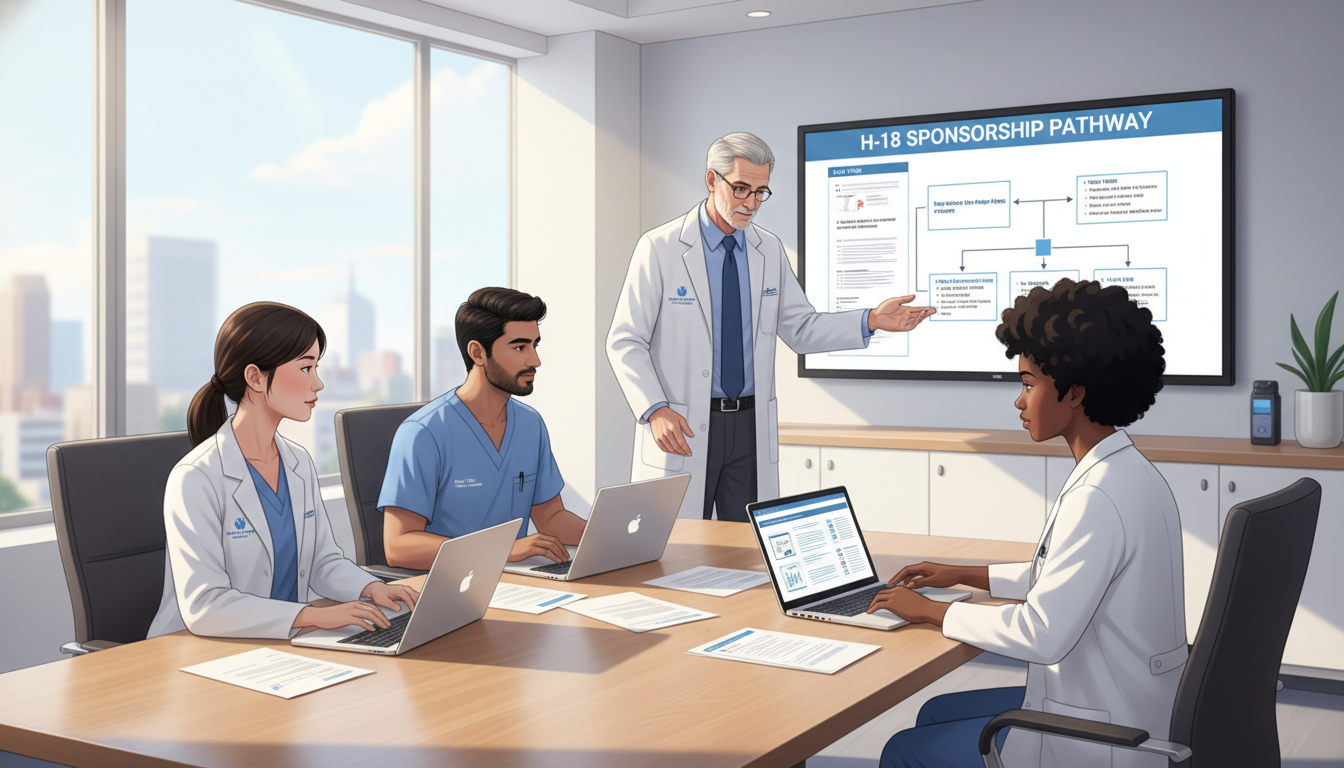
This guide explains how H-1B sponsorship works in the context of family medicine residency, how to identify and evaluate H-1B-friendly programs, and how to position yourself competitively as a foreign national medical graduate. It’s written specifically for non-US citizen IMGs aiming at the FM match.
1. Visa Basics for Family Medicine Residency: Where H-1B Fits In
Before focusing on H-1B residency programs, it’s important to place H-1B in the larger visa landscape.
1.1 Common Visa Types in Residency
For non-US citizen IMGs, three main categories are relevant:
- H-1B (Temporary Worker in Specialty Occupation)
- J-1 (Exchange Visitor, sponsored by ECFMG)
- O-1 (Extraordinary Ability – relatively rare in residency)
In family medicine residency, J-1 is still the default for most programs, but a significant minority will consider or routinely sponsor H-1B. A small number of highly accomplished candidates may qualify for O-1; this article focuses on H-1B.
1.2 Why IMGs Consider H-1B Over J-1
Many foreign national medical graduates prefer H-1B for several strategic reasons:
No 2-year home residence requirement
Unlike J-1, H-1B does not require you to return to your home country for two years after training, nor to obtain a J-1 waiver.More direct path to long-term US practice
You can transition more smoothly to fellowship, attending jobs, and eventually permanent residency.Avoids J-1 waiver constraints
J-1 waiver jobs are often in very specific underserved locations with preset obligations. H-1B allows more flexibility in choosing your first attending position.
However, H-1B sponsorship is not automatically “better” for everyone. There are significant trade-offs.
1.3 Limitations and Challenges of the H-1B Path in Residency
Key challenges specific to H-1B in family medicine residency:
Fewer H-1B residency programs
Many family medicine programs sponsor only J-1, especially smaller community-based residencies.Stricter exam requirements
Most H-1B programs require all USMLE Steps needed for ECFMG certification (Step 1, Step 2 CK, OET, and any evolving requirements) to be completed and reported before ranking, and often Step 3 must be passed before July 1 (some insist on Step 3 before rank order list deadline).Cost and administrative burden for programs
H-1B petitions involve higher legal and filing costs and more paperwork. Programs must be willing and able to handle this.Timing pressure
Your Step 3, ECFMG certification, degree verification, and petition filing all need to align with H-1B start dates.
For a non-US citizen IMG, understanding these constraints early shapes your exam timeline, research strategy, and target program list.
2. H-1B Eligibility Requirements for Family Medicine Residency
To secure H-1B sponsorship as an FM resident, you and the program both must meet specific conditions.
2.1 Basic H-1B Criteria for Physicians
For foreign national medical graduates entering residency, typical H-1B criteria include:
Job in a specialty occupation
Residency training is considered a specialty occupation due to its complexity and educational requirements.Appropriate degree and credentials
- Medical degree equivalent to a US MD/DO
- Official ECFMG certification (or evidence of all components completed and in process, depending on timing)
Required licensure / training permit
- State medical board rules vary, but many states require:
- All USMLE Steps needed for ECFMG certification
- Often USMLE Step 3 for a full license; some allow H-1B on training permits without full Step 3, but many residency programs require Step 3 for H-1B regardless of state rules.
- State medical board rules vary, but many states require:
Employer sponsorship
- The residency program must initiate and support the H-1B petition, including the Labor Condition Application (LCA).
2.2 Common Program-Level Requirements
Family medicine residency programs that support H-1B typically specify their rules clearly on their websites. Common patterns:
Visa type: “We sponsor J-1 and H-1B visas” or “We sponsor J-1 only.”
Step 3 requirement:
- Some: “Step 3 must be passed before ranking.”
- Others: “Step 3 must be passed before May 31” or “before contract start date.”
ECFMG certification:
Required by the start of residency; often needed earlier for H-1B paperwork.Graduation year cutoffs:
Many competitive H-1B programs prefer relatively recent graduates (e.g., within 5–7 years) unless there is strong, continuous US clinical experience.
2.3 H-1B vs J-1 Timeline: Practical Comparison
For a non-US citizen IMG in family medicine, the timeline difference is crucial:
J-1 path:
- No Step 3 required before residency.
- ECFMG issues DS-2019 after program match and contract; visa processing follows.
H-1B path:
- Must complete Step 3 (often by March–April at the latest, depending on program).
- Program files H-1B petition with USCIS after match and contract, often with premium processing.
- Delays in exam results, ECFMG certification, or paperwork can jeopardize your July 1 start.
Actionable advice:
If you are serious about H-1B:
- Schedule USMLE Step 3 as early as realistically possible (ideally before or during interview season) and plan study time before you start applying.
- Confirm state board licensing requirements where your target programs are located.
- Keep your documents (diplomas, transcripts, translations, ECFMG certificates) organized and ready for quick submission.
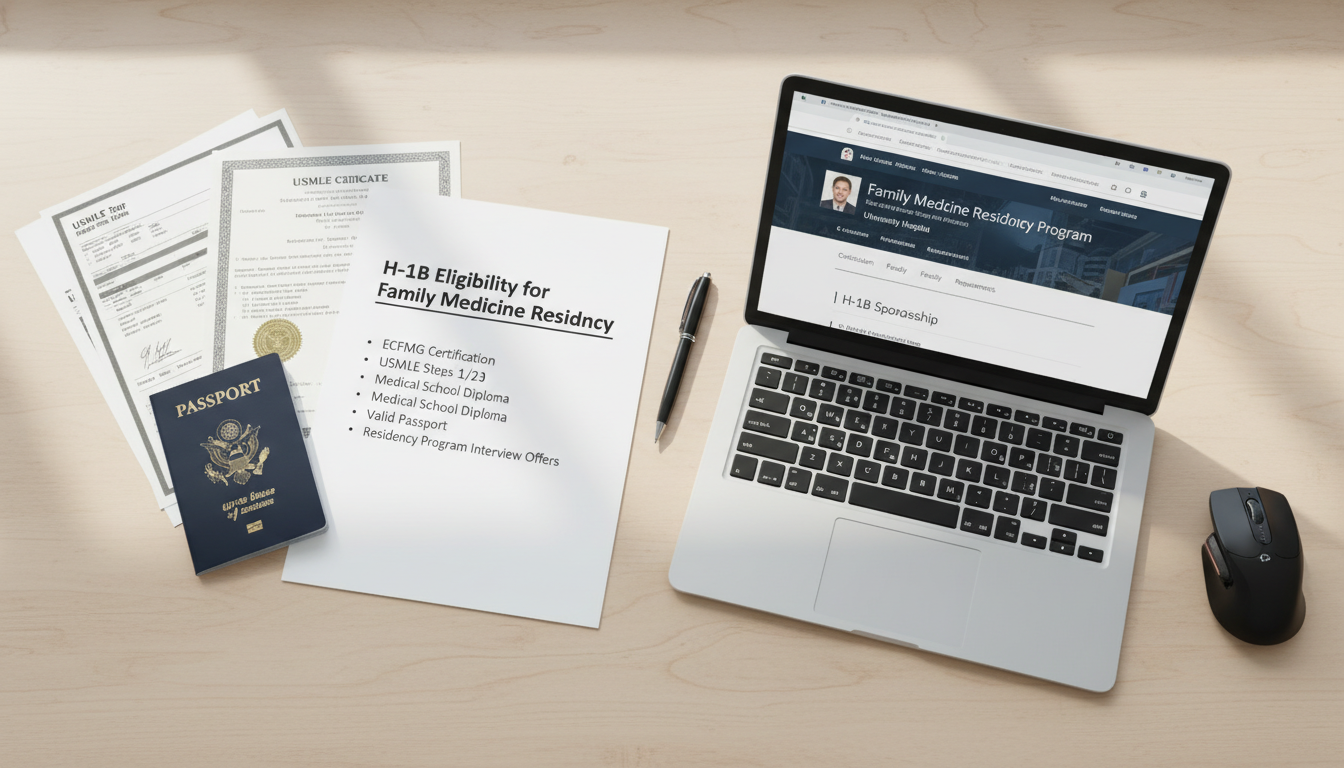
3. Finding H-1B Sponsorship Programs in Family Medicine
There is no single official “H-1B sponsor list” for family medicine residency, but you can systematically build one and verify H-1B-friendly programs.
3.1 Using Official Databases and Program Websites
Start with:
FREIDA (AMA Residency & Fellowship Database)
- Search for family medicine residency programs.
- Under the visa section, many programs indicate whether they accept J-1, H-1B, or other categories.
- Not every program keeps FREIDA fully updated, so cross-checking is essential.
Program websites
- Look for sections like “For Applicants,” “Eligibility & Requirements,” or “International Medical Graduates.”
- Phrases you might see:
- “We sponsor J-1 visa only.”
- “We sponsor J-1 and H-1B visas.”
- “We do not sponsor visas” (occasionally for some community programs).
Email verification
If the information is unclear or missing:- Write a concise, professional email to the program coordinator (not the PD first) asking:
- Whether they sponsor H-1B visas for categorical family medicine residents.
- Whether Step 3 is required before ranking or before start date.
- Any specific deadlines for exam completion.
- Write a concise, professional email to the program coordinator (not the PD first) asking:
Keep all responses in a spreadsheet; over time, this becomes your personalized H-1B sponsor list for the FM match.
3.2 Targeting H-1B Cap-Exempt Institutions
One of the most important concepts is H-1B cap exempt. Some employers can sponsor H-1B regardless of the annual cap, which makes residency sponsorship smoother.
Cap-exempt entities generally include:
- Non-profit hospitals affiliated with universities
- University-based teaching hospitals
- Non-profit research organizations tied to higher education
Many large academic family medicine programs fall into this category. For non-US citizen IMGs, these programs:
- Can file H-1B petitions at any time of year (no April lottery).
- Are experienced in handling H-1B residents.
- Often have internal legal teams or dedicated immigration counsel.
When reviewing programs, note whether they are:
- University-based / academic medical center – often H-1B cap exempt and positive for H-1B sponsorship.
- Community-based with university affiliation – may or may not be cap-exempt, but frequently still sponsor H-1B.
- Purely community-based, small hospital – more variable; many sponsor only J-1 due to resources.
3.3 Practical Research Strategy
A structured approach:
Create a spreadsheet with all ACGME-accredited family medicine programs.
Add columns:
- Visa (J-1, H-1B, both, none)
- H-1B cap exempt (likely yes/no)
- Step 3 required? (Y/N; before rank vs before start)
- Average cut-off for graduation year, USCE requirement
- Notes from email communication
Start broad, then narrow down:
- Initially, include all programs that at least consider H-1B.
- Later, prioritize programs that not only accept H-1B but have a track record (e.g., current residents on H-1B, website mentions).
Ask during interviews
On interview day (when appropriate), ask:- “Do you currently have residents on H-1B visas?”
- “How does your program typically handle H-1B sponsorship timelines?”
Programs accustomed to H-1B residents are more likely to handle the process smoothly.
4. Optimizing Your Application Profile for H-1B-Friendly Family Medicine Programs
H-1B sponsorship inherently increases the investment and risk for programs, so you must clearly justify that investment through your application.
4.1 Academic and Exam Profile
To remain competitive for H-1B-friendly family medicine residency:
USMLE scores
Family medicine is generally less score-driven than some other specialties, but for H-1B:- Solid, consistent scores across Step 1 and Step 2 CK are important.
- A first-attempt pass on Step 3 is especially valued; it signals reliability.
Step 3 timing and communication
- Either have Step 3 completed before interview season or clearly state your scheduled exam date in ERAS and during interviews.
- If you pass Step 3 during interview season, update programs with your result promptly.
ECFMG certification
- Ensure that your ECFMG certification process has no pending issues (name inconsistencies, incomplete documents, etc.).
- The earlier you can certify, the more time programs have to process H-1B paperwork.
4.2 Clinical Experience and Fit for Family Medicine
H-1B or not, programs look for strong alignment with the values of family medicine:
US clinical experience (USCE)
- Aim for inpatient and outpatient FM or primary care rotations in the US.
- Continuity clinic experience, community health centers, or rural rotations are strong pluses.
- Secure letters of recommendation (LORs) from US family medicine attendings whenever possible.
Commitment to primary care
Highlight:- Longitudinal primary care experience in your home country.
- Preventive care, chronic disease management, and community engagement.
- Any work with underserved or multicultural populations – a key theme in many FM programs.
Language and communication
Family medicine demands strong communication skills. For a non-US citizen IMG:- Fluent, clear English in interviews is crucial.
- Showcase patient-centered communication, empathy, and teamwork in your personal statement and LORs.
4.3 Crafting Your ERAS Application with H-1B in Mind
Practical tips:
Personal statement
- Briefly and professionally mention that you are a non-US citizen IMG aware of visa requirements, and that you are especially interested in programs that sponsor H-1B.
- Don’t make visa status the main focus, but show that you are informed and prepared (e.g., already planning Step 3).
CV and experience section
- Emphasize continuity: clinical practice since graduation, no unexplained long gaps.
- Highlight teaching, leadership, and QI projects that show you will add value to the residency program.
Supplemental ERAS information / signaling (if applicable)
- Use program signaling (if available in future cycles) strategically on H-1B-friendly programs that match your profile.
4.4 Communicating About Visa Issues Professionally
During interviews, visa discussions are common for non-US citizen IMGs. Approach them with clarity:
Prepare a concise answer to:
- “What is your current visa status?”
- “Do you require visa sponsorship?”
- “Are you open to J-1 as well as H-1B?”
If you prefer H-1B but are flexible:
- “I am a non-US citizen IMG currently on [status]. I am eligible for both J-1 and H-1B. Given my long-term career plans in the US, I would appreciate consideration for H-1B if feasible, but I understand some programs sponsor only J-1 and I remain open to that as well.”
If you strongly prefer H-1B:
- Be honest but tactful. Some programs may not be able to change policy.

5. Logistics: How the H-1B Process Works in the FM Match
Understanding the typical sequence helps you and your future program avoid unpleasant surprises.
5.1 Typical H-1B Residency Timeline
Below is a generalized timeline for a non-US citizen IMG aiming to start FM residency on July 1:
June–September (Application year)
- ERAS applications submitted; interviews scheduled.
- Ideally: Step 3 either completed or scheduled with enough time for score reporting before March.
October–January
- Interview season.
- Some programs will ask about your Step 3 status and exam date.
- Notify programs as soon as Step 3 results are available.
February
- Rank order list deadline.
- Certain programs require proof of Step 3 pass by this point if they are to rank you for H-1B.
March
- Match Day: you learn your program.
- Immediately after, the program’s GME office or legal team initiates H-1B preparation (if they are sponsoring H-1B).
March–May
- You provide all required documents:
- Passport, diplomas, ECFMG certificate, USMLE transcripts, CV, etc.
- State license / training permit application as required.
- Program files Labor Condition Application (LCA) and then H-1B petition with USCIS. Many use premium processing to minimize delays.
- You provide all required documents:
June
- H-1B approval (often within 15 days with premium processing).
- If outside the US, you attend a visa interview at a US consulate.
- If in the US on other status, change of status may be processed.
July 1
- Residency start date under H-1B status.
If any step is delayed (e.g., Step 3 not passed in time, USCIS processing issues), the program may need contingencies, or in rare cases, may convert you to J-1 if they sponsor both.
5.2 H-1B Duration and Extensions During Training
For residency:
- Initial H-1B approval is typically up to 3 years.
- Family medicine is usually a 3-year program, so one initial H-1B period may cover the entire residency.
- If you pursue fellowship (e.g., sports medicine, geriatrics, palliative care), your new fellowship program would sponsor an extension or transfer of your H-1B, often using cap-exempt status as well.
5.3 Cap-Exempt H-1B and Future Career Implications
Being in a H-1B cap-exempt residency has long-term implications:
During residency and fellowship:
- Your H-1B is usually cap-exempt because your employer is a university or affiliated non-profit.
After training, when you move to a non-academic employer:
- You may need to transition from cap-exempt to cap-subject H-1B if the job is in a private practice or for-profit hospital not eligible for exemption.
- That might involve entering the annual H-1B lottery unless your attending job is also cap-exempt (e.g., at a university hospital or certain non-profit systems).
Because family medicine often offers numerous jobs in community and private practice settings, think strategically:
- Some FM attendings remain in cap-exempt positions (academic, FQHCs affiliated with universities, etc.).
- Others successfully move to cap-subject H-1Bs or to permanent residency (green card) through employer sponsorship.
6. Strategic Planning for Non-US Citizen IMGs: Putting It All Together
6.1 Decide Early on Your Visa Strategy
Ask yourself:
- Am I willing to accept J-1 if an excellent program only sponsors J-1?
- Is avoiding the J-1 two-year home requirement a top priority for my long-term goals?
Based on this:
If H-1B is strongly preferred:
- Prioritize building a robust H-1B sponsor list of FM programs.
- Take Step 3 early and score well.
- Focus most applications on H-1B-friendly, preferably H-1B cap-exempt programs.
If you’re flexible (H-1B or J-1):
- Apply broadly, but highlight your readiness for H-1B (Step 3, cap-exempt awareness, etc.).
- Keep long-term options open, including the possibility of J-1 waiver jobs in family medicine (which can themselves be excellent career starts).
6.2 Common Pitfalls for H-1B-Seeking IMGs
Avoid these frequent issues:
Late or failed Step 3 attempts
A failed attempt close to match can make programs nervous about H-1B; consider your readiness carefully before scheduling.Relying on outdated H-1B sponsor lists
Programs change visa policies over time. Always verify for the current application cycle by website and/or direct email.Poor communication with programs
Not informing programs about your updated visa status, Step 3 results, or documentation can create unnecessary risk.Over-focusing on visa to the exclusion of fit
Match success still depends on clinical skills, fit with family medicine, and interpersonal qualities. Visa is important, but not everything.
6.3 Example Applicant Scenarios
Scenario 1: Recent Graduate, Strong Scores, USCE
- Non-US citizen IMG, graduated 2 years ago, strong Step 1 and Step 2 CK, completed several US FM electives.
- Passes Step 3 in October before interview season.
- Applies to ~80 FM programs, heavily prioritizing H-1B-friendly and H-1B cap-exempt institutions.
- During interviews, clearly states readiness for H-1B.
- Outcome: Multiple H-1B-interested programs rank them highly; matches into an academic FM program under H-1B.
Scenario 2: Older Graduate, Limited USCE
- Foreign national medical graduate, 8 years since graduation, mainly home-country practice, limited US clinical exposure.
- Step 3 passed in February, right before rank list deadline.
- Applies broadly to FM, including both J-1 and H-1B programs.
- Outcome: Most interest comes from J-1-only community programs due to profile; matches on J-1 into a supportive FM residency, later secures a J-1 waiver in a rural primary care setting.
Both paths can lead to successful careers in family medicine; the “right” path depends on your starting point and long-term priorities.
FAQs: H-1B Sponsorship in Family Medicine for Non-US Citizen IMGs
1. Is it realistic for a non-US citizen IMG to get H-1B sponsorship in family medicine?
Yes. Among primary care specialties, family medicine is relatively accessible for non-US citizen IMGs, and a meaningful subset of programs sponsor H-1B, especially university or large community-university affiliated residencies. However, it’s more competitive than J-1 sponsorship because fewer programs offer it and Step 3 is usually required early.
2. Do all H-1B residency programs require USMLE Step 3 before ranking?
No, requirements vary. Some programs require Step 3 before the rank order list deadline, others only before the start of residency, and a few may not mandate Step 3 at all if state rules allow. For planning and safety, assume that most H-1B-friendly programs will prefer or require Step 3 before ranking and schedule accordingly, then verify each program’s policy individually.
3. How can I identify if a family medicine residency is H-1B cap exempt?
Look for indications that the program’s primary employer is:
- A university hospital
- A non-profit hospital officially affiliated with a university
- A non-profit research or educational organization
Program websites often describe themselves as “university-based” or “university-affiliated teaching hospitals.” These are frequently, though not always, H-1B cap exempt. When in doubt, you can ask the GME office or coordinator, “Is your institution considered H-1B cap exempt for residency sponsorship?”
4. If I start residency on J-1, can I later switch to H-1B during residency?
In most cases, no. Once you begin graduate medical education under a J-1 sponsored by ECFMG, your training in the US is generally tied to that J-1 category. Changing to H-1B during the same level of training is rare and complicated, and many programs will not attempt it. If H-1B is a priority, you should focus on starting residency under H-1B from the beginning rather than planning to convert from J-1 later.
By understanding how H-1B sponsorship works, planning your exams and applications strategically, and targeting the right family medicine programs, you can significantly increase your chances of a successful FM match as a non-US citizen IMG while preserving strong long-term immigration options in the United States.