Understanding H-1B Sponsorship for Non-US Citizen IMGs in Boston
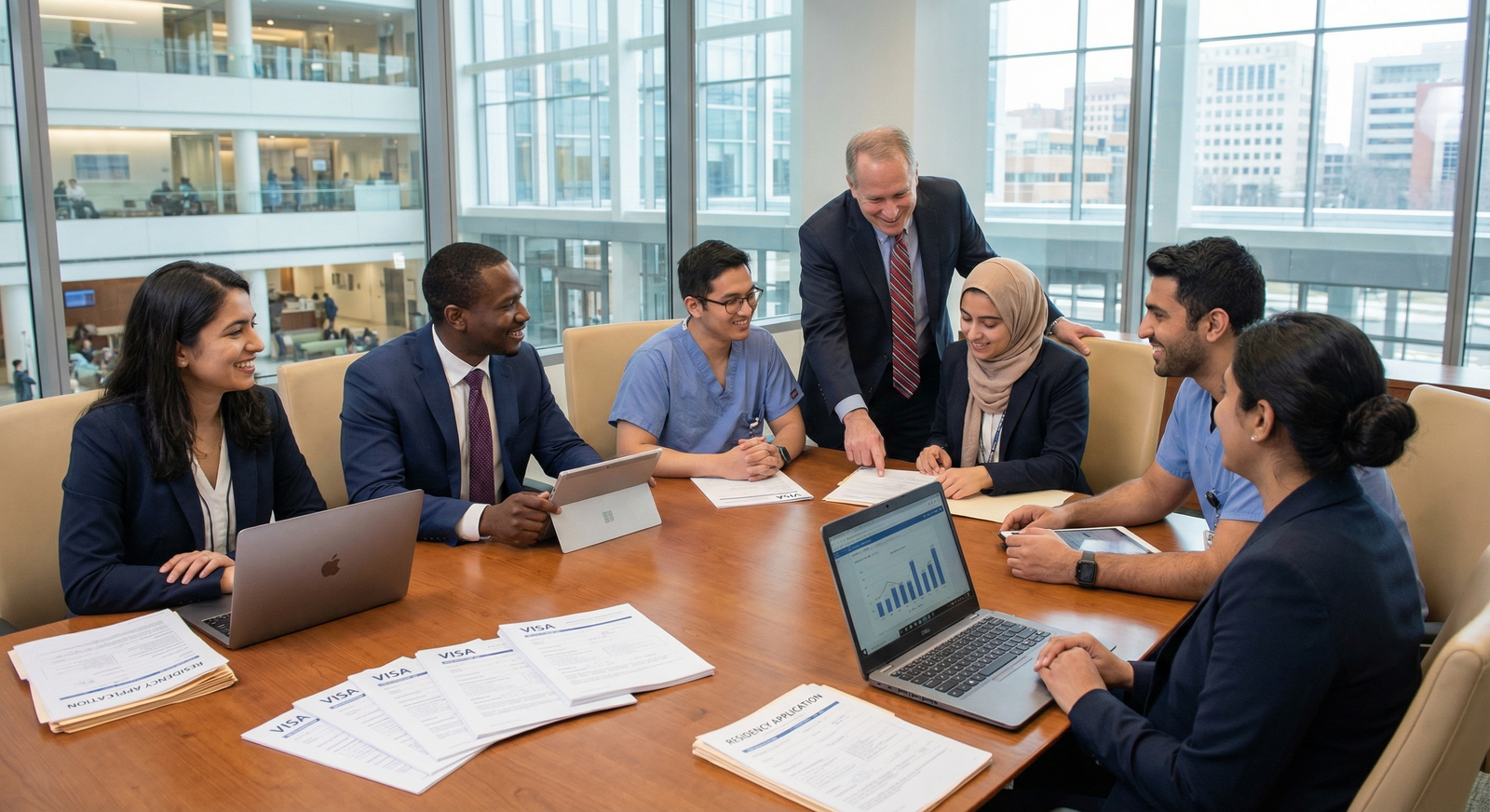
For a non-US citizen IMG planning to train in Boston, understanding H-1B sponsorship is just as important as understanding program reputation or fellowship outcomes. Boston is a major US academic hub with many prestigious Massachusetts residency programs, but not all are equally friendly to H-1B sponsorship. Knowing how H-1B residency programs work, which institutions are H-1B cap exempt, and how to time exams and paperwork can dramatically improve your chances of matching and starting residency on time.
This guide is designed specifically for the non-US citizen IMG or foreign national medical graduate targeting Boston residency programs. It explains how H-1B visas fit into residency training, which types of Boston institutions typically sponsor, and how to build a targeted application strategy.
H-1B vs J-1 in Boston: What Non-US Citizen IMGs Need to Know
Before you build a list of Boston H-1B residency programs, you need to understand how H-1B compares to J-1 for graduate medical education.
Basic Definitions
H-1B (Temporary Worker in a Specialty Occupation)
A work visa that allows hospitals to employ you as a resident physician, typically year-by-year through your training.J-1 (Exchange Visitor – Physician Category)
An educational exchange visa sponsored through ECFMG, commonly used for residency and fellowship.
Why IMGs in Boston Often Prefer H-1B
Non-US citizen IMGs frequently target H-1B for these reasons:
No mandatory two-year home-country rule
- J-1 usually requires you to return to your home country for two years after training (unless you obtain a waiver).
- H-1B has no such home return requirement, which is important if your goal is long-term practice or fellowship in the US.
Easier transition to long-term US work
- Many physicians on H-1B transition directly to employer-sponsored green cards.
- With J-1, you typically must complete a J-1 waiver job (often underserved/rural) first.
Fewer restrictions on moonlighting (where institutionally allowed)
- Some institutions allow limited internal moonlighting for H-1B residents, subject to visa and institutional rules.
- J-1 is generally more restrictive with outside employment.
Attractive for those with USMLE Steps already completed
- Because H-1B requires USMLE Step 3 at the time of filing, programs know H-1B candidates have completed all licensing exams.
When a J-1 May Still Make Sense
For some foreign national medical graduates, J-1 can still be appropriate:
- You are comfortable returning home for two years or pursuing a J-1 waiver later.
- Your target Boston programs are J-1 only and do not offer H-1B.
- You are unable to take or pass USMLE Step 3 in time for H-1B filing.
In Boston, many of the largest academic centers have historically favored J-1 over H-1B for IMGs, but there are notable exceptions and evolving policies. It is critical to check each program’s current stance.
How H-1B Works for Boston Residency Programs
Understanding how the H-1B process fits into Boston residency timelines will help you avoid last-minute surprises.
Cap-Subject vs H-1B Cap Exempt Hospitals
The US government limits (caps) the number of new H-1B visas each year, but some employers are exempt from this cap.
- Cap-subject employers (e.g., many private companies):
Must enter the national H-1B lottery each March. - H-1B cap exempt employers (key for residency):
- Non-profit institutions of higher education
- Non-profit organizations affiliated with higher education
- Governmental research organizations
Most major teaching hospitals in Boston that are affiliated with medical schools qualify as H-1B cap exempt, which means:
- They can file H-1B petitions any time of year (no March lottery deadline).
- They are not competing for a limited number of H-1B slots.
- This flexibility is ideal for residency, where contracts begin around July 1.
When evaluating Boston residency programs, always confirm whether the sponsoring hospital is cap exempt. Many large academic centers in Massachusetts are, but you must verify.
Core H-1B Requirements for Residency
For a foreign national medical graduate entering a Boston residency on H-1B, typical requirements include:
USMLE examinations
- Step 1 and Step 2 CK (as part of ECFMG certification)
- Step 3 passed before H-1B petition filing (not just before Match)
ECFMG Certification
- Must be fully certified by ECFMG by the time you start residency.
- Many programs require certification by Rank Order List deadline.
State Medical License or Limited License
- Massachusetts requires either a full license or a limited license for residents and fellows.
- H-1B petition often needs proof that you qualify for a MA training license, which may require:
- ECFMG certification
- Passing USMLE Steps 1, 2 CK, and 3
- Primary medical degree verification
Employer (Hospital) Sponsorship
- The hospital or GME office must file and support your H-1B petition.
- They control whether they even offer H-1B for residents.
Common Timing Pitfalls for IMGs Aiming for Boston
Late Step 3
If you take Step 3 after Match (March–April) and fail, there may not be enough time to retake and still file the H-1B. Boston GME offices usually want everything in place months before July.Delayed ECFMG certification
Slow primary-source verification or missing documents can delay your MA limited license application and thus your H-1B petition.Misunderstanding of “we sponsor H-1B”
Some programs will say they “can sponsor H-1B,” but:- Only for upper-level transfers (PGY-2+), or
- Only under exceptional circumstances, or
- Only for specific specialties.
You must clarify actual policy for categorical PGY-1 IMGs.
Boston Institutions and H-1B Sponsorship: Patterns and Practical Insights
US program policies change frequently and are often not publicly documented in detail, so you cannot rely on any single, static H-1B sponsor list. Instead, use a pattern-based and verification-based approach.
Types of Boston Programs That Commonly Support H-1B
While you must verify each individual program, in Boston and the wider Massachusetts residency landscape, you will often find:
Large Academic Medical Centers
Affiliated with major universities and medical schools; typically H-1B cap exempt. Historically, some of these centers have been cautious about H-1B for IMGs, preferring J-1 due to administrative simplicity. However, many have begun to support H-1B more consistently in high-demand specialties or for strong candidates.University-Affiliated Community Programs
Community-based hospitals that have formal affiliations with Boston universities. Some are very IMG-friendly and comfortable sponsoring H-1B, especially for internal medicine, family medicine, pediatrics, psychiatry, and transitional year.Independent Community Hospitals in Massachusetts
- Outside central Boston but still within the broader Boston metro or in nearby cities.
- Some of these are extremely IMG friendly and regularly appear on informal H-1B sponsor lists shared among residents.
- They may have more flexible policies and may be eager to recruit high-quality IMGs who are ready for H-1B.
How to Identify Potential Boston H-1B Residency Programs
Because policies change, use a structured approach:
Start with official program websites
- Look for sections titled:
- “International Medical Graduates”
- “Visa Sponsorship”
- “Eligibility & Requirements”
- Wording such as:
- “We sponsor J-1 and H-1B visas for qualified applicants” → positive sign
- “We only sponsor J-1 visas” → H-1B not available
- “We do not sponsor visas” → skip as a non-US citizen IMG
- Look for sections titled:
Check GME Office or Institutional GME Site
- Some Boston hospitals list visa policies at the GME (institutional) level rather than the program level.
- When the institutional policy states “H-1B may be sponsored at the discretion of the program,” you must confirm directly with that specific residency.
Use match data and networking
- Current or recent residents: Ask if they know colleagues on H-1B.
- Alumni networks & IMG forums: Look for posts describing recent H-1B sponsorships in specific Boston programs.
- Pay attention to years: information older than 3–4 years may be outdated.
Email programs directly
- A concise email is often the most reliable way to know a program’s current stance.
Sample email:
Subject: Inquiry Regarding H-1B Sponsorship for Non-US Citizen IMG
Dear Dr. [Program Director Last Name] / Program Coordinator,
I am an international medical graduate (non-US citizen) very interested in the [Specialty] Residency Program at [Hospital Name] in Boston. I plan to apply in the upcoming ERAS cycle.
Could you please confirm whether your program sponsors H-1B visas for categorical PGY-1 residents who have passed USMLE Step 3 before Match and will hold ECFMG certification?
Thank you very much for your time and clarification.
Sincerely,
[Your Full Name]
[Medical School, Country]
Their response becomes real-time data about the program’s H-1B policy.

Examples of Policy Variations You May Encounter
While specific program names and policies must be checked directly, here are realistic patterns you will likely see in Boston:
Academic Internal Medicine Program A
- Statement: “We sponsor J-1 and H-1B visas for qualified applicants.”
- Practice: Prefers J-1 but will sponsor H-1B for candidates with strong academic profiles and USMLE Step 3 completed.
Academic Subspecialty Program B (e.g., Radiology, Dermatology)
- Statement: No clear visa policy on the website.
- Practice: Rarely sponsors H-1B for PGY-1; may sponsor for research fellows or advanced residents who are already in the US on another status.
Community Teaching Hospital C (Boston metro)
- Statement: “We sponsor J-1 and may support H-1B visas.”
- Practice: Frequently sponsors H-1B for IMGs in internal medicine, family medicine, or psychiatry. Appears repeatedly in unofficial H-1B sponsor lists shared among IMGs.
Precisely because Boston is a competitive academic environment, some of the most H-1B-friendly opportunities for non-US citizen IMGs are at university-affiliated community programs rather than the most famous “name-brand” hospitals. A smart strategy includes both.
Application Strategy for Non-US Citizen IMG Seeking H-1B in Boston
To maximize your chances, you need proactive planning long before ERAS opens.
1. Time Your USMLE Step 3 Strategically
For H-1B residency programs in Boston, Step 3 is often the main limiting factor.
- Aim to take and pass Step 3 BEFORE September ERAS submission, or at the latest by:
- December–January of the application cycle for a July start.
- Why so early?
- Some Massachusetts residency programs will not rank H-1B candidates without a Step 3 pass in hand.
- GME offices need ample time to process your MA limited license application and H-1B petition after Match.
A realistic timeline if you are graduating or recently graduated:
- Year 0: Finish medical school / internships, complete Step 1 and Step 2 CK.
- Year 1 (pre-application year):
- Clinical experience, research, observerships in Boston or elsewhere.
- Prepare and take Step 3 by mid-year.
- Year 2: Apply via ERAS in September with Step 3 already passed.
2. Build a Boston-Focused Program List
Construct a balanced target list:
Tier 1: Boston-area programs that clearly sponsor H-1B
- Based on direct confirmation from websites, GME offices, or email.
- Include multiple specialties if you’re flexible (e.g., internal medicine, prelim, transitional year).
Tier 2: Programs that “may sponsor” H-1B
- You must clarify your situation during interview season.
- Strong performance during the interview can sometimes influence the program’s willingness to sponsor.
Tier 3: J-1-only but academically strong Boston programs
- Keep these as backup if your primary goal is simply training in Boston, and you might reconsider J-1 as a pathway.
Try to have at least 10–15 programs in or near Boston that are realistically H-1B-friendly, augmented by additional Massachusetts residency options across the state and some in other states to diversify risk.
3. Strengthen Your Profile as a Foreign National Medical Graduate
Boston is competitive. As a non-US citizen IMG, you should aim to exceed minimum requirements:
USMLE Scores
- Solid scores, particularly on Step 2 CK, still matter.
- Step 3 pass on first attempt is a major plus for H-1B.
US Clinical Experience (USCE)
- Preferably hands-on electives, sub-internships, or observerships in US teaching hospitals.
- Boston-based clinical experience or strong letters from Massachusetts residency faculty will help.
Research and academic activity
- Boston programs are research-oriented; publications, posters, and QI projects are valued.
- If possible, join a Boston-based research group or remote collaboration ahead of applications.
Letters of Recommendation
- Prioritize letters from US faculty, especially those connected to Boston or Massachusetts residency programs.
4. Address Visa and H-1B Concerns in Your Application
You do not need to overemphasize your visa needs, but you must be transparent and prepared:
ERAS Application
- Accurately complete the “Visa” and “Citizenship” sections.
- Avoid ambiguity — programs need to know you will require sponsorship.
Personal Statement
- Focus on your story, goals, and fit for Boston/your specialty.
- It is optional to briefly acknowledge your long-term intention to practice in the US and your readiness (Step 3, exams completed). Avoid turning the statement into a visa essay.
Interviews
- If asked: Be clear and confident about your status:
- Mention that you have passed Step 3 (if applicable).
- Explain that you are prepared for either H-1B or J-1 if that is truly the case, or state clearly that you are only able to pursue H-1B due to home-country constraints or future goals.
- If asked: Be clear and confident about your status:
Practical Tips for Managing the H-1B Process After the Match
Once you match to a Boston program that sponsors H-1B, you enter a second phase: paperwork and deadlines.
1. Communicate Quickly with GME and HR
- Respond immediately to all emails from the residency program, GME office, or hospital HR.
- Provide requested documents (passport, diplomas, ECFMG certificate, USMLE transcript) without delay.
- Ask directly for:
- The timeline for filing the H-1B petition.
- What they need from you to support the Massachusetts limited license application.
2. Coordinate Licensing and Visa Steps
In Massachusetts, the typical sequence for a non-US citizen IMG is:
- Program verifies your appointment and eligibility.
- You apply (with support) for a MA limited license.
- Once licensure eligibility is clear, GME/HR files your H-1B petition with USCIS.
Because Boston hospitals are usually H-1B cap exempt, there is no lottery, but processing time can still be 2–6 months unless the hospital uses premium processing. Ask whether they will file under premium processing to ensure you are approved before July 1 start.
3. Avoid Travel and Status Pitfalls
- If you are already in the US (e.g., on F-1, J-1, or another status), the program may request a change of status to H-1B.
- If you are abroad, once the petition is approved, you will typically:
- Schedule a US consular interview for H-1B stamping.
- Prepare all supporting documents (approval notice, offer letter, ECFMG certificate, etc.).
- Avoid unnecessary travel when your status is pending, especially during the transition period before your H-1B is active.
4. Plan for Family (If Applicable)
If you have a spouse or children:
- They will typically apply for H-4 status.
- Confirm with your future hospital and an immigration attorney (if available) how H-4 will be handled, and whether there are any implications for your arrival or start date.

FAQs: H-1B Sponsorship Programs for Non-US Citizen IMGs in Boston
1. Do all Boston residency programs sponsor H-1B visas?
No. Boston programs vary widely:
- Some only sponsor J-1.
- Some sponsor both J-1 and H-1B, but may favor J-1 for administrative simplicity.
- A subset routinely sponsors H-1B for qualified non-US citizen IMGs, especially in IM-friendly or primary care–oriented specialties.
You must check each program individually through their website, institutional GME pages, or direct email. Never assume that prestigious or IMG-friendly Boston programs automatically sponsor H-1B.
2. Is Step 3 mandatory for H-1B in Massachusetts residency programs?
Yes, for all practical purposes. To obtain H-1B for residency as a foreign national medical graduate:
- You must pass USMLE Step 3 before the H-1B petition is filed.
- Many Boston programs also require Step 3 before they will rank you as an H-1B candidate.
Plan to complete Step 3 well before the Match to maximize your chances.
3. Are Boston teaching hospitals H-1B cap exempt?
Most major Boston teaching hospitals affiliated with universities or medical schools qualify as H-1B cap exempt employers. This means they can file H-1B petitions at any time of year and are not subject to the national numerical cap or lottery. However:
- You must verify each institution’s status.
- Even if the hospital is cap exempt, it may still choose not to sponsor H-1B for residents, or may limit sponsorship to certain specialties or circumstances.
4. How many Boston programs should I apply to as a non-US citizen IMG seeking H-1B?
There is no single correct number, but in a competitive region like Boston, a cautious strategy is:
- Include 10–15 Boston-area programs that you have confirmed as H-1B friendly or potentially H-1B friendly.
- Add other Massachusetts residency programs outside Boston and additional H-1B-friendly programs in other states.
- Total applications for many non-US citizen IMGs commonly range from 60–120 programs, depending on specialty competitiveness and overall profile.
Focus on programs that explicitly mention visa sponsorship, and always confirm H-1B possibilities directly when possible.