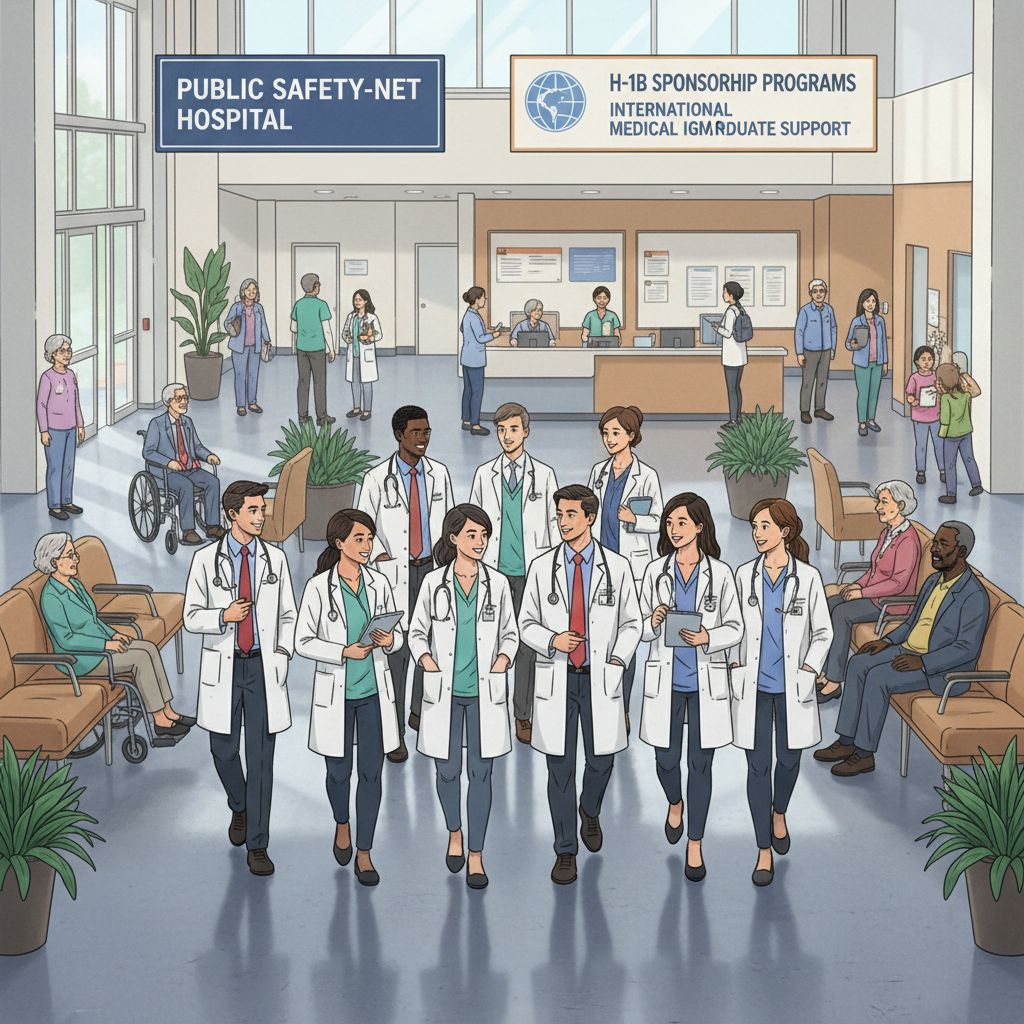
Understanding H‑1B Sponsorship in County Hospital Residency Programs
For a non-US citizen IMG, the question “Which residency programs will sponsor my H‑1B?” can decide not just where you match, but whether you can train in the United States at all. County hospital residency and safety net hospital residency programs can be particularly attractive, but their visa policies are often confusing.
This guide is written specifically for the non-US citizen IMG and foreign national medical graduate who is trying to understand H‑1B residency programs in county and safety‑net hospitals. You’ll learn how H‑1B sponsorship works, why county institutions are frequently H‑1B cap exempt, how to identify realistic programs, and how to market yourself effectively as an H‑1B candidate.
H‑1B Basics for Non‑US Citizen IMGs
What is the H‑1B Visa in a Residency Context?
The H‑1B is a temporary work visa for “specialty occupations” that require a bachelor’s degree or higher. In graduate medical education, it allows a foreign national medical graduate to work and receive training as a resident or fellow while being paid a salary.
Key features relevant to residency:
- Employer-specific: Your visa is tied to the hospital or institution that sponsors you.
- Position-specific: It is granted for a specific job (e.g., PGY‑1 Internal Medicine resident).
- Time‑limited: Generally up to 6 years total (with some exceptions).
H‑1B vs J‑1 for Residency
Most international residents in the US are on a J‑1 visa sponsored by the ECFMG, but many non-US citizen IMGs look for H‑1B because:
Potential advantages of H‑1B over J‑1:
- No J‑1 two‑year home country return requirement.
- May be more straightforward for long‑term US career plans and green card pathways.
- Sometimes preferred by candidates with family, complex immigration history, or those already in another U.S. status (e.g., F‑1 OPT, H‑4).
Potential disadvantages of H‑1B in residency:
- More complex and costly for the hospital (attorney + filing fees).
- Some states require USMLE Step 3 before H‑1B can be filed.
- Not all specialties or programs are willing to sponsor.
- Limited duration (6 years) can be tight if you have long training (e.g., neurosurgery, combined fellowships) plus prior H‑1B time in another field.
For a non-US citizen IMG, you should evaluate whether H‑1B is truly necessary or preferable in your case. But if it is, then finding H‑1B-friendly county hospital residency programs becomes a central strategy.
Why County & Safety‑Net Hospitals Are Often H‑1B Friendly
County Hospitals and the H‑1B Cap
A major issue with H‑1B visas is the annual numerical cap (65,000 regular + 20,000 advanced degree exemptions) administered by lottery. However, many hospitals that run residency programs are H‑1B cap exempt if they meet specific criteria.
A hospital or employer is usually H‑1B cap exempt if it is:
- Directly owned or operated by:
- A US public institution of higher education, or
- A nonprofit institution of higher education, or
- A nonprofit research organization or governmental research organization, or
- A nonprofit entity affiliated with an institution of higher education (through agreements for clinical training, research, or education).
Many county hospitals and safety-net hospitals fall under these structures, often via:
- Formal affiliations with a state university medical school.
- Teaching hospital status within a public university system.
- Operation under a county or city that has defined academic relationships with medical schools.
If a county or safety-net hospital qualifies as H‑1B cap exempt, they may:
- File H‑1B at any time of the year (no April lottery timing).
- Avoid competition in the national H‑1B lottery.
- Sponsor H‑1B specifically for residency and fellowship positions.
This cap-exempt status is extremely important for the non-US citizen IMG, as it makes counties some of the most stable and predictable options for H‑1B residency programs.
Typical Characteristics of County & Safety‑Net H‑1B Programs
Many county hospital residency programs share common features that affect H‑1B sponsorship:
Mission‑Driven, Underserved Focus
Their mission is to serve vulnerable populations. These hospitals are often more open to foreign national medical graduates who reflect diverse backgrounds and languages—especially in Internal Medicine, Pediatrics, Psychiatry, and Family Medicine.Large Teaching Programs
County hospitals often host big residency classes. With higher resident numbers, they may have developed internal processes and relationships with immigration lawyers—making H‑1B sponsorship more routine.Academic Affiliation
Although the facility may be run by the county, the residency program is often academically anchored to a state university. This affiliation can secure H‑1B cap exempt status.Track Record With IMGs
County and safety‑net hospitals often train high proportions of IMGs, which correlates with more familiarity and comfort with visa issues.
However, not all county hospitals sponsor H‑1B, and some limit it to certain specialties, or only sponsor J‑1. So you still need to do careful research and planning.

Eligibility and Requirements for H‑1B in County Hospital Residency
Core Requirements for Foreign National Medical Graduates
For most county hospital residency programs that offer H‑1B sponsorship, you should assume the following baseline requirements:
ECFMG Certification
- Must be completed before starting residency.
- Usually required before the program can file H‑1B.
USMLE Completion (Including Step 3)
- Many states and institutions require USMLE Step 3 passed before filing the H‑1B petition.
- Some programs will not even consider you for H‑1B if Step 3 is pending, especially in states with strict licensing rules.
- Plan to pass Step 3 by January–February of the Match year if you want a realistic chance to process H‑1B in time for a July start.
State Medical Board Requirements
- Each state’s medical board has rules for limited or training licenses.
- For H‑1B, the hospital must show you meet requirements for licensure or training authorization.
- IMGs should review specific state board requirements early (during application season).
No Prior Status Violations
- Clean immigration history is important.
- Overstays, unauthorized employment, or complicated visa history can make institutions hesitant.
Strong Application Profile
- Because H‑1B sponsorship is more complex and expensive, programs may reserve H‑1B for top candidates.
- You should be competitive or above average for that specialty at that program.
Additional Factors Specific to County Hospitals
County hospital residency and safety net hospital residency programs may add extra filters, such as:
- Budget Constraints: Some departments set a cap on total H‑1B residents each year due to attorney and filing fees.
- Specialty Priority: Programs sometimes prioritize H‑1B for specialties with critical staffing needs (e.g., Internal Medicine, Psychiatry) over more competitive or oversubscribed fields.
- Internal Applicants First: Some county systems prioritize internal graduates (e.g., from affiliated medical schools or preliminary interns already in the system).
As a non-US citizen IMG, you should not assume that being in a county or safety-net hospital automatically guarantees H‑1B sponsorship. Policy can vary by specialty and by year, depending on budget and leadership.
Practical Example
Imagine you’re a non-US citizen IMG applying in Internal Medicine. You have:
- Step 1: 235 (pass)
- Step 2 CK: 242
- Step 3: Passed (by December)
- 2 US clinical electives in public hospitals
- ECFMG certified
- No US visa yet (currently abroad)
A county hospital affiliated with a state university that is H‑1B cap exempt is far more likely to seriously consider H‑1B sponsorship for you than a small community hospital without academic ties. You present both academic strength and readiness (Step 3 done) that minimizes their risk.
Building Your H‑1B‑Focused Program List (County & Safety‑Net)
Step 1: Understand Program Types and Structures
For the Category RESIDENCY_PROGRAMS_WITH_FRIENDLY_POLICIES_FOR_IMGS, think in terms of institutional structure:
County Hospitals Attached to State Universities
- Example arrangement: “[County Medical Center] – Affiliated with [State University School of Medicine].”
- Likely to be H‑1B cap exempt, but individual program policies vary.
Urban Safety‑Net Hospitals with Academic Affiliation
- Often serve low‑income, uninsured, or undocumented populations.
- Have strong missions around diversity, which aligns with international residents.
Health Systems Operating County Contracts
- Sometimes a private or nonprofit academic system manages a county or public safety‑net facility.
- These systems may have H‑1B sponsor lists and established immigration offices.
For each program, your goal is to determine:
- Does the institution sponsor H‑1B at all?
- If yes, which specialties and at what level (PGY‑1 only vs later)?
- What are their precise requirements (Step 3 timing, USMLE cutoffs, recency, etc.)?
Step 2: Using Public Data to Identify H‑1B Residency Programs
There is no official centralized “H‑1B sponsor list” for residencies, but you can approximate one by combining several strategies:
Program Websites
- Look for “International Medical Graduates,” “Visa Information,” or “Eligibility & Application” pages.
- Clear signals:
- “We sponsor both J‑1 and H‑1B visas.”
- “H‑1B is available for exceptional candidates who have passed USMLE Step 3.”
- Ambiguous signals:
- “We accept IMGs” (without clarifying visa).
- “We accept ECFMG‑sponsored J‑1 visas” (may or may not exclude H‑1B; you must ask).
FREIDA (AMA Residency Explorer)
- Some programs list whether they sponsor H‑1B.
- Cross‑check with the official program website if data conflicts.
H‑1B Disclosure Data (US Dept of Labor / FOIA Datasets)
- Public data show employers who filed H‑1B petitions.
- Search for county hospitals or university medical centers; if you see multiple resident‑level positions (e.g., “Resident Physician,” “Clinical Fellow”), it’s a strong indicator of H‑1B sponsorship.
- Keep in mind: data may not specify residency vs attending positions, but patterns are informative.
Current Residents’ Profiles and Alumni
- Some programs list current residents with prior visas or notes like “previous J‑1, now H‑1B” or “H‑1B sponsored by [Hospital].”
- Alumni working in the US who were historically on H‑1B may indicate long‑standing H‑1B usage.
Step 3: Direct Communication: How and When to Ask
Even when public data suggest H‑1B use, policies change. You must confirm directly.
Who to contact:
- Program Coordinator (first line).
- Program Director (if coordinator cannot answer or policy is unclear).
- Occasionally GME Office or Institutional Visa/International Office.
When to contact:
- Before applying, if you are highly dependent on H‑1B.
- After receiving an interview, if the website is not explicit.
How to phrase your question:
Example email:
Subject: Visa Sponsorship Inquiry – [Your Name], IMG Applicant to [Program Name]
Dear [Coordinator/Dr. X],
I am an ECFMG-certified international medical graduate planning to apply to your [Specialty] residency program this ERAS cycle. As a non-US citizen IMG, I am restricted to programs that can sponsor H‑1B.
Could you please let me know whether your program sponsors H‑1B visas for incoming PGY‑1 residents, provided they have passed USMLE Step 3 and meet state licensure requirements?
My details in brief:
– ECFMG certified
– USMLE Step 1: Pass; Step 2 CK: [score]; Step 3: [status/passed]
– Graduation year: [Year]
– Current location/status: [Country or US visa type]Thank you very much for your time and clarification.
Sincerely,
[Your Full Name]
AAMC ID: [if you have it]
This short, structured message helps the program quickly assess feasibility and respond clearly.
Strategy: Maximizing Your Chances as an H‑1B Candidate in County Settings
1. Make Step 3 a Priority
For a non-US citizen IMG aiming at H‑1B in county or safety‑net programs, USMLE Step 3 is often the single most important strategic exam decision:
- Many county programs cannot or will not file H‑1B without a passed Step 3 due to state licensing rules or institutional policy.
- Passing Step 3 early (before or during ERAS application) makes you more attractive and simplifies program decision-making.
- If you delay Step 3 until after Match, the window for H‑1B filing and license processing can become very tight.
Actionable advice:
- Plan your Step 3 timeline backwards from July 1 start date.
- Aim to have your score available by January–February in the Match year.
- Use your clinical experience (observerships, electives) to prepare for Step 3 case scenarios.
2. Highlight Fit With County and Safety‑Net Missions
County hospital residency and safety net hospital residency programs strongly value:
- Commitment to underserved populations.
- Ability to work with diverse and vulnerable communities.
- Language skills and cultural competence.
In your application:
- Personal statement: Include experiences working in resource‑limited environments, free clinics, rural rotations, or public health projects.
- CV: Emphasize volunteering in safety‑net clinics, immigrant health, prison health, or community outreach.
- Interviews: Prepare specific stories showing resilience, teamwork, and your comfort with high‑acuity, high‑volume environments.
Being clearly mission‑aligned makes a program more willing to invest in you with H‑1B sponsorship.
3. Be Realistic and Diversify: J‑1 vs H‑1B
Many non-US citizen IMGs want H‑1B only, but this can severely reduce your chances of matching. Consider a balanced strategy:
- Primary list: County and academic programs known to sponsor H‑1B.
- Secondary list: County and academic programs that offer J‑1 but no H‑1B.
- Decide in advance:
- Are you willing to accept J‑1 if H‑1B offers do not materialize?
- How much risk can you tolerate in this Match cycle?
Sometimes, a county program’s GME office will say: “We prefer J‑1, but may consider H‑1B for exceptional candidates.” In that case, you must appear strong—high scores, Step 3 passed, strong letters, and evidence of fit.
4. Leverage Any Existing US Status
If you are already in the US, your current visa can influence decisions:
F‑1 OPT (after US medical school or MPH/PhD):
- Programs may be more open to hiring you on OPT for PGY‑1, then convert to H‑1B later.
- Still, many prefer a stable long-term solution from the start.
H‑4 (Dependent of H‑1B):
- Some institutions find it easier to transition you to H‑1B as they already understand your family’s status.
- Step 3 and state rules still apply.
When communicating with programs, be transparent about your current status and clarify that H‑1B is your target. Some county GME offices appreciate well-informed candidates who understand H‑1B timelines and compliance.
5. Think Beyond Residency: Long-Term Planning
If you ultimately want a US-based attending career in county or safety‑net systems, early H‑1B in residency can help you:
- Accrue US experience under a “dual‑intent” visa (H‑1B), which is compatible with green card processes.
- Build relationships in academic public hospitals that often hire their own residents as faculty.
However, remember:
- H‑1B time used in residency counts toward the 6‑year total.
- For long specialties (e.g., general surgery + fellowship), you might approach or exceed the 6‑year limit before attending-level H‑1B or green card is complete.
- Start asking about employer green card policy in fellowship or late residency years.
Common Pitfalls and How to Avoid Them
Pitfall 1: Assuming All County Hospitals Sponsor H‑1B
Reality: Many county and safety‑net hospitals only sponsor J‑1 for residency, reserving H‑1B for faculty positions.
Solution: Always confirm current policy. Do not rely solely on older forum posts or word-of-mouth.
Pitfall 2: Applying Without Step 3 as an H‑1B‑Dependent Applicant
While a few programs might sponsor H‑1B conditional on future Step 3, most will not.
Solution: If H‑1B is essential, delay your ERAS application until you can realistically pass Step 3, or be willing to consider J‑1 for this cycle.
Pitfall 3: Not Accounting for State Licensure Timing
Each state has its own timeline and documentation requirements. Delays in licensing can delay H‑1B petitions and start dates.
Solution:
- Familiarize yourself with medical board requirements for your target states early.
- Keep your documents (diplomas, translations, ECFMG certificate) ready and certified.
Pitfall 4: Weak Communication About Visa Needs
Some candidates avoid mentioning visa needs for fear of harming their chances, only to surprise programs later.
Solution:
- Be honest but concise.
- Indicate your visa preference (H‑1B) early in the cycle via email when appropriate.
- Show that you understand the process and are motivated to handle your part efficiently.
FAQs: H‑1B Sponsorship in County Hospital Residency Programs
1. Are most county hospital residency programs H‑1B cap exempt?
Many, but not all, county and safety‑net hospitals that run residency programs are H‑1B cap exempt due to their academic affiliation with public universities or nonprofit institutions. This means they can sponsor H‑1B without going through the April lottery. However, cap‑exempt status does not automatically mean they will choose to sponsor H‑1B for residents. Always confirm directly with the program or GME office.
2. Do I absolutely need USMLE Step 3 for an H‑1B residency position?
In practical terms, yes in most cases. For a non-US citizen IMG seeking H‑1B in a county or safety‑net setting, USMLE Step 3 is an essential requirement because:
- Many state medical boards require it for trainee licensure under H‑1B.
- Institutional policy often mandates Step 3 before petition filing.
- Programs are unlikely to risk delays by sponsoring without it.
There are rare exceptions, but you should plan as if Step 3 is mandatory.
3. Can I change from J‑1 to H‑1B later during residency?
Possible, but complicated. If you start residency on a J‑1:
- You will usually be subject to the J‑1 two‑year home residency requirement, which must be fulfilled or waived before you can obtain H‑1B.
- Obtaining a waiver (e.g., Conrad 30, hardship, persecution) typically happens after completing residency or fellowship and may require working in underserved areas.
Direct conversion from J‑1 to H‑1B mid‑residency is uncommon and typically requires a waiver first. If H‑1B without the 2‑year requirement is a priority, starting residency itself on H‑1B is generally preferable.
4. How can I find a reliable H‑1B sponsor list for residency programs?
There is no single official H‑1B sponsor list specific to residency. Instead, you can:
- Use program websites and FREIDA to identify those stating “H‑1B sponsored.”
- Search public H‑1B labor condition application (LCA) data for hospital names and titles like “Resident Physician.”
- Network with current residents and alumni of county and safety‑net hospitals to learn about actual practices.
- Maintain a personal spreadsheet of programs, noting visa policies, responses from coordinators, and evidence of prior H‑1B sponsorship.
Over time, you will build your own targeted list of H‑1B residency programs that fit your profile as a non-US citizen IMG.
By understanding how H‑1B sponsorship interacts with county and safety‑net hospital structures, planning Step 3 strategically, and communicating clearly with programs, a foreign national medical graduate can realistically secure training in the US under H‑1B status. County institutions—with their cap‑exempt advantage and mission-driven environment—are often among the best places to pursue this path.