Understanding H-1B Sponsorship for Non-US Citizen IMGs in Los Angeles
For a non-US citizen IMG, securing an H-1B–sponsoring residency program in Los Angeles can feel like navigating three systems at once: immigration law, GME funding rules, and the NRMP Match. LA residency programs are highly competitive, but they also offer some of the strongest institutional support for international physicians in the country—especially through academic medical centers that are H-1B cap exempt and used to complex visa scenarios.
This guide focuses specifically on H-1B sponsorship programs for non-US citizen IMGs who want to train in Los Angeles residency programs. You’ll learn how H-1B works in the GME context, which program types are most likely to sponsor, how to research an H-1B sponsor list, and how to position yourself competitively as a foreign national medical graduate targeting LA.
1. H-1B Basics for Residency: What Non-US Citizen IMGs Must Know
1.1 What is the H-1B for Residency?
The H-1B is a temporary worker visa for specialty occupations that require at least a bachelor’s degree, and in medicine, typically an MD or equivalent plus passing US licensing exams.
For residency and fellowship, the H-1B is:
- Tied to a specific employer and location (your residency program)
- Time-limited (generally up to 6 years, including all H-1B time in the US)
- Employer-sponsored, not self-petitioned
- Often cap-exempt when sponsored by qualifying institutions (many academic medical centers in LA qualify)
For a non-US citizen IMG, the H-1B is attractive because:
- It is a dual-intent visa (you may pursue permanent residency/green card later).
- It typically does not create a 2-year home residency requirement, unlike many J-1 visas.
- It provides a clearer transition path to post-residency employment in the US.
1.2 H-1B vs. J-1 for IMGs in LA
Many Los Angeles residency programs default to J-1 sponsorship via ECFMG, but a subset will sponsor H-1B, especially for competitive applicants who meet all requirements.
Key comparisons:
Advantages of H-1B:
- No standard 2-year home residency requirement.
- Better platform for permanent residency sponsorship after training.
- Attractive for subspecialty employment or academic positions in the US.
Challenges of H-1B:
- Higher institutional cost (legal + filing fees).
- Strict eligibility at the start of residency:
- USMLE Step 3 passed before H-1B filing
- Appropriate state medical licensure/permit eligibility.
- Some hospitals limit H-1B usage to a subset of programs or rare exceptions.
As a foreign national medical graduate, you must decide early whether you’ll target H-1B residency programs. That choice affects your Step 3 timing, school document preparation, and program list strategy.
2. Why Los Angeles is Attractive for H-1B-Sponsored IMGs
LA is one of the top destinations for IMGs, with a high demand for physicians, diverse patient populations, and several H-1B cap exempt institutions.
2.1 What “H-1B Cap Exempt” Means for LA Residency Programs
Normally, most H-1Bs are subject to an annual numerical cap. However, cap-exempt H-1B residency programs can file H-1Bs at any time of year and are not limited by the general lottery. Typically, cap-exempt employers include:
- Higher education institutions
- Non-profit entities affiliated with higher education institutions (such as teaching hospitals)
- Certain governmental or research institutions
Many major LA teaching hospitals fall into this category. This is a substantial advantage for you as a non-US citizen IMG, because:
- Your residency H-1B is not competing in the lottery.
- Timing is more flexible, aligned with residency start dates.
- You can complete your full training (residency ± fellowship) under cap-exempt H-1B without worrying about lottery selection during training.
The main “cap” issue arises after training, if you move to a non-cap-exempt employer. Knowing this early can help you plan for post-residency H-1B strategies (e.g., staying in academic centers, using waivers, or timing green card applications).
2.2 Types of LA Programs More Likely to Sponsor H-1B
While individual policies can change year-to-year, the following program types in the Los Angeles area often have a history of H-1B support:
Large academic medical centers and university-affiliated hospitals
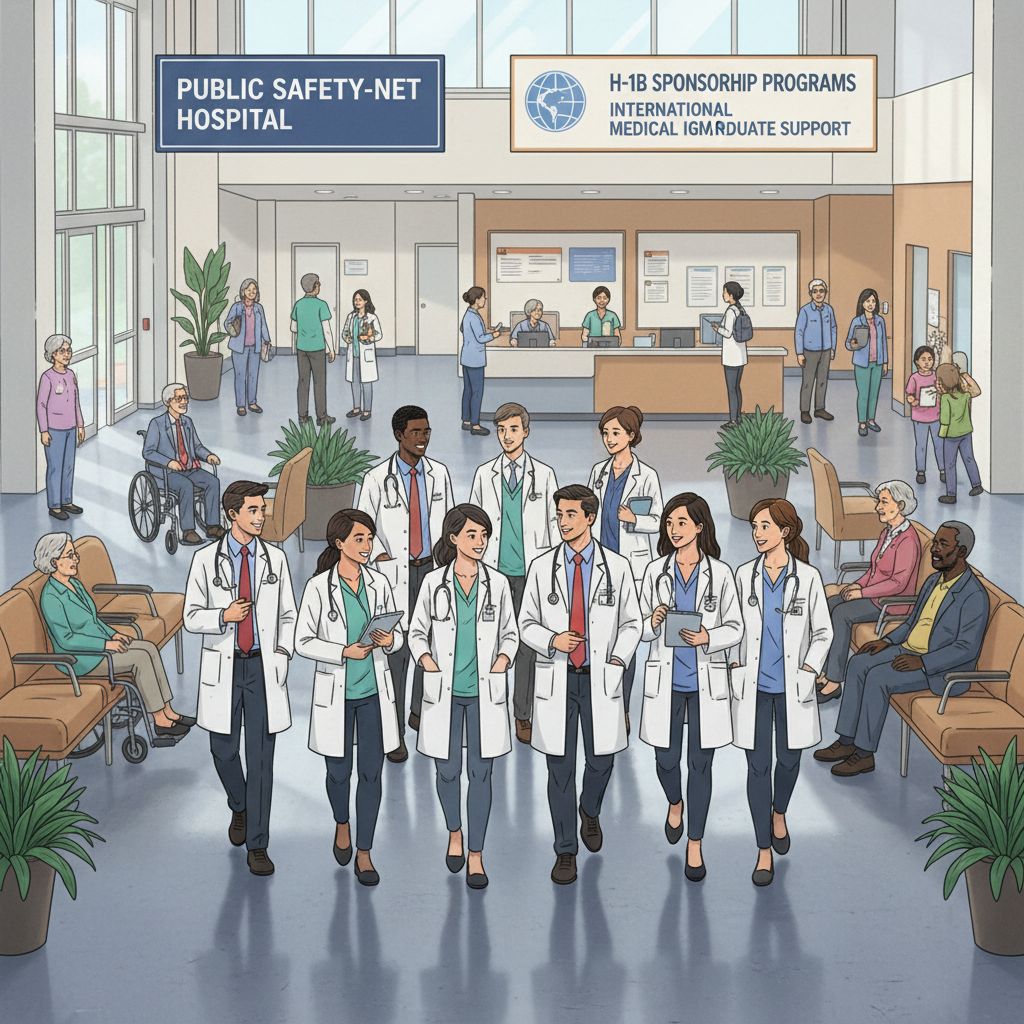
Examples include university-based internal medicine, surgery, and certain subspecialties. These are often cap-exempt and have established legal teams.County and safety-net hospitals with academic affiliations
These institutions serve large underserved and immigrant populations and may be accustomed to sponsoring visas for physicians.Highly specialized fellowships
Cardiology, GI, heme/onc, and other subspecialties sometimes use H-1B to retain strong candidates who are already in the system.
That said, not every program in these categories will sponsor. Visa policy is program-specific, not just institution-specific, and can vary even between departments in the same hospital. You must verify directly.

3. Eligibility Requirements for H-1B Residency Sponsorship in Los Angeles
To receive an H-1B for residency as a foreign national medical graduate, you must meet both USCIS immigration rules and state medical licensing/ECFMG requirements, plus any institutional criteria set by the LA residency program.
3.1 Core H-1B Requirements for Non-US Citizen IMGs
Most LA H-1B residency programs will expect that you have:
Completed medical school
- Degree equivalent to a US MD or DO.
- Verified through ECFMG if you are a non-US citizen IMG.
Full ECFMG Certification
- Passing USMLE Step 1 and Step 2 CK.
- Meeting English language and educational credentials.
USMLE Step 3 Passed Before H-1B Petition Filing
This is critical. Programs cannot file for your H-1B without a Step 3 pass. Practically, this means:- You should plan to take and pass Step 3 before Match or very shortly after, depending on the timeline and the program’s deadlines.
- Many LA programs require Step 3 by Rank Order List certification deadline if you’re seeking H-1B.
State Training License Eligibility
- California has specific requirements for postgraduate training licenses, which may include:
- Minimum number of credit hours
- Primary source verification of medical education
- Programs usually manage the license process, but you must have complete, verifiable documentation in time.
- California has specific requirements for postgraduate training licenses, which may include:
No disqualifying immigration history
- Prior status violations, unlawful presence, or certain J-1 conditions can complicate or block H-1B approval.
3.2 Program-Level Filters Used by LA H-1B Residency Programs
Beyond formal USCIS rules, Los Angeles residency programs often apply internal filters for H-1B sponsorship, such as:
- Higher academic thresholds (e.g., strong USMLE scores, few exam attempts)
- Substantial US clinical experience (USCE) with strong recommendation letters
- Clear evidence of professionalism and communication skills
- A compelling fit with program needs (e.g., long-term academic interests, language skills for local populations, research track record)
In competitive LA markets, H-1B sponsorship is often reserved for the most competitive non-US citizen IMGs because of the extra cost and administrative work. Your goal: move out of the “borderline” group and into the “must-rank, worth-sponsoring” group.
4. Building a Targeted Strategy: Finding H-1B-Friendly LA Residency Programs
4.1 How to Identify H-1B Residency Programs in Los Angeles
There is no official centralized H-1B sponsor list specifically for residency programs, but you can build your own practical list using several approaches:
Program Websites (Visa Policy Section)
- Many LA programs clearly state:
- “We sponsor J-1 and H-1B visas” or
- “We only sponsor J-1 visas” or
- “We accept applications from foreign nationals requiring visa sponsorship but only sponsor J-1 visas.”
- Visit each residency’s website and carefully read the “Eligibility & Visa” or “International Medical Graduates” sections.
- Many LA programs clearly state:
FREIDA & ERAS Program Listings
- FREIDA sometimes lists visa sponsorship types; cross-check with program websites as details can lag.
- On ERAS, some programs describe their visa policies in the program description.
Contact Program Coordinators or GME Office
Write concise, professional emails:- Introduce yourself as a non-US citizen IMG.
- Ask a very specific question, e.g.:
“Does your internal medicine residency currently sponsor H-1B visas for eligible IMGs who have passed USMLE Step 3 prior to the start of residency?” - Avoid broad or generic visa questions; show that you understand the basics.
Use Public USCIS H-1B Data (Advanced)
- USCIS publishes H-1B employer data each year.
- You can search by hospital or university name in the Los Angeles area.
- If you see a program/hospital repeatedly listed as a petitioner for “resident physician” or “internal medicine physician,” it indicates a history of H-1B use.
Leverage Alumni Networks and Social Media
- LinkedIn, specialty-specific IMG groups, and alumni networks from your medical school.
- Ask current or recent residents:
- “Were any IMGs in your program on H-1B?”
- “Did the program help them transition from J-1 to H-1B for fellowship?”
Over time, you’ll develop your own functional H-1B sponsor list for Los Angeles residency programs, which may be more accurate and current than any generic online list.
4.2 Prioritizing Programs in the LA Area
Once you understand which programs are open to H-1B:
Categorize Programs by Visa Policy:
- Category A: Clearly sponsor H-1B and J-1.
- Category B: Primarily J-1 but may consider H-1B on a case-by-case basis.
- Category C: Explicitly J-1 only, no H-1B.
Weigh Program Competitiveness vs. Your Profile:
- Top-tier academic LA programs often have extremely competitive applicant pools.
- If you are a strong applicant (high scores, publications, USCE), you can target more Category A academic programs.
- If your profile is moderate, include:
- Community-based programs with university affiliations.
- Category B programs that have occasionally made exceptions.
Balance Geography with Visa Flexibility:
- Consider greater LA and Southern California (not just central LA) to expand your options.
- Some excellent, slightly less famous programs may be more willing to support H-1B for excellent IMGs.

5. Maximizing Your Competitiveness as a Non-US Citizen IMG for H-1B Sponsorship
5.1 Step 3 Timing and Strategy
To be realistic about H-1B sponsorship in LA, you should plan for:
- Step 3 completed by the time programs are submitting rank lists (or earlier).
- If you’re already in the US (research, observerships, or another visa), consider taking Step 3 even before ERAS submission to signal readiness.
- If you’re abroad, schedule Step 3 at a US test center during a visit, ensuring passport and visa logistics are aligned.
Tell programs in your application:
- Your Step 3 status clearly:
- “Step 3: Completed (Month Year, Score)” or
- “Step 3 scheduled for [date]; results expected by [date].”
- This demonstrates proactivity and seriousness about H-1B.
5.2 Strengthening Your Profile for LA H-1B Residency Programs
To compete in a high-demand location like LA:
Clinical Experience in the US (USCE)
- Aim for hands-on electives or sub-internships in US hospitals.
- Where possible, seek experience in California or similar patient populations (Spanish-speaking communities, underserved settings, large safety-net hospitals).
LORs from US Faculty
- Strong letters from US attending physicians carry significant weight.
- A letter from a faculty member at a well-known California institution can be highly advantageous.
Research, Especially with LA Institutions
- Short-term research positions with LA universities or affiliated hospitals can:
- Build relationships with potential residency programs.
- Demonstrate your commitment to the local academic community.
- Many foreign national medical graduates use research years as a springboard to LA residency.
- Short-term research positions with LA universities or affiliated hospitals can:
Language and Cultural Competence
- LA serves diverse communities: Latinx, Korean, Chinese, Armenian, Filipino, and many others.
- Highlight:
- Additional languages you speak (e.g., Spanish, Korean).
- Experience working with immigrant or underserved populations.
- Programs value physicians who can connect with their specific patient demographics.
Tailored Personal Statement and Application
- Explain why Los Angeles: community ties, research alignment, language, or cultural connection—not just “nice weather.”
- Mention explicitly:
- Your understanding of H-1B requirements.
- Your completed ECFMG status and Step 3 when relevant.
- Example line:
“As a non-US citizen IMG committed to long-term practice in underserved urban communities, I have completed USMLE Step 3 and am fully prepared to begin residency under H-1B sponsorship where institutionally supported.”
5.3 Communicating About H-1B in Interviews
You should not open every conversation by asking “Will you sponsor my H-1B?” But you also can’t ignore it.
Best practices:
- Before interview day, already know the official stance from the website or coordinator.
- During interviews:
- Focus primarily on fit, clinical training, and your goals.
- If appropriate, mention briefly:
“I have completed ECFMG certification and passed Step 3 because I hope to train under an H-1B visa at an institution that supports that pathway.” - If the program has known H-1B sponsorship, you might ask a polite, targeted question in a group info session or to the coordinator, e.g.:
- “For international graduates on H-1B, how does the program help coordinate the transition to fellowship or post-residency positions?”
Avoid sounding like you’re choosing programs only based on visa. Show you are a good fit clinically first; let H-1B be part of a broader professional plan.
6. Long-Term Planning: Post-Residency Options After an LA H-1B Program
The advantage of training in H-1B residency programs—especially in H-1B cap exempt academic centers—is that you gain US experience while keeping a relatively flexible immigration pathway.
6.1 Fellowship on H-1B
Many LA and broader California fellowships are also based in cap-exempt institutions:
- If your residency and fellowship are both in cap-exempt entities (e.g., university hospitals), you may:
- Move from H-1B with one cap-exempt employer to another cap-exempt employer without lottery issues.
- Remain in cap-exempt status for the duration of all training.
6.2 Transition to Employment After Training
After residency/fellowship in Los Angeles:
- If you want to work in private practice or a non-academic hospital (often cap-subject):
- You may need to enter the H-1B lottery unless your employer qualifies as cap-exempt.
- Your total H-1B time (including residency/fellowship) still counts toward the 6-year maximum.
- If you remain in an academic or non-profit teaching hospital:
- You can often continue in cap-exempt H-1B.
- This can provide time to pursue a green card (EB-2, EB-1, etc.).
Planning ahead with your program’s GME office and potential future employers is important so you do not get trapped at the end of training with no status options.
6.3 Avoiding Pitfalls
Common issues for non-US citizen IMGs on H-1B:
- Insufficient H-1B time remaining after long training paths (e.g., 3-year residency + 3-year fellowship).
- Late Step 3 leading to delays or inability to start on time.
- Lack of long-term strategy for moving from cap-exempt to cap-subject employment.
Address these preemptively by:
- Taking Step 3 early.
- Tracking your total time spent in H-1B status.
- Discussing long-term plans with immigration counsel familiar with physician-specific issues.
FAQs: H-1B Sponsorship Programs for Non-US Citizen IMGs in Los Angeles
1. As a non-US citizen IMG, is it realistic to get H-1B sponsorship for residency in Los Angeles?
Yes, it is realistic, but it requires planning and a competitive profile. Several LA academic and county-affiliated programs sponsor H-1B for qualified foreign national medical graduates, especially in core specialties like internal medicine, pediatrics, and sometimes surgery or subspecialties. You must have ECFMG certification, pass USMLE Step 3, and match the program’s academic standards.
2. Do all LA residency programs that accept IMGs also sponsor H-1B visas?
No. Many LA residency programs accept IMGs but only sponsor J-1 visas via ECFMG. Visa policy is program-specific, so you must confirm directly from each program’s website or GME office. Only a subset is willing to act as H-1B residency programs, and some do so only for exceptional candidates or certain departments.
3. How early should I pass Step 3 if I’m targeting H-1B residency programs in Los Angeles?
Ideally, you should pass Step 3 before you submit your ERAS application or, at the latest, before rank lists are certified. Programs cannot file your H-1B petition without Step 3 completion. In a competitive market like Los Angeles, having Step 3 passed early signals seriousness and makes it easier for programs to consider H-1B sponsorship.
4. Are LA academic hospitals considered H-1B cap exempt, and what does that mean for me?
Most major academic medical centers and their directly affiliated teaching hospitals in LA are H-1B cap exempt. This means your residency H-1B is not subject to the annual lottery and can be filed at any time of year within standard timelines. For you as a non-US citizen IMG, this makes H-1B residency more stable during training. However, if you later move to a non-academic or private employer, you may need to navigate the cap-subject lottery unless that future employer is also cap-exempt.
By understanding how H-1B sponsorship works in the specific context of Los Angeles residency programs, and by structuring your preparation—Step 3 timing, USCE, targeted applications—you can significantly increase your chances of training in LA as a non-US citizen IMG under an H-1B visa.