Understanding H-1B Sponsorship in Medical Genetics for Non-US Citizen IMGs
For a non-US citizen IMG or foreign national medical graduate aiming for a career in Medical Genetics in the United States, one of the most strategic questions is: Can I get an H-1B visa for residency? Medical Genetics is a relatively small but rapidly expanding specialty, with increasing focus on genomic medicine, personalized therapies, and rare disease diagnosis. This growth is slowly opening more doors for international applicants, including H-1B opportunities.
This article breaks down how H-1B sponsorship programs in Medical Genetics residency and fellowship work, which institutions are commonly H-1B friendly, and how you can proactively increase your chances of securing a position that will sponsor you. The focus is specifically on non-US citizen IMGs and foreign national medical graduates applying to Medical Genetics & Genomics pathways.
1. H-1B vs J-1 for Medical Genetics: What a Non-US Citizen IMG Should Know
Most foreign national residents in the US train on J-1 visas sponsored by the ECFMG. However, many non-US citizen IMGs specifically seek H-1B residency programs because of future immigration goals, including avoiding the J-1 two-year home-residency requirement.
1.1 Key Differences: H-1B vs J-1 for Medical Training
J-1 Physician Visa:
- Sponsored by ECFMG (not the hospital)
- Requires return to home country for 2 years after training unless you obtain a J-1 waiver (e.g., Conrad 30)
- Commonly used for residency and fellowship in all specialties, including Medical Genetics
- Easier for many smaller programs because they don’t handle immigration paperwork directly
H-1B Visa (Temporary Specialty Worker):
- Employer-sponsored (hospital/university is the petitioner)
- No automatic 2-year home-return requirement
- Time-limited: generally up to 6 years total
- For residency, usually requires:
- Passing USMLE Step 3 before H-1B filing
- Valid state medical license or eligibility (often requires the same documents as full licensure)
- Higher administrative and legal cost to institutions
- More common at large academic medical centers and university hospitals
For a non-US citizen IMG planning a long-term US career in Clinical Genetics, Laboratory Genetics, or Medical Biochemical Genetics, the H-1B route can be strategically advantageous.
2. Training Pathways in Medical Genetics and H-1B Implications
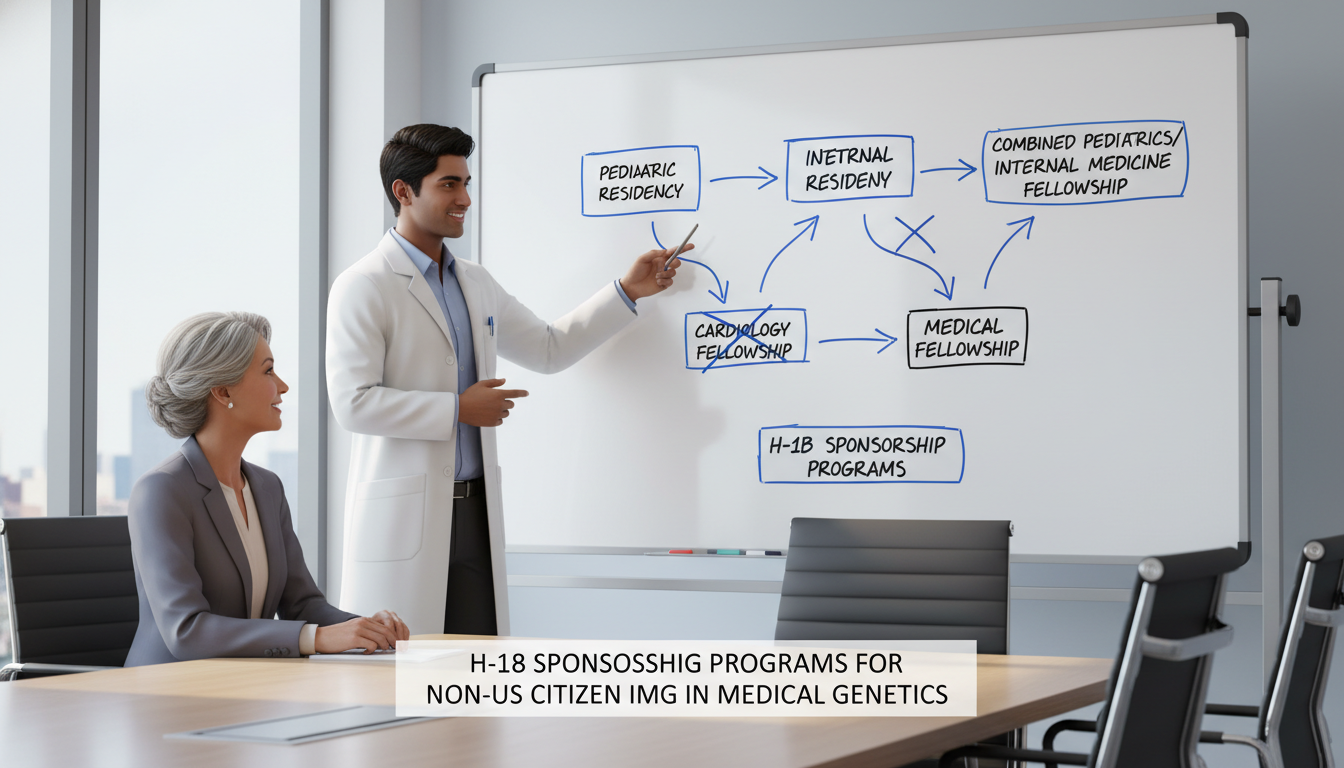
Medical Genetics is now usually pursued through integrated or combined pathways. Understanding the structure helps you anticipate at which stage H-1B matters most.
2.1 Main Training Routes in Medical Genetics
Common routes to become a board-certified Medical Geneticist include:
Combined Pediatrics–Medical Genetics (Peds/Genetics)
- 4–5 years combined program
- Graduates are eligible in both Pediatrics and Medical Genetics
- Many also do Genetics fellowship stages at the same academic center
Combined Internal Medicine–Medical Genetics (IM/Genetics)
- 4–5 years combined program
- Less common than Peds/Genetics, but present at several large institutions
Medical Genetics & Genomics Residency (After Prior Residency)
- 2-year program following completion of a primary residency (e.g., Pediatrics, Internal Medicine, OB-GYN, etc.)
- Often treated like a fellowship in terms of visa and salary structures
Laboratory-based Genetics Programs
- Molecular Genetic Pathology
- Laboratory Genetics and Genomics
- Cytogenetics (now merged under broader categories)
- Typically pursued after residency (Pathology, Medical Genetics, etc.)
2.2 Where H-1B Is Most Often Used in Genetics
H-1B can appear in several stages:
Primary residency (Pediatrics or Internal Medicine):
- Some IMGs secure an H-1B from the beginning of their categorical residency.
- They then continue in H-1B status when they enter a Genetics residency/fellowship at the same or another H-1B-cap-exempt academic institution.
Combined programs (Med/Peds–Genetics):
- Often sponsored entirely by large university hospitals.
- If a program is H-1B-friendly, they may file one or more sequential H-1Bs to cover the integrated period.
Genetics residency or fellowship after another specialty:
- If you are already on H-1B at a university hospital, transferring to a genetics residency in another academic institution is typically easier (still requires an H-1B petition but independent of the annual H-1B cap if both are cap-exempt).
- Some programs will sponsor H-1B even if you are coming from J-1 or outside the US, but this is less frequent.
3. Understanding H-1B Sponsor List and Cap-Exempt Status in Medical Genetics
Non-US citizen IMGs frequently ask for a “H-1B sponsor list” for residency. While there is no official, constantly updated universal list, you can identify likely H-1B-friendly genetics programs using some principles.
3.1 What Is H-1B Cap-Exempt and Why It Matters
The standard H-1B is subject to an annual cap (65,000 + 20,000 for US master’s/PhD holders), drawn via a lottery. However, most US residency and fellowship programs at major teaching hospitals are H-1B cap exempt, meaning:
- They can file an H-1B petition anytime during the year
- They are not subject to the numerical lottery
- They’re usually:
- Non-profit hospitals affiliated with a university
- University-based medical centers
- Research organizations
For Medical Genetics, which is heavily concentrated at major academic centers, many institutions are naturally H-1B cap exempt. This is a major advantage for you as a non-US citizen IMG, because:
- You avoid the uncertainty of the H-1B lottery
- Employers can extend or transfer your H-1B more flexibly
- You can progress from residency to genetics fellowship often within cap-exempt institutions
3.2 Typical Types of Institutions That Sponsor H-1B for Genetics
While practices vary, the following types of institutions are more likely to appear on a functional H-1B sponsor list for medical genetics residency and fellowships:
- Large university hospitals (state universities, Ivy League, major private universities)
- Children’s hospitals that are academic affiliates with a university
- Cancer centers with strong genomic medicine divisions (often employ geneticists and sponsor H-1Bs for physician-scientists)
- Institutes of genomic medicine or rare disease centers within academic health systems
Programs at community-based hospitals without prior IMG history are least likely to sponsor an H-1B for a genetics resident.
3.3 How to Build Your Own Practical H-1B Sponsor List
Because public, centralized lists quickly become outdated, you should construct your own up-to-date list tailored to Genetics:
Start with the ACGME program list for:
- Medical Genetics and Genomics
- Combined Pediatrics–Genetics
- Combined Internal Medicine–Genetics
- Laboratory Genetics and Genomics
(Visit ACGME or ABMGG sites and download/search program lists.)
For each program, check:
- Is it at a university hospital or major academic center?
- Does the institution generally sponsor H-1B for other specialties (IM, Peds, Pathology)?
Search targeted queries:
"[Institution Name] H-1B residency visa policy""[Institution Name] GME visa sponsorship""[Institution Name] international medical graduate H-1B"
Examine GME or program websites:
- Many list policies clearly:
- “We sponsor both J-1 and H-1B for eligible residents”
- “We only sponsor J-1”
- “We do not sponsor visas”
- Look for explicit mention of:
- USMLE Step 3 requirement
- Deadlines for H-1B paperwork
- Many list policies clearly:
E-mail program coordinators specifically about H-1B:
- Ask before applying, especially if application fees and limited ERAS slots matter.
- Phrase your question clearly:
“As a non-US citizen IMG with/without current US visa status, does your Medical Genetics (or Peds/Genetics) residency sponsor H-1B visas for eligible applicants, provided they have Step 3 completed?”
Collect and update this data into your own spreadsheet. This becomes your practical H-1B sponsor list tailored to Medical Genetics.
4. Requirements and Strategies to Secure H-1B in Medical Genetics
Even at H-1B-friendly institutions, not every non-US citizen IMG will qualify. You must strategically plan your profile and application to meet common requirements.
4.1 Core Requirements for H-1B Residency or Fellowship
Most H-1B residency programs in Medical Genetics or its feeder specialties (Pediatrics, IM, Pathology) require:
USMLE Step 3 Passed
- Must be completed before H-1B petition filing; some programs want it before ranking.
- As a foreign national medical graduate, taking Step 3 early (often during or immediately after a preliminary PGY-1 year) is crucial.
ECFMG Certification
- Required for any IMG entering US residency, regardless of visa type.
Eligibility for State Medical License or Training License
- H-1B often requires proof you meet the criteria for state licensure.
- Requirements vary by state; some require a certain number of prior training years.
No existing J-1 obligations
- If you’ve already been on a J-1 visa in the US for graduate medical education, shifting directly to H-1B may be restricted by the 2-year home residency requirement, unless you secure a waiver.
Institutional policies and GME approval
- Some GME offices cap the number of H-1B residents or restrict H-1B to “hard-to-fill” specialties.
4.2 Strategic Steps for Non-US Citizen IMGs Targeting H-1B in Genetics
1. Plan Your Timeline Around Step 3
- Aim to pass Step 3 as early as feasible:
- If still outside the US, consider taking Step 3 after ECFMG certification and some USCE.
- If already on a J-1 in a different training program, consider whether your long-term plan involves a J-1 waiver route instead of switching to H-1B.
Actionable tip:
Build a 12–18 month preparation schedule that includes Step 3 well before ERAS application for Genetics or your first residency.
2. Start with an H-1B-Friendly Primary Residency
Because Medical Genetics residencies are small, many non-US citizen IMGs strategically:
- Secure an H-1B for Internal Medicine or Pediatrics at a H-1B-friendly, cap-exempt institution.
- Develop strong clinical and research experience in:
- Inherited diseases
- Metabolic disorders
- Genomic diagnostics
- Then apply to a Genetics residency or fellowship at the same or another H-1B-cap-exempt center.
This path:
- Establishes your track record as a resident in the US system.
- Makes programs more comfortable sponsoring an H-1B continuation rather than a brand-new petition.
3. Build Genetics-Focused Credentials
Medical Genetics is small but academically intense. To stand out:
- Pursue research in genetics or genomics:
- Case series in rare diseases
- Exome sequencing projects
- Collaborations with genetic counsellors or lab scientists
- Obtain US clinical experience (USCE) in:
- Genetics clinics
- High-risk OB/fetal medicine with genetics emphasis
- Metabolic clinics or NICU with metabolic/genetic consults
- Get letters from:
- Board-certified medical geneticists
- Pediatric or internal medicine faculty with strong genetics affiliations
Programs more readily invest in H-1B sponsorship for applicants who clearly demonstrate a serious, long-term commitment to genetics.
4. Highlight Long-Term Institutional Fit
When you discuss your H-1B expectations with programs (in e-mails or interviews):
- Emphasize your desire to stay in academic genetics, potentially in:
- Clinical roles
- Lab-based roles
- Physician-scientist tracks
- Mention alignment with the institution’s:
- Rare disease clinics
- Genomics initiatives
- Newborn screening programs
Institutions are more likely to sponsor H-1B for candidates who may:
- Stay for additional years (fellowship, junior faculty)
- Contribute to research output and specialized clinics

5. Contacting Programs and Presenting Yourself as an H-1B Candidate
As a non-US citizen IMG, your approach to communication and transparency about visa needs can significantly influence your success in the genetics match.
5.1 How and When to Ask About H-1B for Genetics
Before the ERAS season:
- Identify your top 20–30 programs (Peds, IM, or Genetics direct) known or likely to be H-1B-cap exempt.
- E-mail their coordinators or program directors with:
- Your brief background (foreign national medical graduate, ECFMG-certified)
- Your exam status (Step 1, 2 CK, 3)
- A direct question about H-1B sponsorship
Sample concise e-mail template:
Subject: Inquiry About H-1B Sponsorship for Medical Genetics
Dear [Coordinator/Dr. X],
I am a non-US citizen IMG (ECFMG-certified) with a strong interest in Medical Genetics. I plan to apply to your [Pediatrics/IM/Medical Genetics] residency program this upcoming ERAS cycle. I have passed USMLE Steps 1 and 2 CK, and expect to complete Step 3 by [month, year].
Could you please let me know whether your GME office sponsors H-1B visas for eligible residents, including those in [Pediatrics/IM/Medical Genetics]?
Thank you very much for your time and guidance.
Sincerely,
[Your Name, Credentials]
Document their responses. Some programs will say:
- “Yes, we sponsor H-1B for eligible candidates.”
- “We generally prefer J-1 but may consider H-1B in certain cases.”
- “We do not sponsor H-1B; we only accept J-1.”
Use this to refine your program list and ERAS strategy.
5.2 Addressing Visa and Long-Term Goals in Interviews
Prepare to discuss:
- Why you prefer H-1B:
- Honest but professional: long-term career in the US, desire to avoid J-1 home requirement, interest in academic career requiring continuity.
- Your long-term vision:
- Example: “I hope to complete Pediatrics and Medical Genetics training and then continue with a career in academic genomics, focusing on metabolic disorders and newborn screening in a university setting.”
- Reassurances:
- You understand H-1B requirements and Step 3
- You are willing to work with institutional attorneys and complete paperwork promptly
Avoid framing H-1B purely as a personal immigration need; instead, connect it to academic continuity and patient care.
5.3 Negotiating the Transition Between Primary Residency and Genetics
If you are already in an H-1B-sponsored residency:
- Discuss your intention to apply for a Genetics residency/fellowship with:
- Your current Program Director
- The GME office
- Ask whether:
- Your current institution offers Genetics training (you might stay there).
- They will support an H-1B amendment/extension for your Genetics years.
- If moving institutions, confirm:
- The receiving Genetics program will file an “H-1B transfer” petition.
- There is no gap in status between your current and future positions.
6. Common Pitfalls and How to Avoid Them as an H-1B-Seeking IMG in Genetics
6.1 Applying Broadly Without Checking Visa Policies
Many non-US citizen IMGs waste ERAS applications on programs that categorically do not sponsor H-1B. In a niche field like Medical Genetics, this is especially risky.
Solution:
Do the visa policy research early. Prioritize programs:
- At large academic centers
- With explicit H-1B or IMG-friendly policies
- With history of employing international faculty in genetics/genomics
6.2 Ignoring State Licensing Requirements for H-1B
Some states require:
- More pre-residency training
- Additional documentation for foreign graduates
Solution:
Review the state medical board requirements where your target Genetics programs are located. Confirm with the GME office that you are license-eligible for an H-1B petition.
6.3 Delaying USMLE Step 3
Without Step 3, most institutions cannot file H-1B for residency. You may match but then be constrained to J-1.
Solution:
Plan Step 3 early enough that:
- Score is available by the time rank lists are made (for first residency)
- Or by the time Genetics fellowship applications begin
6.4 Not Using Cap-Exempt H-1B to Your Advantage
If you are already in a cap-exempt H-1B position:
- You can usually transfer to another cap-exempt medical genetics or academic position without the lottery.
- This flexibility is a major strategic asset.
Solution:
When planning your career progression (residency → genetics → faculty), try to remain within the cap-exempt ecosystem (university hospitals, major academic centers).
FAQs: H-1B Sponsorship in Medical Genetics for Non-US Citizen IMGs
1. As a non-US citizen IMG, can I match directly into a Medical Genetics residency on an H-1B visa?
Yes, it is possible but less common than J-1. Programs that sponsor H-1B are usually large academic, cap-exempt institutions. They will require USMLE Step 3, ECFMG certification, and state licensure eligibility. Because Medical Genetics programs are small, many IMGs first enter Pediatrics or Internal Medicine on H-1B and then move into Genetics.
2. Is Medical Genetics considered H-1B cap exempt?
The specialty itself is not what determines cap-exempt status. Cap-exempt depends on the employer type. Most Medical Genetics residency and fellowship programs are based at university hospitals or non-profit academic centers, which are H-1B cap exempt. That means they can sponsor H-1B without the annual lottery, a major advantage for a foreign national medical graduate.
3. Where can I find an official H-1B sponsor list for Medical Genetics residency programs?
There is no single official, continuously updated list specific to medical genetics. Instead, you should:
- Use ACGME and ABMGG program lists to identify genetics and combined programs.
- Check each institution’s GME website for visa policies.
- E-mail coordinators to confirm whether they sponsor H-1B for residents/fellows. Over time, this becomes your personal, current H-1B sponsor list focused on Medical Genetics.
4. If I complete residency on a J-1, can I switch to H-1B for Medical Genetics fellowship?
In most cases, no—if you were on a J-1 physician visa, you will have a 2-year home country residence requirement unless you obtain a J-1 waiver. Until that requirement is met or waived, you generally cannot change status to H-1B in the US. Some physicians pursue a J-1 waiver job after training and then later transition into genetics-related academic roles, but this is more complex and individualized. You should discuss such plans with an experienced immigration attorney.
By understanding the intersection of H-1B residency programs, H-1B cap exempt institutions, and the specific structure of Medical Genetics training, a non-US citizen IMG can design a realistic, strategic pathway into this rapidly evolving and intellectually rewarding specialty in the United States.