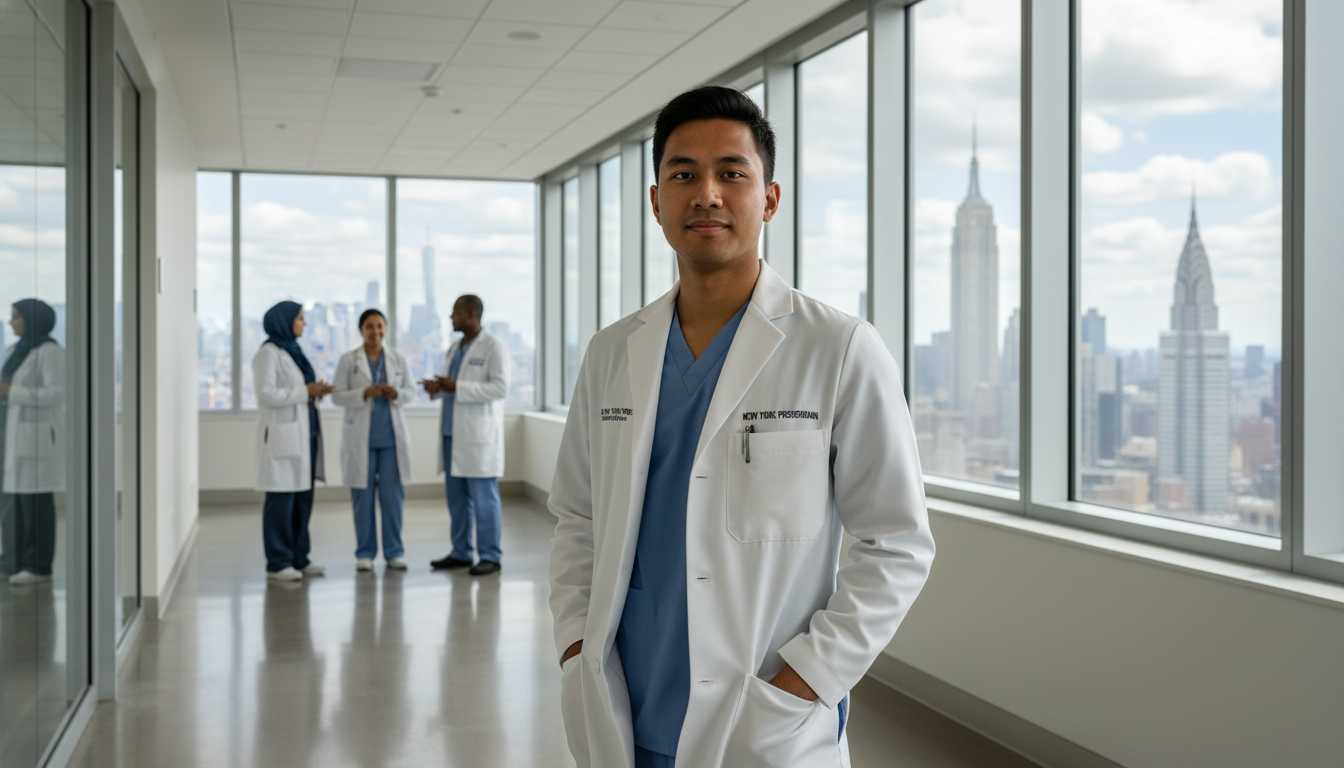
Understanding H-1B Sponsorship for Non‑US Citizen IMGs in NYC
For a non-US citizen IMG, New York City is one of the most attractive—and competitive—destinations for residency. It offers enormous clinical volume, diverse patient populations, and many academic hospitals familiar with international graduates. But if you are a foreign national medical graduate who prefers an H‑1B visa over a J‑1, you need to be especially strategic.
This article explains how H‑1B residency programs work in New York City, which types of institutions are more likely to sponsor, how the H‑1B cap exempt rules help residency applicants, and how you can strengthen your application as a non‑US citizen IMG. You will also find a practical, NYC‑focused H‑1B sponsor list framework, examples, and FAQs.
J‑1 vs H‑1B for IMGs in New York City
Before focusing on specific NYC residency programs, you need a clear understanding of how H‑1B differs from J‑1 and why programs may prefer one over the other.
J‑1: The Default Visa for Most IMGs
Most New York City residency and fellowship positions that take IMGs are filled on J‑1 visas sponsored through the ECFMG. Key points:
- Pros
- Well‑established pathway; most GME offices are very familiar with it.
- No prevailing wage or complex Department of Labor (DOL) process.
- Available for most residency and fellowship specialties.
- Cons
- Usually requires a two‑year home country physical presence after training or a waiver (e.g., underserved area jobs).
- Can limit portability and long‑term planning if you want to stay directly in the US after training.
For many IMGs, especially those open to working in underserved areas after training, J‑1 is acceptable and often simpler.
H‑1B: Attractive but More Complex
An H‑1B residency position allows you to train as a “temporary worker in a specialty occupation.” For a foreign national medical graduate, the H‑1B can offer:
- Pros
- No automatic two‑year home return requirement.
- Often perceived as a more direct bridge toward long‑term work and, later, permanent residency.
- Flexibility to transition to hospitalist or attending roles without J‑1 waiver constraints.
- Cons
- More expensive and administratively complex for programs (legal fees, prevailing wage, DOL and USCIS filings).
- Requires USMLE Step 3 passed before H‑1B filing (for most GME offices).
- Some specialties and institutions in NYC have strict “J‑1 only” policies.
Because of these challenges, H‑1B residency programs are fewer in number and more competitive, especially in highly desired locations like New York City.
The Legal Framework: H‑1B Cap Exempt and Academic Hospitals in NYC
A critical concept for residency applicants is the H‑1B cap exempt status. Understanding this will help you read between the lines when researching NYC programs.
H‑1B Cap vs Cap‑Exempt
Regular H‑1B (cap-subject):
- Limited annual quota.
- Lottery process (usually in March).
- Common for private companies and non‑teaching hospitals.
H‑1B cap exempt:
- Not subject to the annual quota or lottery.
- Can be filed at any time of the year.
- Generally applies to:
- Non‑profit institutions of higher education.
- Non‑profit entities affiliated with such institutions.
- Non‑profit or governmental research organizations.
Most large academic medical centers and teaching hospitals in NYC fall into these cap‑exempt categories. This is crucial: NYC residency programs that are part of universities or closely affiliated teaching hospitals can usually file H‑1B petitions outside the lottery, which makes sponsorship more feasible.
How This Plays Out in New York City
In New York City, major teaching hospitals linked to universities (e.g., Columbia, NYU, Mount Sinai, etc.) are typically H‑1B cap exempt. This means:
- They can sponsor H‑1B visas directly for residency and fellowship without worrying about the yearly quota.
- Processing timelines are more predictable and can align with July 1 start dates.
- Their GME offices often have established workflows for H‑1B, especially for hard‑to‑recruit specialties or highly competitive candidates.
However, being cap‑exempt does not mean the program must sponsor H‑1B. Every institution sets its own internal policy (e.g., “J‑1 only,” “H‑1B case‑by‑case,” or “H‑1B encouraged”).

NYC Landscape: Types of H‑1B-Friendly Residency Programs
Because individual program policies change frequently, no list is perfectly stable. Instead, it’s more useful to understand which categories of NYC residency programs tend to sponsor H‑1B and how to build your own up‑to‑date H‑1B sponsor list each season.
1. Large University‑Affiliated Academic Centers
These are your best starting point if you are a non‑US citizen IMG seeking H‑1B residency in New York City. They are:
- Usually H‑1B cap exempt.
- Home to many subspecialties and fellowships.
- Experienced with complex immigration scenarios (e.g., J‑2, F‑1 OPT/EAD, H‑4, O‑1, and H‑1B).
In NYC, examples of this category (for research purposes, not guarantees of current sponsorship) include:
- Large university‑hospital systems in Manhattan, Brooklyn, Queens, and the Bronx.
- Teaching hospitals that explicitly mention H‑1B on their GME or residency program pages.
- Institutions with high IMG representation across various specialties.
Patterns:
- Internal medicine, pediatrics, psychiatry, and neurology often have at least some H‑1B slots in these centers.
- Surgical specialties are more variable; some strongly prefer US graduates but may sponsor H‑1B for exceptional candidates.
2. Community Hospitals with Academic Affiliation
Several NYC community hospitals have formal affiliations with universities and may also be H‑1B cap exempt through that relationship. For the foreign national medical graduate, these institutions may be more welcoming, particularly in primary care specialties.
Characteristics:
- Often serve high‑need, immigrant, or underserved populations.
- Heavy reliance on IMGs for patient care services.
- Policies sometimes more flexible than top‑tier academic departments, but funding constraints can limit H‑1B sponsorship.
Patterns:
- They may accept J‑1 and H‑1B but set a cap on H‑1B slots per year for budget reasons.
- They might only sponsor H‑1B for upper‑level transfers, chief residents, or candidates with strong research or US clinical experience.
3. NYC Safety‑Net and Public Hospitals
Public systems and safety‑net institutions in NYC care for large uninsured and immigrant populations and attract many IMGs. Their H‑1B policies vary:
- Some rely heavily on J‑1 because it is less costly and administratively simpler.
- Others, especially those affiliated with medical schools, will sponsor H‑1B for selected residents, particularly in internal medicine, psychiatry, and pediatrics.
These institutions are often mission‑driven and value language skills and cultural competence, which can be a strong advantage for non‑US citizen IMGs.
4. Private or Non‑Teaching Hospitals
Purely private non‑teaching hospitals in NYC typically:
- Do not offer residency training, or
- Offer limited numbers of accredited programs with stricter visa policies.
These are not usually the primary target for residency applicants seeking H‑1B in NYC, although they may become relevant after residency (for attending positions on H‑1B).
How to Build a Real‑Time NYC H‑1B Sponsor List
Because policies and leadership change, you need a dynamic approach instead of relying solely on a static H‑1B sponsor list you find online.
Step 1: Use FREIDA and Program Websites
- Go to the AMA FREIDA database.
- Filter:
- “Accepts IMGs” or “Accepts international graduates.”
- Region: New York; focus on NYC boroughs (Manhattan, Brooklyn, Queens, Bronx, Staten Island).
- For each program of interest:
- Open their official GME or residency site.
- Check “Eligibility and Visa Sponsorship” or “For International Medical Graduates” sections.
You are looking for language like:
- “We sponsor J‑1 and H‑1B visas.”
- “We sponsor H‑1B visas on a case‑by‑case basis.”
- “We only sponsor J‑1 visas through ECFMG (no H‑1B).”
Document this in a personal spreadsheet with columns such as:
- Program name.
- Specialty.
- Visa policy (explicit).
- H‑1B in recent years? (yes/no/unclear).
- Notes (e.g., Step 3 requirement, previous IMG comments).
Step 2: Cross‑Check with GME/HR Offices
If the website is unclear:
- Email the program coordinator or GME office directly.
- Use a concise, professional template:
Dear [Name or Program Coordinator],
I am an international medical graduate planning to apply to your [specialty] residency program this year. I am a non‑US citizen IMG and would require visa sponsorship.
Could you please confirm whether your program sponsors H‑1B visas for incoming PGY‑1 residents, or if J‑1 is the only visa option? If H‑1B is possible, is USMLE Step 3 required before ranking?
Thank you very much for your time and guidance.
Sincerely,
[Your Name], MD
Most programs respond with a clear policy statement. Record each answer in your spreadsheet.
Step 3: Talk to Current and Recent Residents
Use:
- LinkedIn.
- Alumni networks from your medical school.
- Social media groups (e.g., Facebook/WhatsApp groups for IMGs in NYC).
Ask targeted questions:
- “Are there any residents currently on H‑1B in your program?”
- “Did anyone in your last 2–3 classes match directly on H‑1B?”
- “Did the program require USMLE Step 3 before ranking?”
These firsthand reports often reveal nuances such as:
- Programs that theoretically sponsor H‑1B but haven’t done so in years.
- Programs that sponsor H‑1B mainly for upper‑level transfers or fellows.
- Specialties within a hospital system that have different visa policies.

Requirements and Timelines for H‑1B Residency in NYC
Even at H‑1B‑friendly institutions, there are strict requirements. As a non‑US citizen IMG planning for New York City residency, you must prepare early.
Core Eligibility Requirements
Most H‑1B residency programs in NYC require:
- USMLE Step 1 and Step 2 CK passed
- Usually required for ECFMG certification and residency application.
- USMLE Step 3 passed
- Many GME offices require Step 3 before they will even initiate an H‑1B petition for residency.
- Some allow Step 3 after match but before visa filing, which is extremely tight.
- Valid ECFMG certification by the time of visa filing.
- Credential evaluation
- Your medical degree must be equivalent to a US MD (ECFMG handles this in most cases).
- State license eligibility
- For residency, this is generally a training permit or limited license in New York, with specific rules that the GME office will coordinate.
Because H‑1B is a “specialty occupation” visa, USCIS wants evidence that you are entering a professional role that requires an advanced degree and licensure. Residency training meets this standard, but all documentation must be aligned.
Timelines: Matching H‑1B and Residency Start Dates
Typical sequence for a PGY‑1 spot:
- September–February: Apply and interview.
- March: Match results.
- March–April: Program gathers documents for H‑1B filing (passport, diplomas, ECFMG certificate, Step 3, etc.).
- April–May: H‑1B petition filed with USCIS (often using premium processing to ensure a quick decision).
- May–June: Visa approval and consular processing (if abroad) or change‑of‑status (if already in the US in a valid status).
- July 1: Residency start date.
Because of this tight schedule, having USMLE Step 3 completed before January of your application cycle is ideal if you are targeting H‑1B residency programs in NYC. Without Step 3, many programs will not consider H‑1B sponsorship, no matter how strong your profile is.
Strategy: Maximizing Your Chances as a Non‑US Citizen IMG
1. Decide Early: H‑1B Only, J‑1 Only, or Flexible?
You should clearly define your stance before ERAS submission:
- H‑1B only:
- Highly restrictive, especially even within NYC.
- Limits program list substantially and may reduce your overall match probability.
- Prefer H‑1B but accept J‑1:
- Realistic for most foreign national medical graduates.
- You can apply widely but prioritize H‑1B‑friendly programs at the top of your rank list.
- Open to either equally:
- Maximizes match chance but requires acceptance of J‑1 obligations.
A common approach for many non‑US citizen IMGs is to prioritize H‑1B in New York City and other large academic centers, while including J‑1 programs to avoid being left unmatched.
2. Build a Balanced Program List in NYC and Beyond
For NYC specifically, consider:
- Tier 1: Clearly H‑1B‑friendly NYC programs
- Programs that explicitly state they sponsor H‑1B and have recent residents on that visa.
- Tier 2: NYC programs that “may” sponsor H‑1B case‑by‑case
- Good to apply if your profile is very strong (high scores, US clinical experience, research).
- Tier 3: J‑1‑only NYC programs
- Apply if NYC location is your top priority and you are open to J‑1.
Add a similar structure for other regions (New Jersey, Connecticut, Pennsylvania, etc.) to avoid over‑concentrating your applications in one city.
3. Strengthen Your Profile for H‑1B-Sponsoring Programs
H‑1B‑friendly programs are often selective. To stand out:
- Take and pass USMLE Step 3 early
- This is one of the single strongest signals that you are serious about H‑1B.
- Gain US clinical experience (USCE) in teaching hospitals
- Ideally in NYC or another major US city.
- Form strong relationships and obtain detailed letters of recommendation.
- Emphasize language and cultural skills
- NYC serves patients speaking dozens of languages.
- Highlight your ability to care for diverse immigrant populations—this aligns with the missions of many New York City residency programs.
- Show academic or research productivity
- Publications, QI projects, presentations.
- Particularly helpful at university‑based, research‑intensive programs.
4. Communicate Clearly During Interviews
During interviews:
- If asked directly about visa needs, answer honestly:
- “I am a non‑US citizen IMG and will require visa sponsorship. I have already passed USMLE Step 3 and am eligible for H‑1B.”
- Emphasize flexibility if you are open to both:
- “I would prefer H‑1B if possible, but I understand that many NYC programs use J‑1, and I am willing to consider either option depending on your institutional policy.”
Avoid long visa discussions unless the interviewer brings it up. Program coordinators and GME offices, not faculty, handle visa logistics—but your clarity and preparation reflect well on you.
Common Pitfalls and How to Avoid Them
Pitfall 1: Assuming All NYC Programs Sponsor H‑1B Because They Are Academic
Reality:
Some New York City residency programs are J‑1 only by policy, even at large university hospitals. They may list this clearly on their websites or in FREIDA. Always verify.
Pitfall 2: Taking Step 3 Too Late
If you sit for Step 3 in March or April of your match year:
- You may not have your score report ready when the GME office needs it to file the H‑1B petition.
- This can force the program to revert you to J‑1 or, in worst cases, jeopardize your position.
Aim to finish Step 3 at least several months before match if H‑1B is your goal.
Pitfall 3: Relying on Outdated H‑1B Sponsor Lists
Residency programs change leadership, funding, and policies frequently. A hospital that sponsored H‑1B three years ago might now be J‑1 only. Use old lists only as starting points, then:
- Confirm on websites.
- Email coordinators.
- Cross‑check with current residents.
Pitfall 4: Over‑Restricting Your Application to NYC Only
NYC is very competitive. Limiting your applications exclusively to New York City residency programs that sponsor H‑1B can be risky, even for strong applicants. To protect yourself:
- Apply to a mix of NYC and non‑NYC programs.
- Consider nearby states with H‑1B‑friendly programs (New Jersey, Connecticut, Pennsylvania).
- Aim for enough total applications (often 60–100+ for competitive IMGs, depending on specialty and profile).
FAQs: H‑1B Sponsorship for Non‑US Citizen IMGs in New York City
1. Is it realistic for a non‑US citizen IMG to match into an H‑1B residency program in NYC?
Yes, but it is competitive and requires planning. Many New York City residency programs sponsor H‑1B, especially in large academic centers, but they often expect:
- Strong USMLE scores (including Step 3).
- US clinical experience.
- Solid letters of recommendation.
- Clear communication about your visa status.
You must target your applications thoughtfully and be prepared with Step 3 early.
2. Do I absolutely need USMLE Step 3 for H‑1B sponsorship in New York City?
In almost all cases, yes. For residency H‑1B, most NYC programs require:
- Step 3 passed before the H‑1B petition is filed.
- Some will not rank an applicant for H‑1B unless Step 3 is already passed.
Technically, USCIS does allow some flexibility, but GME offices have their own internal policies. Treat Step 3 as a practical requirement if you want H‑1B.
3. Are H‑1B residency programs in NYC subject to the annual H‑1B cap and lottery?
Most residency positions in academic NYC hospitals are H‑1B cap exempt, because the employers are non‑profit institutions of higher education or affiliates. This means:
- No lottery.
- No cap competition with tech or corporate jobs.
- Filings can be done year‑round to match the residency start date.
Always confirm with the individual institution, but nearly all major university‑affiliated NYC hospitals fall in the cap‑exempt category.
4. If I match into a J‑1 residency in NYC, can I later switch to H‑1B?
Switching from J‑1 to H‑1B during or right after residency is usually complicated because of the two‑year home country physical presence requirement tied to J‑1. You typically must:
- Fulfill the two‑year home requirement, or
- Obtain a waiver (e.g., J‑1 waiver jobs in underserved or government settings).
There are narrow exceptions, but you should not count on an easy switch. If your long‑term plan relies on H‑1B, prioritize programs willing to sponsor you on H‑1B from the start.
For a non‑US citizen IMG set on training in New York City, H‑1B sponsorship is achievable with the right strategy: early Step 3, targeted applications, careful research of NYC residency programs, and clear communication of your visa needs. Use the concepts in this guide to create your own, up‑to‑date H‑1B sponsor list, and approach the match with both ambition and realism.