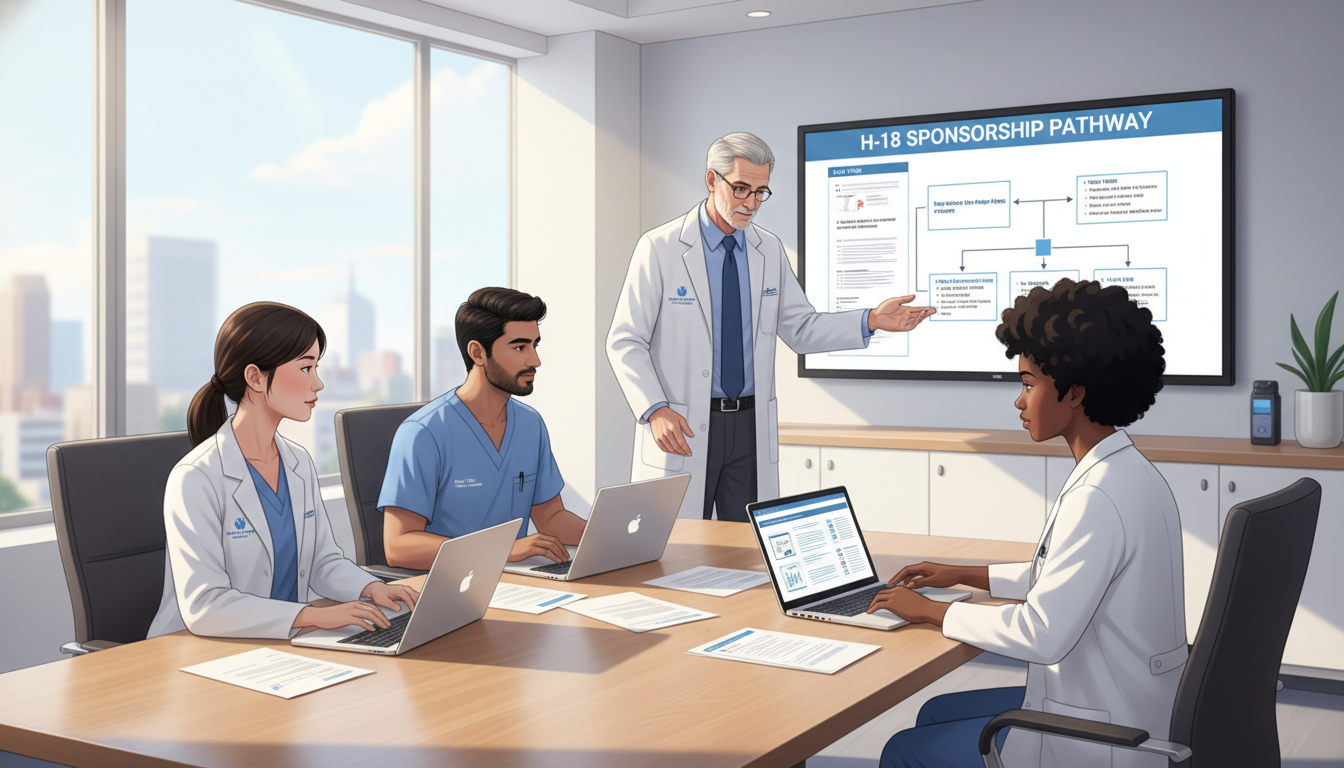
Understanding H-1B Sponsorship for Non-US Citizen IMGs in Pediatrics-Psychiatry
For a non-US citizen IMG interested in pediatrics-psychiatry or a triple board residency, the question of H-1B sponsorship is just as important as program reputation or research opportunities. Visa policy will shape where you can apply, how you plan your exams, and what your long-term career looks like in the US.
This article walks you step-by-step through:
- How the H-1B visa works in residency training
- What’s unique about peds psych and triple board pathways
- How to find and evaluate H-1B residency programs and build your own “H-1B sponsor list”
- Application strategies tailored specifically to the foreign national medical graduate in this niche field
The focus is practical: what to do, when to do it, and how to avoid common pitfalls as a non-US citizen IMG.
1. The Basics: H-1B Visa and IMGs in Residency
1.1 What is the H-1B for Residency?
The H-1B is a temporary employment visa for “specialty occupations,” which includes physicians in ACGME-accredited training. For IMGs in residency, the key points are:
- You are a paid employee of the hospital or institution (not a trainee on an exchange program like J-1).
- The program must apply for and sponsor your H-1B petition with USCIS.
- You must meet all licensing requirements, including specific USMLE steps, before H-1B approval.
For many foreign national medical graduates, H-1B offers:
- Greater flexibility for future practice compared with the J-1 (no 2-year home requirement).
- A more direct path toward permanent residency (green card) if you later secure an employer willing to sponsor you.
However, it is also more complex and resource-intensive for programs, which is why many prefer J-1 sponsorship via ECFMG.
1.2 “Cap-Subject” vs “H-1B Cap Exempt”
In general, the H-1B has an annual numerical limit (the “cap”). But most residency programs are part of cap-exempt institutions:
- Non-profit hospitals affiliated with universities
- Public or non-profit academic medical centers
- University-based children’s hospitals and psychiatric hospitals
These institutions can be H-1B cap exempt, meaning:
- They are not counted against the annual national H-1B limit.
- They can usually file H-1B petitions year-round, not only in April.
- You avoid the H-1B lottery that affects private-sector applicants.
For you, this means that:
- Most academic pediatrics-psychiatry and triple board programs that do H-1B sponsorship will be cap-exempt and more predictable in terms of visa timelines.
- If you later switch to a private group practice after training, that future H-1B might be cap-subject, so long-term planning still matters.
When you are researching programs, look for signals that they are:
- Part of a university medical center
- Affiliated with a medical school
- Large children’s or psychiatric hospitals with residency programs
These settings are highly likely to be H-1B cap exempt.

2. Unique Considerations in Pediatrics-Psychiatry and Triple Board
2.1 Understanding the Training Pathways
When people talk about peds psych residency, they usually mean one of three pathways:
Triple Board Programs
- 5-year integrated programs
- Train in Pediatrics + General Psychiatry + Child & Adolescent Psychiatry
- Lead to board eligibility in all three fields
- Extremely small number of programs and positions nationally
Combined Pediatrics–Psychiatry–Child & Adolescent Psychiatry Programs (Peds-Psych-CAP)
- 5-year integrated pathway, similar in spirit to triple board but structured slightly differently
- Also very small in number
Sequential Training
- Complete a standard Pediatrics residency (3 years)
- Then complete Psychiatry residency and/or Child & Adolescent Psychiatry fellowship
- Longer total training but more flexible, with more program options at each stage
For a non-US citizen IMG, the visa strategy may differ depending on which path you choose.
Triple Board and Peds-Psych-CAP Programs
Pros for foreign national medical graduates:
- Single, integrated 5-year pathway with a cohesive training team.
- If H-1B is obtained at the start, you may have fewer visa changes during training.
Cons:
- Very limited number of positions nationwide, so H-1B sponsor options are narrow.
- Some triple board programs may not sponsor H-1B at all, preferring J-1 only.
Sequential Path (Peds then Psych/CAP)
Pros:
- More total programs = broader H-1B sponsor list to work with.
- You can choose Pediatrics programs with strong H-1B history and later choose a Psychiatry or CAP program that fits your long-term visa strategy.
Cons:
- You may need multiple visas over the course of your training.
- Transitions (e.g., pediatrics residency to CAP fellowship) require careful timing of H-1B extensions or transfers.
2.2 Why Some Programs Avoid H-1B Sponsorship
Even cap-exempt academic hospitals sometimes avoid or limit H-1B sponsorship due to:
- Administrative burden and legal fees
- Institutional policies favoring J-1 for all IMGs
- State licensing requirements that are stricter for H-1B holders at entry
- Concern about delays if USCIS processing is slow
For a non-US citizen IMG, this means you must:
- Confirm actual sponsorship history, not just a generic “we accept IMGs” statement.
- Ask specific questions about whether they have current or recent residents on H-1B.
2.3 How This Impacts Peds Psych Applicants
In a narrow specialty like pediatrics-psychiatry, visa policy has disproportionate impact:
- You may need to prioritize visa-friendly over dream-name programs, at least at the initial residency stage.
- Target pediatrics programs known to sponsor H-1B with strong psychiatry and child psych connections if a triple board slot is unavailable.
- Keep a realistic balance: apply broadly to J-1 friendly programs as well, in case H-1B options are limited.
3. Eligibility Requirements for H-1B Residency Programs
Before you can be sponsored for an H-1B for residency, you must satisfy both USCIS and state licensing criteria. For peds psych and triple board, these are similar to other specialties but with a few nuances.
3.1 Exam Requirements
Most H-1B residency programs require:
- USMLE Step 1 – passed (score requirement varies or pass/fail accepted depending on year taken)
- USMLE Step 2 CK – passed with a competitive score
- USMLE Step 3 – usually required before H-1B petition filing
Why Step 3 matters so much:
- USCIS expects that an H-1B physician is fully qualified for independent practice under state law.
- Many state medical boards consider Step 3 a prerequisite for a training license when sponsored on H-1B.
- J-1 does not require Step 3, so programs that only sponsor J-1 are more flexible in that regard.
For a foreign national medical graduate planning to start residency on H-1B, aim to:
- Take Step 3 by early fall or winter of the application year (ideally before interviews).
- Have your score report ready to provide to programs that consider H-1B sponsorship.
3.2 ECFMG Certification and Degree Requirements
You must also:
- Be ECFMG-certified by the time of residency start (ideally earlier).
- Have a recognized medical degree equivalent to a US MD/DO.
- Provide official transcripts and diplomas—programs will need these for credentialing and visa documentation.
3.3 State Licensing Rules and Institutional Policies
Some states have:
- Stricter rules for initial training licenses on H-1B (e.g., minimum number of post-graduate years abroad, etc.).
- Different expectations about supervision vs. independence.
Programs within those states may respond by:
- Requiring Step 3 and sometimes certain clinical experience.
- Setting internal minimum score thresholds for IMGs, especially for H-1B.
During your research, pay attention to:
- Where programs are located and how IMG-friendly that state’s licensing board is.
- Whether the program clearly states language about H-1B sponsorship on their website or FAQ.

4. Building and Using an H-1B Sponsor List for Peds Psych
There is no official public H-1B sponsor list for residency programs, especially not for such a niche area as pediatrics-psychiatry. You will need to build your own targeted list using multiple sources.
4.1 Step-by-Step Strategy to Identify H-1B Residency Programs
Start with Program Directories
- For triple board and peds-psych-CAP, use:
- ACGME program search
- APA/ABPN and ABP websites listing triple board and combined programs
- For pediatrics and psychiatry separately:
- FREIDA (AMA)
- Individual specialty society directories
- For triple board and peds-psych-CAP, use:
Check Program Websites for Visa Statements
Look for sections labeled “international applicants,” “visa sponsorship,” or “frequently asked questions.”
Common wording that suggests H-1B support:- “We sponsor both J-1 and H-1B visas.”
- “H-1B sponsorship may be considered for exceptional applicants who have passed Step 3.”
- “The institution is an H-1B cap exempt employer and may sponsor training positions.”
Cross-Check With IMG Forums and Alumni
- Online communities (e.g., dedicated IMG forums, Reddit medical threads, private Facebook groups) often share current or recent experiences.
- Search “[Program Name] H1B residency” or “H1B [Hospital Name] IMG.”
- Pay attention to recent reports, as visa policies can change year-to-year.
Email Program Coordinators Professionally
If the website is vague, send a short, focused email:- Introduce yourself (non-US citizen IMG, interested in peds psych/triple board).
- State that you have or will soon have USMLE Step 3 passed.
- Ask: “Does your program currently sponsor H-1B visas for residents and have you done so in recent years?”
This clarity is essential. Many programs “in theory” accept H-1B but have not actually sponsored one in a long time.
Record Your Findings in a Tracking Sheet
Keep a spreadsheet with columns for:- Program name and specialty (Peds, Psych, Triple Board, Peds-Psych-CAP)
- City/state and institution type (university, community, children’s hospital)
- Visa policy (J-1 only, J-1 preferred, H-1B possible, H-1B regularly sponsored)
- Notes on Step 3 requirement and prior IMG/H-1B experience
- Last updated date and source (website, email response, resident conversation)
4.2 Prioritizing Programs on Your List
When you have a list of potential H-1B-friendly programs, prioritize based on:
Consistent H-1B Sponsorship History
- Programs that currently have H-1B residents are safer bets.
- Ask specifically: “Do you have any current residents on H-1B in pediatrics / psychiatry / triple board?”
Academic vs. Community Programs
- Academic medical centers and children’s hospitals are more often H-1B cap exempt and administratively experienced.
- Some strong community-based pediatrics or psychiatry programs do sponsor H-1B but verify carefully.
Fit With Your Career Goals
For peds psych and triple board interests, ask:- Does the pediatrics program offer strong behavioral pediatrics and developmental services?
- Does the psychiatry program have a large child and adolescent psychiatry division?
- Are there existing triple board or combined track residents with whom you can speak?
Location and Long-Term Plan
Think about where you may want to live and work post-training:- Some states have more IMG-friendly licensing boards and larger immigrant communities.
- If you plan to pursue a green card later, consider states and institutions with histories of supporting IMGs long-term.
5. Optimizing Your Application as a Non-US Citizen IMG
Visa-friendly status alone will not get you an interview; you must be a strong applicant in a competitive, small field.
5.1 Academic and Clinical Profile
Focus on building:
Solid USMLE performance
- Step 2 CK: strong score to offset any concerns about IMG status.
- Step 3: sit early, and ideally pass with a comfortable margin.
Meaningful US clinical experience (USCE)
- Pediatrics and psychiatry rotations or observerships, particularly in academic centers.
- Letters from US faculty who can comment on your communication skills, professionalism, and work with children/adolescents.
Demonstrated interest in both pediatrics and psychiatry
- Research in child mental health, developmental pediatrics, autism, adolescent depression, etc.
- Volunteer work in schools, child advocacy programs, community mental health, or pediatric hospitals.
5.2 How to Present Your Visa Needs in Your Application
In your ERAS application and personal statement:
- Be honest but strategic about visa needs.
- You don’t need to highlight “H-1B or nothing” on the first line of your personal statement.
- You can mention your long-term commitment to US practice and preference for training in settings that allow continuity of career (which H-1B supports).
During interviews:
- If asked about visa status, be clear and concise:
- “I am a non-US citizen IMG and will require visa sponsorship. I have already passed Step 3 and am eligible for H-1B if your institution sponsors it. I’m also open to discussing J-1 if that is your standard policy.”
Even if H-1B is your goal, keeping some flexibility (J-1 as a backup) can protect you in a tight match season, particularly in a niche specialty like peds psych.
5.3 Application Strategy Specific to Peds Psych and Triple Board
Because triple board and combined peds-psych programs are few:
Apply broadly to:
- Triple board / peds-psych-CAP programs that are IMG- and H-1B-friendly.
- Pediatrics programs with strong child psych connections.
- Psychiatry programs with strong child and adolescent psychiatry training.
Consider a two-stage strategy:
- Stage 1: Match into a pediatrics or psychiatry residency with solid H-1B support.
- Stage 2: Transition to CAP fellowship or a combined track later once you are already in the system.
This layered approach gives you more H-1B residency program options and spreads risk.
6. Long-Term Planning: Beyond Residency
6.1 Transitioning from H-1B Training to Practice
After residency or fellowship, your options include:
- Continue on H-1B with a new employer (often cap-subject if not academic).
- Move to a cap-exempt academic position (e.g., children’s hospital, university department of psychiatry).
- Pursue permanent residency (green card) through employer sponsorship.
Skills in child and adolescent psychiatry plus pediatrics are in high demand. Many hospitals and clinics struggle to recruit enough child psychiatrists and developmental-behavioral pediatricians, which can work in your favor when seeking immigration sponsorship.
6.2 J-1 vs H-1B: Keeping Perspective
Even if you strongly prefer H-1B now, keep in mind:
- A J-1 residency followed by a J-1 waiver job serving an underserved population can be a powerful pathway—especially in child mental health.
- Your combined pediatrics-psychiatry skill set is particularly attractive in rural and underserved communities, which often host waiver-eligible positions.
If you do match on H-1B in a peds psych or triple board pathway:
- Maintain meticulous records of every H-1B approval notice and your I-94 history.
- Keep an immigration lawyer involved early if your career plans are complex.
Frequently Asked Questions (FAQ)
1. Is it realistic for a non-US citizen IMG to get H-1B sponsorship in a triple board program?
It is possible but challenging. Triple board programs have very few positions, and not all sponsor H-1B. Your best strategy is to:
- Sit Step 3 early and show strong exam scores.
- Directly confirm with each triple board program whether they have current or recent H-1B residents.
- Apply in parallel to pediatrics and psychiatry programs that are H-1B-friendly as a backup.
2. Do all H-1B residency programs require USMLE Step 3 before starting?
Almost all programs that truly sponsor H-1B for residents require Step 3 passed before they file the petition, which is usually several months before July 1. A few institutions might allow a later timeline, but this is uncommon and risky. For practical purposes, plan to complete Step 3 by early winter of the application cycle.
3. How can I tell if a hospital is H-1B cap exempt?
Many teaching hospitals and university medical centers are H-1B cap exempt by law. Clues include:
- Affiliation with a university or medical school
- Status as a non-profit academic medical center or children’s hospital
- Existing residency programs and prior H-1B sponsorship for physicians
You can also search online for “[Hospital Name] H1B cap exempt” or ask the program coordinator directly. Cap-exempt institutions are usually more experienced in handling physician H-1Bs.
4. Should I avoid J-1 if I can get H-1B for peds psych training?
Not necessarily. H-1B offers advantages (no 2-year home requirement, more flexible for green card), but J-1 remains a very common and viable path for IMGs. In small, competitive fields like pediatrics-psychiatry and triple board, insisting on H-1B only may dramatically reduce your match chances. A practical approach is:
- Target H-1B-friendly programs and present yourself as ready for H-1B (with Step 3).
- Stay open to J-1 at programs that offer excellent training and strong support for J-1 waiver jobs later.
This balanced strategy protects your career while still leveraging the advantages of H-1B where possible.