Understanding H‑1B Sponsorship in State University Residency Programs
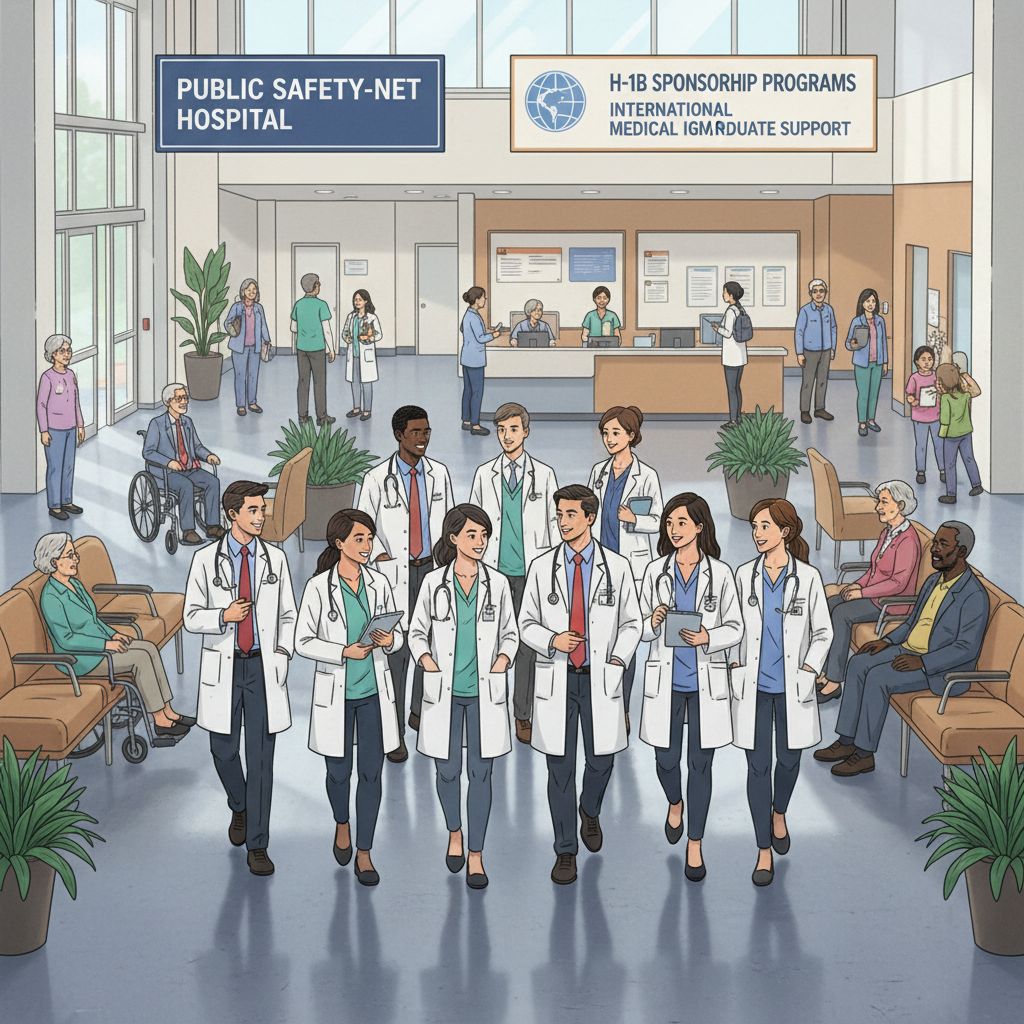
For a non-US citizen IMG, navigating H‑1B sponsorship within state university residency programs can be confusing and high‑stakes. State universities and public medical schools can be excellent options because many are H‑1B cap exempt and have long histories of working with international trainees—but their policies vary widely.
This article explains how H‑1B residency programs work in state universities, how they differ from private institutions, which specialties and institutions tend to sponsor H‑1B, and how you, as a foreign national medical graduate, can strategically target and secure these positions.
We’ll focus on:
- How H‑1B visas function specifically in residency and fellowship
- Why many state university and public medical school residency programs are attractive for non-US citizen IMGs
- How to identify and approach H‑1B friendly programs
- Practical application and interview strategies
- Common pitfalls and how to avoid them
1. H‑1B Basics for Non‑US Citizen IMGs in Residency
1.1 What is the H‑1B for Residency Purposes?
The H‑1B is a temporary work visa for specialty occupations. In GME (residency and fellowship), it allows a hospital or university to employ a physician in training if:
- The position requires a professional degree and specialized knowledge
- The salary meets or exceeds the prevailing wage
- The physician holds an unrestricted license or appropriate training license, depending on state rules
For a non-US citizen IMG, the H‑1B is often attractive because:
- It is a dual-intent visa (you can pursue permanent residency/green card without violating status).
- It avoids some of the longer-term limitations that come with J‑1 (e.g., the 2‑year home-country requirement, unless waived).
- It can, in many cases, be extended up to 6 years (and beyond in specific circumstances related to green card filing).
1.2 Cap-Subject vs. Cap-Exempt H‑1B
This distinction is crucial when looking at state university residency programs:
Cap-subject H‑1B:
- Limited to 65,000 regular + 20,000 US-advanced-degree visas per fiscal year.
- Requires entry into the annual H‑1B lottery.
- Common in private companies, some community hospitals, and non-university affiliated institutions.
H‑1B cap-exempt:
- Exempt from the annual numerical cap and lottery.
- Available year-round, no strict lottery date.
- Typically used by:
- Institutions of higher education (e.g., state universities)
- Nonprofit entities affiliated with institutions of higher education (e.g., many university teaching hospitals)
- Nonprofit or governmental research organizations
Most public medical school residency programs at state universities fall into one of the cap‑exempt categories, making them:
- More flexible in timing (they can file an H‑1B petition outside the lottery window)
- More reliable for non-US citizen IMGs wanting to avoid the uncertainty of the lottery
1.3 Why J‑1 Is Still More Common (and Why It Matters to You)
Even though many state universities could sponsor H‑1B, most still prefer J‑1 visas for residency. Reasons include:
- J‑1 is administratively simpler (ECFMG handles much of the process).
- Lower institutional legal cost and paperwork.
- Some state health systems want residents to return to home countries or use J‑1 waivers to fill underserved areas after training.
For a foreign national medical graduate, this means:
- Not all state university programs that can sponsor H‑1B will actually do so.
- You must specifically target programs that have a history of H‑1B sponsorship and clearly state a willingness to sponsor.

2. Why State University and Public Medical School Programs Are Strategic for H‑1B
2.1 Cap-Exempt Advantage in Practice
Because many state universities and their teaching hospitals are H‑1B cap exempt, they can:
- File your H‑1B petition after Match Day with predictable approval timelines.
- Avoid the lottery risk that private hospitals or community programs may face if they are cap‑subject.
- Provide continuity from residency to fellowship within the same public medical school residency system or affiliated hospitals.
This cap‑exempt status is especially important if:
- You need H‑1B for PGY‑1 or categorical positions and cannot risk a lottery delay.
- You plan to continue into subspecialty fellowship training under H‑1B.
- You want an institution that may later support an employment-based green card while on H‑1B.
2.2 Academic Environment and Support Systems
State university and public medical school residency programs often offer:
- Established international offices that frequently handle H‑1B petitions.
- GME offices experienced with non-US citizen IMGs and visa transitions (e.g., from F‑1 OPT to H‑1B).
- Institutional lawyers or outside counsel specialized in academic H‑1B cases.
This infrastructure is key for a non-US citizen IMG because:
- You’re less likely to encounter last-minute confusion about licensing, exam deadlines, or documentation.
- The program can guide you clearly through ECFMG certification, state licensing requirements for H‑1B, and petition timelines.
2.3 State-Specific Licensing Rules and H‑1B Eligibility
Eligibility for H‑1B as a resident is influenced by state medical board requirements. State university programs must comply with those rules. Typical patterns:
- Many states allow an H‑1B resident to work under a training license with completed USMLE Step 1, Step 2 CK, and, sometimes, Step 3.
- Some state boards require USMLE Step 3 before the H‑1B can be approved for residency training, especially for H‑1B.
- A few states are stricter, making H‑1B for PGY‑1 difficult unless you’ve already passed Step 3 and meet other criteria.
For a foreign national medical graduate targeting public medical school residency programs, this translates to:
- Check both: the residency program’s visa policy and the state’s medical board requirements.
- Programs in states with favorable training-license rules are more likely to sponsor H‑1B, especially at the PGY‑1 level.
3. Identifying H‑1B Friendly State University Residency Programs
3.1 Reading Program Policies Carefully
On ERAS and program websites, look for wording like:
- “We sponsor J‑1 and H‑1B visas.”
- “H‑1B sponsorship available for highly qualified candidates who have passed USMLE Step 3 by [date].”
- “We are a cap-exempt H‑1B employer affiliated with [State University].”
Be cautious with ambiguous statements:
- “We accept international medical graduates” but no mention of visas
- “We generally do not sponsor H‑1B visas” or “H‑1B considered only in exceptional cases”
For non-US citizen IMGs, ambiguous or negative language usually means you should not rely on H‑1B sponsorship there unless you directly confirm otherwise.
3.2 Using the “H‑1B Sponsor List” Strategically
There is no single official US-wide H‑1B sponsor list for residency programs. However, you can build an effective, targeted list by:
Checking program websites and FAQ pages
- Many state university and public medical school residency programs openly state: “We sponsor H‑1B.”
- Note the specialty and level (categorical vs. advanced, fellowship).
Using AMA FREIDA and ERAS filters (where available)
- Some databases allow filtering by “visa sponsorship,” which can narrow to programs that accept H‑1B and/or J‑1.
Talking to current or recent residents
- LinkedIn, alumni networks, and IMG forums can reveal whether a program has successfully sponsored H‑1B recently.
- Ask specifically: “Did the program sponsor H‑1B for intern year or just for fellowship?”
Searching online for institutional H‑1B data
- Some universities publish reports of H‑1B employees (including residents and fellows).
- Use search terms “[University Name] H‑1B public disclosure,” “[Hospital Name] H1B physician resident,” or “H‑1B cap exempt university hospital.”
As you collect information, compile your personal H‑1B sponsor list of state university residency programs that:
- Explicitly sponsor H‑1B
- Have confirmed recent sponsorship for non-US citizen IMGs
- Operate within a cap-exempt structure
3.3 Specialties and Program Types Likely to Sponsor H‑1B
While policies vary, certain patterns are common among H‑1B residency programs at state universities:
More likely to sponsor H‑1B:
- Internal Medicine (especially academic tracks)
- Pathology
- Neurology
- Psychiatry
- Certain subspecialty fellowships (e.g., Cardiology, GI, Endocrinology, Hem/Onc) in public medical school systems
Less likely (but still possible) to sponsor H‑1B:
- Family Medicine (many prefer J‑1, especially in community-based programs)
- Pediatrics (varies by institution)
- Surgical specialties (some academic programs sponsor, many do not)
Your task as a non-US citizen IMG:
- Prioritize academic, university-based programs in your target specialty.
- Look for those explicitly friendly to IMGs and familiar with visa processes.

4. Application Strategy for Non‑US Citizen IMGs Seeking H‑1B
4.1 Preparing Your Profile for H‑1B-Friendly Programs
H‑1B sponsorship generally requires more institutional investment than J‑1, so many programs reserve H‑1B for stronger applicants. You can improve your competitiveness by:
Passing USMLE Step 3 early
- This is a major differentiator; many state university programs require Step 3 before offering H‑1B.
- If possible, complete Step 3 before the interview season or by rank list deadline.
Strengthening academic credentials:
- US clinical experience at academic centers
- Letters of recommendation from US faculty (especially from state university or public medical school settings)
- Evidence of research, QI projects, or teaching experience
Demonstrating long-term commitment:
- Explain clearly in your personal statement and interviews why you are committed to a career in the US and academic medicine.
- Show understanding of the H‑1B cap exempt system and realistic long-term plans (residency → fellowship → potential faculty role).
4.2 Communicating About H‑1B with Programs
How and when you ask about H‑1B matters:
Before applying:
- Review program and institutional websites carefully.
- If unclear, send a concise email to the GME office or program coordinator:
- Introduce yourself briefly.
- Ask: “Does your program sponsor H‑1B visas for non-US citizen IMG residents?”
- Mention if you have already passed Step 3.
During interviews:
- Ask about visa policies professionally and efficiently. For example:
- “I am a non‑US citizen IMG and am particularly interested in H‑1B sponsorship. Could you share your current policy and any requirements, such as Step 3 timing?”
- Clarify whether H‑1B is:
- Offered routinely,
- Limited to certain specialties or positions,
- Conditional on board scores or internal ranking.
- Ask about visa policies professionally and efficiently. For example:
After interview / pre‑rank period:
- If still unclear, follow up once, politely, to confirm policy.
- Document what they tell you in a personal spreadsheet—useful when building your own practical H‑1B sponsor list.
4.3 Managing Timing: Match, H‑1B Filing, and Start Date
A typical timeline for H‑1B in state university residency programs might look like:
- September–January: Application and interviews
- February: Rank lists finalized
- March: Match Day
- March–April: Program confirms visa category (H‑1B vs. J‑1)
- April–May: H‑1B petition prepared and filed by university/hospital
- May–June: H‑1B approval (via regular or premium processing)
- Late June–July: Residency start (orientation, PGY‑1)
Key actions for you as a non‑US citizen IMG:
- Confirm as early as possible if the program will sponsor H‑1B and what documents they need.
- Keep your passport, ECFMG certificate, degree, and USMLE transcripts ready and organized.
- Be prepared for possible premium processing if timing is tight; some institutions will pay for it, others may require the applicant to cover this optional fee.
5. Navigating Long-Term Career Planning with H‑1B
5.1 From Residency to Fellowship in State University Systems
Many state university programs are part of larger health systems with multiple training levels:
- Internal medicine residency → Cardiology fellowship
- Pediatrics residency → Neonatology fellowship
- Neurology residency → Epilepsy or Neurocritical Care fellowship
If the hospital and university are H‑1B cap exempt, then:
- You can often move from H‑1B residency to H‑1B fellowship without entering the H‑1B lottery.
- This continuity is particularly attractive for non-US citizen IMGs who want multiple years of training in the US without gaps.
When interviewing, ask:
- “Do your fellowships also sponsor H‑1B?”
- “Have previous residents continued into fellowship here under H‑1B status?”
5.2 Transitioning to Post-Training Employment
After residency/fellowship, options vary:
- Academic faculty positions at state universities (often H‑1B cap exempt as well)
- Hospitalist or specialist roles within the same public medical school system
- Employment at private hospitals or practices (may require a cap-subject H‑1B if they are not cap exempt)
Key consideration for non-US citizen IMGs:
- If you complete training under cap-exempt H‑1B, then move to a cap-subject employer, that new employer generally must win a lottery-based cap-subject H‑1B unless you obtain a different status (e.g., O‑1, green card sponsorship).
- Many IMGs strategically:
- Stay within cap-exempt academia for several years,
- Begin employment-based green card processing,
- Then consider moves to private practice after gaining permanent residency.
5.3 Comparing H‑1B vs. J‑1 for Your Long-Term Path
Key differences important for you as a foreign national medical graduate:
J‑1:
- Requires a 2‑year home-country physical presence after training unless waived.
- Often requires working in underserved areas for waiver jobs (for many primary care/some specialties).
- Less paperwork during training, but more constraints later.
H‑1B (especially cap exempt):
- No 2‑year home-return requirement.
- More straightforward path toward permanent residency for many.
- Higher up-front demands (Step 3, institutional willingness, wage rules).
Your optimal choice depends on:
- Specialty (primary care vs. subspecialty vs. surgical)
- Geographic preferences
- Whether you are open to underserved-area service after training
- Your competitiveness for H‑1B residency programs at public medical schools
6. Practical Tips and Common Pitfalls for Non‑US Citizen IMGs
6.1 Practical Tips
Pass USMLE Step 3 early if at all possible
- This single step can convert many “maybe H‑1B” programs into real options for you.
Target cap-exempt institutions explicitly
- Focus on state university residency programs and public medical school residency sites with clear academic affiliations.
Maintain a structured spreadsheet
- Track: program name, university/hospital, state, visa policy, Step 3 requirement, IMG-friendliness, resident contacts, and notes from communications.
Leverage networks
- Connect with alumni from your medical school who matched into US state university programs.
- Join IMG-focused forums and groups to update your personal H‑1B sponsor list.
Be visa-transparent in your applications
- Don’t hide your need for H‑1B; clearly indicate your citizenship, visa history, and exam status.
- Many H‑1B friendly programs appreciate clarity early in the process.
6.2 Common Pitfalls to Avoid
Assuming all academic centers sponsor H‑1B
- Some state universities accept only J‑1 due to institutional policies. Always confirm.
Waiting too late for Step 3
- If you take Step 3 after rank lists are certified, some programs might not consider you for H‑1B even if scores are strong.
Ignoring state licensing rules
- You may be admissible for J‑1 but not meet the state’s requirements for H‑1B training licensure. Check both sets of rules.
Relying solely on unofficial lists
- Online H‑1B residency program lists can be outdated. Use them as a starting point, then verify directly.
Underestimating documentation needs
- Keep all degree certificates, ECFMG documents, exam reports, and translations ready; delays can jeopardize H‑1B filing timelines.
FAQ: H‑1B Sponsorship for Non‑US Citizen IMGs in State University Programs
Q1. Do most state university residency programs sponsor H‑1B for non‑US citizen IMGs?
Not most, but a significant minority do. Many public medical school residency programs are technically eligible to sponsor H‑1B (cap exempt), but actual sponsorship depends on GME policy, state licensing rules, and willingness to handle the additional workload. You must identify individual programs with a documented history of H‑1B sponsorship and confirm their current stance.
Q2. Is H‑1B always better than J‑1 for an IMG in residency?
Not always. H‑1B usually offers a more flexible long-term pathway in the US (no 2‑year home return requirement and dual intent), but it is harder to obtain, often requires Step 3, and fewer programs sponsor it. J‑1 is widely accepted, easier administratively, and opens many doors for residency. The best option depends on your specialty, competitiveness, and long-term goals. Some non-US citizen IMGs deliberately choose J‑1 with plans for a waiver job afterward.
Q3. Can I transfer from a J‑1 residency to an H‑1B residency within a state university program?
Directly switching from a J‑1 to H‑1B during residency is complicated and often discouraged. J‑1 GME visas are issued through ECFMG and come with specific conditions. Some trainees move from J‑1 fellowship to H‑1B employment afterward, but mid-training status changes are rare and require specialized legal advice. If your long-term intent is H‑1B, it’s usually better to target H‑1B residency programs from the beginning.
Q4. Where can I find an accurate H‑1B sponsor list for residency programs?
There is no single official national list. The most reliable approach is to build your own database by:
- Reviewing each program’s website and FREIDA/ERAS entry
- Emailing program coordinators or GME offices to ask directly
- Talking to current or recent residents (especially non-US citizen IMGs)
- Reviewing public H‑1B disclosure data for major state universities and teaching hospitals
Use any online “H‑1B friendly” lists only as a first guide, then verify all information directly with the programs.
By deliberately targeting H‑1B-friendly, cap-exempt state university residency programs, preparing your profile (especially with early Step 3), and communicating clearly with institutions, you can significantly increase your chances of securing an H‑1B-sponsored position as a non‑US citizen IMG.