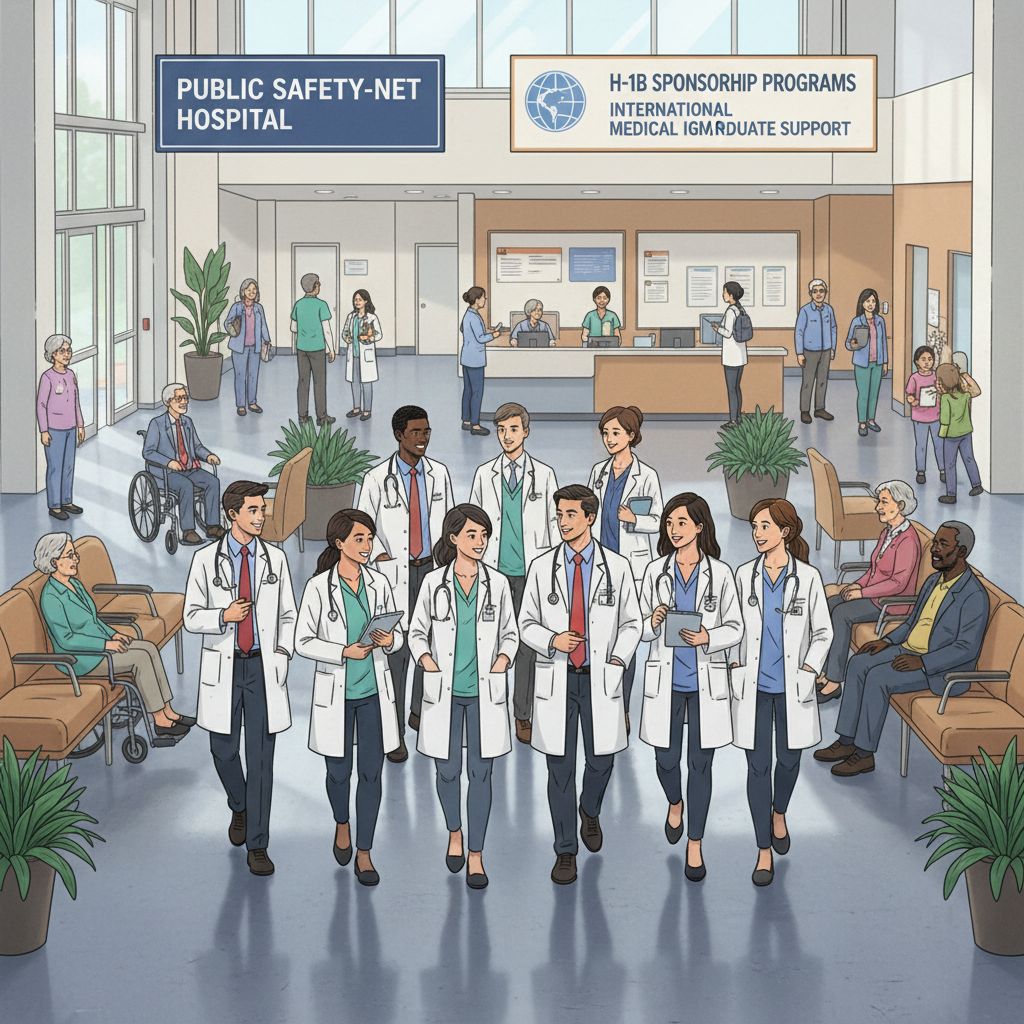
Understanding H‑1B Sponsorship in Northeast Residency Programs
For many international medical graduates (IMGs), the Northeast Corridor—stretching roughly from Boston through New York, New Jersey, Philadelphia, Baltimore, and Washington, DC—is the top target for graduate medical education. It combines high‑density academic centers, strong clinical volume, and globally recognized institutions.
If you need H‑1B sponsorship for residency (rather than J‑1), navigating which northeast residency programs sponsor H‑1Bs and how “H‑1B‑friendly” they are becomes crucial. This article breaks down how H‑1B residency sponsorship works along the East Coast, what makes a program truly H‑1B‑friendly, and how you can strategically approach your applications and interviews.
We’ll focus on:
- Key features of H‑1B sponsorship for residency
- How the cap‑exempt rules benefit residents
- Typical requirements and timelines in northeast residency programs
- Examples of institutional patterns in major cities along the Northeast Corridor
- Practical strategies for building your own H‑1B sponsor list
H‑1B Basics for Residency Applicants
Before diving into specific northeast residency programs, it’s essential to understand how the H‑1B visa works in the GME (Graduate Medical Education) context.
What is the H‑1B for Residents?
The H‑1B is a temporary, employment‑based visa for professionals in specialty occupations. For residency:
- Employer: Your sponsoring hospital or institution
- Role: Graduate medical trainee (resident or fellow)
- Duration: Up to 6 years total, usually issued in 1–3 year increments
- Status: Dual intent (can pursue permanent residency without jeopardizing status)
For IMGs, the H‑1B is often preferred over the J‑1 when:
- You plan to stay in the U.S. long‑term and don’t want a 2‑year home residency requirement, or
- You have immediate plans for a green card after residency or fellowship, or
- You are ineligible for J‑1 for personal, financial, or regulatory reasons.
Cap‑Exempt vs Cap‑Subject: Why It Matters
The single most important concept for residency is H‑1B cap exemption.
- In the standard employment market, H‑1Bs are cap‑subject, limited by an annual numerical quota and an associated lottery.
- Most residency programs in academic or non‑profit hospitals are H‑1B cap exempt, meaning:
- No lottery
- No October 1 start restriction
- Petitions can be filed year‑round
- Multiple filings over your career (residency, fellowship) without using a cap number
Residency‑sponsoring employers are typically H‑1B cap exempt when they are:
- A non‑profit hospital affiliated with an institution of higher education, or
- A non‑profit research organization, or
- An institution of higher education itself.
This is why major Northeast Corridor academic centers frequently sponsor H‑1Bs without lottery concerns. As you build your H‑1B sponsor list, you’ll notice an overwhelming majority of programs are in teaching hospitals that qualify as H‑1B cap exempt employers.
Why Some Programs Prefer J‑1 Instead
Even though northeast residency programs are usually able to sponsor H‑1Bs, many still prefer J‑1 visas. Common reasons:
- Administrative familiarity: Institutions have long‑standing processes with ECFMG for J‑1 sponsorship.
- Cost: H‑1B petitions involve higher legal and filing costs for the employer.
- Flexibility: Some programs perceive J‑1 as more standardized for GME visa processing.
- Institutional policy: Some academic centers have a blanket rule of “J‑1 only except in rare cases.”
This means H‑1B availability is not automatic—even at top East Coast residency programs that technically qualify as cap‑exempt. Policy varies by institution, department, and occasionally even by program director.

Typical H‑1B Requirements in Northeast Residency Programs
Most east coast residency programs that sponsor H‑1Bs apply similar baseline requirements. Understanding these in advance can help you decide whether H‑1B is realistic for your situation.
1. USMLE Step Requirements
For H‑1B sponsorship, the vast majority of northeast programs require:
- USMLE Step 1: Passed (score no longer reported, but pass is necessary)
- USMLE Step 2 CK: Passed, usually before rank list certification
- USMLE Step 3:
- Frequently required for H‑1B; many institutions will not initiate an H‑1B petition without a passing Step 3 result by a set deadline (often March–April for a July 1 start).
Some programs allow you to match with Steps 1 and 2 only, then:
- Require you to pass Step 3 before contract finalization, or
- Set a strict internal deadline (e.g., “must have Step 3 passed by March 15 to qualify for H‑1B; otherwise must switch to J‑1 if eligible”).
Actionable advice:
If your goal is H‑1B, particularly in competitive northeast residency programs, plan to take Step 3 as early as possible, ideally:
- During a research year or before the main application season, or
- During a transitional or preliminary year if already in the U.S.
2. ECFMG Certification and Credentialing
Northeast institutions will require:
- ECFMG certification by the time of training start (July 1 or later if off‑cycle).
- Verified medical degree and transcripts meeting institutional credentialing standards.
Some hospitals’ legal teams will not file H‑1B petitions until:
- ECFMG certification is complete, and
- You have provided all required medical school documentation.
This can compress timelines if you are waiting on documents—plan early.
3. Institutional and State Licensing Requirements
H‑1B petitions for residency are tightly tied to state licensing rules. Along the Northeast Corridor, each state has its own requirements:
- Massachusetts, New York, New Jersey, Pennsylvania, Maryland, DC all have specific rules about training licenses and post‑graduate training years.
- Some states require a full license for H‑1B residents after a specific PGY level; others allow training licenses only.
For initial H‑1B sponsorship (PGY‑1/PGY‑2), programs usually:
- File under a training license framework, or
- Demonstrate that the training position itself meets state regulations.
Be aware that for later fellowship H‑1Bs, state licensing may become more complex (e.g., full licenses, additional credentialing, background checks).
4. English Proficiency and Communication
While there may not be a formal English test requirement for the visa itself, Northeast Corridor programs emphasize:
- Clear communication abilities (given high‑volume, high‑acuity environments).
- Comfort working in diverse, often underserved urban communities.
Some institutions may conduct additional language or communication assessments as part of credentialing.
Institutional Patterns Along the Northeast Corridor
Rather than memorizing every single H‑1B‑friendly program, it’s more useful to recognize patterns by institution and region. Below is a conceptual overview to guide your research; always confirm current policies directly with the programs because policies change frequently.
1. Boston and Greater Massachusetts
Profile: Dense concentration of world‑renowned academic centers; many are H‑1B cap exempt and have long experience with IMGs.
Typical features:
- Several major teaching hospitals (affiliated with Harvard, Boston University, Tufts, UMass) historically have capacity and experience with H‑1B petitions.
- Some departments at large academic centers are J‑1‑only by policy, while others sponsor H‑1B selectively for highly qualified candidates.
- Community‑based northeast residency programs in Massachusetts (not just in Boston proper) may show greater flexibility and individual assessment.
What to look for:
- Program websites with explicit wording such as:
- “J‑1 and H‑1B visas sponsored”
- “H‑1B considered for exceptional applicants with passed Step 3”
- Resident profiles listing current H‑1B holders (often mentioned in alumni or “current residents” pages, sometimes indirectly).
2. New York City and Surrounding Areas
Profile: Probably the single richest region for IMGs in the country; huge number of northeast residency programs across multiple hospital systems.
Key patterns:
- Many of NYC’s large hospital systems are firmly H‑1B cap exempt and have decades of experience sponsoring H‑1B residents and fellows.
- Some community hospitals with heavy IMG representation have a reputation as H‑1B‑friendly, particularly in internal medicine, pediatrics, psychiatry, and family medicine.
- On the other hand, certain prestige‑focused programs at major Manhattan institutions may prefer J‑1 and either:
- Not sponsor H‑1B at all, or
- Restrict H‑1B to subgroups (e.g., physician‑scientists, funded research tracks).
Practical tip:
- When creating your personal H‑1B sponsor list, NYC should feature prominently—but treat each institution and specialty individually. Look for:
- FAQ pages on visas
- GME office visa policy pages
- NRMP or FREIDA entries specifying “H‑1B sponsored: Yes/No”
3. New Jersey and Suburban East Coast Programs
Profile: High number of IMGs, a mix of community‑based and university‑affiliated hospitals, and relatively strong history of H‑1B sponsorship.
Common patterns:
- Many internal medicine, family medicine, and psychiatry northeast residency programs in New Jersey are open to H‑1B with Step 3 completed.
- Several systems have explicit, GME‑level policies:
- “We sponsor J‑1 and H‑1B; Step 3 is required for H‑1B” or
- “H‑1B is limited; J‑1 is preferred unless strong justification.”
New Jersey programs can be a strategic target for IMGs requiring H‑1B, especially if:
- You’re willing to work in non‑major city locations.
- You balance applications between university‑affiliated and smaller community programs.
4. Philadelphia and Pennsylvania Corridor
Profile: Mix of top academic centers and community hospitals across Philadelphia and smaller cities.
Patterns to note:
- Many academic centers in Philadelphia and central Pennsylvania are H‑1B cap exempt and have historically sponsored H‑1Bs, especially for residents who:
- Have advanced research background, or
- Commit to internal medicine subspecialties or long‑term affiliation.
- Some community programs elsewhere in Pennsylvania are not set up for H‑1B and may state “J‑1 only” due to limited legal or administrative resources.
Strategy:
- For H‑1B, focus on larger teaching hospitals and university‑affiliated networks first.
- Use FREIDA and program websites to check each program’s stance—don’t assume based solely on IMG percentage.
5. Baltimore–Washington, DC Corridor
Profile: Major academic institutions, federal connections, and a blend of urban and suburban training environments.
Key points:
- Many hospitals associated with large universities or research institutions are H‑1B cap exempt and regularly sponsor H‑1B for residency and fellowship, especially in internal medicine, neurology, and psychiatry.
- Federal institutions may have distinct rules; check carefully for citizenship or permanent residency requirements (e.g., certain VA or NIH‑associated positions).
Strategy:
- Target programs where GME offices explicitly mention both J‑1 and H‑1B.
- For fellowship planning, this region can be particularly favorable for H‑1B continuation in research‑oriented roles.

How to Build Your Personal H‑1B Sponsor List
Because policies change and are often specialty‑specific, the most useful resource you can create is your own up‑to‑date H‑1B sponsor list for northeast residency programs.
Step 1: Use Public Databases Strategically
Start with:
- FREIDA (AMA) – Filter by region (Northeast) and specialty, then:
- Review “Visa” or “Requirements” sections
- Note whether H‑1B is explicitly mentioned
- Individual program websites – Look for:
- GME office pages labeled “International Medical Graduates” or “Visa Information”
- Phrases like:
- “We sponsor J‑1 and H‑1B visas”
- “H‑1B visas considered on a case‑by‑case basis”
- “We sponsor J‑1 only”
Create a spreadsheet with columns such as:
- Program name
- City/state
- Specialty
- Visa types sponsored (J‑1 / H‑1B / both / unclear)
- Step 3 requirement for H‑1B
- Notes and date of last confirmation
Step 2: Cross‑Check with Alumni and Current Residents
LinkedIn, hospital websites, and alumni lists can reveal visa patterns:
- Look for recent or current residents who:
- List “H‑1B” or “H‑1B sponsored” in their profiles
- Show continuous training at the same institution (internal medicine then fellowship) under H‑1B
- If a program’s resident profiles frequently list “International medical graduate – visa: H‑1B,” that’s a strong indicator of an H‑1B‑friendly environment.
You can also:
- Reach out (politely and briefly) to current residents via email or LinkedIn, asking:
- “Does your program currently sponsor H‑1B visas for residents, and is Step 3 required before ranking?”
- Keep your message short and specific; avoid sending generic mass emails.
Step 3: Contact GME Offices When Information is Unclear
If a program’s website does not specify visa types:
- Email the program coordinator or GME office, asking directly:
- Whether the program sponsors H‑1B
- Whether H‑1B is available for your specialty
- Whether Step 3 is required and by what date
Sample concise email snippet:
Dear [Coordinator’s Name],
I am an international medical graduate preparing my application for [Specialty] residency. I would be grateful if you could clarify whether your program sponsors H‑1B visas for residents and, if so, whether USMLE Step 3 is required before ranking or by a specific date.
Thank you for your time and assistance.
Sincerely,
[Your Name]
Log the responses in your spreadsheet with dates—policies evolve, so timing matters.
Step 4: Prioritize Based on Your Credentials and Goals
Once you have your H‑1B sponsor list for northeast residency programs, prioritize:
High‑yield H‑1B‑friendly programs
- Explicitly sponsor H‑1B
- High number of current IMGs
- Clear Step 3 policies
Possible but conditional programs
- “Case‑by‑case” H‑1B
- Strong preference for J‑1 but not fully closed to H‑1B
J‑1‑only programs
- You may still apply if J‑1 is acceptable to you or if your H‑1B situation is uncertain.
Remember: You don’t need only H‑1B options. Many IMGs apply broadly, then decide between J‑1 and H‑1B only after interview offers and match results.
Application and Interview Strategy for H‑1B‑Seeking IMGs
Beyond identifying east coast residency programs that are H‑1B‑friendly, you should also adapt your application strategy.
1. Emphasize Completion of Step 3 (If Applicable)
If you already have Step 3:
- Highlight it prominently on your ERAS application and CV.
- Mention it in your personal statement if your primary goal is continuity in the U.S.
- During interviews, gently reinforce that you:
- Understand the H‑1B requirements
- Have taken initiative to meet them early
Programs often interpret early Step 3 as a sign of serious commitment and planning.
2. Be Clear but Flexible About Visa Preferences
On ERAS and in communications:
- If you must have H‑1B (e.g., J‑1 is not an option due to personal circumstances), you can note:
- “I am specifically seeking programs that sponsor H‑1B visas.”
- However, be aware that:
- Some programs interpret strict H‑1B requests as extra administrative burden.
- In borderline cases, they may prefer an applicant who is open to J‑1.
A balanced approach is:
- Stating in interviews:
- “My preference is H‑1B due to long‑term career planning, but I understand that visa policy is institution‑specific and I’m willing to discuss options with your GME office.”
3. Understand Timing and Documentation
For a July 1 start in a northeast residency:
- Many programs will want all H‑1B paperwork ready by March–April.
- You’ll need:
- Step 3 pass (if required)
- ECFMG certification
- Valid passport
- Medical school diplomas and transcripts
- Signed contract (or offer letter) for the H‑1B filing
Coordinate early with:
- The program coordinator
- The GME office
- Any immigration attorney retained by the institution
Be responsive to document requests; delays can jeopardize your H‑1B petition.
4. Consider Long‑Term Planning (Fellowship and Beyond)
Because residents in H‑1B cap‑exempt positions do not use up a cap number, your post‑residency options along the Northeast Corridor include:
- Continuing in cap‑exempt hospital systems (fellowship and then attending roles)
- Later transitioning to a cap‑subject employer (private practice or non‑exempt hospital), which would require entering the H‑1B cap lottery at that time.
During residency and fellowship interviews in the Northeast, ask tactful questions like:
- “Do your graduates commonly continue on H‑1B in your health system?”
- “Is your institution H‑1B cap exempt, and do you sponsor H‑1Bs for attending positions?”
This helps you chart a long‑term career pathway without unexpected immigration obstacles.
FAQs: H‑1B Sponsorship for Northeast Residency Programs
1. Are all Northeast Corridor residency programs H‑1B cap exempt?
No. Many major academic and non‑profit hospitals are H‑1B cap exempt, but not all employers in the region qualify. Smaller private hospitals or certain community institutions may be cap‑subject or may not sponsor H‑1B at all. Always confirm the employer’s cap status and visa policy through their GME office or official materials.
2. Do I absolutely need Step 3 for H‑1B residency in the Northeast?
In practice, yes, in almost all cases. While a few programs might file with conditional plans, the overwhelming norm in east coast residency programs is to require USMLE Step 3 before initiating an H‑1B petition. If you are serious about H‑1B, plan to complete Step 3 as early as feasible.
3. Can I switch from J‑1 to H‑1B after starting residency in the Northeast?
It’s possible in some circumstances but often complicated. If you start on a J‑1, you may become subject to the two‑year home residency requirement, which can block a later change to H‑1B unless a waiver is obtained. Some residents switch visa types when starting fellowship at a different institution, but this requires legal planning. Talk to an immigration attorney early if you anticipate such a transition.
4. How reliable are “H‑1B sponsor lists” shared online for northeast residency programs?
Unofficial lists (forums, spreadsheets, social media) can be useful starting points but are often outdated or incomplete. Programs change policies frequently—sometimes yearly. Use such lists only as a screening tool, then:
- Verify every program’s current policy via its website, FREIDA, and direct communication.
- Keep your own, date‑stamped notes for accuracy.
By understanding how H‑1B cap‑exempt rules work, recognizing institutional patterns along the Northeast Corridor, and methodically building and updating your own H‑1B sponsor list, you can target east coast residency programs that truly align with your immigration needs and career goals.