Understanding H-1B Sponsorship in Transitional Year Residency
For many international medical graduates (IMGs), finding a transitional year residency that offers H-1B sponsorship can be the key to entering the U.S. graduate medical education system and ultimately securing a categorical position. This pathway is especially appealing to candidates who want to avoid or limit time on J-1 status, or who have long‑term plans that make the H-1B more suitable (such as future green card sponsorship through employment).
However, H-1B sponsorship in transitional year (TY) programs is complex and less common than J-1 sponsorship. Understanding the landscape, eligibility requirements, and strategies to identify H-1B residency programs is essential to building a realistic match plan.
This guide will walk you through:
- How H-1B works in the residency context
- Why H-1B‑sponsoring transitional year programs are relatively rare
- Practical strategies for finding a TY program that may sponsor H-1B
- How to interpret the H-1B sponsor list concept and H-1B cap exempt rules
- Application and documentation tips tailored for IMGs
H-1B Basics for Transitional Year Residency Applicants
Before focusing on transitional year programs, it’s important to understand the fundamentals of the H-1B for residency training.
What Is the H-1B Visa in GME?
The H-1B is a temporary work visa for “specialty occupations” that require at least a bachelor’s degree or equivalent. In graduate medical education, this usually applies to:
- Residents and fellows with appropriate credentials, and
- Faculty and attending physicians.
For residency, the H-1B is employer‑specific and position‑specific. Your visa is tied to the hospital (or university/hospital system) that sponsors you and specifically to your training role.
Key features relevant to transitional year residency:
- Duration: Typically granted in increments up to 3 years; total H‑1B time in the U.S. is usually capped at 6 years (with some exceptions in green card processes).
- Full licensure requirement: Residents on H‑1B generally need to meet state requirements for an unrestricted or certain defined type of license (depending on the state). Many states require passing all USMLE Steps (including Step 3) and sometimes completion of a minimum number of training years.
- Prevailing wage & employment conditions: The sponsoring institution must show appropriate compensation and working conditions, which involves additional administrative work and cost.
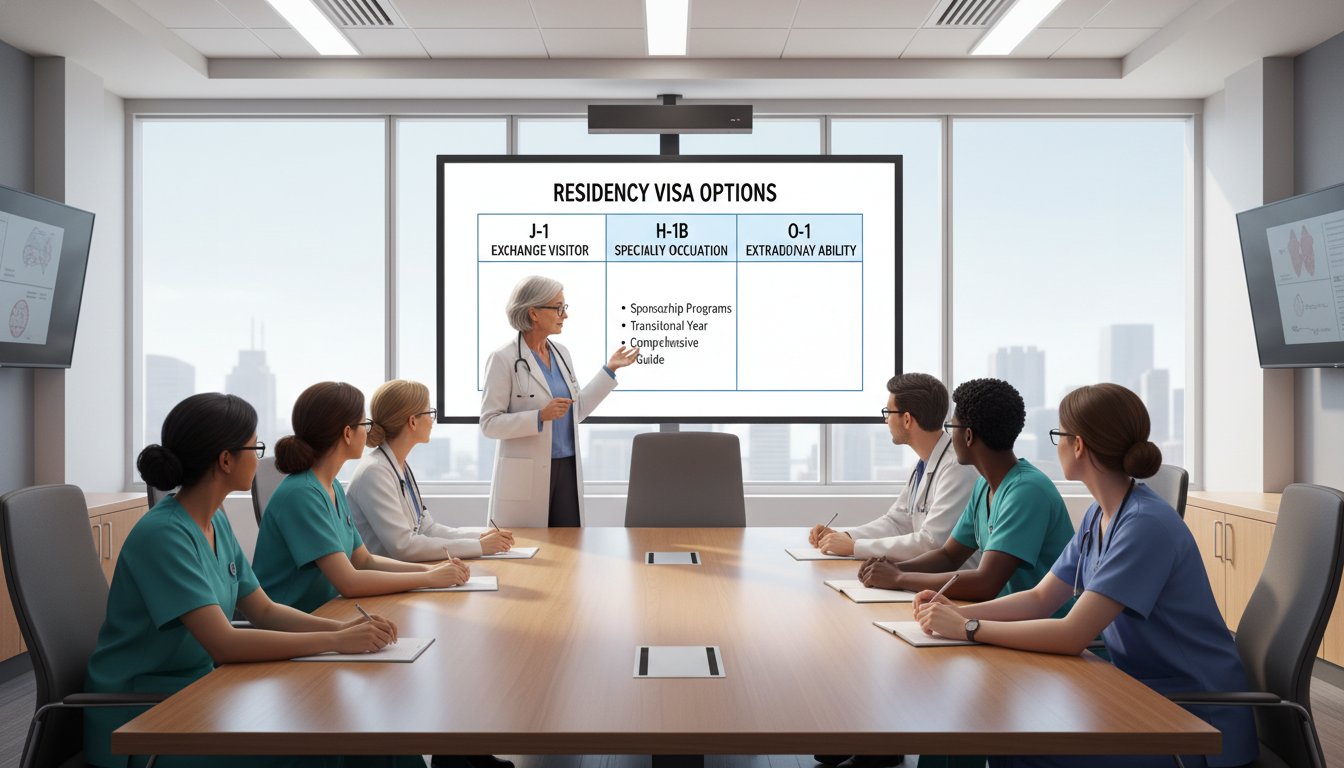
H-1B vs J-1 for Transitional Year Residents
Most IMGs in residency are sponsored by the ECFMG for a J-1 visa. H-1B sponsorship is significantly less common because it is more complex and expensive for institutions.
Common advantages of H-1B vs J-1:
- No 2-year home-country physical presence requirement (which applies to J-1).
- More straightforward pathway to employer‑sponsored permanent residency (“green card”) in many cases.
- More flexibility if you later move into non-academic or non‑underserved settings (where J-1 waiver jobs might be limited).
Common disadvantages:
- Requires USMLE Step 3 and often early completion before residency start (this is critical for transitional year positions).
- Some states/licensing boards may not permit an H-1B resident if they can’t meet licensure requirements in time.
- Fewer TY program directors are willing to sponsor H-1B due to administrative burden and short, 1‑year training period.
For a transitional year specifically, the short length creates a unique barrier: many institutions feel it is not efficient to process an H-1B for a single year of preliminary training, especially when a J-1 is easily available.
Why H-1B Sponsorship Is Rare in Transitional Year Programs
Understanding why H-1B residency programs are limited in the transitional year space will help you set realistic expectations and tailor your strategy.
1. Short Duration of Training
A transitional year residency is one year long. From a program’s perspective:
- Preparing and filing an H-1B petition can take several months, legal fees, and staff effort.
- By the time the resident starts, the institution has invested significant resources for only one year of service.
- If there are delays in approvals or licensing, the resident might start late, adding further complexity.
As a result, many program directors feel that H-1B sponsorship is more reasonable for categorical programs (3–5 years) than for a 1‑year TY program.
2. Institutional Visa Policy and Risk Management
Many academic medical centers have institutional policies that impact all departments, including transitional year:
- Some institutions are “J-1 only” for residents, citing simplicity and ECFMG’s centralized oversight.
- Others allow H-1B only for advanced or fellow-level positions, or only if the resident has a pre‑existing H-1B with that institution in another role.
- Legal and risk teams may discourage H‑1B use in residency due to concerns about wage regulations and immigration audits.
If the institution’s central GME or legal office prohibits H-1B sponsorship for PGY‑1, even a willing program director cannot proceed.
3. Licensing and Step 3 Requirements
Many states require:
- Passing USMLE Step 3 before H‑1B filing, and
- Meeting educational/credential prerequisites for a training or limited license.
Timing is the main challenge:
- IMGs often take Step 3 after starting residency.
- To enter on H-1B, Step 3 usually must be passed months before July 1, allowing time for state license and H-1B processing.
This requirement alone filters out many IMG applicants and makes some programs hesitant to promise H-1B for transitional year positions.
4. Preference to Use J-1 for Preliminary Positions
Programs often see transitional year slots as:
- Flexible positions that support multiple specialties (anesthesiology, radiology, dermatology, neurology, etc.), and
- Logistically simpler when every incoming TY resident is on the same visa type (usually J-1).
Using J-1 across the board for all transitional year residents is administratively clean and avoids differential treatment concerns.
Identifying Transitional Year Programs That May Sponsor H-1B
Although uncommon, some transitional year programs have sponsored H-1B in the past or may consider it for exceptional candidates. Because there is no official, constantly updated H-1B sponsor list for GME, you’ll need a systematic research and outreach strategy.
1. Start With Institutions Known to Be H-1B Friendly
Even if you’re targeting a transitional year residency, begin by identifying institutions that are already:
- H-1B cap exempt (most hospitals and university-affiliated teaching institutions), and
- Known to sponsor H‑1B for categorical residents or fellows.
You can find these by:
- Reviewing program websites and visa policies for internal medicine, family medicine, or other categorical residencies at the same institution.
- Searching online forums, IMG communities, and alumni networks for “H-1B friendly residency” discussions.
- Looking at institutional GME pages, which sometimes list visa types for all programs collectively.
If the institution is H-1B friendly in general, there’s a higher chance (though not a guarantee) the transitional year program could consider H-1B.
2. Check Each Transitional Year Program’s Official Website
For each TY program of interest:
- Go to the program’s main residency page.
- Look for sections titled “International Medical Graduates,” “Visa Policy,” or “Eligibility Requirements.”
- See if they explicitly mention:
- “J-1 only”
- “J-1 and H-1B considered,” or
- “We sponsor J-1 through ECFMG. H-1B sponsorship may be considered for exceptional candidates who have passed USMLE Step 3 and meet licensing requirements.”
Many sites are vague, so lack of information doesn’t mean H-1B is impossible. It simply means you will need to reach out directly.
3. Directly Contact Program Coordinators and GME Offices
Emailing program coordinators is often the most effective way to clarify visa policies for TY positions. When you write:
- Be concise and respectful.
- Clearly state your situation and ask specific questions.
Example email template:
Subject: Visa Sponsorship Inquiry – Transitional Year Residency
Dear [Program Coordinator/Program Director Name],
I am an international medical graduate applying to your Transitional Year program. I have completed USMLE Step 3 and will have ECFMG certification by the start of residency.
Could you please let me know whether your program, or your institution’s GME office, is able to sponsor H‑1B visas for PGY‑1 residents in the Transitional Year track? If so, are there any additional eligibility criteria or timelines I should be aware of?
Thank you very much for your time and guidance.
Sincerely,
[Your Name, Medical School, AAMC ID]
If the program responds that they only sponsor J‑1, take that as definitive unless they point you to a central GME office that says otherwise.
4. Use Alumni Networks and Social Media
Connect with:
- Former residents from TY programs you’re interested in.
- IMG organizations and regional medical graduate associations.
- LinkedIn groups, Telegram, WhatsApp, or Facebook communities geared toward IMGs entering U.S. residency.
Ask targeted questions, such as:
- “Do you know anyone who matched into your TY program on H-1B?”
- “Did your institution sponsor H-1B for any PGY-1s in the last few years?”
Even if you can’t verify current policy, patterns from the last 3–5 match cycles can be informative.
5. Evaluate “Possibility” vs “Probability”
Programs can easily say “H-1B may be considered” without having actually sponsored H-1B for a transitional year resident before. When deciding where to apply:
- Consider programs that have documented prior H-1B residents or clearly state visa flexibility as higher-yield targets.
- View programs that only state “case-by-case” or are vague as medium‑ or low‑yield.
Because of the overall scarcity, a strategic applicant often:
- Applies broadly to transitional year programs, including some J-1 only (if J-1 is acceptable to them), and
- Targets a smaller subset where H-1B is genuinely plausible, especially at H-1B cap exempt academic centers with robust GME infrastructures.

Understanding H-1B Sponsor Lists and Cap-Exempt Status
When researching H-1B residency programs, you’ll encounter terms like H-1B sponsor list and H-1B cap exempt. Knowing what they mean can prevent confusion and misinterpretation.
What Is an H-1B Sponsor List?
In the residency world, there is:
- No single, official, publicly maintained “H-1B sponsor list” specifically for transitional year programs.
Instead, people may refer to:
Institutional GME policies
- Some universities or hospital systems list which visa types they sponsor across all training programs.
- These can act like an internal “H-1B sponsor list” for that institution.
Crowdsourced or third‑party compilations
- Websites, PDF lists, or spreadsheets created by current and former residents, highlighting institutions that have historically sponsored H-1B for categorical programs or certain specialties.
- These are helpful but may be outdated or incomplete, and often don’t distinguish between transitional year and other residencies.
Federal data on H-1B filings
- U.S. Department of Labor and USCIS release data on certified Labor Condition Applications (LCAs) and approved H-1B petitions.
- Analysts or individuals may use this data to infer which hospitals/universities file H-1Bs frequently.
These sources can help identify H-1B friendly institutions, but they rarely specify whether transitional year positions themselves have been sponsored.
What Does H-1B Cap Exempt Mean?
The regular H-1B program has an annual numerical limit (“cap”) on new H-1B visas, with a lottery for most for‑profit employers. However:
- Many teaching hospitals and universities are H-1B cap exempt because they are:
- Institutions of higher education
- Non‑profit entities affiliated with universities, or
- Non‑profit research organizations.
For IMGs seeking residency:
- Being sponsored by a cap-exempt institution means you are not subject to the H-1B lottery.
- The hospital can file your petition at any time of the year and does not compete for limited cap numbers.
- Almost all academic medical centers with residency programs fall into the cap-exempt category.
However, cap-exempt status does not equal willingness to sponsor H-1B. An institution can be cap-exempt and still refuse H-1B sponsorship for residents.
Using Cap-Exempt Status Strategically
When exploring transitional year programs:
- Prioritize academic medical centers and university-affiliated hospitals (more likely to be cap exempt and to have experience with H-1B).
- Confirm cap-exempt nature through:
- Their affiliation with a medical school or university.
- Online descriptions of the hospital’s structure and mission.
Then, evaluate whether they actually use H-1B for any residency positions.
Building a Competitive H-1B-Focused Transitional Year Application
If you are committed to pursuing H-1B sponsorship programs for transitional year training, you need to align your credentials and application strategy with what programs expect.
1. Prioritize USMLE Step 3 Early
For most H-1B‑sponsoring institutions:
- USMLE Step 3 is mandatory before they can file your petition.
- You should plan to:
- Pass Step 3 before ERAS opens, or at least well before rank list deadlines.
- Have your score report available to share with programs early in the application season.
This single factor can sharply differentiate you from other IMGs and signals to programs that H-1B sponsorship is legally and logistically feasible.
Actionable advice:
- Schedule Step 3 as soon as your Step 2 CK performance and state eligibility allow.
- Consider applying for Step 3 in a state where ECFMG certification is sufficient (some states have more flexible requirements).
- Build a short, intensive Step 3 study plan so you can clear it before the peak ERAS period.
2. Understand State Licensing Requirements
Because H-1B residents often need a license or a training permit compatible with work visa status:
- Review the state medical board requirements for states where your target TY programs are located.
- Note:
- Minimum years of clinical training required (some states require at least 1 year U.S. GME for any form of license, making PGY‑1 H‑1B more complex).
- Whether IMG licenses can be issued before or at the start of PGY‑1.
Where possible, prioritize programs in states known to be friendlier to IMG licensing at the PGY‑1 level.
3. Demonstrate Long-Term Fit and Clear Career Plans
Program directors may hesitate to invest in H-1B sponsorship if they think:
- You will leave immediately after transitional year with no ongoing affiliation, or
- Your career path is unclear.
In your personal statement and interviews:
- Clearly articulate your downstream categorical specialty (e.g., anesthesiology, radiology, neurology, dermatology).
- Explain how a strong transitional year at their institution will:
- Prepare you for your advanced program, and
- Potentially lead to continued training or research at the same institution (if true).
Programs are more likely to sponsor H-1B for a transitional year if they see:
- A high-performing candidate likely to bring prestige and productivity.
- A potential long-term relationship with their institution or affiliated specialties.
4. Highlight Any U.S. Clinical Experience and Research
To stand out among IMGs and justify the extra effort of H‑1B sponsorship:
- Emphasize U.S. clinical experience (USCE):
- Observerships, externships, sub-internships, or prior PGY‑1 training.
- Showcase substantial research work, especially in U.S. settings:
- Publications, presentations, and QI projects linked to the institution’s academic culture.
Programs inclined to sponsor H-1B often value candidates who are academically productive, as this aligns with their institutional mission.
5. Communicate Early and Professionally About Visa Needs
When building your ERAS application and interview strategy:
- Indicate clearly that you need visa sponsorship.
- If the program allows for visa-type preference selection, specify H-1B but avoid sounding inflexible if you’d also accept J‑1.
- During interviews, bring up the topic only if appropriate:
- If the program already lists H‑1B as an option, you can politely ask for clarification on timelines and requirements.
- If the website is unclear, it’s often better to first clarify with the coordinator via email before or after interview day.
Programs appreciate candidates who:
- Understand that H-1B is more complex,
- Have already completed key prerequisites (like Step 3), and
- Approach discussions about sponsorship with maturity and realism.
Strategic Planning: Balancing H-1B Goals With Match Reality
Pursuing H-1B sponsorship in a transitional year is a high‑reward but relatively low‑probability path. To reduce risk, you should build a resilient overall match strategy.
1. Decide Whether J-1 Is Acceptable for You
Some IMGs strongly prefer H‑1B because of future plans (e.g., avoiding the J-1 2‑year home requirement). Others primarily want a U.S. residency position and are flexible.
Honestly assess:
- Are you willing to accept a J-1 transitional year if that is the only viable option?
- Or are you prepared to go unmatched this cycle and reapply rather than accept J‑1?
Your answer will:
- Dictate how broadly you apply, and
- Influence how you communicate your preferences to programs.
2. Construct a Tiered Application List
Consider building a list with:
High-priority H-1B friendly institutions
- Transitional year programs at institutions that sponsor H-1B for categorical residents and have signaled some openness for PGY‑1.
- You may send more personalized communication and targeted LOIs here.
Mixed-policy institutions
- Programs where the policy is unclear or case-by-case.
- You still apply, but treat these as uncertain bets.
J-1 friendly or J-1 only programs (if you are open to J-1)
- These expand your chances of matching overall.
- Especially important if your application has any weaknesses (older YOG, fewer USCE, lower scores).
3. Apply Broadly Enough to Offset the Rarity of H-1B Sponsorship
Because H-1B residency programs in transitional year are limited:
- You should apply more widely than a similar applicant who is fully flexible on visa type.
- It’s common for visa‑dependent applicants to apply to 40–80 transitional year programs (often in combination with preliminary medicine or surgery positions), depending on competitiveness.
Work with mentors or advisors to balance:
- The cost of applications and interviews, and
- The need for a wide net due to your specific visa constraints.
4. Stay Informed on Policy Changes
Immigration and GME policies evolve. To stay updated:
Regularly check:
- ECFMG and NRMP announcements.
- AAMC guidance on residency visas.
- Institution‑specific GME websites for updated visa policies.
Engage with IMG advocacy groups that track policy updates relevant to:
- H‑1B usage in residency.
- Changes in J-1 waiver programs that might affect your long‑term plans.
FAQs: H-1B Sponsorship in Transitional Year Programs
1. Is it realistically possible to get an H-1B for a transitional year residency?
Yes, it is possible but relatively rare. The main barriers are:
- Institutional policies preferring or requiring J-1,
- The short 1‑year duration of transitional year training, and
- The requirement for Step 3 and licensing eligibility prior to filing.
You should treat H-1B for transitional year as a stretch goal and plan a broad application strategy, including programs where H-1B is unlikely or not available, depending on your flexibility.
2. Do I absolutely need USMLE Step 3 to be sponsored on H-1B for a transitional year?
In practice, yes for almost all programs. Most state medical boards and hospital credentialing offices require Step 3 completion to:
- Obtain an appropriate license or training permit compatible with H-1B, and
- Satisfy institutional and legal expectations for employing a resident on a work visa.
If you are serious about H-1B for PGY‑1 (including transitional year), prioritize scheduling and passing Step 3 before you apply or as early as possible in interview season.
3. Are all teaching hospitals H-1B cap exempt, and does that mean they’ll sponsor me?
Most teaching hospitals and university‑affiliated medical centers are indeed H-1B cap exempt, meaning they can file H-1B petitions without going through the annual lottery. However:
- Cap-exempt status only means they can use H-1B; it does not mean they will sponsor H-1B for residents.
- Many cap-exempt institutions still adopt a “J-1 only” policy for GME.
You must verify both cap-exempt status and actual H-1B sponsorship practices for the specific TY program or institution.
4. Should I mention my H-1B preference in my personal statement or interviews?
You should be transparent about your need for visa sponsorship, but strategic in how you express preferences:
- In ERAS, indicate that you require sponsorship and that you are eligible for H-1B (especially if you have Step 3).
- In personal statements, you can briefly note that you are an IMG requiring visa sponsorship, without arguing extensively for H-1B vs J-1.
- In interviews, follow the program’s lead:
- If they mention H‑1B as an option, you can politely clarify that you have Step 3 and would welcome H‑1B sponsorship.
- If they’re clearly J-1 only, pressing for H-1B may not be productive.
Aim for a tone of professional realism: you understand the complexity of H-1B, you have prepared by completing Step 3, and you are grateful for any sponsorship option they can offer.
By understanding how H-1B residency programs operate, recognizing the constraints unique to transitional year positions, and carefully aligning your credentials and application strategy, you can maximize your chances of identifying and matching into a TY program that can support your long-term goals. While H-1B sponsorship in transitional year residencies remains a niche opportunity, a well‑planned, informed approach can uncover viable pathways for motivated IMGs.