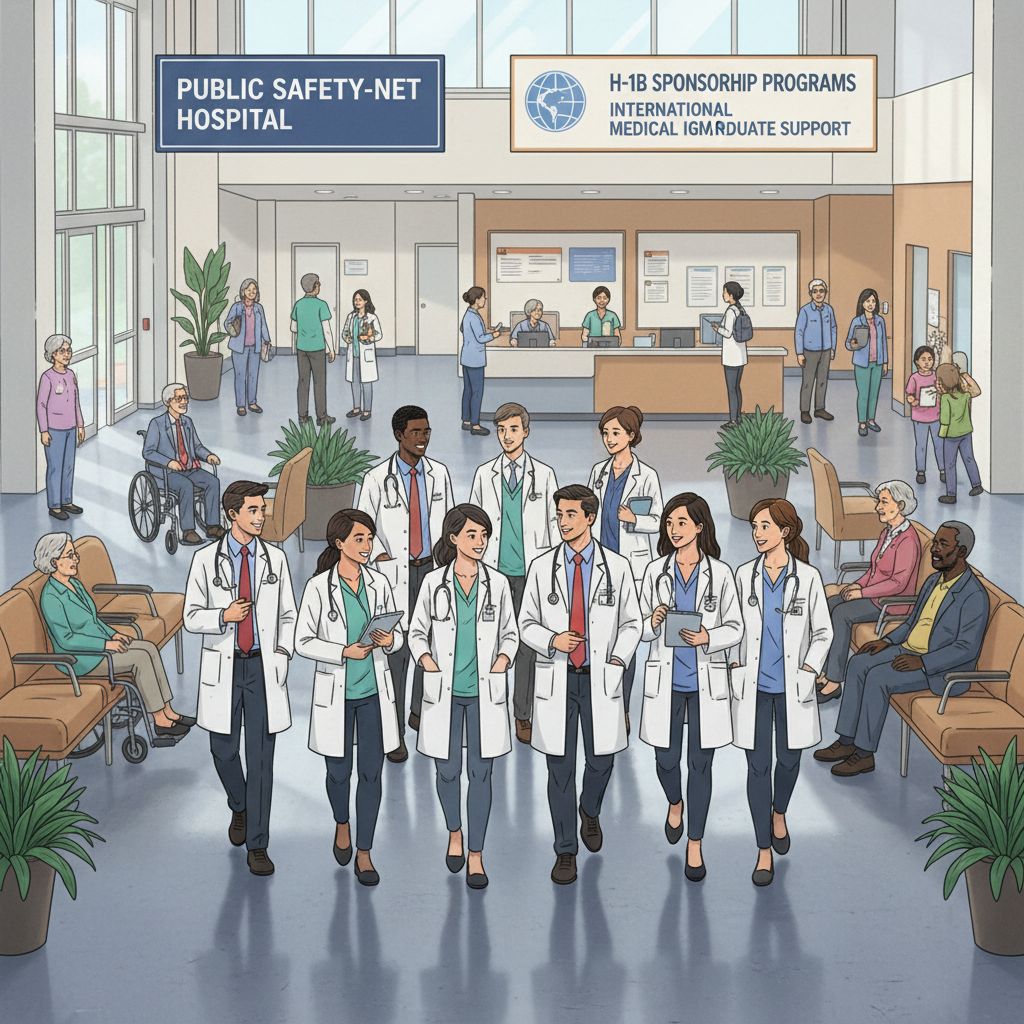
Understanding H-1B Sponsorship in Urology Residency
For international medical graduates (IMGs) interested in urology, navigating immigration and training pathways is almost as important as mastering anatomy and surgical skills. Urology is one of the most competitive specialties in the United States, and the overlay of visa and sponsorship rules adds a layer of complexity that can make or break an application strategy.
This guide focuses specifically on H-1B sponsorship programs in urology, helping you understand:
- How the urology residency training structure intersects with visa rules
- Which types of institutions are more likely to be H-1B cap exempt
- How to strategically identify and approach H-1B residency programs
- Practical steps to strengthen your profile for an H-1B–sponsoring urology match
While no article can replace program-specific verification or legal advice, this resource will give you a clear framework, vocabulary, and strategy to move forward intelligently and confidently.
1. Basics of the H-1B Visa for Urology Residency
Before targeting any H-1B sponsor list or specific program, you should understand the fundamentals of how the H-1B functions in the context of graduate medical education (GME).
1.1 What is the H-1B in Residency Training?
The H-1B is a non-immigrant work visa for “specialty occupations” that require at least a bachelor’s degree and specialized knowledge. In medicine, it is often used for:
- Residency and fellowship training
- Academic or hospital-employed attending positions
Key distinctions from J-1 for residents:
- Employer-sponsored work visa (the hospital/university is the employer)
- Requires USMLE Step 3 (most states) before the petition can be filed
- Typically limited to 6 years total, including time spent in training
- Does not include the two-year home-country residency requirement (unlike J‑1)
For urology, which involves a 5–6 year training pathway (preliminary/general surgery year plus 4–5 years of urology), the total H‑1B clock matters significantly.
1.2 Cap-Subject vs. Cap-Exempt H-1B for Urology
Not all H-1B positions are the same. A central concept is the H‑1B cap:
- The US government limits the number of new H‑1B visas issued annually in most sectors.
- New “cap-subject” H‑1Bs must go through the lottery, with deadlines around March/April each year.
However, many residency positions—including urology—may qualify as H-1B cap exempt, meaning:
- No lottery requirement
- Can file petitions at any time of the year
- Not counted against the annual numerical cap
Most academic urology programs are affiliated with:
- Universities or university medical centers
- Non-profit or government teaching hospitals
These institutions often qualify as cap exempt employers. That means they can support an H‑1B visa for residency or fellowship even if the regular cap is reached.
Important nuance:
Being cap exempt in residency does not automatically guarantee cap exemption for future attending jobs. After finishing training, if you move to a private practice or non-exempt employer, you may need to go through the standard H‑1B lottery process unless you remain with a cap-exempt institution.
1.3 Typical H-1B Requirements for Urology Residency
While every institution has its own policies, typical requirements for an H-1B residency program in urology include:
- Valid ECFMG certification
- Completion of USMLE Step 1, Step 2 CK, and Step 3
- A medical degree that meets state medical board requirements
- Eligibility for a training license (or full license in some states)
- No prior status violations in the US
Practical implication:
You must plan Step 3 early, ideally before the urology match deadline, if you intend to pursue H‑1B. Many programs will not rank or sponsor you for H‑1B if you have not passed Step 3 by a specified date.
2. Structure of Urology Training and How It Interacts with H-1B
Urology has a unique training structure compared with other specialties, which directly impacts visa strategies.
2.1 Urology Residency Length and H-1B Time Limits
Most urology training programs follow one of these patterns:
- 5-year track: 1 year of general surgery + 4 years of urology
- 6-year track: 2 years of general surgery + 4 years of urology
- Integrated models where the early years combine surgery and urology rotations
Given the 6-year maximum H-1B duration, the following becomes critical:
- If your residency is 5 years and you start on H‑1B from PGY‑1, you may finish just under the 6-year ceiling—leaving limited time for fellowship under H‑1B unless you move to a cap-exempt position that can “reset” the strategy (e.g., O‑1 or later green card).
- If your residency is 6 years, you will likely use the entire H‑1B clock in training, making a subsequent fellowship or attending job on H‑1B more complex.
Some programs proactively manage this by:
- Sponsoring J‑1 first, then switching to H‑1B for fellowship or attending
- Sponsoring H‑1B starting later (e.g., after a year on J‑1 or another status)
- Counseling residents early on about long-term immigration planning
You should ask explicit questions during interviews about how the program handles the H‑1B time limit vs. residency length.
2.2 Categorical vs. Non-Categorical Positions
In the urology match, most positions are categorical—meaning:
- You match into urology, and your preliminary surgery year is coordinated as part of your match outcome.
From a visa perspective, that means the same institution or coordinated partners often sponsor you across:
- PGY‑1: Surgical prelim or integrated year
- PGY‑2 to PGY‑x: Urology-specific years
Key issue:
If your PGY‑1 is at a different hospital (even if coordinated), its visa policies must also allow H‑1B. Some smaller or community surgery programs may not sponsor H‑1B or may be unfamiliar with it.
Action step:
Confirm with the urology program:
- “Is the institution sponsoring my visa the same for my preliminary year and urology years?”
- “If my PGY‑1 is at a different hospital, will they also sponsor an H‑1B resident?”

3. Types of Urology Programs That Commonly Sponsor H‑1B
There is no official, centralized H‑1B sponsor list for urology. However, some patterns can help you target programs more strategically.
3.1 Academic Medical Centers and University Hospitals
These are the most common H‑1B residency programs in urology:
- Large, university-affiliated hospitals
- NCI-designated cancer centers with strong urologic oncology divisions
- Academic centers with robust research programs (NIH-funded faculty, labs, etc.)
Why they tend to sponsor H-1B:
- Many qualify as H‑1B cap exempt (university or affiliated non-profit)
- They often have established GME offices and immigration attorneys
- They regularly sponsor H‑1B for residents, fellows, and faculty, so the process is familiar
Characteristics to look for:
- Affiliation with a major university or medical school
- Large GME office with dedicated visa or international office
- History of hiring IMGs at the faculty level
These institutions are your best starting point if you’re an IMG aiming for H‑1B sponsorship in the urology match.
3.2 Major Non-Profit Teaching Hospitals
Some non-university hospitals may still qualify as cap exempt due to:
- Formal, documented affiliations with universities for educational purposes
- Non-profit status and primary mission linked to education or research
Some large, multi-hospital systems sponsor H‑1B for residents but may have institution-wide policies that differ by site. Urology may be concentrated at one flagship hospital that has more experience with visas.
Questions to ask or research:
- “Is your institution cap exempt for H‑1B?”
- “Do you currently have any residents or fellows on H‑1B?”
- “Does the GME office support H‑1B for categorical residents, including urology?”
3.3 Community-Based or Hybrid Programs
A smaller number of community-based urology residencies or hybrid academic–community programs may sponsor H‑1B, but this is less consistent. Challenges include:
- Limited administrative experience with H‑1B
- Preference for J‑1 ECFMG sponsorship due to simpler central management
- Institutional policies that prohibit H‑1B sponsorship for trainees
However, some high-volume community or private-university hybrid programs do sponsor H‑1B, particularly if they are closely tied to a medical school.
Approach:
- Review their current and past resident rosters—are there many IMGs?
- Email the program coordinator directly and ask about visa policies.
- Cross-reference with online alumni profiles (LinkedIn, institutional bios) to look for past H‑1B usage.
4. How to Identify Urology Programs That Sponsor H‑1B
Because there is no official, specialty-specific H‑1B sponsor list, you need to be proactive. A strategic approach can save you months of uncertainty and wasted applications.
4.1 Sources of Information
Use multiple data points to build your target list:
Program Websites
- Some list visa policies explicitly (e.g., “We sponsor J‑1 and H‑1B visas”).
- Others state, “We accept J‑1 only” or “We do not sponsor visas.”
FREIDA (AMA Residency & Fellowship Database)
- Many programs indicate whether they accept/sponsor J‑1, H‑1B, or both.
- Check under “Program Requirements” or “Visa Policy.”
Institutional GME Office Sites
- Many large institutions maintain a GME visa policy page independent of specialty.
- Search for “[Hospital/University name] GME visa policy H‑1B”.
Current and Former Residents
- LinkedIn profiles: look for residents with “H‑1B” in their posts or who are clearly IMGs now working in the US.
- Department social media accounts sometimes highlight international trainees.
Emailing Program Coordinators
A concise, respectful email can clarify ambiguous information.
For example:
“I am an IMG planning to apply for urology residency and am interested in your program. Could you please let me know whether your institution is able to sponsor H‑1B visas for residents, or if you only accept J‑1 visa sponsorship through ECFMG?”
4.2 Recognizing Red Flags and Gray Areas
Be cautious with the following:
- “We accept residents who are already in valid visa status”
- This may mean they do not initiate H‑1B but are willing to transfer or continue an existing status.
- “We accept J‑1 and consider H‑1B on a case-by-case basis”
- This is common language; ask follow-up questions:
- “Have you sponsored H‑1B for urology residents in the last 3–5 years?”
- This is common language; ask follow-up questions:
- Silence on visa policy
- If the program website says nothing, you cannot assume they sponsor H‑1B. Always verify.
4.3 Building Your Personal H‑1B-Friendly Urology Program List
Organize your research in a spreadsheet with columns like:
- Program name
- Institution type (university, non-profit teaching, community)
- Visa policy (J‑1 only, J‑1 + H‑1B, unknown)
- Cap exempt? (yes/no/unknown)
- Historically sponsored H‑1B for residents (yes/no/unclear)
- Contact notes and date of last confirmation
As you collect data, you’ll start to see patterns and natural tiers of programs:
- Clearly H‑1B friendly and cap exempt
- Open to H‑1B but with restrictions or rare sponsorship
- J‑1 only (should be excluded if you are H‑1B–dependent)
- Unknown – require direct contact

5. Application Strategies for the Urology Match with H‑1B in Mind
Because urology is highly competitive, your application strength and your visa needs both influence your match strategy.
5.1 Early Timeline Planning
Key milestones if you are targeting an H‑1B–sponsoring urology residency:
2–3 years before match
- Plan USMLE Step 1 and Step 2 CK completion.
- Begin clinical exposure in urology (observerships, research fellowships).
12–18 months before match
- Aim to complete USMLE Step 3 if you are firmly committed to H‑1B.
- Build relationships with urology faculty who can write strong letters.
Match season (summer–fall of application year)
- Submit urology applications (ERAS) with specified visa requirement.
- Tailor personal statements to show genuine interest in urology, not just “any H‑1B program.”
Interview season
- Be transparent but strategic when discussing visa needs.
- Ask specific, professional questions about H‑1B policies.
5.2 Presenting Your Visa Situation Professionally
During interviews or email exchanges:
Be clear and concise:
- “I am an IMG, currently on [status], and I will require H‑1B sponsorship for residency. I have passed USMLE Step 3 (or am registered to take it by [date]).”
Show that you understand the basics:
- Acknowledge the training length vs. H‑1B 6-year limit if asked.
- Demonstrate you have long-term plans in academic or clinical urology.
Avoid sounding demanding:
- Present H‑1B as a requirement, not a negotiable preference, but with appreciation for the administrative work involved.
5.3 Strengthening Your Competitiveness as an IMG in Urology
Programs willing to sponsor H‑1B often have many competitive applicants. To stand out:
Urology-focused research
- Publications, abstracts, and posters in urologic oncology, endourology, or reconstructive urology.
- Research years in a US academic center can be extremely valuable and may expose you to future sponsors.
Meaningful clinical exposure in US urology
- Observerships, externships, or research with clinical shadowing.
- Try to work closely with urologists who can write strong, personalized letters.
Demonstrated technical aptitude
- Participation in surgical skills labs, simulation training, or hands-on workshops.
- If available, certificates or documented participation in urology bootcamps or endoscopy courses.
Communication and professionalism
- Urology is team-based and procedure-heavy; programs value residents who are technically capable and easy to work with.
- Strong English proficiency and cultural adaptability are essential—especially in patient counseling and OR communication.
5.4 Considering the J‑1 vs. H‑1B Trade-Off
Some IMGs initially prefer H‑1B, but for urology, it’s worth examining the trade-offs carefully:
Advantages of J‑1 for urology residency
- No need for Step 3 before the match.
- No 6-year time cap issue during residency (J‑1 is extended year by year for training).
- Commonly used; most programs are accustomed to J‑1 processing via ECFMG.
Disadvantages of J‑1
- Two-year home-country physical presence requirement after training, unless you get a J‑1 waiver job.
- Waiver positions in urology can be more limited than in primary care, though they do exist in underserved areas.
Advantages of H‑1B
- No home-country requirement after training.
- Easier pathway to transition to an attending role or fellowship without a waiver.
- Potentially more straightforward shift to permanent residency (green card) if the employer supports it.
Disadvantages of H‑1B
- Requirement for Step 3 and state licensing readiness earlier.
- The 6-year cap can complicate a full 6-year residency plus fellowship.
- Some institutions simply do not sponsor H‑1B for residents.
Your choice may depend on:
- Your long-term plan (academic vs. community, US vs. home country)
- Your ability to complete Step 3 early
- Availability of H‑1B–friendly urology residency programs that fit your profile
6. Long-Term Planning Beyond Urology Residency
The urology match is only one stage in a longer professional and immigration journey.
6.1 Fellowships and Subspecialization
Many urologists pursue fellowships in:
- Urologic oncology
- Endourology/stone disease
- Pediatric urology
- Female pelvic medicine and reconstructive surgery
- Male infertility/andrology
For H‑1B holders, questions to consider:
- Will your total H‑1B time allow both residency and fellowship?
- Is your fellowship institution also H‑1B cap exempt and experienced in sponsorship?
- Could you transition to O‑1 (extraordinary ability) status if your research and achievements are very strong?
Early mentorship from faculty who have navigated similar paths is invaluable.
6.2 Transition to Attending Positions
After completing urology training:
- If you are at a cap-exempt academic center, you may remain there on H‑1B indefinitely (through extensions) or transition to a green card.
- If you want to move to private practice or a non-cap-exempt employer, they may need to enter the cap-subject H‑1B lottery, unless you change to another visa category.
Some urologists complete:
- J‑1 waiver jobs in underserved areas (if on J‑1)
- National Interest Waiver (NIW) or employment-based green card with academic institutions
Your early choice of H‑1B vs. J‑1 for residency affects this long-term trajectory, so gather information early and revisit your plan periodically.
FAQs: H-1B Sponsorship Programs in Urology
1. Do all urology residency programs that take IMGs sponsor H‑1B?
No. Many urology programs that accept IMGs may only support J‑1 (through ECFMG). Others sponsor both J‑1 and H‑1B, and a smaller group may not sponsor any visas at all. You must verify program-specific policies rather than assume that IMG-friendliness automatically means H‑1B sponsorship.
2. Is USMLE Step 3 mandatory for H‑1B in urology residency?
In practice, yes. For nearly all states and training licenses, USMLE Step 3 is required before the H‑1B petition is filed. Some programs will interview you without Step 3 but expect a passing score before rank lists are finalized or before the contract is issued. If you intend to pursue H‑1B, schedule Step 3 early enough to avoid delays.
3. How can I find out if a specific urology program is H‑1B cap exempt?
You can:
- Check the institution’s GME visa policy page
- Look for wording such as “affiliated with [University]” or “non-profit academic medical center”
- Ask the program coordinator directly, using clear questions like:
- “Is your institution considered cap exempt for H‑1B sponsorship?”
- “Have you sponsored H‑1B visas for residents or fellows in recent years?”
Most university-affiliated academic centers are cap exempt, but always confirm rather than relying on assumptions.
4. If I start residency on J‑1, can I switch to H‑1B later in urology?
Sometimes, but not always. Some programs or state medical boards may allow a status change from J‑1 to H‑1B (for example, for fellowship or faculty roles), while others prefer residents to remain on J‑1 for the duration of training. Any mid-training switch involves careful coordination with ECFMG, the program, and possibly an immigration attorney. This kind of transition is more common at the fellowship or attending level than within residency itself.
By understanding how H‑1B residency programs, H‑1B cap exempt institutions, and the structure of urology residency interconnect, you can design a realistic, efficient application strategy. Combine this visa awareness with strong clinical preparation, focused urology exposure, and deliberate networking, and you will be well-positioned to compete in the urology match as an IMG seeking H‑1B sponsorship.