
Understanding H-1B Sponsorship in VA Residency Programs
For many international medical graduates (IMGs), the combination of VA residency programs and H-1B sponsorship is especially attractive. VA hospitals (Veterans Affairs medical centers) are large teaching sites affiliated with academic medical centers, and many of these institutions have a long history of working with non–U.S. citizen trainees.
However, the H-1B landscape is often confusing—particularly when it intersects with veterans hospital residency training, federal employment, and academic teaching hospitals that may be H-1B cap exempt. This article explains how H-1B sponsorship works in the context of VA-affiliated residency programs, what IMGs should know before applying, and how to strategically identify opportunities.
1. Basics of H-1B for Medical Residency (and Why VA Settings Are Unique)
What is an H-1B Visa in the Residency Context?
The H-1B is a temporary, employment-based visa for “specialty occupations,” which includes physicians in residency and fellowship training. In teaching hospitals, the H-1B is typically used for:
- Medical residency positions (GME training)
- Subspecialty fellowships
- Occasionally, attending or staff physician roles after training
Most IMGs who match to residency in the U.S. train on the J-1 visa, sponsored by the Educational Commission for Foreign Medical Graduates (ECFMG). A smaller but important percentage train on H-1B, often because they:
- Are ineligible or not interested in the J-1
- Want to avoid the J-1 two-year home-country physical presence requirement
- Have long-term plans for U.S. permanent residency and want a pathway that may be more straightforward for them
Why VA-Affiliated Programs Matter for H-1B
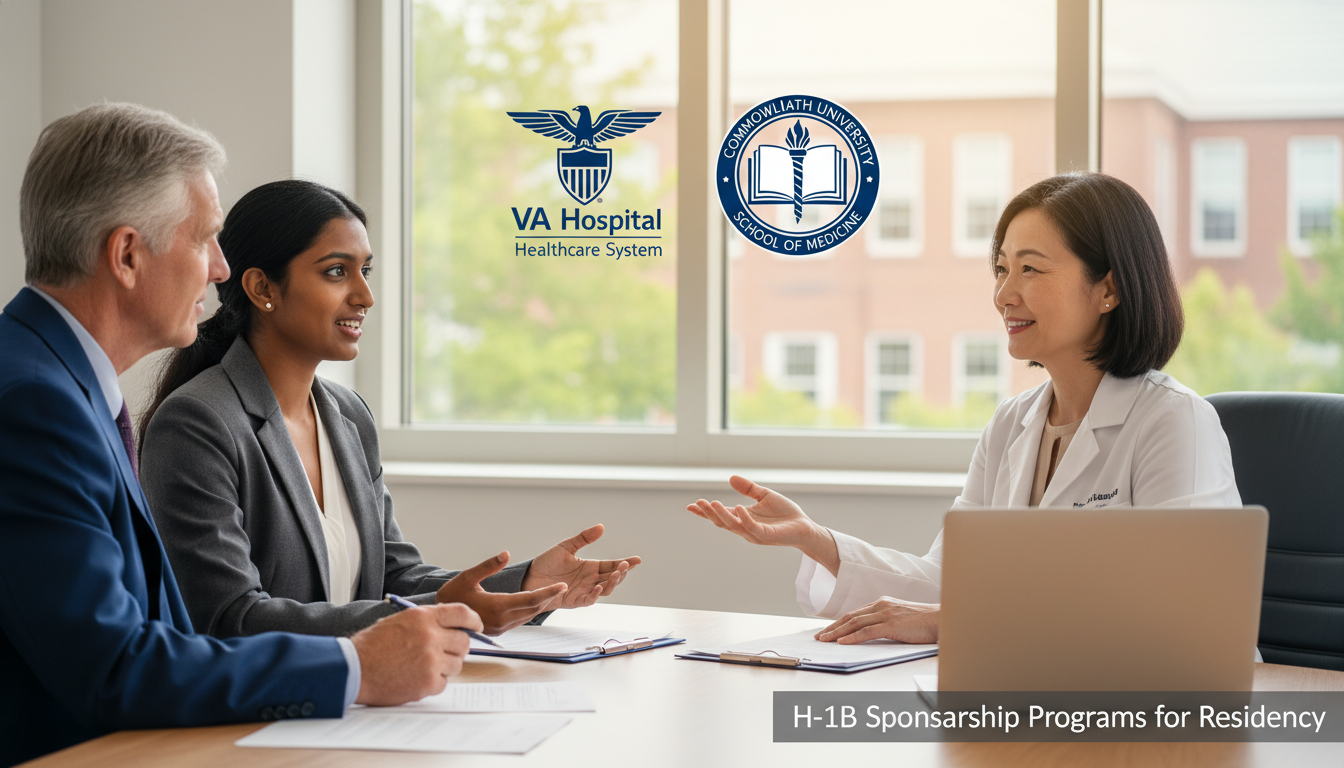
VA hospitals are federal facilities, but most residents in VA hospitals are not VA employees. Instead, they are employees of the affiliated academic teaching hospital (university or health system). This distinction is important:
- The VA site is a major training location, sometimes where residents spend 30–70% of their time.
- The GME office and payroll are usually handled by the academic partner (e.g., a university hospital system), which is typically the H-1B sponsor.
- The VA itself usually does not sponsor H-1B for residents; the academic institution does.
Because many academic hospitals associated with VA facilities are non-profit, educational, or government-related institutions, they are often H-1B cap exempt. That means:
- They can file H-1B petitions at any time of year (no April 1 lottery issue).
- They are not limited by the national H-1B numerical cap.
- They usually have established workflows and experience with H-1B applications for residents and fellows.
This cap-exempt status, combined with the mission of serving veterans, can make VA-affiliated programs particularly IMG-friendly—though this varies significantly by institution.
2. Cap-Exempt vs Cap-Subject H-1B in VA-Associated Training
Understanding H-1B Cap and Cap Exemption
H-1B visas in the U.S. fall into two broad categories:
Cap-Subject H-1B
- Subject to an annual numerical limit (the “H-1B lottery”).
- Only certain private-sector employers usually fall into this category.
- Timing and selection are uncertain.
H-1B Cap-Exempt
- Not subject to the annual numerical cap or lottery.
- Can file petitions year-round.
- Includes certain employers such as:
- Institutions of higher education
- Non-profit entities related to or affiliated with institutions of higher education
- Non-profit research organizations
- Government research organizations
Most university hospitals and academic medical centers that partner with VA hospitals fall under one of these cap-exempt categories.
How This Applies to VA Residency Programs
A typical VA-affiliated residency program structure:
- Primary H-1B employer: Academic hospital or medical school (e.g., “University X Medical Center”).
- Training sites: University hospital + VA medical center + possibly additional sites (county hospital, community clinic, etc.).
- GME office: Located in the university or affiliated health system, which manages employment and visa sponsorship.
This means:
- Your H-1B petition is usually filed by the university GME office, not by the VA hospital.
- The academic hospital is often H-1B cap exempt, allowing more stable planning and smoother transitions between residency and fellowship.
However, not all VA-affiliated institutions choose to sponsor H-1B for residents, even if they are legally eligible. Sponsoring is a policy decision, not an obligation.

3. H-1B Policies in VA-Affiliated Residency Programs: What IMGs Need to Know
Do VA Residency Programs Sponsor H-1B?
VA-based or VA-affiliated programs vary widely in their visa policies. Some:
- Sponsor both J-1 and H-1B for eligible applicants
- Only sponsor J-1
- Accept only U.S. citizens/permanent residents in some sensitive specialties (rare but possible, especially in positions requiring specific security clearance or direct VA employment)
Most of the time, the program’s policy is determined by:
- The academic institution’s GME office policies
- Institutional legal counsel’s comfort with immigration law
- Administrative workload and past experience with H-1B sponsorship
- Funding sources and cost considerations
Because training occurs at both the university hospital and the VA, programs must ensure compliance across all training sites, but that usually does not prevent H-1B sponsorship when the main employer is cap-exempt.
Typical Eligibility Criteria for H-1B in VA-Affiliated Programs
Residency programs that sponsor H-1B often require:
- USMLE scores and completion
- Generally Step 1 and Step 2 CK passing scores
- Step 3 often required before H-1B petition filing (many programs insist on Step 3 before they will agree to sponsor H-1B)
- ECFMG Certification for IMGs
- Unrestricted state medical license or training license eligibility (depending on the state’s rules; sometimes Step 3 is part of that requirement)
- Absence of visa issues that would prevent timely approval (overstays, prior denials, etc.)
You’ll typically find this information, if it’s public, in:
- The program’s website (under “International Medical Graduates,” “Visa Sponsorship,” or “Eligibility Criteria”)
- FREIDA or other residency databases under “Visa Status Accepted”
- GME office pages for the affiliated university/hospital
J-1 vs H-1B: Strategic Considerations for VA-Based Training
Advantages of H-1B in VA-associated programs:
- No J-1 home country two-year requirement after training.
- Flexibility to move to cap-exempt (and later cap-subject) H-1B roles.
- Often easier to transition directly from residency to fellowship in the same or another academic institution under cap-exempt rules.
Potential disadvantages or challenges:
- Some VA-affiliated programs simply do not sponsor H-1B due to cost/logistics.
- H-1B is employer-specific; switching programs mid-training is more complex.
- You may need Step 3 completed early, before ranking or contract issuance.
- Filing fees and legal costs may be higher (usually covered by the employer, but some institutions push certain costs to the applicant, which must be done in a legally compliant way).
4. Identifying VA Programs That Sponsor H-1B: Practical Steps
1. Use Public Databases (But Verify)
Start with public resources that mention visas, then confirm details directly.
FREIDA (AMA Residency & Fellowship Database)
- Filter by specialty and state, then look at each program profile.
- Under “Visa Status,” note whether they accept H-1B.
- Many VA-affiliated programs are clearly listed under an academic institution that has a VA training site.
Program Websites
- Look for sections like:
- “International Medical Graduates”
- “Visa Sponsorship”
- “FAQ for Applicants”
- Check whether they mention:
- H-1B sponsorship
- Requirement for Step 3
- Statement such as “We sponsor J-1 and H-1B visas” or “We only sponsor J-1 visas”
- Look for sections like:
2. Understand the Institutional Context
In VA-related settings, your real H-1B sponsor is almost always the university or health system. To build your own H-1B sponsor list for VA-affiliated training:
- Look at major academic centers known to partner with VA hospitals, such as:
- Large university medical centers in each state
- Systems that frequently mention VA sites in their program descriptions
- Cross-check if each academic center is:
- A non-profit academic medical center
- Affiliated with an institution of higher education
- These characteristics often indicate H-1B cap exempt status.
Once you identify cap-exempt academic centers, list which of their programs include VA hospitals as training sites—these form your target set of VA residency programs likely to have H-1B pathways.
3. Directly Contact the GME or Program Coordinator
Because online information may be outdated, always confirm by email:
Sample email script:
Subject: Inquiry Regarding H-1B Sponsorship for Residency Applicants
Dear [Program Coordinator / Program Director],
I am an international medical graduate interested in applying to your [specialty] residency program. I noticed your program includes a significant training component at the VA hospital.
Could you please clarify whether your program sponsors H-1B visas for residency positions, and if so, whether Step 3 must be completed before ranking or before starting residency?
Thank you very much for your time and assistance.
Sincerely,
[Your Name], MD
[Current Institution, if any]
This approach:
- Shows professionalism and proactive planning
- Gives you official, current information
- Helps you avoid wasting applications on programs that cannot sponsor your preferred visa type
4. Prioritize Programs With Established H-1B Track Records
When you compile your list of VA residency programs with potential H-1B sponsorship, favor programs that:
- Clearly state “We sponsor H-1B visas”
- Have current or recent residents on H-1B (you can sometimes discover this by:
- Talking with current residents at virtual open houses
- Asking during interview day Q&A
- Checking alumni profiles where visa status is mentioned)
Patterns to look for:
- Large university programs strongly integrated with a VA hospital
- States where many academic centers openly support H-1B for residents (e.g., some northeastern and midwestern institutions)
- Subspecialties that frequently use H-1B for fellows and may be more open to H-1B for residents (e.g., certain internal medicine or surgical departments)
5. Application Strategy: Maximizing Your Chances in VA-Based H-1B-Friendly Programs
Prepare Early for USMLE Step 3
Because many H-1B–sponsoring programs require USMLE Step 3 before filing the petition:
- Plan to take Step 3 before or during the application season, if possible.
- If you are on another status (e.g., F-1 OPT), time your exam so that results are available before:
- Rank list deadlines, or
- Contract issuance deadlines (depending on each program’s policy).
Mentioning in your application that you’ve scheduled Step 3 with a date can reassure programs that you are planning for H-1B eligibility.
Customize Your Personal Statement for VA-Focused Programs
For VA-affiliated programs, demonstrate genuine interest in veterans’ care:
- Highlight:
- Any prior work with military or veteran communities
- Interest in PTSD, traumatic brain injury, chronic pain, addiction, or geriatric care—all highly relevant in VA settings
- Commitment to underserved or complex patient populations
Link this to your long-term goals and explain how training in a veterans hospital residency program aligns with your desired career path.
Address Visa Status Transparently in Interviews
During interviews, most programs will ask about your visa needs. When applying to VA-affiliated programs that might be H-1B-friendly:
- Be clear and honest:
- “I am currently on [visa type] and will require H-1B sponsorship for residency.”
- “I have passed Step 1, Step 2 CK, and Step 3, and I am ECFMG-certified.”
- If Step 3 is pending, say so and give the scheduled date.
Avoid trying to push programs into commitments during interviews, but you can ask factual, neutral questions such as:
- “Does your GME office currently sponsor H-1B for residents in your program?”
- “Is Step 3 required before the match, or only before starting residency?”
Build a Balanced Program List
If H-1B is essential for you (e.g., you cannot or do not want to take J-1), your list should include:
- A strong core of H-1B-friendly, cap-exempt academic hospitals with VA sites
- Some backup programs that might sponsor J-1 (if you are open to it)
- Programs across multiple geographic regions to diversify your odds
Remember that VA sites are widespread, but not every VA-affiliated residency program will accommodate H-1B. A balanced strategy is critical to maximize your match chances.
6. Post-Residency Planning: Leveraging H-1B and VA-Affiliated Training
Transitioning to Fellowship in VA-Linked Institutions
If your residency H-1B was sponsored by a cap-exempt academic center:
- Moving to a cap-exempt fellowship at another university/VA-affiliated institution is often straightforward.
- This usually involves:
- An H-1B transfer or new petition (still cap-exempt)
- Updated credentials and training license/license eligibility
- Timing coordination to avoid gaps in status
Fellowships that heavily involve VA training (e.g., cardiology, GI, pulmonary/critical care, geriatrics, psychiatry subspecialties) often remain in the cap-exempt environment and may be more experienced with IMG trainees.
Long-Term Career: VA Employment and H-1B
Once you are board-eligible or board-certified, VA employment itself can be an option. Key points:
- VA physician jobs may at times be open to non–U.S. citizens (though U.S. citizens are usually preferred).
- H-1B sponsorship at the VA as employer is variable and more complex than in academic settings. Some VA systems have sponsored H-1B for attending roles; others rely on permanent residents or citizens.
- Alternatively, you might remain in university employment (cap-exempt) while working part-time at a VA facility under an academic contract.
For long-term immigration planning, many physicians trained at VA-affiliated institutions pursue:
- Academic positions in cap-exempt institutions
- Conrad 30 waiver positions (for those who were on J-1) in medically underserved areas
- Employer-sponsored PERM and green card processes while on H-1B
If you complete residency and fellowship training on H-1B in cap-exempt settings, you may later move to:
- A cap-subject H-1B role in the private sector (requiring lottery selection), or
- Continue in cap-exempt roles in academia or certain non-profit/community systems.
FAQs: H-1B Sponsorship and VA Residency Programs
1. Are VA residency programs themselves H-1B sponsors?
Not usually. The VA hospital is generally not the legal sponsor for residents. Instead:
- The academic affiliate (university hospital or health system) employs residents and sponsors visas.
- The VA is a training site, where you rotate and care for veterans, but your paycheck and visa sponsorship generally come from the university partner.
Always look at the university or academic institution’s visa policy, not just the VA site name.
2. Are VA-affiliated hospitals considered H-1B cap exempt?
The VA hospital as a federal facility is not typically the entity sponsoring resident H-1Bs. However, its academic partners—university medical centers and related non-profit hospitals—are often H-1B cap exempt because they are:
- Institutions of higher education, or
- Non-profit entities affiliated with such institutions.
Therefore, most residency and fellowship training that involves VA sites occurs under cap-exempt H-1B sponsorship from the academic partner, not the VA itself.
3. Do I need USMLE Step 3 to get H-1B sponsorship in a VA-affiliated residency program?
In most cases, yes. Many GME offices that sponsor H-1B require:
- Step 3 passed before they will:
- File the H-1B petition, and often
- Issue a firm H-1B-based offer.
Policies vary:
- Some require Step 3 before the rank list deadline.
- Others allow you to take Step 3 after match but before your start date.
Because requirements are program-specific, always confirm directly with the residency program or GME office.
4. How can I build a targeted H-1B sponsor list focused on VA training opportunities?
To build an H-1B sponsor list centered on VA-affiliated programs:
- Identify major academic medical centers with VA partnerships in your specialty.
- Check their residency websites and FREIDA listings for H-1B acceptance.
- Confirm by emailing program coordinators about:
- H-1B sponsorship
- Step 3 requirements
- Prioritize programs that:
- Are clearly H-1B cap exempt (university-owned or non-profit, education-related)
- Have a demonstrable track record of sponsoring H-1B for residents or fellows
By combining this structured research with direct communication, you can systematically target VA residency programs that align with both your training goals and your H-1B visa needs.