Understanding H-1B Sponsorship for IMGs in the Great Lakes Region
For an international medical graduate (IMG), the H-1B visa can be a powerful pathway to residency and future practice in the United States—especially in the Great Lakes Region, where a dense network of academic medical centers and midwest residency programs creates multiple opportunities.
This IMG residency guide focuses specifically on H-1B sponsorship programs in:
- Illinois
- Indiana
- Michigan
- Ohio
- Wisconsin
(Some definitions of the Great Lakes add Minnesota and Pennsylvania; where relevant, these will be mentioned, but the primary focus remains the five core Great Lakes states.)
We will walk through:
- How H-1B residency programs differ from J-1
- Key advantages and limitations of H-1B for IMGs
- What makes a program “H-1B friendly”
- Examples and patterns among Great Lakes residency and fellowship programs
- How to research and build your own H-1B sponsor list
- Practical application strategies and common pitfalls
This article is aimed at IMGs in the residency match and applications phase who are prioritizing H-1B over J-1 and are strongly considering Great Lakes / Midwest residency programs.
1. H-1B vs J-1: What Every IMG Needs to Know
Before identifying H-1B friendly programs, you need to understand what you’re asking programs to commit to. Many rejections or vague answers happen simply because applicants do not understand the implications for hospitals and Graduate Medical Education (GME) offices.
1.1 H-1B Visa Basics for Residency
For residency and fellowship, H-1B is a temporary work visa for specialty occupations:
- Employer-sponsored: The residency program (hospital/university) is your petitioner.
- Specialty occupation: Residency training qualifies as a specialty occupation requiring a professional degree.
- Initial validity: Up to 3 years, with a typical total maximum of 6 years (including any previous H-1B time).
- Credential requirement: Most programs require USMLE Step 3 passed before visa filing (not always before ranking, but sooner is always better).
- Prevailing wage: Employer must pay at least the prevailing wage for that position.
For many academic centers in the Great Lakes Region, H-1B is a well-established route for IMGs in internal medicine, pediatrics, neurology, pathology, and sometimes surgical specialties.
1.2 Advantages of H-1B Over J-1 for IMGs
No two-year home-country return requirement
- J-1 physicians typically must return to their home country for two years or obtain a waiver (often through service in underserved areas).
- With H-1B, you can move directly into fellowship or attending jobs without navigating the waiver maze.
Direct pathway to employment and green card
- Many physicians on H-1B transition seamlessly into employer-sponsored permanent residency (EB-2/EB-3).
- This is particularly attractive in states like Ohio, Michigan, and Illinois, which have multiple large health systems eager to retain physicians long term.
Greater flexibility for location changes (within rules)
- You can change employers (portability) as long as the new employer files a new H-1B petition.
- Many Great Lakes healthcare systems use this flexibility to attract IMGs after residency.
1.3 Limitations and Risks of H-1B for Residents
USMLE Step 3 requirement
- Many H-1B residency programs require Step 3 passed by the time of rank list certification or at least before the visa petition (spring/early summer).
- This means you must schedule Step 3 early—often during or just after internship in your home country or before starting residency.
Six-year clock
- If you spend several years on H-1B (e.g., in research or prior training) before US residency, you could have limited time left for residency + fellowship.
- For example, 3-year internal medicine + 3-year cardiology = 6 years. Prior H-1B time in another job may complicate this.
Employer cost and administrative burden
- Filing, legal fees, and compliance are more intensive than for J-1.
- Some community programs in the Midwest may state they “don’t sponsor H-1B” simply because they lack legal support or funding.
2. What Makes a Great Lakes Program “H-1B Friendly”?
Not every program that “has done an H-1B” is truly IMG-friendly. You want predictability, not a one-off exception.
2.1 Core Features of an H-1B-Friendly Residency
When you evaluate midwest residency programs in the Great Lakes Region, look for these signs:
Clear visa policy on the website
- Ideally states: “We sponsor J-1 and H-1B visas for qualified international medical graduates,” with any conditions (e.g., Step 3 requirement) spelled out.
Multiple current or recent H-1B residents
- Evidence from resident bios, LinkedIn, or networking that several current or recent IMGs are on H-1B, not just J-1.
Institutional immigration support
- Presence of an institutional International Office or legal counsel dedicated to immigration.
- Common in large academic centers (e.g., Big Ten university hospitals, major health systems).
Consistent practice, not just theoretical policy
- If a program says “we can consider H-1B” but has no history of actually sponsoring, treat this cautiously.
2.2 H-1B Cap-Exempt vs Cap-Subject Programs
A crucial concept for IMGs is H-1B cap exemption:
Cap-subject H-1B:
- Limited annual quota; selection through lottery (usually in March).
- Risky for residents, as training must start on time (July 1).
H-1B cap-exempt:
- Universities and their affiliated teaching hospitals are typically cap-exempt.
- This describes most academic centers in Great Lakes cities like Chicago, Detroit, Cleveland, Columbus, Madison, Milwaukee, and Indianapolis.
- They can file H-1B petitions any time of year without the lottery, making them much more IMG-friendly.
For the purposes of an IMG residency guide to H-1B, most Great Lakes university-based programs will be H-1B cap exempt, which is a major advantage.
2.3 Typical H-1B-Focused Specialties in the Great Lakes
In this region, the most consistently H-1B friendly specialties include:
- Internal Medicine (especially university-based and large community-academic hybrids)
- Pediatrics and Medicine-Pediatrics
- Neurology
- Pathology
- Psychiatry (varies by program)
- Family Medicine (select programs, especially in underserved areas)
- Some radiology and anesthesiology programs with strong IMG representation
Surgical specialties (general surgery, orthopedics, neurosurgery) are more variable and often less H-1B friendly, though not impossible.
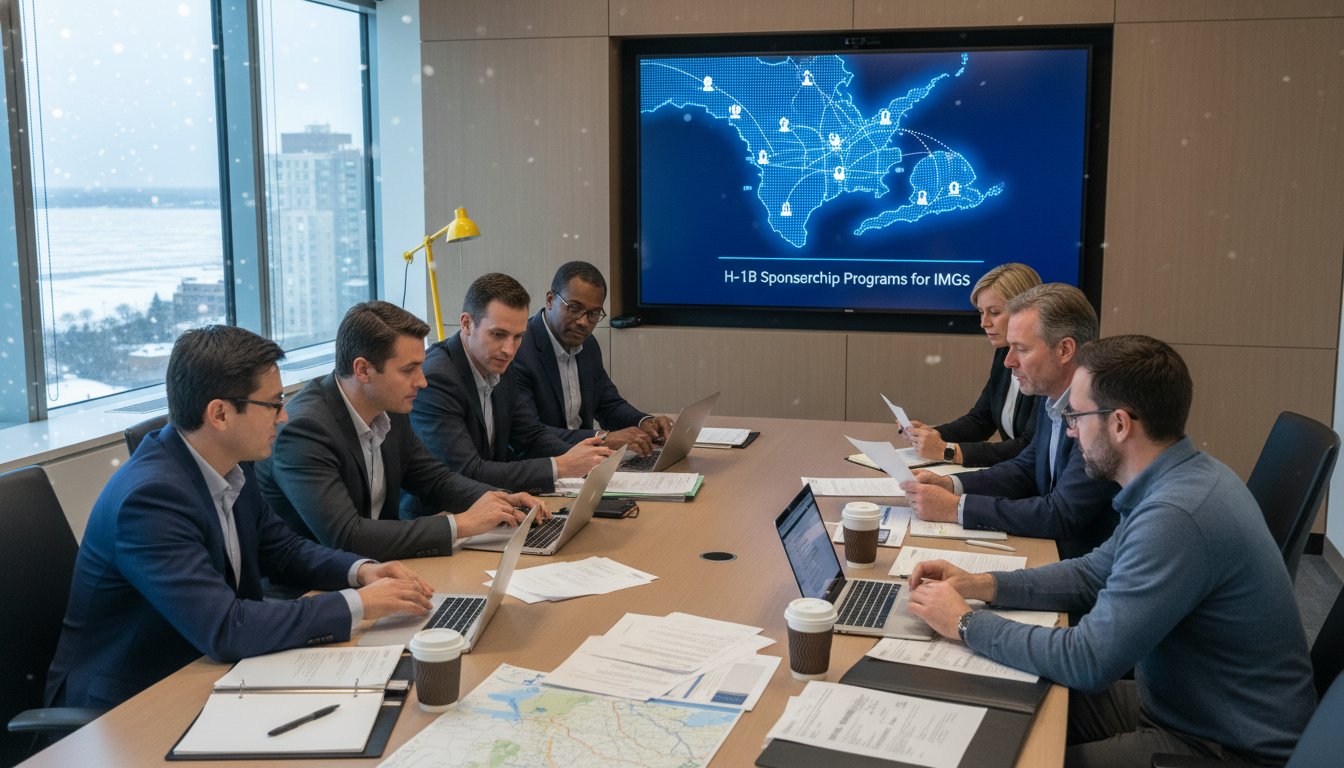
3. Patterns and Examples in Great Lakes H-1B Sponsorship
Specific program policies change frequently, so you should always verify the most current information. Rather than listing exact hospital names (which may become outdated), this section focuses on patterns within the Great Lakes Region and how to recognize H-1B friendly ecosystems.
3.1 Illinois: Chicago and Beyond
Chicago is one of the densest hubs of H-1B friendly programs for IMGs in the country.
Common patterns:
- Large academic centers and their affiliated midwest residency programs routinely sponsor H-1B for IMGs in internal medicine, pediatrics, neurology, pathology, and sometimes radiology.
- Many community-based but university-affiliated hospitals in Chicagoland also sponsor H-1B, often listed explicitly on their websites.
Outside Chicago:
- Several medium-sized cities in Illinois with university-affiliated hospitals also host H-1B residency programs, especially in internal medicine and family medicine.
- Pay attention to university-affiliated community programs; these often rely heavily on IMGs and are open to H-1B.
3.2 Michigan: Great Lakes Residency Opportunities
Michigan offers robust options, particularly in Detroit, Ann Arbor, Grand Rapids, and other regional hubs.
Patterns to look for:
- Major health systems and university hospitals frequently appear on informal H-1B sponsor lists shared among IMGs.
- Internal medicine, pediatrics, psychiatry, and some surgical subspecialties often include H-1B IMGs.
- Several great lakes residency programs in Michigan located in semi-urban or underserved areas actively recruit IMGs and are flexible with H-1B sponsorship, especially where physician shortages are high.
3.3 Ohio: Academic Giants and Community Partners
Ohio combines large academic centers with numerous affiliate hospitals:
- Academic medical centers in cities like Cleveland, Columbus, and Cincinnati typically are H-1B cap exempt and have experience sponsoring IMGs.
- Community teaching hospitals affiliated with these centers may also sponsor H-1B, especially in internal medicine and family medicine.
Look for:
- Internal medicine and subspecialty fellowships with a history of IMG trainees.
- Clear policy language like “We sponsor J-1 and H-1B visas” in departmental webpages.
3.4 Indiana and Wisconsin: Smaller but High-Yield Ecosystems
While smaller than Illinois, Michigan, or Ohio, Indiana and Wisconsin still provide valuable H-1B residency opportunities:
- In both states, the main academic medical centers and their extended networks host most of the H-1B sponsorship.
- Several midwest residency programs in family medicine, internal medicine, and psychiatry in these states actively rely on IMGs and are more open to H-1B.
Examples of patterns to look for:
- Programs that explicitly mention “international medical graduate” or “IMG friendly” on their websites, along with visa support.
- Locations with chronic physician shortages (rural or semi-rural Wisconsin or Indiana) may be more willing to sponsor H-1B to secure residents.
3.5 Minnesota and Pennsylvania (Bordering the Lakes)
Though not always included in narrow Great Lakes definitions, Minnesota and Pennsylvania border the Great Lakes and have sizable H-1B activity:
- Minnesota’s major academic center has a long history of IMG training and H-1B sponsorship, especially in internal medicine and subspecialties.
- Western Pennsylvania programs near Lake Erie often have university affiliations and may sponsor H-1B.
For IMGs prioritizing Great Lakes lifestyle and geography, including these states in your search can broaden your H-1B sponsor list significantly.
4. Building Your Personal H-1B Sponsor List in the Great Lakes
Given that formal lists quickly become outdated, your best strategy is to build a custom, evidence-based H-1B sponsor list.
4.1 Step-by-Step Research Strategy
Start with official program websites
- Go to each residency’s “Eligibility” or “For International Medical Graduates” section.
- Look for exact wording:
- “We sponsor J-1 and H-1B visas.”
- “We sponsor J-1 visas only” (exclude from H-1B list).
- “We may consider H-1B visa on a case-by-case basis” (treat as “possible,” but verify directly).
Use FREIDA and ACGME data cautiously
- FREIDA sometimes lists visa types, but this is not always updated. Use it as a starting point, not a final authority.
- Verify anything you find there directly with the program.
Cross-check previous residents and fellows
- Review program alumni/resident pages and search their names on LinkedIn or other professional sites.
- If you find IMGs with job titles like “Resident Physician – Internal Medicine (H-1B status)” or working immediately after residency in the US, that suggests H-1B usage.
- Reach out politely to recent IMGs and ask: “Did the program sponsor H-1B? What were the conditions?”
Contact program coordinators or GME offices
- Write a concise, respectful email:
- Introduce yourself (IMG, graduation year, intended specialty).
- Ask one or two specific questions:
- “Does your program sponsor H-1B visas for incoming residents?”
- “If yes, is USMLE Step 3 required at the time of ranking or at the time of visa filing?”
- Avoid long autobiographies. Focus on visa policy clarity.
- Write a concise, respectful email:
Track all information in a spreadsheet
Include columns for:- Program name and specialty
- City and state (Great Lakes Region filter)
- Visa policy statement (exact wording)
- Evidence of prior H-1B (yes/no/unknown)
- Step 3 requirement deadline
- Contact date and response summary
- Your personal priority rating (1–5)
By the end of this process, you will have your own H-1B sponsor list targeted to Great Lakes midwest residency programs, much more reliable than informal online rumors.
4.2 Interpreting Common Visa Policy Phrases
Programs often use ambiguous language. Here’s how to decode it:
“We sponsor J-1 and H-1B visas”
- Very positive. Confirm Step 3 timing and any limits on number of H-1B spots.
“We sponsor J-1 visas. H-1B is considered only under exceptional circumstances.”
- Risky. Only apply if you have strong connections or a standout profile and can tolerate the uncertainty.
“We do not sponsor visas” or “US permanent residents and citizens only”
- Exclude immediately from your H-1B list; not IMG-friendly for non–green card holders.
No information listed
- Treat as unknown. Email the coordinator or GME office for clarification before spending an application slot.

5. Application Strategy: Maximizing Your H-1B Chances in the Great Lakes
Once you have your target list of great lakes residency programs that sponsor or may sponsor H-1B, you must align your application timing, exam strategy, and communication with visa realities.
5.1 Prioritize Step 3 Carefully
For H-1B residency programs, USMLE Step 3 is often your ticket to sponsorship:
Aim to pass Step 3 before or during the ERAS/NRMP cycle, ideally no later than:
- December–January of the application cycle for many programs, or
- Before match rank list deadlines if that’s the program’s requirement.
In your application or interview:
- Highlight Step 3 completion and score clearly in your CV and ERAS.
- If pending, be ready to tell programs your scheduled date and study plan.
Example:
An IMG applying to internal medicine programs in Detroit and Chicago schedules Step 3 for early November. She informs H-1B-friendly programs in her ERAS personal statement and during interviews that her Step 3 is in progress with firm date and preparation details. When her passing result arrives in December, she immediately emails updated score reports to all programs that sponsor H-1B. This proactive approach shows commitment and reduces program anxiety about visa risk.
5.2 Tailor Your Program Mix
Balance your applications:
Core H-1B-friendly list
- Great Lakes academic and community-academic programs that clearly sponsor H-1B.
- These should form a large portion of your list.
Backup J-1-friendly list
- Programs that do not sponsor H-1B but are IMG-friendly and would still be acceptable if J-1 becomes necessary for you.
- This protects you against Step 3 delays or unexpected policy changes.
“Maybe H-1B” list
- Programs with ambiguous language but located in areas where you strongly want to live (e.g., specific Great Lakes cities).
- Approach them with targeted emails and ask for clarification early.
5.3 Communicating About Visa Issues in Interviews
In interviews, how you discuss visas affects how comfortable programs feel about sponsoring you:
Be informed:
- Understand basics of H-1B, H-1B cap exempt, and your Step 3 timeline.
- Be ready to explain calmly why you prefer H-1B (e.g., no J-1 waiver, long-term retention, ability to continue to fellowship).
Be concise:
- When asked about visa needs, respond:
- “I will require visa sponsorship. I prefer H-1B, and I have already passed Step 3 / scheduled Step 3 for [date]. I understand your institutional policies are the final authority.”
- When asked about visa needs, respond:
Avoid appearing demanding:
- Instead of: “I will only accept H-1B.”
- Say: “Given my long-term goals to continue training and eventually practice in the U.S. without the constraints of a J-1 waiver, H-1B would be ideal. I understand that final decisions depend on institutional policy, and I respect that.”
5.4 Common Mistakes IMGs Make
Assuming all large programs sponsor H-1B
- Some top-tier academic programs sponsor only J-1, even in IMG-heavy states. Always check.
Ignoring Step 3 until too late
- Delayed Step 3 can disqualify you from H-1B in otherwise perfect programs.
Relying solely on word-of-mouth or old forum posts
- Visa policies change yearly. Use them as hints, then confirm with official sources.
Not distinguishing between cap-exempt and cap-subject H-1B
- Nearly all Great Lakes residency programs at university hospitals are H-1B cap exempt, but be careful if you see offers from private clinics or non-teaching settings after residency.
6. Planning Beyond Residency: Fellowships and Long-Term H-1B Strategy
H-1B residency is only the first step. Many IMGs in the Great Lakes Region aim for fellowship and eventual permanent jobs.
6.1 Fellowship on H-1B
Key considerations:
Remaining H-1B time:
- If you start a 3-year residency with zero prior H-1B time, you’ll have up to 3 years left for fellowship on H-1B (assuming no green card yet).
- High-demand specialties (cardiology, GI) often require 3-year fellowships, which fits within the 6-year limit.
Fellowship program policies:
- Not all fellowships that accept IMGs sponsor H-1B; some prefer J-1 for fellows.
- While in residency, start checking fellowship visa policies early, especially within the same Great Lakes region where you trained.
6.2 Transition to Employment and Green Card
In many Great Lakes states, health systems are eager to retain trained IMGs:
- Employers may sponsor EB-2 or EB-3 employment-based green cards during your H-1B period.
- The advantage of training in H-1B residency programs within H-1B cap exempt institutions is that you can later move to either:
- Another cap-exempt employer (university/teaching hospital), or
- A cap-subject employer (private practice/hospital group) that enters you into the regular H-1B cap lottery.
6.3 Strategic Benefit of Training in the Great Lakes Region
Why the Great Lakes is an especially practical choice for IMGs on H-1B:
- High density of university-based, cap-exempt institutions
- Long traditions of IMG-friendly recruitment, especially in internal medicine and psychiatry
- Wide network of affiliated hospitals where you can later work or train further
- Many communities designated as medically underserved, which increases demand for physicians and encourages sponsorship for both H-1B and green card processes
FAQs: H-1B Sponsorship Programs for IMGs in the Great Lakes Region
1. Do most Great Lakes residency programs sponsor H-1B for IMGs?
No. While the Great Lakes Region has many H-1B residency programs, especially at large academic centers, not all programs sponsor H-1B. Many sponsor only J-1. Your best approach is to target university-based and university-affiliated programs first and verify each program’s visa policy directly on their website or by emailing the coordinator.
2. Is Step 3 absolutely required for all H-1B residency programs?
In practice, yes for the vast majority. Most programs and their immigration lawyers require a USMLE Step 3 pass before filing the H-1B petition. Some may be flexible on whether it must be completed before ranking vs before the petition, but you should plan to take Step 3 as early as possible if you want H-1B in the Great Lakes Region.
3. Are Great Lakes residency programs H-1B cap exempt?
Most university hospitals and their directly affiliated teaching hospitals are H-1B cap exempt, meaning they are not limited by the annual H-1B lottery. This is a major advantage for IMGs, as it allows more predictable start dates for residency. However, non-teaching clinics or private hospitals may be cap-subject; always confirm the employer type if you are offered a post-residency job.
4. How can I quickly identify H-1B-friendly programs when time is short?
Focus first on:
- Large academic centers in major Great Lakes cities (Chicago, Detroit, Cleveland, Columbus, Madison, Milwaukee, Indianapolis).
- Their affiliated community-academic hospitals.
- Internal medicine, pediatrics, neurology, psychiatry, and family medicine programs with high IMG representation.
Use website visa policy pages, FREIDA as a starting point, and short, targeted emails to coordinators. Create a simple spreadsheet to track which programs clearly state they sponsor H-1B, and prioritize those in your ERAS application strategy.
By combining early Step 3 planning, focused research on H-1B cap-exempt Great Lakes institutions, and strategic communication with programs, you can construct a realistic and high-yield path to H-1B residency sponsorship as an international medical graduate in this region.