Understanding H‑1B Sponsorship for IMGs in Los Angeles
For an international medical graduate (IMG), Los Angeles is one of the most attractive and diverse regions in the United States to train and practice. The city’s large academic centers, safety‑net hospitals, and community programs see a high volume of immigrant and underserved populations—exactly the kinds of settings where IMGs often thrive.
However, if you are not a U.S. citizen or permanent resident, your pathway into Los Angeles residency programs will be heavily influenced by visa options—especially the H‑1B. This article serves as a detailed IMG residency guide focused on H‑1B sponsorship programs in Los Angeles, how they work, how to target them, and how to position yourself to match successfully.
We will focus specifically on:
- What the H‑1B is and when it is used for residency
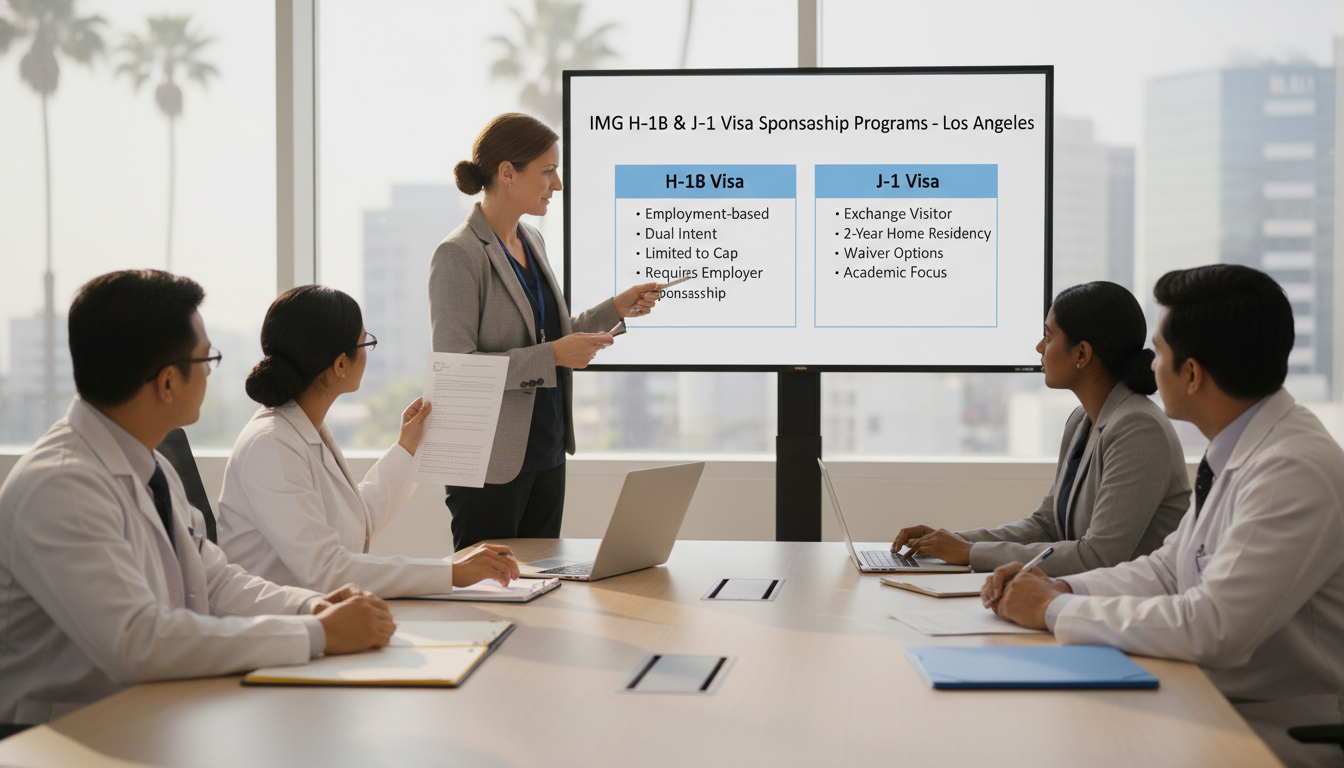
- How H‑1B differs from J‑1 for IMGs
- Features of Los Angeles residency programs that may sponsor H‑1B
- Typical H‑1B sponsor list elements and what to look for on program websites
- Step‑by‑step strategy to apply effectively as an IMG seeking H‑1B
- FAQs about H‑1B cap, cap‑exempt institutions, and common obstacles
1. H‑1B Basics for International Medical Graduates
What is the H‑1B in the residency context?
The H‑1B is a temporary work visa for specialty occupations that require at least a bachelor’s degree (medicine clearly qualifies). In graduate medical education (GME), it allows hospitals and institutions to sponsor IMGs as workers, not as exchange visitors, which differentiates it from the J‑1.
Key points for IMGs:
- You are employed and paid as a resident physician by the hospital.
- The hospital/institution files the H‑1B petition on your behalf.
- The visa is typically requested to cover the full length of your training contract (often in 1–3 year increments).
- Many Los Angeles academic centers are H‑1B cap‑exempt, which is a major advantage.
H‑1B vs. J‑1: Why IMGs care
Most IMGs in U.S. residencies enter on J‑1 exchange visas, sponsored by ECFMG. The J‑1 often works well, but it has a catch: the two‑year home residency requirement after training, unless you obtain a waiver (e.g., Conrad 30 waiver, hardship, or persecution waiver).
H‑1B is attractive because:
- No automatic 2‑year home return requirement
- Can lead more directly to employment or fellowship after residency
- Easier continuity for those planning long‑term U.S. careers
However, H‑1B is not automatically “better”. It is:
- More expensive and administratively complex for programs
- Restricted by USMLE and licensing requirements (you normally need all Steps, including Step 3)
- Limited by the H‑1B maximum duration (usually up to 6 years total, with some exceptions)
In LA residency programs, many institutions default to J‑1 but may sponsor H‑1B selectively for strong candidates or in specific specialties.
2. H‑1B Structure: Cap, Cap‑Exempt, and Why Teaching Hospitals in LA Matter
To understand H‑1B sponsorship in Los Angeles, you must understand the distinction between cap‑subject and H‑1B cap‑exempt employers.
What is the H‑1B cap?
The standard H‑1B for most employers is subject to an annual numerical cap:
- 65,000 standard H‑1Bs per fiscal year
- 20,000 additional spots for U.S. master’s degree or higher
- Processed through a lottery when applications exceed the quota
If an employer is cap‑subject, you need to:
- Enter the H‑1B lottery (usually in March)
- If selected, you can start work on/after October 1 that year
This structure does not align well with the residency calendar, which starts around June/July. That is why being H‑1B cap‑exempt is crucial in GME.
H‑1B cap‑exempt employers
Many hospitals that host residency programs are affiliated with:
- Universities
- Non‑profit hospital systems
- Academic medical centers
- Government or public institutions
These often qualify as H‑1B cap‑exempt, meaning:
- No lottery is required
- No annual numerical limit
- H‑1B can be filed at any time of year
- Start date can align closely with residency start (e.g., July 1)
For an IMG targeting LA residency programs, identifying H‑1B cap‑exempt institutions can dramatically simplify your path.
Typical cap‑exempt entities in Los Angeles
While policies change and you must verify details directly, categories of institutions in Los Angeles that are often cap‑exempt include:
- Major university‑affiliated teaching hospitals
- Large academic medical centers tied to universities (e.g., public universities or not‑for‑profit private universities)
- County and public hospitals
- Facilities that serve as safety‑net providers and have formal academic affiliations
- Non‑profit health systems with formal GME programs
- Institutions recognized as non‑profit and engaged in educational missions
Not every residency at every hospital in the Los Angeles area will offer H‑1B sponsorship, but cap‑exempt status increases the likelihood.
3. How to Identify H‑1B Friendly Residency Programs in Los Angeles
Finding accurate, up‑to‑date information on H‑1B sponsor lists can be challenging. Many IMGs rely on hearsay or outdated websites. Instead, use a systematic process.
Step 1: Start with the program’s official website
For each program you’re interested in:
- Go to the GME office or residency program website.
- Look for sections titled:
- “International Medical Graduates”
- “Visa Sponsorship”
- “Eligibility & Requirements”
- “FAQ” or “Application Information”
Programs often explicitly state:
- “We sponsor J‑1 visas only.”
- “We sponsor J‑1 and H‑1B visas for eligible candidates.”
- “We sponsor J‑1 only; H‑1B considered in exceptional cases.”
If the website is vague or silent, plan to email the program coordinator or GME office.
Step 2: Ask targeted, professional questions
When emailing, keep it brief and respectful. For example:
Dear [Coordinator Name],
I am an international medical graduate planning to apply to your [specialty] residency program in the upcoming ERAS cycle. I am currently on [visa status or abroad], and I am very interested in training in Los Angeles.
Could you please confirm:
- Which visa types your program currently sponsors for residents (J‑1, H‑1B)?
- If H‑1B is sponsored, are there any specific requirements (e.g., Step 3 completion by rank list deadline, prior U.S. clinical experience, etc.)?
Thank you very much for your time and guidance.
Sincerely,
[Your Name, credentials, AAMC ID if applicable]
This approach:
- Signals professionalism and seriousness
- Allows you to build a document trail of each program’s stated policy
- Helps clarify whether they are true H‑1B residency programs or only J‑1
Step 3: Cross‑check with unofficial H‑1B sponsor lists
There are many unofficial spreadsheet‑style lists online (forums, IMG communities, etc.) that track:
- Programs that reportedly have sponsored H‑1B in past years
- Notes on which specialties and years they did so
Use these as secondary references only. Always cross‑verify with:
- Official program websites
- Direct communication with coordinators or GME offices
Policies can change annually based on:
- Institutional financial circumstances
- GME leadership changes
- Legal/immigration environment
- Health system mergers or restructuring
Step 4: Focus your efforts strategically
As an IMG targeting Los Angeles residency positions on H‑1B:
- Prioritize programs that clearly state H‑1B sponsorship
- Keep a secondary list of programs that are J‑1 only (you may still want to apply if J‑1 is an acceptable backup for you)
- Be realistic: many programs in competitive specialties may limit H‑1B due to administrative burden
To maximize your chances:
- Consider applying more broadly across California and nearby states, not just Los Angeles, while prioritizing LA for your top choices.
- Use national IMG residency guides and state‑by‑state H‑1B sponsor lists as reference points.
4. Eligibility Requirements for H‑1B Residency Programs
Even when a Los Angeles program is willing to sponsor H‑1B, not every IMG applicant qualifies. H‑1B has specific legal and institutional requirements.
Core legal requirements
For an H‑1B residency position, typical requirements include:
USMLE exams
- Step 1 and Step 2 CK: must be passed
- Step 3:
- For H‑1B, most programs require Step 3 to be passed before filing the H‑1B petition.
- Many want Step 3 passed before ranking you in the Match, sometimes even before the rank list deadline.
ECFMG certification
- You must be ECFMG certified before starting residency.
- Certification itself requires:
- Passing Step 1
- Passing Step 2 CK
- Meeting ECFMG’s medical school and credentialing criteria
State licensing / training license requirements
- California has strict rules about:
- Medical school recognition
- Minimum clinical training requirements
- Many LA residency programs will not rank you unless:
- You are eligible for a California training license (PTL) or equivalent
- Your school appears on the relevant approved lists
- California has strict rules about:
English proficiency and documentation
- Strong communication skills are essential; some institutions may ask for proof (e.g., clinical references, prior experience).
- You must have complete documentation of your identity, education, and status to file an H‑1B petition.
Institutional preferences and additional expectations
Even if you meet the above:
U.S. clinical experience (USCE)
- Many H‑1B sponsoring programs prefer or require hands‑on USCE (sub‑internships, observerships with meaningful participation, or prior research with patient contact)
- In LA particularly, programs serving complex, diverse populations want to see that you can navigate U.S. health systems and documentation standards.
Recency of graduation
- Some programs prefer candidates who graduated within the last 5–7 years.
- If you are older‑year graduate, strong clinical activity and recent experience can compensate.
Academic performance and exam scores
- Because H‑1B sponsorship adds cost and administrative burden, programs often reserve it for:
- Strong academic performers
- Candidates with excellent letters of recommendation
- Applicants who will clearly add value to the program (e.g., research, language skills, prior experience with underserved populations)
- Because H‑1B sponsorship adds cost and administrative burden, programs often reserve it for:

5. Strategic Application Plan for IMGs Seeking H‑1B in Los Angeles
To improve your chances, you need more than just good scores—you need a clear strategy tailored to LA residency programs that may offer H‑1B.
5.1 Decide early if H‑1B is essential or preferred
Clarify your priorities:
- Is an H‑1B absolutely required because you cannot accept a J‑1 (e.g., previous J‑2 status, family immigration strategy, concern about 2‑year return rule)?
- Or is H‑1B preferred but J‑1 acceptable?
This will influence:
- How restricted your program list can be
- Whether you can broaden your search beyond H‑1B sponsor programs
- How you frame your story during interviews
If H‑1B is non‑negotiable, your list of Los Angeles residency options may be narrower; you must compensate with stronger preparation and broader U.S. geographic targets.
5.2 Timeline planning: USMLE Step 3 and documentation
Aim for this sequence:
- Complete Step 1 and Step 2 CK with competitive scores.
- Obtain ECFMG certification as early as possible.
- Plan Step 3 to be:
- Passed by early winter of the year before you want to start residency (ideally before January), so programs can confidently consider H‑1B.
- This timing allows the GME office to prepare H‑1B petitions well before July.
In practical terms:
- If you plan to start residency July 2027, target Step 3 completion by December 2026 (earlier is even better).
Some Los Angeles programs explicitly state: “H‑1B candidates must have passed USMLE Step 3 by the time of rank list submission.”
5.3 Customizing your program list for Los Angeles
Build a tiered list:
Tier 1: LA H‑1B‑friendly programs (confirmed)
- Programs that explicitly state they sponsor H‑1B for residents
- Have confirmed via email that they accept IMGs with H‑1B
Tier 2: LA programs that sometimes sponsor H‑1B
- Programs that say “J‑1 preferred, H‑1B in exceptional cases”
- Programs with history of occasionally sponsoring H‑1B (per multiple reliable reports)
Tier 3: LA J‑1‑only programs
- You may still apply if J‑1 is acceptable or if you are keeping a backup track
Tier 4: H‑1B‑friendly programs outside Los Angeles
- Statewide and national options to increase your chances of matching
Within each tier, further prioritize by:
- Specialty competitiveness (internal medicine vs. dermatology, for example)
- Your specific profile and strengths
- Personal factors (family location, cost of living, etc.)
5.4 Craft a narrative that aligns with Los Angeles healthcare needs
Los Angeles has:
- Large immigrant populations (Spanish, Korean, Chinese, Armenian, Filipino, Persian, and many more)
- Significant health disparities and underinsured patients
- High rates of chronic diseases and complex social determinants of health
In your application:
- Highlight any language skills, especially Spanish or other commonly spoken languages.
- Emphasize experience with underserved or multicultural communities.
- Showcase resilience, adaptability, and teamwork, key traits programs value in residents handling complex caseloads.
Programs are more willing to sponsor H‑1B if they see you as:
- A long‑term asset to patient care
- Someone who understands and embraces LA’s diverse patient population
- A future colleague who will elevate the program’s mission
5.5 During interviews: How to discuss visa needs
When invited to interview:
Be transparent, but not demanding:
- Clearly state you are an IMG who will need visa sponsorship.
- If H‑1B is your preference, express it as such:
- “Because of my long‑term career plans in the U.S., H‑1B is my preferred option if possible.”
Avoid ultimatums early:
- Do not immediately say you will only accept H‑1B unless that is truly the case and the program is clearly H‑1B‑friendly.
Ask informed questions near the end of the interview or via follow‑up email:
- “Could you share how your program typically handles visa sponsorship for IMGs (J‑1 vs. H‑1B)?”
- “For candidates who have completed Step 3, does your program sometimes sponsor H‑1B?”
Demonstrate that your priority is fit with the program and clinical training quality, with visa as an important but secondary topic.
6. Practical Tips and Common Pitfalls for IMGs Targeting H‑1B in LA
Practical tips
Document everything
- Keep copies of all communications about visa sponsorship from programs.
- Maintain an organized folder for:
- Passport
- USMLE transcripts
- ECFMG certificate
- Medical diploma and transcripts
- Any prior visa documents (F‑1, B‑1/B‑2, J‑1, etc.)
Use advising resources
- Many schools and IMG prep services offer visa and residency counseling.
- Speak with IMGs who matched into Los Angeles residency programs recently and ask about their path.
Be realistic about specialty choice
- Highly competitive specialties (e.g., dermatology, plastic surgery) have:
- Fewer positions overall
- Fewer IMGs
- Less tolerance for additional administrative burden like H‑1B sponsorship
- Internal medicine, family medicine, pediatrics, psychiatry, and some other specialties typically offer more opportunities.
- Highly competitive specialties (e.g., dermatology, plastic surgery) have:
Monitor changes in U.S. immigration policy
- Rules for H‑1B, processing times, and compliance obligations can change.
- Check:
- Official USCIS alerts
- ECFMG announcements
- GME office updates
Common mistakes to avoid
Waiting too long for Step 3
- Delaying Step 3 until after Match season can shut you out of H‑1B‑sponsoring programs.
Over‑reliance on rumors
- Just because a friend matched on H‑1B at a Los Angeles institution 5 years ago does not guarantee the same policy today. Always confirm.
Narrowing your list only to a handful of LA programs
- Even if LA is your dream location, the Match is unpredictable. Balance your list with H‑1B‑friendly options nationwide.
Poor communication with programs
- Being vague or inconsistent about your visa needs can cause confusion. Be clear, concise, and professional.
Ignoring J‑1 completely (if you could accept it)
- If your long‑term plans can still work with J‑1 plus a waiver program, completely avoiding J‑1 programs can unnecessarily reduce your chances of matching.
FAQs: H‑1B Sponsorship for IMGs in Los Angeles
1. Are most Los Angeles residency programs H‑1B cap‑exempt?
Many large academic and public hospitals in Los Angeles are affiliated with universities or are non‑profit entities, which typically qualify as H‑1B cap‑exempt. However, this does not mean all such programs choose to sponsor H‑1B. Cap‑exempt status simply means they can sponsor H‑1B without the lottery. You must still verify each program’s policy individually.
2. Do I need USMLE Step 3 to be considered for H‑1B sponsorship?
In almost all cases, yes. For residency H‑1B sponsorship, programs and their legal teams usually require that you have passed USMLE Step 3 before they file the H‑1B petition. Many LA programs that sponsor H‑1B expect Step 3 to be completed before the Rank Order List deadline. Without Step 3, J‑1 is generally the only viable option.
3. If a program says “J‑1 only,” will they ever make an exception for H‑1B?
Occasionally, but it is uncommon. When a program publicly states “J‑1 only,” it usually reflects institutional policy or financial constraints. Exception requests are rarely granted and often require high‑level institutional approval. If you absolutely must have H‑1B, focus primarily on programs that explicitly state they sponsor H‑1B or that at least indicate they will consider it for exceptional candidates.
4. Can I switch from J‑1 to H‑1B later during residency in Los Angeles?
It is sometimes possible but can be legally and practically complex. If you start residency on J‑1, you are generally subject to the two‑year home return requirement unless you obtain a waiver. Converting from J‑1 to H‑1B later typically requires addressing that requirement (e.g., via a waiver) and institutional willingness to re‑sponsor you. Do not assume it will be straightforward; discuss scenarios with immigration counsel and your GME office before making decisions.
Focusing your search on H‑1B sponsorship programs for international medical graduates in Los Angeles demands early planning, precise execution, and honest self‑assessment. By understanding how H‑1B works, identifying H‑1B cap‑exempt institutions, timing your exams strategically, and presenting a compelling application that resonates with LA’s diverse patient population, you can significantly improve your chances of securing an H‑1B‑sponsored residency position in one of the most dynamic cities in the United States.